




Abstract
Introduction:
Despite recent educational advances, the need for a national standardized primary palliative care curriculum for health professions students remains evident.
Methods:
An interprofessional leadership team developed a set of core learning objectives built on previously published competencies. A survey was then sent to palliative care experts for feedback and consensus.
Results:
Twenty-eight of 31 objectives met a 75% consensus threshold, 2 were combined with others, and 12 were refined based on survey feedback.
Discussion:
With interprofessional input at all stages, we finalized a comprehensive list of 26 learning objectives for a primary palliative care curriculum targeting health professions students. These objectives will be widely available through an online course but can also be adopted for use by individual educators across health professions institutions. These objectives and related curriculum are critical to producing practice-ready clinicians who are prepared to care for the burgeoning population of seriously ill patients.
Introduction
There is a great need for training of generalist clinicians in primary palliative care.1–8 As the field has matured palliative care educational efforts have grown rapidly, most notably in undergraduate medical education, but remain underrepresented in other health professions training programs.1–3,7,9,10 Nearly 10 years have passed since the publication of proposed essential palliative care competencies for U.S. medical students and residents, 5 yet standardized evidence-based curricula and assessment methods have lagged behind.1,2,7,11 Competencies for graduate nursing students have yet to be widely disseminated 7 and gaps persist in undergraduate nursing education. 10
Efforts to standardize palliative care education in Europe have outpaced the United States, but the degree of institutional uptake and graduate impact is unclear.3,11,12 A standardized developmentally appropriate national palliative care curriculum for U.S. health professions students and associated core learning objectives to guide student learning are needed.3,6,13,14 This curriculum would support both specialist and generalist educators teaching palliative care to early learners, promote integration of palliative care concepts into already overloaded curricula, help standardize teaching and assessment methods, and address known gaps in graduate preparedness.15–18
In 2020, Aquifer, 19 a leader in online education for health professions (physician, advanced practice nurse, and physician assistant) students, received funding from the Arthur Vining Davis Foundations to develop a course titled Principles and Practice of Excellence in Primary Palliative Care. 20 The goal was to create a standardized vast-reaching national curriculum and to produce a “practice ready” health care workforce prepared to deliver high-value compassionate serious illness care. A national interprofessional strategic leadership group developed the overarching vision and principles for the course that was informed by a literature review and faculty and student needs assessments; a White Paper summarizing these findings and recommendations is forthcoming. In this study, we describe the subsequent development and validation of core learning objectives for the course and recommendations for their implementation in a variety of teaching settings.
Methods
Learning objective development
We convened a subgroup of interprofessional palliative care leaders from seven institutions around the United States to develop core learning objectives for health professions students. Group members were leaders in palliative care education at their institutions and included physicians (n = 4), advanced practice nurses (n = 2), social workers (n = 2), a chaplain (n = 1), and a medical student (n = 1). In a multistep process, we generated a comprehensive list of learning objectives based on national consensus guidelines, 21 previously published medical student competencies, 5 and existing health professions education literature.7,10 Working in interprofessional dyads, we drafted three to six learning objectives per dyad that mapped to each of the five previously defined guiding principles and embodied our overarching vision statement for the course (Fig. 1). Through a series of e-mails and conference calls, we revised each objective and reviewed the list for completeness until agreement was reached, drafting a total of 31 objectives.
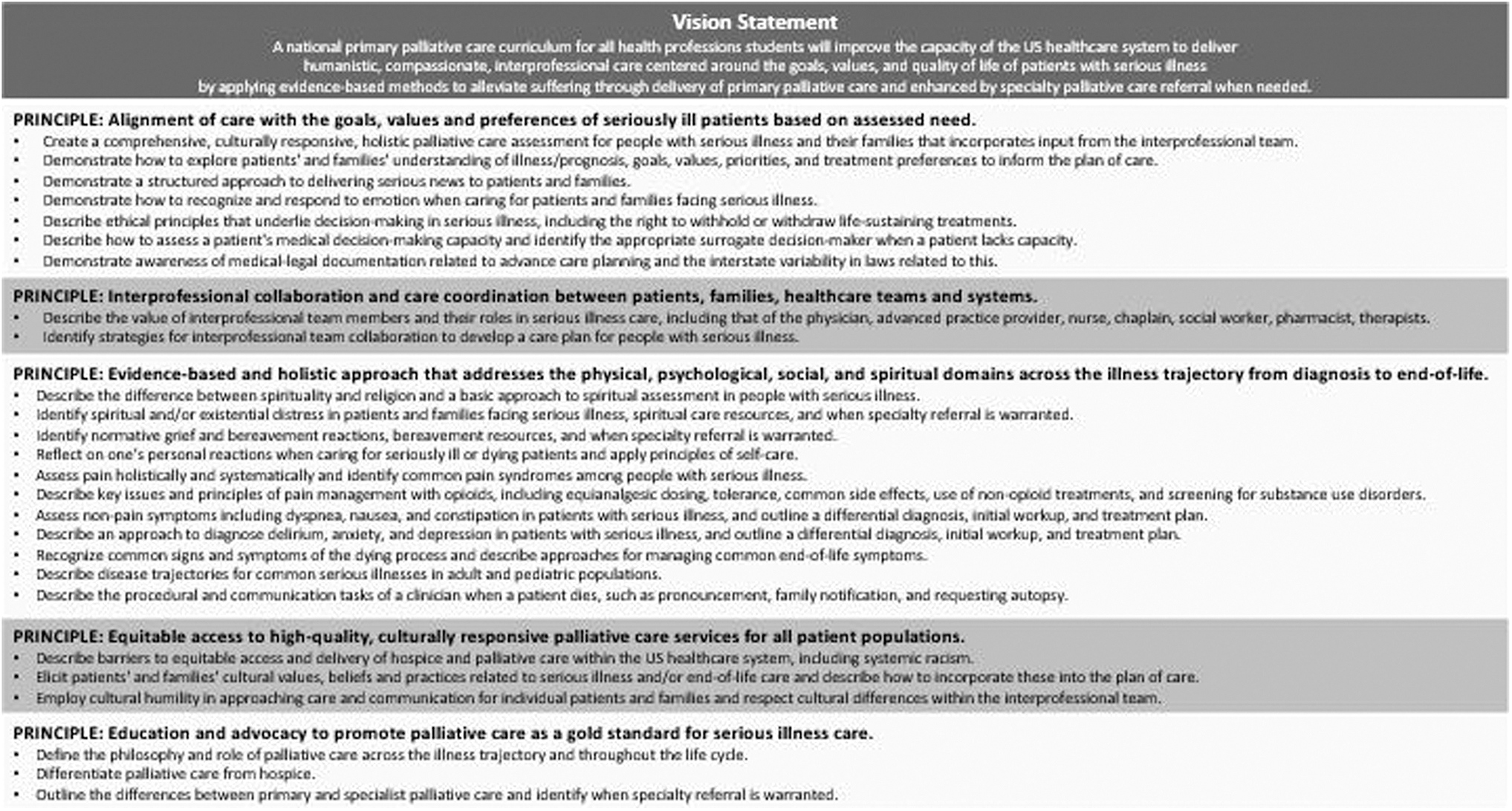
Final list of 26 revised learning objectives mapped to overarching principles.
Survey development and implementation
A web-based Qualtrics survey was developed to solicit expert interprofessional feedback on our proposed objectives, including whether the list was comprehensive and developmentally appropriate for this learner group. The survey was piloted with 14 educators who previously participated in Aquifer faculty focus groups to ensure clarity and no changes were made to the survey as a result. Survey instructions assured deidentification of data and confidentiality. Authors did not have access to respondent identifiers, and all data were anonymous and stored securely. The study was approved by the University of Washington institutional review board.
We collected participant demographic information, including clinical discipline, duration of practice, and teaching experience. We asked respondents if each learning objective should be included (yes, no, not sure) and to explain (through free text) why an objective should not be included if no was selected. We asked respondents to offer subjective feedback including suggested revisions to objectives and/or additional objectives they felt were missing. Participants received an e-mail invitation to participate followed by two e-mail reminders over two months. Participation was voluntary and not incentivized.
Survey participant selection
We identified 68 expert palliative care clinicians with national palliative care leadership, health professions educational leadership, or scholarship related to palliative care education. We e-mailed the survey to (1) American Academy of Hospice and Palliative Medicine's medical student and resident engagement workgroup members; (2) Social Work Hospice and Palliative Care Network board members; (3) first (second if the first was a trainee) and senior authors of published palliative care curricula for health professions students on MedEdPORTAL; and (4) first (second if the first was a trainee) and senior authors of articles about palliative care education for health professions students from our prior literature review.
Data analysis
We calculated the percentage of participants who agreed a learning objective should be included in a national curriculum and used the common Delphi consensus threshold of 75% agreement among survey respondents to include a given learning objective. 22 Three authors (A.Z., K.G.S., and S.E.M.) independently reviewed the results and voted to keep, discard, or modify each objective based on respondent feedback. Feedback was reviewed, discussed, and reconciled during a consensus conference.
Results
The survey response rate was 30.8% (21/68). Demographic characteristics of respondents are shown in Table 1. The majority of respondents spent most of their clinical practice in palliative care. Both junior and senior faculty were represented, and most had taught health professions students for more than five years.
Participant Characteristics (N = 21)
Of the 31 initially proposed learning objectives, 28 met the predetermined 75% consensus threshold to be included. The three learning objectives that failed to meet this threshold were removed. Based on written comments from respondents and our review, two other learning objectives were identified as redundant and were combined with others. Twelve learning objectives were modified in response to survey feedback. Critical feedback usually involved concerns that a learning objective was too detailed for health professions students or recommendations to change the chosen Bloom's Taxonomy verb used (i.e., changing “apply” to “describe” or “identify”). Four survey respondents suggested objectives that were missing, and we deemed these either not meaningfully different from existing objectives or out of scope for this learner level. Figure 1 includes a final list of 26 revised learning objectives.
Discussion
Based on a comprehensive needs assessment and with national interprofessional input into their development and refinement, we have created a comprehensive list of learning objectives for a national primary palliative care curriculum targeting U.S. health professions students. Our preliminary work addresses repeated calls for a standardized curriculum and core learning objectives.1,2,6,7,11,13,14,23 These objectives build on previously published competencies5,11,12 with a renewed focus on communication skills, interprofessional teamwork, recognizing primary versus specialty-level skills and when to refer, cultural and self-awareness, and issues of equity and access in the context of serious illness care. These objectives are appropriate for incorporation into health professions student curricula and can be used by educators who are engaged in curriculum design and teaching at this learner level.
A standardized developmentally appropriate curricular framework has many benefits. A readily available peer-reviewed list of objectives reduces administrative burden and empowers generalists to continue the important work of teaching palliative care content—often in the preclinical years. This is particularly important in addressing the nationwide shortage of palliative care specialists available to teach this material. 24 In using these objectives, institutions can demonstrate that they are promoting basic palliative care competence among their graduates and meeting credentialing requirements.
In addition to the planned nationally available online Aquifer curriculum, educators may use our principles and learning objectives across courses, clinical rotations, or teaching sites, as the objectives are broad enough to apply across specialties. For example, an obstetrics/gynecology clerkship director might integrate experiences involving delivering serious news into their clerkship requirements 25 using the relevant objectives from our list. An educator in a preclinical skills course might use our objectives about responding to emotion in a class-wide communication skills workshop featuring small group practice with simulated patients and faculty feedback.
This project has several important strengths. It is one of the first U.S. efforts to nationally define a core set of primary palliative care learning objectives for health professions students. An interprofessional leadership team participating in all phases of curricular development helped reduce individual bias and ensure multiple experiences and viewpoints were represented.
This project also has several limitations. Although it nears reported mean response rates for web surveys,26,27 the response rate was low, which limits the generalizability of findings due to potential inadequate sampling and nonresponse bias. Most respondents identified as female, so there was a degree of homogeneity in this sample, although this female predominance mirrors observed U.S. hospice and palliative care workforce demographics. 28 Most respondents were physicians or social workers, so the viewpoints of nurses, advanced practice nurses, and physician assistants are underrepresented. This was not a formal Delphi ranking process and our survey instead forced choices of yes, no, unsure for efficiency.
Conclusion
Using an interprofessional approach, we have developed a comprehensive list of primary palliative care learning objectives for health professions students. We propose these be adopted by educators to ensure that graduating students demonstrate a basic level of competence in palliative care knowledge and skills as they go on to care for our nation's most vulnerable patients.
Footnotes
Authors' Contributions
Conceptualization, methodology, investigation, formal analysis, writing—original draft and review and editing, and visualization by A.Z. Conceptualization, investigation, data curation, and writing—review and editing by S.S. Conceptualization, formal analysis, and writing—review and editing by K.G.S. Methodology and writing—review and editing by D.J., C.J., and A.C.W. Conceptualization, methodology, and writing—review and editing by K.B., R.L.E., and B.R. Resources and writing—review and editing by J.R. Conceptualization, methodology, investigation, formal analysis, and writing—original draft, review, and editing by S.E.M.
Funding Information
No funding was received for this article.
Author Disclosure Statement
No competing financial interests exist.