




Abstract
Background:
Constipation is a concern among patients with Eastern Cooperative Oncology Group (ECOG) performance status (PS) of 3 and 4.
Objectives:
To assess naldemedine's efficacy and safety in cancer patients on opioids with poor PS.
Design:
Multicenter, retrospective study.
Setting/Subjects:
Japanese cancer patients with ECOG performance status 3 or 4 who received naldemedine.
Measurements:
Frequency of defecations before/after naldemedine use. Responders were patients whose defecation frequency increased to ≥3 times/week, from baseline ≥1 defecations/week over seven days after naldemedine administration.
Results:
Seventy-one patients were analyzed; 66.1% were responders (95% confidence interval: 54.5%–76.1%). Defecation frequency increased significantly after naldemedine in the overall population (6 vs. 2, p < 0.0001) and among those who defecated <3 times/week before naldemedine (4.5 vs. 1, p < 0.0001). Diarrhea (38.0%) of all grades was the most common adverse event; 23 (85.2%) events were classified as Grade 1 or 2.
Conclusion:
Naldemedine is effective and safe among cancer patients with poor PS.
Introduction
Opioid-induced constipation (OIC) is a frequently observed adverse event in patients treated with opioids, with an incidence of >50% if not prevented.1,2 A study based on Rome IV, an international OIC diagnostic criteria, reported a 56% incidence of OIC in Japan for various malignancies, irrespective of performance status (PS) and type of opioid analgesic. 3
Currently, three peripherally acting μ-opioid receptor antagonists (PAMORAs), methylnaltrexone, naloxegol, and naldemedine, are used for the treatment of OIC, although only naldemedine has been approved in Japan. 4 No comparative study has been conducted to evaluate the efficacy of individual PAMORAs in specific patient populations.
The Eastern Cooperative Oncology Group Performance Status (ECOG-PS) utilizes a subjective scoring system for evaluating the overall general condition of patients with cancer and is correlated independently with progression-free survival and overall survival.5,6 Because clinical trials evaluating new drugs have focused primarily on patients with good PS, most likely to experience substantial improvements, the treatment benefits or risks in patients with poor PS have rarely been examined.
One study has examined the dose-dependent effects of morphine on persistent and nonpersistent constipation and ECOG-PS in patients with advanced cancer using multiple regression analysis. 7 This study revealed a significantly high correlation between opioid use and persistent constipation, as measured by the Bowel Function Score, and worse PS. All patients with persistent constipation had poor PS (ECOG-PS 3 or 4); only 6% of patients with ECOG scores in this range reported no constipation at four weeks. There was a highly significant difference in ECOG-PS scores between the persistent constipation group and the nonconstipated group at four weeks. 7
Another study reported more severe constipation and worse quality of life among patients with an ECOG-PS of 3 and 4. 8 Aforementioned findings suggest that patients with poor PS may be affected by constipation. However, previous phase III trials included carefully selected participants; additionally, no detailed study has evaluated predictors of efficacy or adverse events among patients with poor PS.9,10 Thus, the tolerability of naldemedine in patients with poor PS remains unclear. We previously investigated the use of naldemedine in clinical practice,11,12 although analysis of efficacy and feasibility specific to cancer patients with poor PS was insufficient. This retrospective study aimed to evaluate the efficacy and safety of naldemedine in cancer patients with poor PS (PS ≥3) treated with opioids in a clinical practice setting.
Materials and Methods
Patients
We retrospectively collected clinical data from the electronic medical records of cancer patients with poor PS treated with naldemedine (June 7, 2017, to August 31, 2019) at 10 Japanese institutions. Patients who met the following criteria were enrolled: (1) those hospitalized for greater than seven days before and after naldemedine administration and whose defecation frequency was measured; (2) those in whom naldemedine was used concomitantly with opioids; and (3) cancer patients with poor PS (ECOG-PS 3 or 4). Patients were orally administered 0.2 mg of naldemedine with opioids once daily. The study was approved by the Ethics Committee of Gunma Prefectural Cancer Center (no. 405-31046; approval date: 09-27-2019) and the institutional review board of each participating institution. Written informed consent was waived owing to the study's retrospective nature.
Assessment of PS, treatment efficacy, and adverse events
The ECOG-PS scale scores range from 0 to 4: low scores indicate a good general condition, whereas high scores signal poor prognosis. 5 A PS ≥3 was defined as poor PS. We assessed the frequency of defecation (times/week) for seven days before and after naldemedine administration. Responders were defined as patients whose frequency of defecation increased to ≥3 times/week from baseline of ≥1 defecation/week, over seven days after the initiation of naldemedine administration. The baseline was the number of defecations during the one-week period before naldemedine administration. Adverse events were assessed using the Common Terminology Criteria for Adverse Events 5.0 criteria.
Statistical analyses
Fisher's exact test and Wilcoxon signed-rank test were performed. Factors predicting treatment efficacy were identified and evaluated using multivariate ordered logistic regression analysis; results were expressed as odds ratios and 95% confidence intervals (CIs). Statistical significance was considered at a two-tailed p-value of <0.05. Statistical analyses were performed using JMP 11.0 for Windows (SAS Institute, Cary, NC).
Results
Patient background variables
Seventy-one patients were enrolled (Supplementary Fig. S1); their data are available in a previously published study. 12 Sixty patients died due to disease progression during the analysis period. Clinical background data are summarized in Table 1 and opioid and laxative usage in Table 2. Fifty patients (70.4%) had a PS of 3, and 21 (29.6%) had a PS of 4. Number of laxative types used at baseline were “no drugs” (n = 16, 22.5%), “one drug” (n = 30, 42.3%), “two drugs” (n = 17, 23.9%), and “three drugs” (n = 8, 11.3%).
Baseline Patient Characteristics
Within three weeks before starting naldemedine administration.
Total number of patients.
BMI, body mass index; PS, performance status.
Administration of Opioids and Laxative Agents
Oral morphine equivalent dose of regular opioids.
Including multiple uses.
Treatment efficacy
Forty-seven patients (66.1%, 95% CI: 54.5%–76.1%) were responders (Fig. 1). There was no statistical difference between responders and nonresponders for patient background variables (Table 3).
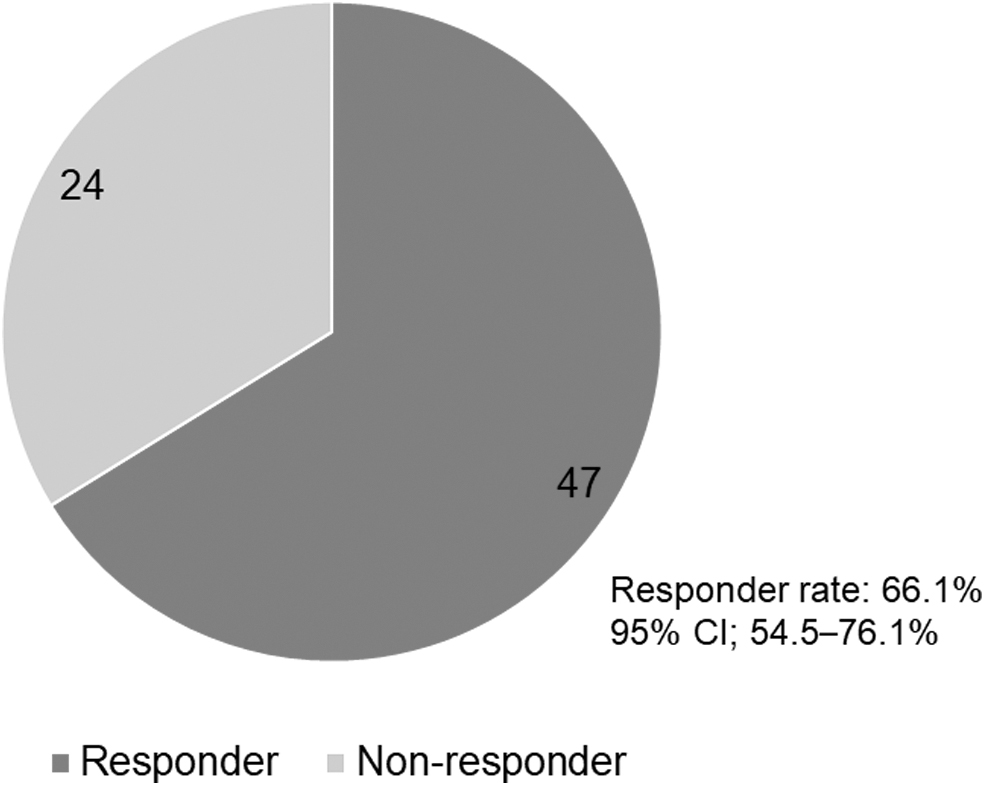
A pie chart showing the number of responders and nonresponders after naldemedine administration. Responder rate: 66.1%; 95% CI: 54.5–76.1. CI, confidence interval.
Patient Characteristics According to Treatment Response
Fisher's exact test was used to evaluate associations among categorical variables.
Differences were considered statistically significant at a two-tailed p-value of <0.05.
Changes in defecation frequency before and after initiating naldemedine treatment were evaluated for all patients and separately calculated for those who defecated <3 times in the week before naldemedine initiation. Median defecation frequencies in all patients (n = 71) in the weeks before and after naldemedine administration were 2 (range, 0–14) and 6 (range, 0–49), respectively, indicating a significant increase in defecation after naldemedine treatment (p < 0.0001; Fig. 2a). The median number of bowel movements increased significantly from 1 (range: 0–2) to 4.5 (range: 0–11) (p < 0.0001; Fig. 2b) in patients who defecated <3 times in the week before naldemedine administration (n = 36).

Comparison of defecation frequency.
Clinical factors affecting treatment efficacy
Multivariate logistic regression analysis found that no clinical factor was significantly related to naldemedine efficacy, including sex, age, body mass index, concomitant laxative use before starting naldemedine, morphine-equivalent regular opioid dose, and history of chemotherapy within the 21 days before naldemedine administration (Table 4).
Multivariate Logistic Regression Analysis for Factor of Responder in Patients Receiving Naldemedine
Variables Factors predicting treatment efficacy were identified and evaluated using multivariate ordered logistic regression analysis, and the results are expressed as ORs and 95% CIs. Differences were considered statistically significant at a two-tailed p-value of <0.05.
CI, confidence interval; OR, odds ratio.
Safety
Table 5 shows toxicities related to naldemedine treatment. Diarrhea of any grade was the most common adverse event (n = 27, 38.0%), of which 23 (85.2%) had grade 1 or 2 diarrhea.
Adverse Events Encountered During Naldemedine Administration Period
Adverse events were graded using the Common Terminology Criteria for Adverse Events version 5.0.
Discussion
Patients with a PS ≥3 were excluded from the COMPOSE-4 and COMPOSE-5 randomized phase III trials assessing naldemedine use in cancer patients presenting with OIC. 7 Thus, the efficacy and safety of naldemedine in a clinical practice setting in patients with poor PS have not been previously evaluated in prospective clinical trials. In this analysis population, 66.1% of patients were responders, despite having a poor PS; this was comparable to the responder rate in the COMPOSE-4 trial (71%) 9 and the response rate to naloxegol (73%), a PAMORA similar to naldemedine. 13 We evaluated the defecation frequency in patients who defecated <3/week, in accordance with one of the Rome IV diagnostic criteria.
Our results were also consistent with previous studies evaluating the impact of baseline patient characteristics on naldemedine efficacy in those with OIC and good PS.14,15 Therefore, naldemedine is expected to be clinically effective in patients with poor PS with any baseline background characteristic.
Diarrhea and abdominal pain were the most frequently observed adverse events (incidence rates: 19.6%–39.7% and 1.7%, respectively) in prospective clinical trials in cancer patients with favorable PS experiencing OIC.9,16 In our study, the incidences of diarrhea and abdominal pain were 38.0% and 4.2%, respectively, comparable to those of the prospective phase III study in patients with favorable PS. 9 Although patients with PS ≥3 were included in this cohort, serious adverse events were observed in only four patients (5.6%, grade 3 diarrhea). Therefore, naldemedine can be safely administered to cancer patients with poor PS in clinical practice: its toxicity does not require special consideration.
Limitations included the retrospective nature of the study, due to which we could not objectively assess defecation based on the Bowel Function Index, 17 the Bristol Stool Form Scale, 18 or a defecation diary. Second, data on laxative doses were not collected in this study, as laxative doses are adjusted daily, particularly for magnesium oxide. Because significant effects of magnesium oxide on OIC have been reportedly observed only at doses exceeding 1000 mg/day, 2 this study may have included patients who received inadequate doses of laxatives at baseline. Third, we recognize that PS assessment is subjective and debatable. However, PS evaluation is always an issue in such studies and is a recognized limitation that prevents a completely objective evaluation.
Although naldemedine is administered to many outpatients in clinical practice, it is virtually impossible to accurately determine the defecation frequency to evaluate its efficacy, and this study only included inpatients whose defecation frequency could be assessed by medical staff, which is more reliable than data from outpatients. Because this study involved patients with poor PS, objective evaluation by health care professionals was important. In addition, as this study only included those with PS ≥3, it was inevitable that many patients would be hospitalized; thus, the poor PS group may reflect actual clinical practice scenarios better than the good PS group.
Conclusions
This study demonstrated that naldemedine is efficacious and can be feasibly administered in a clinical practice setting to treat cancer patients with poor PS; it should therefore be considered for the treatment of OIC in such patients. Further validation in clinical practice is necessary.
Footnotes
Acknowledgments

Authors' Contributions
Conceptualization and methodology, H.I. and Y.F.; formal analysis and data curation, H.I. and K.K.; project administration, visualization, and writing—original draft preparation, H.I. and Y.F.; supervision, S.K., T.S., K.O., K.K., and K.M.; investigation and resources, Y.F., H.I., E.H., T.M., S.Y., H.T., T.K., M.I., S.T., M.M., H.N., and J.M.; writing—review and editing, all authors. All authors have read and approved the final article.
Funding Information
No funding was received for this article.
Author Disclosure Statement
No competing financial interests exist.
References
Supplementary Material
Please find the following supplemental material available below.
For Open Access articles published under a Creative Commons License, all supplemental material carries the same license as the article it is associated with.
For non-Open Access articles published, all supplemental material carries a non-exclusive license, and permission requests for re-use of supplemental material or any part of supplemental material shall be sent directly to the copyright owner as specified in the copyright notice associated with the article.
