




Abstract
Background:
State policy-making to address disparities in access to and quality of palliative care is increasing. Yet, there is no mechanism to systematically assess palliative care policies nationally.
Methods:
We describe the development of the Palliative Care Law and Policy GPS by the Center to Advance Palliative Care and the Yale Solomon Center for Health Law and Policy. The GPS is an online, searchable repository of national palliative care policies. We developed the GPS by conducting a systematic search of Lexis+, LegiScan, and state health departments for palliative care-related statutes and proposed legislation, categorizing policies into workforce, payment, quality/standards, clinical skill-building, public awareness, telehealth, and pediatric palliative care, and creating an interactive website.
Conclusions and Implications:
The GPS is a critical tool that can advance palliative care research, practice, and policy. Next steps include the expansion of data from 2010 onward as well as gathering state-level regulations and partially automating search and updating functions.
Introduction
Palliative care-related policy activity has significantly increased over the past decade, partly from increased state-level activism by advocates of palliative care.1,2 However, how palliative care is delivered and who receives it differs substantially across state lines. Examining palliative care policies across different states can aid in the creation and execution of new policies that tackle various critical concerns in the field, such as workforce, accessibility, and quality, among others.
In 2019, the Solomon Center for Health Law and Policy at the Yale Law School (Solomon Center), in partnership with the Center to Advance Palliative Care (CAPC), undertook a two-year process to develop an online, searchable, and publicly available database of law and policies related to palliative care. As a result of this endeavor, we developed the Palliative Care Law and Policy GPS (PCLP GPS) to provide researchers, clinicians, policymakers, and other stakeholders with a resource for assessing policy development, shaping future policy-making, and supporting clinical decision-making. In this paper, we describe the initial development of the PCLP GPS and share next steps.
Methods
Idea conception
In July 2019, members of the Solomon Center and interdisciplinary representatives from the Yale Schools of Nursing and Medicine established a working relationship with CAPC to advance innovative palliative care policies. A critical barrier to this goal was the absence of a comprehensive publicly available database tracking state-level palliative care policies. Palliative care policies were searchable through individual state websites, restricted access databases (e.g., LexisNexis), or consolidated into trackers focused around a single topic related to palliative care (i.e., state advisory councils).1,2 What followed was a systematic process to identify relevant palliative care law and policies and present resulting data in a publicly available website.
Creating a policy framework and search strategy
The first step of this process was to create a policy framework that would structure the PCLP GPS. The core team (S.S., E.R.) reviewed resources relevant to state-level palliative care policy, including the CAPC and the National Palliative Care Research Center State-by-State Palliative Care Report Card (Report Card), 3 and reports by the National Academy for State Health Policy.1,2 Based on this work, the team identified seven policy areas to categorize palliative care-related legislation: workforce; payment; quality/standards; clinical skill-building; public awareness; telehealth; and pediatric palliative care (Table 1). The first five categories are areas explored in iterations of the Report Card 3 and the latter two reflect emerging areas of interest. These categories are not mutually exclusive, with some policies falling under multiple categories.
The Palliative Care Law and Policy GPS Categories, Definitions, and Examples
Next, we convened a team of research assistants comprised of law, social work, and medical students overseen by Solomon Center and CAPC senior team members. We recruited research assistants through listservs open to graduate students at Yale University in the schools of law, medicine, public health, and nursing. This team conducted a comprehensive legislative search for palliative care policies using two searchable online databases containing federal and state legislation, Lexis+ and LegiScan. The research team searched for laws and bills related to palliative care by using the Lexis+ and LegiScan categories of Statutes and Legislation. Our search strategy was based on consultations with CAPC, the Solomon Center, and Yale research librarians. Specifically, we searched for any law or bill that included the terms “palliative” or “palliative care” in its text.
We used exclusion criteria to ensure that results focused on upstream palliative care for people living with serious illness (i.e., those who are not at the end of life), given the complex range of results for upstream palliative care alone. 4 Thus, we excluded policies focused on care at the immediate end of life including aid-in-dying and policies on hospice care, except for those policies that relate to hospice delivery for pediatric populations (due to considerations around concurrent care). Future initiatives may take up these policies separately. We also excluded policies on therapies such as medical marijuana and psilocybin, given the evolving body of literature and the existence of other policy aggregators focused specifically on these subjects. To confirm the efficacy of our review, we selected 10 state legislative databases and individually searched each for legislation using the same criteria, comparing the results of both approaches to ensure we captured all relevant data. No policies were missing between the two sources.
Populating the policy database
We developed a standardized system for collecting policy data. We first developed a template data entry form to capture each bill and/or law, a summary of the entry, its category classification, and links to the full legislative text on LegiScan. Next, we trained research assistants in using the form and conducting policy searches. Each research assistant was assigned a set of states to review. CAPC and Solomon Center senior staff then reviewed the research assistants' classifications and summaries to determine whether each policy merited inclusion in the database and was properly categorized. This involved reviewing the data entry forms and comparing the summaries with the bill or law's language to ensure that the policy pertained to palliative care.
Engineering the online PCLP GPS
We partnered with the Yale University Information Technology (IT) Department to develop the PCLP GPS website. We began the website design process by looking at established legislative trackers, including those maintained by the Sabin Center for Climate Change Law at Columbia University 5 and the National Conference for State Legislatures. 6 Both include features we wished to integrate into the PCLP GPS: (1) inclusion of detailed legal or legislative information; (2) data provided through a partnership with StateNet, a service for gathering state and federal laws and regulations that is partly driven by customizable automated searches; (3) data visualization tools, including interactive maps, supported by Microsoft Power BI [Microsoft Corporation, Version 2.117.286.0]; (4) the use of categories and sub-categories as well as a searchable state-by-state map; (5) tracking of legislation over time; (6) ability to filter by date as well as status (engrossed, enrolled, introduced, passed, failed, and vetoed) and category (workforce; payment; quality/standards; clinical skill-building; public awareness; telehealth; and pediatric palliative care); and (7) data freely available to the public through an interactive platform.
Using Microsoft Power BI, the Yale IT Department developed an interactive website to house the PCLP GPS (Fig. 1). The homepage of the PCLP GPS displays an interactive map of the United States. Users have the option to search for policies by region, category (workforce, payment, quality/standards, clinical skill-building, public awareness, telehealth, and pediatric palliative care) or bill status or by selecting any of the states in the map. The category, status, title, link to relevant legislative language, and a brief description are listed for each policy in the database. The website was designed to be adaptable, including the ability to expand the years of coverage and categories (i.e., regulations) as the initial survey range is expanded and partially automated in the future.
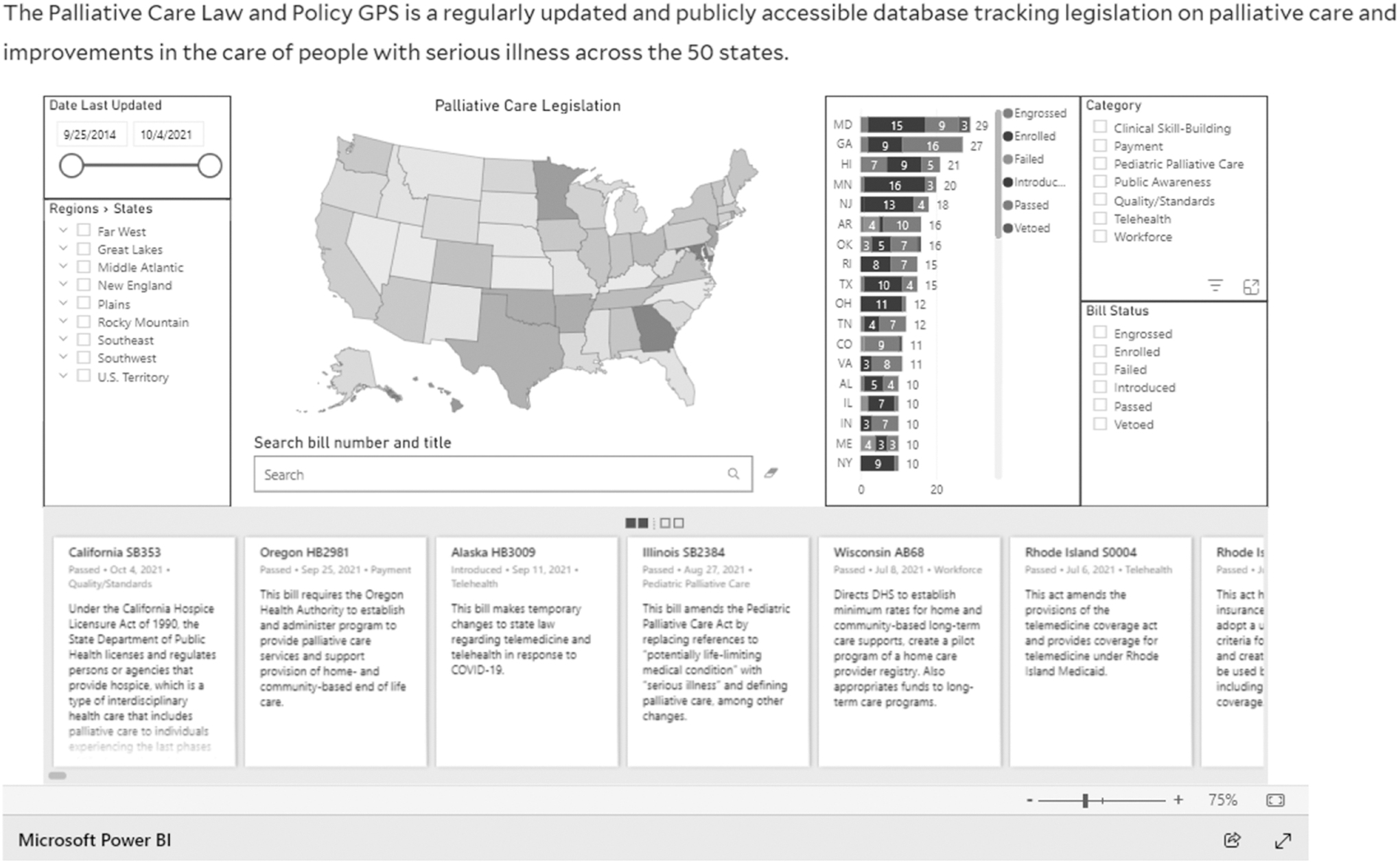
The Palliative Care Law and Policy GPS.
Once the PCLP GPS was populated with legislation proposed or enacted between 2019 and 2021 within the 50 states and the District of Columbia, we pilot-tested it with a convenience sample of interdisciplinary clinicians and researchers from the Yale Schools of Law, Medicine, and Nursing (n = 5). Reviewers were asked to interact with the PCLP GPS between May 21, 2021 and June 15, 2021 and to provide written qualitative feedback on accessibility (e.g., ease of search process, clarity of data) and usefulness (e.g., the relevance of data, the utility of policy categorization). Reviewers liked the interactive map, but wished it was larger for viewing and felt the policy categorization scheme was helpful but wanted the ability to sort policies based on these categories. Based on feedback, we enlarged the interactive map, listed bills and laws via interactive cards below the map (not only as a scrolling list), and grouped search categories for ease of reference. Following these adjustments, reviewers had the opportunity to access the PCLP GPS again and approve the revisions before the PCLP GPS went live on August 2021.
Next steps
The PCLP GPS is an online, freely available tool to help researchers, clinicians, and policymakers advance the field of palliative care. This tool will increase access to palliative care policies, support advocates and policymakers wishing to implement palliative care policies in their own states, and support future policy-related research. Our next steps are to use the PCLP GPS to support research in two key policy areas: (1) palliative care workforce development and sustainability, and (2) opioid prescribing legislation. Specifically, we are evaluating policies designed to attract clinicians into the palliative care workforce while retaining those already in practice and are examining palliative care provider exemptions in opioid prescribing policies.
We continue to refine the PCLP GPS, expanding its capabilities in five main ways. First, the PCLP GPS will soon include legislative data from 2010 through the present. The enactment of the Affordable Care Act in 2010 was of seminal importance to the field of palliative care, which will be reflected in the expanded dataset. Second, the PCLP GPS will include data on the Veterans Administration, the Indian Health Service, and the territories for the same period. These entities have not always been included in reviews of palliative care policy. Incorporating them into the PCLP GPS will provide a more holistic perspective on the landscape of palliative care policymaking while encouraging policy innovation across all covered entities. Third, we will expand the PCLP GPS to include state-level regulations. A wide range of policies are created or implemented through the work of state agencies, including how and where palliative care itself is defined. Capturing this source of policymaking is vital for fully capturing the policy landscape.
Finally, a key challenge in the development of the PCLP GPS is ensuring that it remains up-to-date as policies change in status and new policies are introduced. Thus, as a next step, we will automate the search process using StateNet. There are multiple benefits to incorporating automation into data gathering, including ensuring that the database is current and reducing the administrative burden presented by manual searches.
Conclusion
Health policy can improve access and enhance the quality of palliative care for all people with serious life-limiting illness. The PCLP GPS is a critical tool to help stakeholders understand how states are adopting palliative care policies over time. Ongoing refinements to the PCLP GPS will expand the survey range and enhance data collection through partial automation. The resulting database will help shape palliative care policy nationwide.
Footnotes
Acknowledgments
The Solomon Center wishes to thank the following individuals for their contributions to the development of the PCLP GPS: Carolyn T. Lye, JD, MD, Suzanne Marmo, PhD, LCSW, APHSW-C, Susan Godino, MSW, Jennifer O'Connor, MSW, Ezra Ruiz, JD, John Nann, JD, and Franz Hartl.
Funding Information
Dr. S.L.F. is supported by the National Heart, Lung, and Blood Institute of the National Institutes of Health (NHLBI K12HL138037).
Author Disclosure Statement
No competing financial interests exist.