




Abstract

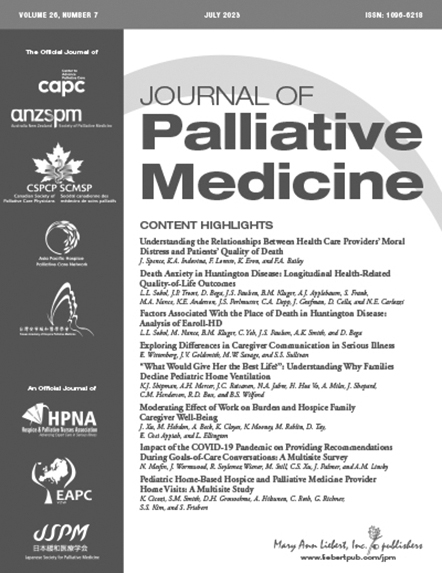
Letters to the Editor
Analysis evaluated the experiences of patients within a community-based Palliative Care Program for members of Commonwealth Care Alliance® One Care (Medicare-Medicaid Plan) or Senior Care Options (HMO D-SNP) offerings in Massachusetts. (page xxx)
Brief Reports
Study to present the experiences of cancer patients who participate in a social model palliative day care program (PDCP). This is the first research study that evaluates early integration of PDCP, from the patients' perspective, in Central—Eastern Europe. (page xxx)
Fast Facts and Concepts
Palliative Care Issues in Aortic Stenosis #467 (page xxx)
Serious Illness Considerations for Indigenous People of North America #468 (page xxx)
Personal Reflection
She was at her wits end, but that was such a reductive way of characterizing her. Here she was, caring for her husband on hospice, and the medical establishment had the audacity to comment on her intensity. Diagnosed with gastrointestinal cancer several years ago, Brad had recently suffered a rapid decline precipitated by a fall and fractures throughout his tumor-ridden spine. (page xxx)
Case Discussions in Palliative Medicine
In this patient, antibiotics were started due to concerns about possible symptomatic infection rather than due to burdensome symptoms of infection. Unfortunately, she developed serious and distressing toxicity associated with antibiotics. While it is not possible to conclude that the antibiotic was the only reason for the seizures, and the etiology was suspected to be multifactorial since the patient had other causes that could also have contributed, including hypoxia; the complete resolution after the discontinuation for ciprofloxacin strongly suggests that the antibiotic contributed to the seizures. (page xxx)
Book and Media Reviews
(page xxx)
Does Geography Matter?
In this retrospective cohort study of 3546 patients with cancer who died in a public hospital in a geographically diverse region in Australia, decedents from some rural areas had higher rates of emergency department visits and intensive care unit admissions but lower rates of acute hospital admission, inpatient palliative care, and inpatient radiotherapy. Shorter travel times were associated with higher rates of inpatient specialist palliative care. This occurred despite a universal access health care system. (page xxx)
What Outcomes Does “Early” Palliative Care Mean in Pediatric Cancer Care?
“Early” palliative care is advocated in pediatric cancer care. In this retrospective chart review in a single center, 32 patients received early (>12 weeks from death) versus 118 patients received late (<12 weeks from death) palliative care. Early palliative care was only associated with location of death. (page xxx)
Continuous Deep Sedation for Psycho-Existential Suffering
While sedation for intractable physical symptoms is a widely accepted practice in palliative medicine, its use for psycho-existential distress is controversial. In this nationwide study in Japan, 164 patients admitted to 23 different palliative care units in 1 year were analyzed. Only one patient received continuous deep sedation for psycho-existential suffering alone. A total of 8.5% (14/164) received continuous deep sedation for psycho-existential suffering with physical symptoms. Dependency, loss of autonomy, and hopelessness were common reasons for psycho-existential suffering treated with deep sedation. (page xxx)
Cost Comparison of Treatment for Pleural Effusion and Ascites
The placement of invasive catheters for management of the symptoms of pleural effusion and ascites in patients with advanced disease has been controversial. Not least among the controversies is cost in this population with overall short survival. In this study of 3396 cases of pleural effusions, 1302 cases studied in a single German Center were of ascites. If the patient survives several months, an indwelling catheter results in both enhanced quality of life and cost savings. (page xxx)