




Abstract
Background:
Every year, a significant number of parents/caregivers experience the loss of a child, many of whom have received palliative care services. The resultant consequences of grief on their physical and psychological well-being can be significant. Little is known about bereaved parents/caregivers experience with or perceptions about participating in bereavement-focused research.
Objective:
To explore bereaved parents’ perceptions of participating in three research studies about their loss experiences and legacy perceptions.
Design:
A retrospective secondary analysis was conducted using qualitative and archival data drawn from three prior studies.
Setting/Subjects:
Participants included parents/caregivers of 44 children (ages from birth to 18 years) who died between 2000 and 2020 at a freestanding academic children’s hospital in the United States.
Measurements:
Transcripts from semi-structured interviews and documentation of email communications were analyzed using an inductive coding approach grounded in psychological phenomenology.
Results:
Participant experiences of and motivations for participating in bereavement-related research were organized into two themes: 1) a means of extending the child’s legacy and 2) an avenue for self-expression and gratitude. None of the participants across studies indicated any discomfort in, dissatisfaction with, or ill feelings toward bereavement research involvement.
Conclusions:
Bereaved parents/caregivers described their research participation in personally meaningful and altruistic ways and reported gratitude for their involvement in and the focus of the research. With careful attention to bereaved parent/caregiver participant needs and preferences, it is possible to produce impactful family-centered palliative care research that can improve anticipatory and bereavement service provision.
Key Message
Research participation can provide bereaved parents/caregivers with therapeutic benefits, including opportunities for self-expression, honoring their child’s legacy, and helping others. Trauma-informed, flexible, and participant-centered research designs are essential to minimize harm, enhance benefits, and inform evidence-based, family-centered palliative care and bereavement services.
Introduction
Every year, a significant number of parents/caregivers experience the sudden or anticipated death of a child. 1 Approaching and experiencing the end of a child’s life has profound long-term impacts on the psychosocial and physical well-being of parents/caregivers, including complicated or prolonged grief disorders, anxiety, depression, and even increased risk of mortality.2,3 These adverse health outcomes, coupled with strained social relationships, perceived feelings of isolation, and inequitable distribution of bereavement support services, raise valid concerns about the physical and psychological safety of recruiting bereaved parent participants for research purposes.4,5 Despite these concerns, there is growing evidence that bereaved individuals may find research participation to be an overall positive experience and even personally beneficial to their grief process.4,6–8
A recent systematic review on research participation experiences among those bereaved by suicide found that while some individuals reported negative experiences—such as feelings of guilt or painful memories—the majority viewed participation positively, citing benefits such as altruism, social support, and personal growth. 6 Negative experiences were often tied to the interview process itself, which some found upsetting or distressing due to reactivated memories or emotions such as guilt, anger, or self-reproach. In addition, some participants expressed regret or sadness about exposing themselves and their deceased loved ones, as well as frustration with impersonal methodologies, including lengthy or emotionally taxing questionnaires.
Despite these challenges, many bereaved individuals have described research participation as a meaningful and therapeutic experience. Prior work with cancer-bereaved parents suggests research participation can serve as a therapeutic outlet for remembering the deceased, helping others, and improving care practices. 8 Similarly, research with bereaved parents whose children died from chronic conditions found that a sensitive initial approach and the use of in-depth qualitative interviews enhanced the experience, allowing parents to set the pace and content of discussions, which fostered empowerment. 4 The importance of methodological intentionality was also evident in a study of bereaved parents who completed online questionnaires; participants responded positively, expressing appreciation for the study’s design, a desire to contribute further, and a sense of satisfaction in helping others. 7 Together, these findings suggest that with careful attention to communication, approach, and timing, research can be conducted in a way that minimizes harm while offering bereaved parents a meaningful opportunity to share their experiences.
Conducting research with grieving populations requires deliberate and ethically informed design efforts that prioritize sensitivity and respect while minimizing the potential burden of participation.4,9 At the same time, scholars note the persistent lack of research on bereaved parents’ experiences, needs, and barriers to supportive interventions—limiting insights available for improving end-of-life, palliative, and hospice care. 10 Given the complexity of grief as both an experience and an empirical construct, qualitative research grounded in phenomenological or interpretive paradigms seemed most suited for illuminating the nuanced and coconstructed nature of participation in loss-centered research—with loss in itself largely being a process of meaning reconstruction. Therefore, the purpose of this study was to explore bereaved parents’ perceptions of participating in three interview-based qualitative research studies about their loss and legacy experiences.
Materials and Methods
To better understand bereaved parents’ qualitative research participation experiences, a secondary analysis was performed on interview transcripts and email communications collected from three studies (see Table 1): the first explored the legacy perceptions and experiences of 10 parents/caregivers who experienced infant or perinatal loss 11 ; the second explored the legacy perceptions and experiences of 16 parents/caregivers who experienced the death of a child (ages 6 months to 18 years) 1 ; and the third examined the hospital-based bereavement service perceptions of 18 parents/caregivers who lost an infant or child (from birth to 18 years). 12 To minimize additional potential burden for participants of these studies, no new data were gathered for the purposes of this paper; rather, transcripts and email communications were treated as archival data sources as commonly seen in the secondary analytics of qualitative data.13,14
Summary of Original Studies
Participants
Bereaved parents/caregivers who participated in the original studies1,11,12 were recruited from the same freestanding children’s hospital affiliated with an academic medical center in the United States. This hospital serves a multi-state area with a level I trauma center, multiple quaternary intensive care units, and more than 300 total inpatient beds. Full IRB review and approval from Vanderbilt University and Medical Center Institutional Review Board were independently obtained for each study (protocols 171121, 1 191997, 11 and 221397 12 ).
Most participants in this secondary analysis were White (88.6%) mothers (84.1%) who were 30 to 39 years old (38.6%) at the time of participation (see Table 2). Slightly less than half of participants experienced a perinatal loss (46.3%); in addition, a large majority of bereaved parent participants reported that their child died in an intensive care unit (81.8%). Sudden/acute illness or injury (29.5%), congenital conditions (25.0%), and chronic illness (25.0%) were the most common mechanisms of loss. Several participant families received palliative care services either in the hospital prior to death, in the maternal–fetal medicine center prior to and at time of birth, or via home-based hospice services.
Participant Demographics
N = 44; some participants did not disclose all demographic variables.
Other1 denotes undetermined (n = 1).
ICU, intensive care unit.
Procedures and analysis
Data included in this secondary analysis included 34 semi-structured interview transcripts and 72 email communications. All participant-generated textual data—including interview transcripts, written emails, and otherwise documented communications—were coded by members of the research team using an inductive coding approach (see Fig. 1). 15
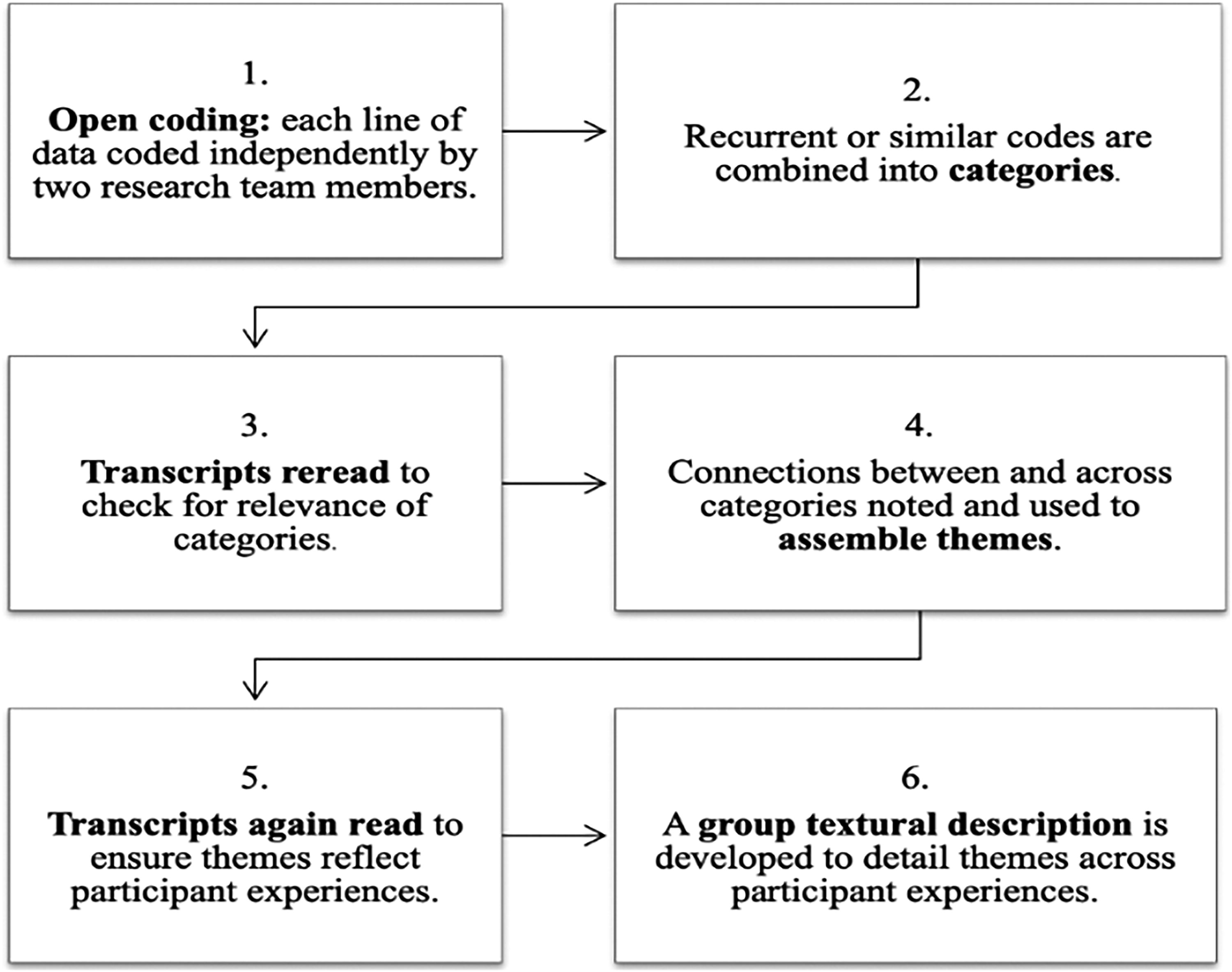
Data analysis procedures. Adapted from process and figure described by Boles et al. 15
Results
Two overarching themes emerged in the analysis: 1) research participation as a means of extending the child’s legacy and 2) research participation as an avenue for self-expression and gratitude. Each theme included several subthemes that illustrated the multifaceted experiences of these parents.
Theme 1: Research participation as a means of extending the child’s legacy
Bereaved parents included in this analysis frequently described research participation as a significant way to honor and extend their child’s legacy. Specifically, participant responses in this category yielded three subthemes: 1) telling their child’s story, 2) helping other bereaved families, and 3) contributing to the improvement of services and systems.
An opportunity to extend the child’s legacy
Many participants described research engagement as an opportunity to share their child’s story, thereby keeping their memory alive. As one participant who experienced a perinatal loss shared, “it’s fun, you know, it’s fun to talk about her and keep her memory alive. So, I appreciate it” (F30). Other participants shared how their child’s legacy was the meaning and motivation of their research participation:
This to me, this kind of thing is part of his legacy. If we can do everything we can to make a difference and help increase understanding for people then that’s part of what his legacy is, too. To us (B7).
Many participants found comfort in being able to speak about their child’s life, memories, challenges, and the impact of their loss. One parent said in an email exchange, “I’m interested and excited to talk to you about [my son] and his wonderful legacy. No one has spoken to us about him for a year and we are so very grateful for him” (B6). This storytelling aspect not only served as a form of tribute but also helped parents maintain connection with their deceased child even long after they are gone: “just because someone dies, doesn’t mean they’re gone. Thank you for doing this study” (B13).
Helping other bereaved families
Another powerful motivator for participation was the desire to help other families navigating similar losses or experiences. As one participant shared during the recruitment process:
Thank you for inviting me to participate. I am very much interested in any way I can help with the study regarding loss of my daughter and just being able to help me share with anybody else. I am really honored that you all called me (B23).
Several participants expressed a strong sense of purpose in contributing to the research that might provide insights and support for others in the future. In an email to the research team, parents who lost their twins perinatally expressed their interest in participating, saying, “we are always willing to do anything that will help other families deal with the loss of a child” (F1, F2). Another responded similarly to a recruitment email, “we would love to participate in order to help others who are grieving” (F24). For many participants, it appears, the altruistic aspect of participation was often seen as a means for converting personal tragedy into a source of hope and assistance for others, stating, “I wanna make other people know that they can survive this. It’s a bad situation, but it can be turned into good, and to be able to be positive and help other people, and continue to give people hope” (F23).
Improving services and systems
Several participants expressed hope that their research participation would contribute to improvements in health care services, bereavement support, and systematic changes. A bereaved mother who lost her daughter when she was 2 months old stated:
I’m glad you guys are doing things like this and I hope that it implements change at [research institution] and also, you know, that it could become broader to help families and providers at lots of different hospitals (F29).
In other words, they saw their involvement as a form of advocacy for better care practices and policies for future families. Another reflected, “it matters that eight years later, that Vanderbilt would call us and be interested in our opinion and we appreciate it very much” (B11). This sense of advocacy appeared to empower parents in their grief by affording them a proactive role in influencing positive change.
Theme 2: Research participation as an avenue for self-expression and gratitude
Participants also reflected on the personal impacts of research participation. Specifically, this theme was characterized by two sub-themes: 1) the opportunity for self-expression and 2) feelings of gratitude.
Opportunity for self-expression
According to participants, research participation provided a unique outlet for self-expression, where parents/caregivers could openly discuss their grief, experiences, emotions, and “share their hearts” in safe space (B12). One father who lost his son perinatally noted, “this is probably the most I’ve talked about [my son] since it happened” (F21). Another similarly explained how people in her life aren’t emotionally stable enough to speak about her daughter, which is “why I decided to contact you today. We haven’t talked about her in 9 years. We haven’t had the chance to” (B3). Similarly, one mother whose son died at 2.5 months old from surgical complications related to congenital heart disease reflected, “I’m probably going to get teary, but I love talking about him” (S72).
For some, this was one of the few opportunities they had to process their loss in a meaningful way. One mother described how research participation gave her the opportunity to “share [her] side of the story and [her] side of things” (S31). Another reflected, “I feel like I just keep rambling and talking; like every parent, you just don’t want to lose your child, and you don’t want them to be lost to others. So, it meant a lot to participate” (B15). This expression was often described as cathartic, offering a sense of relief and validation.
Feelings of gratitude
Parents/caregivers expressed deep gratitude toward the researchers for addressing such a sensitive and often overlooked subject. They appreciated the care and dedication the research team showed in exploring bereavement needs and experiences as they offered encouragement to “continue doing great work” (S28) and gratitude “for taking the time and for doing the research (S12), “we appreciate you doing the study” (B17). This gratitude often extended to the research process itself, with parents/caregivers appreciating the respectful and compassionate approach taken by the research team:
I appreciate everything you’ve done. Your energy and understanding man … some people make me sad. I get to crying [in other studies] and don’t want to do it, and you know, I hang up the phone. But you didn’t make me feel like that, you were really good with it (B5).
Approaching families in a sensitive, genuine, and caring way made participants feel valued, but also provided motivation to participate in future studies. One father openly expressed his hopes for continued research in this domain, sharing, “I like this study. I like being able to tell you the great things [the hospital did] because I wouldn’t have had that time with my son if it hadn’t been for them. Keep doing what you are doing. Keep studying, keep going” (S28). Another shared his gratitude, “I’m glad y’all are studying it. I’m glad you’re gonna do what you can to help” (B8).
Discussion
The purpose of this study was to explore bereaved parents’ perceptions of participating in three research studies about their bereavement experiences and legacy perceptions, with the goal of better understanding their research participation needs and enhancing opportunities for family-centered palliative care research. Overall, this secondary analysis highlighted the dual role of research participation for bereaved parents—both as a means of extending their child’s legacy and as a personal coping mechanism or opportunity for self-expression. 8 While many participants described finding solace and purpose in extending their child’s legacy by sharing their stories and helping others, they also valued the emotional support and validation gained through the research process itself. These findings align with previous literature on bereavement research participation, which has identified potential therapeutic benefits, such as meaning-making, altruism, and increased social support.4,6–8
However, it is important to recognize that not all bereaved parents find research participation beneficial. While many participants in these studies expressed positive experiences, prior research has shown that some bereaved individuals may find participation distressing or overwhelming, particularly if the research process reactivates painful memories or emotions such as guilt or anger. 6 In addition, some parents in prior studies have expressed concerns about impersonal methodologies or regret about exposing their grief experience. 6 These mixed responses raise the question of whether bereaved parents who opt into research are inherently more open to participation, potentially introducing self-selection bias. In other words, those who find participation too painful may simply decline, meaning that research predominately captures perspectives from those already inclined to see participation as meaningful.4,7 This methodological consideration underscores the need for researchers to design studies that minimize potential distress, offer multiple participation options, and acknowledge the willingness to participate may vary based on individual grief trajectories.
Prior research has debated the ethical consideration of enrolling bereaved individuals in research due to concerns about their emotional vulnerability.1–3 However, the findings of this study contribute to a growing body of evidence suggesting that bereaved parents can and do engage in research in ways that are personally meaningful and not universally harmful. This study builds upon previous literature in several key ways. First, it reinforces the importance of trauma-informed and intentionally flexible research designs that allow bereaved parents to set the pace of participation, consistent with prior qualitative research with grieving populations.4,9 Second, it highlights the role of research participation in legacy-building, a topic that has been explored in pediatric palliative care research but remains underexamined in bereavement research. 8 Finally, this study provides empirical support for expanding bereaved parent involvement beyond research, advocating for greater integration into health care planning, bereavement program evaluation, and policy development.
While prior work has primarily examined bereavement research participation in the context of specific loss types—such as suicide bereavement 6 or cancer-related parental loss 8 —this study uniquely includes parents with diverse loss experiences, including sudden and traumatic deaths, chronic illness, and perinatal loss. By capturing this range of bereavement experiences, the findings suggest that research design strategies emphasizing and methodological flexibility have broad applicability across different types of parental grief.
This study highlights the profound impact of tailoring research methods to be sensitive, flexible, and participant centered when working with bereaved individuals.4,7 The three studies analyzed in this secondary analysis incorporated opt-in recruitment, multiple format choices (in-person, virtual, or written responses), and flexibility regarding interview pacing. Such approaches allowed participants to engage in ways that felt safe and comfortable, potentially contributing to their positive experiences. Furthermore, interdisciplinary research teams—including professionals with clinical backgrounds in child life, psychology, and child development—provided compassionate support throughout the process, which may have helped mitigate distress.
To enhance practical applications for future research, Table 3 provides a summary of best practices for designing research with bereaved parents.
Suggestions for Designing Research with Bereaved Parents
By implementing these strategies, researchers can minimize potential distress while fostering meaningful participation.
To our knowledge, this secondary analysis is among the few studies to explore bereaved parents’ real-time reflections on research participation, offering insights into both perceived benefits and challenges. A key strength is the diversity of bereavement experiences represented, spanning sudden traumatic loss and anticipated deaths due to chronic illness. In addition, because reflections were collected at the time of participation, this study minimizes recall bias and provides practical recommendations for trauma-informed research design.
However, like any research study, this secondary analysis was not without limitations. The sample was largely homogenous in terms of parent gender and race, raising questions about whether this reflects disparities in who is approached for research or differences in willingness to participate. More inclusive recruitment strategies are needed to ensure diverse perspectives. In addition, self-selection bias is a potential concern, as those who declined participation may have had more negative views, limiting the generalizability of findings. While qualitative research offers rich insights, future studies should explore. Perspectives from broader bereaved populations and examine how participation impacts grief experiences over time. These limitations highlight the ethical complexities of conducting research with bereaved parents. While many find participation meaningful, ensuring a voluntary, flexible, and trauma-informed approach is essential. Future research should refine methods to better capture diverse experiences while addressing barriers to inclusion and representation.
Clinical implications
Beyond research considerations, this study underscores the importance of recognizing bereaved parents as active contributors to the advancement of pediatric palliative care and bereavement support services. Given the well-documented mental and physical health risks associated with child loss,1–3 clinicians may hesitate to engage bereaved parents in research or advisory roles, fearing that participation could be retraumatizing. However, this study suggests that participation—when approached sensitively—can be a constructive part of the grief process for some parents. Research participation can provide a structured avenue for meaning-making, reinforcing previous findings that suggest engaging in storytelling or helping others can be therapeutic in bereavement.4,6–8
To better support bereaved parents in both research and clinical settings, health care providers should consider:
Offering structured opportunities for parents to contribute their perspectives in bereavement program development. Providing clear, noncoercive invitations to participate in research, allowing parents to decide if and when they wish to engage. Educating health care teams on the potential benefits of research participation as part of meaning making in grief. Exploring longitudinal research on the impact of participation on long-term grief trajectories.
Future studies should examine whether and how research participation influences grief outcomes over time, potentially informing the development of evidence-based interventions.
Conclusion
Although prior literature has often centered on the vulnerability of bereaved parents, the findings of this secondary analysis suggest an equally valid perspective: that for some, research participation can be a meaningful part of the grieving process.4,6–8 By allowing parents/caregivers the opportunity to tell their child’s story, extend their legacy, contribute to improved health care systems, and express their emotions, researchers and clinicians can cocreate participation opportunities that are both ethically sound and meaningful for all families.
Footnotes
Acknowledgments
The team would like to acknowledge and thank the many parents/caregivers and family members whose experiences informed this research.
Authors’ Contributions
M.T.J. helped conceptualize and design the study; managed and coordinated responsibility for the research planning and execution; led data analysis and interpretation; drafted the initial article; critically reviewed and revised the article; and approved the final article as submitted. A.T. participated in data analysis and interpretation. J.C.B. conceptualized and designed the study; supervised and participated in data analysis and interpretations; drafted the initial article; critically reviewed and revised the article; and approved the final article as submitted.
Funding Information
No external funding was received for this article.
Author Disclosure Statement
The authors have indicated they have no conflicts of interest to disclose.