




Abstract
Background:
This study sought to examine the relationship of negative stereotype attitudes and endorsement of western standards of beauty (i.e., colorism) on the substance use behavior of low-income urban African American girls. Racial socialization was also examined as a potential moderator to identify any buffering effects of parental messages concerning race.
Methods:
Two hundred seventy-two African American female adolescents (mean age 13.02 years) were recruited from community venues in a Northeastern city. Adolescents completed a self-report questionnaire.
Results:
Results of a series of hierarchical regression analyses indicated that girls who accepted an African American standard of beauty reported lower levels of substance use than those who endorsed colorism. Additionally, racial socialization buffered the negative relationship of colorism to substance use behavior, but only for a certain subset of girls.
Conclusions:
Tailored health interventions that consider both gender-specific and race-specific issues may improve risk behaviors, including substance use among adolescent females.
Introduction
Race and gender each represent salient cultural group memberships that are important areas of study, 1 –3 Although each in isolation fails to accurately reflect the complexities and life experiences of these groups. 1,4 –6 Categories such as race and gender do not act independently of one another but instead interrelate and are bound together and influenced by one another. Intersectionality, as it is often termed, seeks to examine the ways in which these categories interact on multiple levels. Often, studies of African American women and girls focus on one area in isolation of the other (e.g., race vs. gender). In particular, there is a large body of literature that has shed light on how race and race-related constructs impact the lives of low-income African American girls. 7 –10 Race and gender experiences differentially affect African Americans according to these intersecting structures. 11 Unfortunately, less attention in the literature has been given to how gender and race intersect. What does it mean to be female and African American? How does that position in society manifest itself in the way African American girls see themselves? Does their affiliation with these social groups influence their health behavior? This study expands the discourse about intersectionality with an attempt to empirically measure the influence of stereotypes and negative images that stem from intersecting systems of racism and sexism on the substance use behavior of low-income urban African American girls.
We discuss identity and self-concept and review the ways in which the intersection of race and gender may shape self-concept among African American girls. This is followed by an examination of the rates of substance use among African American girls, which will highlight the importance of prevention with this population. Finally, we report findings from our study that examined gender-specific self-constructs through the lens of an African American experience (i.e., negative stereotype image and colorism) and its relationship to substance use among urban African American girls.
Self-concept among adolescent girls
How one identifies oneself is important because self-concept mediates and regulates one's behavior. 12 Periods of transition (e.g., going from middle school to high school) can cause changes in an adolescent's self-concept. Research shows that many girls experience a marked decline in their self-esteem during early adolescence. 13 Previous research among general populations has concluded that the issues girls have with their self-esteem and body image can lead to substance use and abuse. 14,15 Social comparisons and interpersonal interactions help to determine self-concept and identity. 12 In the United States, comparisons based on cultural and social group membership often center around gender and race. However, there is limited research in this area with urban African American female adolescent populations. Therefore, we have chosen to focus our study on the self-concept of African American girls during early adolescence. Using the framework of intersectionality, we focus our discussion on two factors that have been found to influence an African American girl's sense of self: (1) racially charged and gendered stereotypes and (2) societal messages concerning culturally based physical image.
Stereotype images
Stereotypes are important to consider when examining how gender and race influence self-concept in the lives of African American females. Stereotype images are based on the belief that there are certain appearances, behaviors, or attributes shared by all members of a certain group. There is a history of negative stereotypes about African Americans, which were often used to help justify mistreatment during slavery and segregation. Women's and African American studies, among other disciplines, have led to the identification of several historical stereotype images of African American women including the promiscuous “mulatto” Jezebel; the asexual, dark-skinned Mammy; the emasculating matriarch; the disagreeable sapphire; and the breeding welfare mother. 16,17 Remnants of these images remain but are exemplified by similar, yet updated archetypes. These contemporary stereotypes, outlined by Stephens and Phillips, 18 include the diva; her beauty is characterized by western standards (long, straight hair, slim build, light skinned). She appears independent but chooses to target men who can raise her social status (trades sex for social status). The gold digger barters with her sexuality for economic and material gains. The freak seeks to satisfy her sexual desires. Considered a bad girl who gains male attention by being overly sexual, she is sexually liberated and empowered and seeks out sex for physical satisfaction not for a relationship.
Many of these contemporary stereotype images are influenced by hip hop culture and illustrate concepts of African American women with a strong focus on sexuality. 19,20 Stephens and Phillips 18 contend that these negative stereotypes, which are propagated in the media and in broader society, have helped to shape the self-perception of today's African American women/girls. Societal messages and media images that emphasize the appearance of women and girls are thought to foster self-objectification among adolescent girls and women. According to the objectification theory, adolescent girls become aware that their bodies are examined and evaluated by others and consequently internalize the observer's perspective to evaluate their own bodies. 21 This is supported by a study by Gordon 22 with 176 African American girls (mean age 15 years). Results indicated that girls who identified more with stereotypical images of black women in music videos were more likely to emphasize the importance of appearance in their own lives. In addition, Townsend et al. 23 explored contemporary stereotype images among African American adolescent girls using the Modern Jezebel Scale (MJS), a modified version of the Stereotypic Roles of Black Women Scale (SRBWS). 24 According to Townsend et al., 23 girls who endorsed the Modern Jezebel stereotype believed that African American girls are highly sexual, aggressive, and even combative. Because of their increased relevance, we focus on these contemporary stereotypes in our study, examining their relationship to substance use among low-income African American girls.
Body image and colorism
Body image is a multifaceted and multidimensional concept about one's view of one's body and its appearance. Body image also incorporates emotional and physical reactions to one's self-view of his or her appearance. 25 Body image perceptions may change over time and tend to be most salient during adolescence. Self-esteem and self-concept have consistently been shown to be related to body image dissatisfaction for females. 26,27 Research has indicated that African American females have more positive body image views compared to white and Hispanic females. 28 –32 This could be because African American females, unlike European females, relate their body image more to public image and personality than to body appearance. 33,34 Although previous research has found lower levels of poor body image among African American females, this is not to say there are no concerns related to body image and appearance satisfaction among this population. Of particular relevance to body image and African American females is the issue of skin color.
Similar to the stereotypical images described, stratification in the African American community based on skin color is a remnant of slavery. Because the system of slavery in western society was based on race, those slaves who had white ancestry where allocated privileges that their darker counterparts were not, 35 conveying the message that African Americans who were aesthetically closer to white were more pleasing than those who were not. This skin color stratification of African Americans has been termed “colorism,” 36 and its effect on self-esteem is stronger for African American girls/women than for African American men/boys. 35 Adopting a colorism-informed standard of beauty may pose a particular risk for those African American girls who do not conform to this standard. Taking into consideration objectification theory, internalization of stereotyped images and self-objectification may lead to appearance dissatisfaction among African American girls, which may be manifested in a preference for physical characteristics that they believe will be judged more favorably (e.g., lighter skin, longer hair, fine hair texture). African American girls' lived experience includes exposure to many images that send messages to African American girls about how they should look and behave. This may create an unsympathetic environment within which African American girls are expected to function and attempt to develop a healthy view of themselves as young women. 37 The stress of balancing these challenges may lead to substance using behaviors. Thus, we examine how colorism (acceptance of a western standard of beauty) is related to substance use among African American girls.
Substance use among African American female adolescents
Adolescence is a period when there is a high rate of substance use. Although substance use rates for males are higher than the overall rates for females, the gender gap is closing. More teenage girls than boys are starting to use substances (i.e., marijuana, alcohol, cigarettes). 38 Overall, substance use among African American girls tends be lower than rates among other racial groups, 39 although rates among African American girls for some substances, in particular marijuana use, are similar. For example, black adolescent females (35%) had similar lifetime marijuana use as Hispanic (35.9%) and white (34.1%) females. 39 Black females' current marijuana use (past 30 days) was similar to use among white females (17%).
The substance use trajectory without intervention among adolescents is often characterized by initial use, then casual experimentation, followed by more frequent substance use. The earlier a young person initiates substance use, the more at risk he or she is for later use and abuse. There is a need to focus substance use prevention efforts on African American girls across the early to midadolescent age range to reflect this typology. In addition, examining correlates associated with the early initiation and experimentation of substance use is important for preventing the consequences of longer-term use, which include decreases in school functioning and study habits, risk for depression, and involvement in other risk behaviors. 40 Studies focused on this population are also of significance given the disparity in health and social consequences of substance use for this population. This includes sexually transmitted infection (STI)/HIV infection and risk for arrest/incarceration. 41,42 Most adolescent substance users decline or stop using by adulthood, but for African Americans, there is a disproportionately higher rate of those who abuse substances in adulthood compared to other racial groups.
Racial socialization, healthy self-concept, and substance use prevention
Several protective factors have been identified in the substance use literature. Of particular import is the parental practice of racial socialization, given its cultural relevance to the population under study. The primary aim of parental socialization is to transmit values, norms, and beliefs to enhance the performance and survival of one's child. 9 This transmission is based on the parents' perception of the environment and their history of interaction with the larger society. 43 Given the historical, social, and political realities many members of the African American community face in U.S. society, the socialization process often includes a racial component. Termed “racial socialization,” this process communicates African American history, cultural values, and traditions. 9,44 Another important component of racial socialization for African American families is teaching defensive mechanisms against prejudice and discrimination. 9,45
Through the racial socialization process, African American parents attempt to buffer, defend, and fortify their girls against external and societal assaults that may include stereotype images and issues associated with colorism. Research has found that exposure to most forms of parental racial socialization is associated with healthy adjustment among African American youth. 44,46,47 For example, a study by Brown 48 was conducted with 154 African American youth (mean age 19 years) to examine the relationship between racial socialization and resiliency factors, such as lower levels of substance use. Receiving racial socialization messages from parents, particularly messages promoting cultural pride and history, was significantly positively related to resiliency among participants. 48 Because the previous literature has found racial socialization to play an important role in African American youth development, this study explores how it impacts the relationship of stereotype image and colorism on substance use behaviors among urban African American girls.
Study conceptualization, purpose, and hypothesis
As noted, few researchers have considered race and gender when conceptualizing studies with African American female populations. This study is an attempt to incorporate intersectionality in our research on self-concept and body image by relating these variables to the lived experiences of urban low-income African American girls. Our study focuses on negative stereotype images and endorsement of western standards of beauty (i.e., colorism). Specifically, the purpose of the study is to measure attitudes toward negative stereotype images and colorism among adolescent urban low-income African American girls. Given the previous research on self-concept and body image, we hypothesize that attitudes concerning negative stereotype images will be positively related to endorsement of colorism. We also examine how attitudes concerning negative stereotype images and colorism are related to substance use behavior. We hypothesize that attitudes about negative stereotype images and colorism will be positively related to substance use behaviors. In addition, we explore how experiences with parental racial socialization moderate the relationship of stereotype images and colorism on substance use behavior. Much of the literature on racial socialization highlights the protective effect of parental racial socialization as a whole and the specific subscales. We hypothesize that parental racial socialization will serve as a protective buffer and moderate the negative relationship among stereotype images, colorism, and substance use behaviors. Given this is one of the first studies to examine these factors among a sample of African American girls, we are interested in examining the differential effects of the racial socialization subscales but do not propose different hypotheses for each.
Materials and Methods
Participants
A convenience sample of 272 African American girls voluntarily participated in this study as part of a larger longitudinal investigation on the efficacy of an HIV/substance abuse prevention program funded by the Substance Abuse Mental Health Services Administration, Center for Substance Abuse Prevention (SAMHSA/CSAP). Participants for this study included girls in the intervention and girls in the comparison group who did not receive the intervention. Results from this study are from the baseline interviews completed by girls before the start of the intervention. Data were collected beginning in the fall of 2004 and ending in the fall of 2008.
Participants were recruited from four middle schools that were sites for a risk prevention program targeting African American adolescent girls. All girls at each school were eligible to participate as long as they were between the ages of 10 and 15. Only those girls self-identifying as African American, black, or biracial (one parent identified as black/African American) were included in the study. The resulting sample ranged in age from 10 years to 15 years (mean age 13.02, standard deviation [SD] 1.04) at the start of the study. The majority of the girls came from families where both mothers and fathers were employed, 74.3% and 77.2%, respectively. However, only 10% of the girls lived with both parents. Approximately 31% of the sample lived with one parent and a sibling(s), and another 14% lived with a biologic parent and a stepparent. The rest of the sample had other living arrangements, including living in multigenerational households (10%), with mother only (10%), or with other relatives (i.e., father only, grandparents, aunts, uncles, older siblings, stepparent) (25%).
All the students attended middle schools in Southwest Philadelphia, which is predominantly African American. According to census data, 73% of the 154,000 residents of Southwest Philadelphia in 2000 were African American. 49 Households in this district have a median annual income <$25,000, with approximately 34% of these households headed by females.
Data collection
Before data collection, the study was reviewed and approved by the Institutional Review Board of the second author's home university. Information sessions were held with teaching, support, and administrative staff to inform them of the program and to answer their questions. Teachers and counselors were tasked with announcing the program to students in the classrooms. Girls who expressed an interest were invited to attend an orientation session with their parents/guardian held by project staff. Project goals and objectives were presented to each parent, and questions from the families were addressed. Parental consent was obtained from parents, and assent was obtained from youth during the orientation session. Data for this study were collected before the students' participation in the prevention program. All girls who provided parental consent participated in the pretest data collection. At questionnaire administration, trained African American research assistants administered questionnaire packets in the classrooms. One assistant read the questionnaire aloud as the girls read along silently. The second assistant was available to answer questions as necessary. Before beginning the questionnaires, the students were informed about the confidentiality of their participation, including the use of ID numbers to ensure their anonymity. They were told that the questions were about their thoughts and feelings on different subjects. It took approximately an hour for participants to complete the packets of questionnaires. Girls who were absent on the scheduled day of data collection were administered the questionnaire individually upon their return to school. All the students were provided with small gift bags of lotion and scented body spray as incentives for their participation.
Measures
Measures were selected to be reliable, valid, and appropriate for the target population of African American girls in early adolescence. Only those measures from the larger protocol relevant to the present study are discussed.
Stereotype images were assessed using the MJS. 23 The MJS is a 20-item measure that assesses black adolescent girls' identification with the various stereotype images that have been constructed about black women. Items for the scale were adapted from the SRBWS. 24 Because the original survey was normed with an adult sample, we administered a pilot test of the scale to 15 African American girls between the ages of 11 and 15. Pilot administration focused on comprehension and relevance of items for this target population. All items that presented a problem during the pilot were altered to increase comprehension without changing meaning. Terms were changed or omitted based on recommendations from the girls. The new version was then piloted on a separate group of 15 girls. Factor analyses and reliability analyses were performed on a sample of 270 to determine the latent factor structure of the new scale. Instead of a four factor scale, factor analysis revealed a single factor structure, Modern Jezebel. Given that this is a different construct than was originally identified in the SRBWS, the factor warranted a new label (see reference 23 for a full description of factor analysis and scale validation). Sample items are as follows: Black girls are loud and have an attitude. Black girls use sex to get what they want. The internal consistency reliability for the MJS was 0.82.
Colorism was assessed using the Image Acceptance Measure (IAM), 50 which measures the rejection of stereotypically preferred physical traits that stem from a standard of beauty consistent with colorism (e.g., light complexion, straight and long hair, thinness). Sample items are as follows: Straightened hair looks better than natural hair. I think guys prefer girls who have lighter skin. The 12-item measure uses a 5-point score (from 1, agree a lot, to 5, disagree a lot). A higher IAM score denotes rejection of colorism or an appreciation for a more traditional African American standard of beauty. This scale evidenced strong internal consistency (α=0.90) with our sample.
Racial socialization was assessed by the Teenager Experience of Racial Socialization (TERS) scale, which was developed by Stevenson et al. 51 to measure the frequency of messages that adolescents have received from their parents or guardians about their culture and racial barriers. TERS is a 40-item measure that asks respondents to list how often they have heard each racial socialization message from their caregiver/parent on a 3-point Likert scale (0, never; 1, a few times; 2, a lot). Messages include: You should be proud to be black. Whites have more opportunities than blacks. You should know about black history, so you will be a better person. A total score represents a composite of racial socialization, with a high score representing a high level of racial socialization. The five subscales include a 13-item Cultural Coping with Antagonism (CCA) scale, a 9-item Cultural Pride Reinforcement (CPR) scale, a 5-item Cultural Legacy Appreciation (CLA) scale, a 6-item Cultural Alertness to Discrimination (CAD) scale, and a 6-item Cultural Endorsement of the Mainstream (CEM) scale. The alpha coefficient for full scale among this sample was excellent (0.90). Reliability for subscales was as follows: 0.90 (CCA), 0.77 (CPR), 0.75 (CLA), 0.79 (CAD), and 0.66 (CEM).
Substance use was assessed using items that the SAMHSA/CSAP cross-site research team identified from the JSI Youth Form scale of drug use behaviors. 52 Students were asked to indicate how many times in the past 30 days they had used each of six substances (alcohol, cigarettes, marijuana, cocaine, inhalants, and other illegal drugs). Because of the low frequency of reported drug use (most participants reported never using a drug or trying a drug one or two times), scores on the drug use measure were converted to a drug experimentation index. Students who indicated using a specified substance at least once or twice were assigned a 1 for that drug, and students who reported never using a specific drug received a 0 for that drug. Scores for each drug were then summed to compile a drug extermination index that ranged from 0 to 6. A higher score indicates a greater number of substances tried in the previous 30 days.
Results
Descriptive findings
Descriptive information (including reliability coefficients) on the scales that were used in the study is presented in Table 1. Overall endorsement of beauty standards that rejected colorism and were more consistent with traditional African American aesthetics was moderately high (mean=3.40). Although generally the girls tended to reject colorism, they appeared to endorse attitudes consistent with colorism on items related to black women's hair and nails (IAM scale).
N/A, not available.
Endorsement of the Modern Jezebel stereotype was moderate (mean=2.96). Study participants were most inclined to agree with some of the statements that pertained to the assertive nature of African American girls. Tables 2 and 3 show item frequency responses for both the IAM scale and the MJS. Scores on the TERS indicate that, on average, participants reported hearing most racial socialization messages a few times. Messages that constitute the CPR subscale were most highly endorsed by the sample. The CPR subscale received a mean score of 1.42, indicating participants reported hearing those messages between a few times and lots of times.
Reported current drug use in this sample was low. As previously mentioned, use of a substance was scored dichotomously (0, no use; 1, use), and scores for all substances were summed to indicate the number of substances currently used. Average score on the drug experimentation index was 0.53 (i.e., current use of less than one substance) out of a possible high of 6 (i.e., current use of all six substances). This indicates most girls reported use of less than one drug in the previous 30 days. The most highly endorsed substance was marijuana (10.2%), followed closely by cigarettes (9.5%) and alcohol (9.1%). This is consistent with national surveillance studies of youth substance use. 13
Preliminary analyses
Bivariate correlations were used to identify significant relations among study variables (Table 4). As shown, colorism and negative stereotype images were significantly related, such that girls who endorsed stereotype images consistent with Modern Jezebel also endorsed a western standard of beauty (i.e., colorism) [r(267)=−0.12, p≤0.05]. Colorism and negative stereotype images were both significantly related to CAD [r(265)=−0.15, p≤0.05 and r(267)=0.22, p≤0.001, respectively], such that girls who reported hearing socialization messages concerning racial discrimination also endorsed a western standard of beauty (i.e., colorism) and stereotype images consistent with Modern Jezebel. Girls who endorsed stereotype images and western standards of beauty also reported hearing socialization messages that reinforced mainstream culture [r(269)=0.22, p<0.01, and r(268)=−0.14, p<0.05].
Because of missing data, n=267–274 for these analyses.
p=0.10; * p<0.05; ** p<0.01; *** p<0.001.
C, colorism; MJ, Modern Jezebel; SU, substance use.
Colorism and stereotype images on substance use among African American girls and buffering effects of racial socialization
Relationships were explored between societal messages (i.e., stereotype images and colorism) and substance use. These relationships were examined using hierarchical regression analysis, including interaction terms to test for moderation effects. Age was entered in the first step as a covariate to control for any effect that could be accounted for in the model by its presence. Next, stereotype images and colorism were entered as predictors in the second step. Each of the racial socialization subscales was included as a predictor in the third step, followed by each of the interaction terms in the fourth and final step. As suggested by Aiken and West, 53 all variables used to compute interaction terms were centered. Substance use was entered as the dependent variable.
As shown in Table 5, there was a significant negative relationship found between the measures of colorism and substance use. Those girls who endorsed colorism and rejected a more traditional African American standard of beauty (low IAM score) reported higher levels of substance use. In addition, a notable interaction emerged: Colorism×CEM. Simple slope regression analyses 53 were performed to probe the significant interaction and to plot the interaction effects. Close examination of the interactions suggest that the relationship between colorism and substance use was negative at all three levels of CEM, but the relationship was strongest among those girls who reported hearing fewer socialization messages that reinforced mainstream culture. In other words, as rejection of colorism and acceptance of an African American standard of beauty increased, reported substance use decreased, particularly among girls who reported hearing low levels of CEM messages. Those girls who endorsed colorism and accepted a western standard of beauty, yet reported hearing few socialization messages that reinforced mainstream culture, reported the highest level of substance use (Fig. 1).
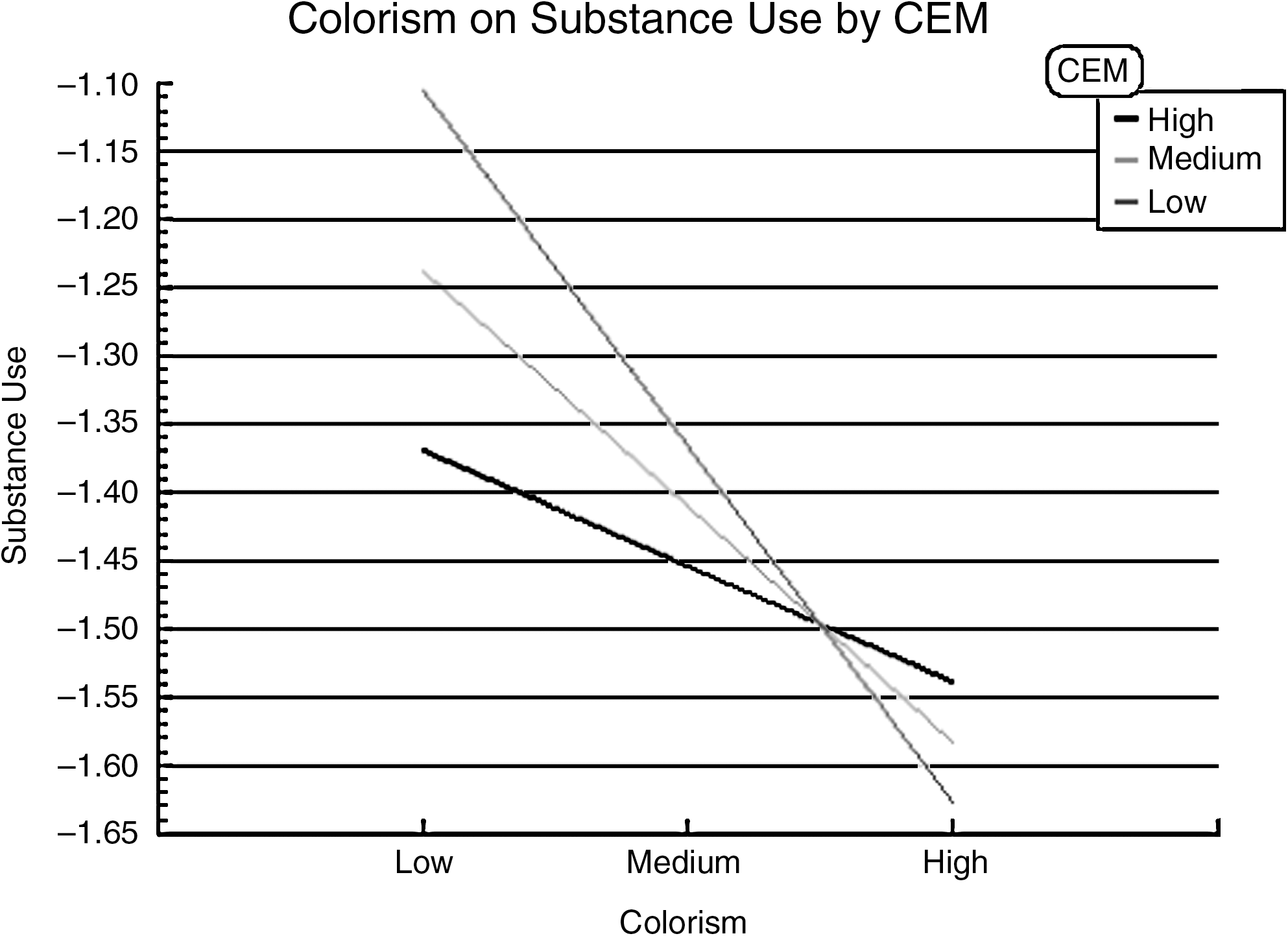
Moderation effect of colorism on substance use by cultural enforcement of mainstream (CEM).
ΔR2 signifies how much the proportion of the data variability accounted for by the model has increased at each step of the regression. SEB is the standard error of the regression coefficient.
p<0.01; ** p<0.05; *** p<0.001.
Another interaction emerged between colorism and CAD, although only approaching significance (p=0.095). As with the previous interaction, rejection of colorism and acceptance of an African American standard of beauty was associated with decreased substance use. However, unlike the interaction described above, the negative relationship was strongest for those girls who reported hearing high levels of CAD messages. Among girls who rejected colorism and endorsed an African American standard of beauty, those who reported hearing fewer CAD messages reported higher substance use compared with those who reported hearing more CAD messages. The results also indicated that girls who endorsed colorism and reported hearing a lot of CAD messages had the highest level of substance use (Fig. 2).

Moderation effect of colorism on substance use by Cultural Alertness to Discrimination (CAD).
Discussion
Life for urban African American girls involves many factors that are unique to their cultural and gender experience. This includes identity and self-concept-related constructs, such as negative stereotype images and endorsement of western standards of beauty (i.e., colorism). Many girls in our sample agreed with statements associated with negative stereotypes of African American girls, particularly those associated with sexual behaviors. This finding supports previous research that has identified contemporary stereotypes influenced by hip hop culture and includes a strong focus on sexuality. 19,20 As hypothesized, girls in our sample who agreed with negative stereotype image statements were more likely to endorse western standards of beauty. As previously stated, Gordon 22 conducted a study with African American girls and found that those who identified more with stereotype images of black women in music videos were more likely to emphasize the importance of appearance in their own lives. Identification with stereotype images and western standards of beauty may influence not only self-concept among African American girls but also their decision making and behavior. Our study shows evidence of this in that girls who endorsed western standards of beauty were more likely to report using substances than those who accepted an African American standard of beauty. One explanation for this may be through objectification theory, 21 whereby African American girls may internalize the western standard of beauty preferences of others. These internalized preferences may lead to their own personal appearance dissatisfaction, which in turn may lead to substance-using behaviors.
The negotiation of societal messages (i.e., negative stereotype images and colorism) is partially dependent on an individuals' understanding of her own identity. 54 This may come from parental racial socialization messages about race, culture, and awareness of discrimination/racism. Given the previous research that shows the central role of racial socialization in African American families, 48,55 our study sought to examine if parental racial socialization moderated the effect of negative stereotype images and colorism on substance use behavior among African American girls. Acceptance of an African American standard of beauty was related to lower levels of substance use and was particularly true among girls who reported hearing fewer messages that reinforced mainstream culture (CEM). Although not statistically significant, there also appears to be a trend where acceptance of an African American standard of beauty was related to lower levels of substance use among girls reporting hearing many messages related to racism and discrimination (CAD). This could be an indication that girls who reported hearing many messages concerning discrimination but few messages endorsing mainstream culture resided in households that were culturally conscious (i.e., cognizant of issues specific to the African American experience). These culturally conscious families would be more likely to promote an African American beauty standard. Girls who endorsed beauty standards consistent with these values may, therefore, be less likely to conflict with parents, a common risk factor for substance use.
We expected that girls who endorsed western standards of beauty would be more likely to report using substances, given that this reflects a negation of their own physical features as African Americans. However, we were surprised by the trend that suggests girls who endorsed western standards of beauty and reported hearing many messages related to racism and discrimination (CAD) had the highest level of substance use. We expected racial socialization messages to serve a protective function for all girls. Although unexpected, our findings are in line with previous studies that have found that racism and discrimination messages (i.e., CAD) may have negative implications for outcomes among African American boys and girls. 10,55,56 This finding could reflect added stress from hearing racial discrimination messages. This additional stress, along with the endorsement of a beauty standard that may negate their own physical features, may heighten the risk of substance use for these girls, particularly at this developmental stage in which appearance and self-image are so important. It is also plausible that the racism awareness messages from parents are in response to observations that their daughter(s) reject an African American standard of beauty. Parents may be relaying more discrimination and racism awareness messages in an effort to change their daughters' values to those that are more culturally conscious. Both of these interpretations imply a conflict between the parent(s) and daughter, which may heighten her risk for substance use.
There are many unanswered questions that we believe could benefit from future investigations. Our study indicated that some African American girls internalized negative stereotype images and endorsed Western standards of beauty. Future research could examine how negative stereotype images and colorism beliefs are internalized by African American girls. Where are urban African American girls learning these stereotypes and beliefs? In what ways are the negative stereotype images and beliefs helping to shape their identity and self-concept? In what ways are parents responding to girls' endorsement or rejection of African American standards of beauty? Qualitative studies can be used to describe the types of parental racial socialization messages received by urban African American girls. Explorations can identify differences in the content of parental racial socialization messages based on demographic characteristics, such as gender of the parent and socioeconomic status. There are several models that could explain how colorism and substance use may be impacted by parental racial socialization. For example, parental racial socialization may be a mediator whereby girls' colorism attitudes are shaped by the racial socialization messages they receive from their parents and, therefore, affect their use of substances. Given the cross-sectional nature of the study, however, we cannot ascertain the direction of the relationships studied. It is also quite possible that substance use occurred before endorsement of western standards of beauty parental and/or racial socialization messages. Longitudinal research would allow us to identify the trajectory of internalized self-concept and substance use behaviors among this sample.
Limitations
The current study has several limitations that must be considered. The data collected in this study were derived from self-report, and we were unable to ascertain if parental racial messages were representative of the amount of socialization practiced. The study was cross-sectional in nature; therefore, no conclusions about causality can be made. The study was limited to a convenience sample of African American female youth in a specific northeastern urban geographic location, and, thus, the study's findings may not be generalizable to youth from other racial/ethnic backgrounds or geographic locations. Despite the limitations, we believe the findings have value in the literature, particularly given the dearth of information about African American girls and how racial and gender intersect.
Conclusions
The culturally specific constructs of self-concept (i.e., stereotyped images and colorism) were related to substance use in our study population. Prevention programs may seek to develop curriculum content that addresses these topics. For example, the media tend to positively endorse western standards of beauty more than African American features. The influence from such media images may lead to an increased desire in some African Americans girls to look more “western” (e.g., long hair, light features) in an attempt to better blend in with society's views and preference. Studies have shown that the media influence youth risk behavior. 57 Thus, self-medicating with substances may be an attempt to alleviate or decrease the pain and discomfort caused by the struggle to fit in at an age when identity and self-concept are so central to an adolescent's worldview. In light of this, prevention programs might include discussions with urban African American girls about the images they are exposed to and how these relate to their identity and in what ways viewing those images impacts their health behavior.
Our study also found that racial socialization messages moderated the relationship between colorism and substance use. For girls who endorsed colorism and a western standard of beauty, fewer parental messages about mainstream values increased the risk of substance use, whereas among girls who rejected colorism and accepted an African American standard of beauty, messages making them aware of racism/discrimination were more protective. This suggests that health interventions work with parents of African American girls to tailor their racial socialization messages to address their daughters' particular adjustment and identity development, resulting in programs that are specific to the needs of the youth instead of the traditional one-size-fits-all approach. Overall, given the unique contributions of the findings, our study adds to the body of literature to better inform our understanding of how race and gender intersect to influence substance use behavior among African American girls. The results illustrate that more research should be conducted to better elucidate the health consequences of stereotype images and rejection of African American standards of beauty among African American women and girls.
Footnotes
Acknowledgments
Data for this article were obtained through a grant to the second author by the Substance Abuse and Mental Health Services Administration (SAMHSA grant 1H79SP1068). Special thanks are extended to Saleema B. Curtis, M.P.H., Tiffany R. Jackson, M.Ed., and Sara Whitfield for their assistance with recruitment, retention, data collection, and program organization of the grant. We appreciate Kathryn Rhindress and William Chaplin, Ph.D., for their assistance with this report.
Disclosure Statement
No competing financial interests exist