




Abstract
Objective:
To inform campaign development by assessing awareness, previous receipt, and knowledge of the purpose of Papanicolaou (Pap) testing among women aged ≥18 years and to identify differences in awareness, receipt, and knowledge by demographic characteristics.
Methods:
Data were analyzed from the 2008 HealthStyles survey, an annual mail survey conducted in the United States covering trends in health-related behavior. Women were asked questions on awareness, past use, and knowledge of the purpose of the Pap test and other gynecologic tests and procedures; 2991 women participated.
Results:
Although 96.7% of the women had heard of and 93.0% reported having received a Pap test, these proportions were lower among those who were 18–34 years old and among those who had lower levels of education and income. Over 80% knew the Pap test was used to screen for cervical cancer, but 63.3% believed it also was used to screen for vaginal cancer (44.9%), sexually transmitted diseases (STDs) other than human papillomavirus (HPV) (41.7%), ovarian cancer (40.6%), and other cancers and infections.
Conclusions:
General familiarity and past receipt of the Pap test were high, but misconceptions about its purpose were prevalent. It is important that women understand what a routine Pap test is and is not capable of detecting so that signs and symptoms of gynecologic conditions other than cervical cancer may be recognized and addressed appropriately.
Introduction
Since its introduction in the 1940
To reduce the burden of disease associated with cervical cancer, an accurate understanding of the screening modalities available and recommendations for their use is imperative. In 2007, the Gynecologic Cancer Education and Awareness Act of 2005, or Johanna's Law, was signed into law to raise awareness of the five main types of gynecologic cancer: cervical, ovarian, uterine, vaginal, and vulvar. To support this legislation, the Inside Knowledge: Get the Facts About Gynecologic Cancer campaign (
Materials and Methods
To gather information about the public's awareness of gynecologic cancer, we developed and commissioned questions for inclusion in Porter Novelli's 2008 HealthStyles survey (Washington, DC) an annual mail survey of noninstitutionalized adults, ≥18 years, in the contiguous United States. Administered by Synovate Inc., the survey is designed to capture the public's opinions, beliefs, and trends in health behavior. Reports from this survey have been used previously to describe knowledge and attitudes about breastfeeding, 6 medication adherence, 7 and direct-to-consumer genetic tests. 8 A total of 7000 Healthstyles surveys were sent to mail panel households that had previously participated in Porter Novelli's ConsumerStyles survey. Responses were received from 5399 Healthstyles participants (2991 of whom were women), yielding a response rate of 77.1%. The resulting HealthStyles database was poststratified and weighted according to U.S. Census benchmarks on age, sex, race/ethnicity, income, and household size to reduce potential nonresponse bias.
Familiarity with the Pap test and four other gynecologic cancer-related tests and procedures was assessed in the survey by asking respondents: “Have you heard of any of the following?” Respondents were instructed to check “yes, no, or not sure” for each of the items: Pap test, pelvic examination, transvaginal ultrasound (TVU), CA-125 blood test, and human papillomavirus (HPV) test. Previous receipt of these tests and procedures was assessed by asking: “Have you ever had any of the following?” using the same response options.
Knowledge about the purpose of the Pap test in screening for cancer was assessed by the question: “To the best of your knowledge, a Pap test or Pap smear is used to check for which of the following?” Eight cancers and conditions and a “none of these” response option (Fig. 1) were listed with open boxes next to each, and respondents were asked to mark with an X all that apply. Demographic variables were also collected and included age, race/ethnicity, marital status, education level, and income.
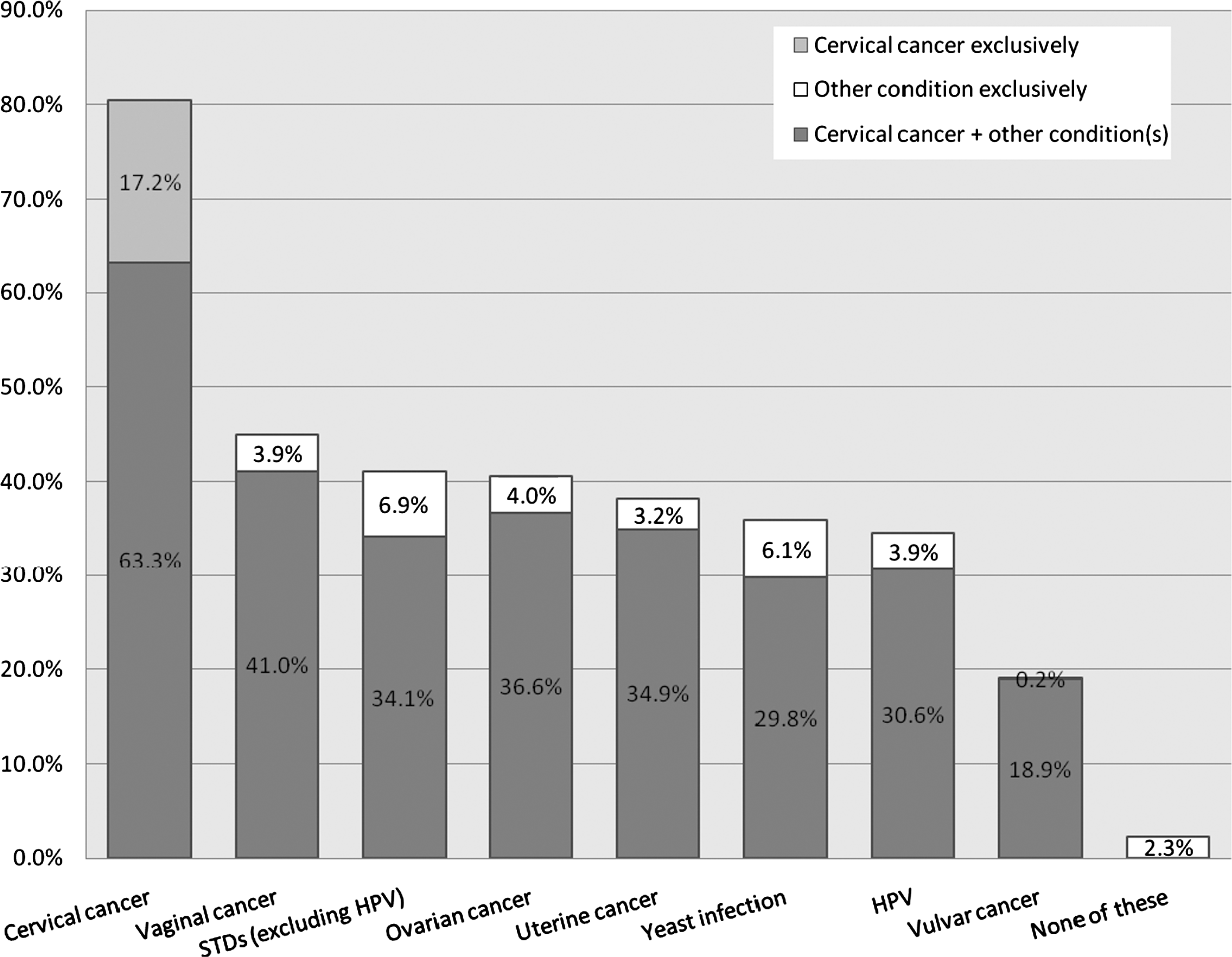
Beliefs about the purpose of the Pap test in screening for cancer and other conditions. HPV, human papillomavirus; STD, sexually transmitted disease.
Because CDC licenses the results of HealthStyles from Porter Novelli and because personal identifiers were not included in the data provided to CDC, analysis of these data was declared exempt by CDC's Institutional Review Board.
Results
The most familiar gynecologic cancer-related test or procedure was the Pap test, with 96.7% of the sample reporting having heard of it, whereas 95.5 % had heard of a pelvic examination, 81.6% had heard of an HPV test, 57.4% had heard of a TVU, and 26.4% had heard of a CA-125 blood test. As Table 1 shows, although familiarity with the Pap test differed significantly by various demographic characteristics other than age, it was a familiar term to >95% of the women in every subgroup. Previous receipt of a Pap test was reported by 93.0% of the sample, which was higher than the proportion who reported receiving any of the other gynecologic tests and procedures (i.e., pelvic examination 85.7%, HPV test 22.1%, TVU 26.4%, CA-125 blood test 10.6%). As Table 1 shows, prior receipt of the Pap test differed significantly by each of the demographic characteristics assessed. Although prior receipt of the Pap was reported by >90% of all but one demographic subgroup, it was lowest among women aged 18–34 years (92.5%), those who had a high school diploma or less education (92.0%), and those who had a household income of ≤$15,000 (88.8%).
All percents are weighted; n's are not weighted. Chi-square is based on weighted values.
Knowledge of purpose refers to the correct identification that Pap tests check for cervical cancer, regardless of additional beliefs about their purpose.
Knowledge of singular purpose refers to the correct identification that Pap tests screen exclusively for cervical cancer.
HPV, human papillomavirus.
When asked about conditions for which the Pap test checks, respondents selected a mean of 3.5 of the eight conditions listed. As Figure 1 demonstrates, cervical cancer was the most common response, with 80.5% of the sample demonstrating knowledge of its link with the Pap test; however, the vast majority (63.3%) believed that the Pap test screened for cervical cancer in conjunction with other conditions. Only 17.9% answered that the Pap test was used to screen for cervical cancer exclusively. Over one third of the sample reported believing that the Pap test was used to check for vaginal cancer (44.9%), sexually transmitted diseases (STDs) other than HPV (41.0%), ovarian cancer (40.6%), uterine cancer (38.1%), yeast infections (35.9%), and HPV infection (34.5%). A smaller proportion believed it tested for vulvar cancer (19.1%). Only 2.3% answered that it tested for none of the conditions listed.
As Table 1 further demonstrates, knowledge of the Pap test's link with cervical cancer differed significantly by demographic characteristics; it was lowest among those who were ≥65 years old (79.8%), those who had a high school diploma or less education (77.0%), and those who had a household income of ≤$15,000 (75.4%). Women who reported a history of cervical cancer or abnormal Pap test results were more likely to know that the Pap test screens for cervical cancer than were women with no history of these conditions (98.4% vs. 83.5% for cervical cancer history, p<0.05; 88.5% vs. 81.7% for history of abnormal Pap results, p<0.05); however, women who previously had been diagnosed with an HPV infection or a gynecologic cancer other than cervical cancer were no more likely than those without a diagnosis of these conditions to be aware of the link between the Pap test and cervical cancer.
Table 1 also reports the proportions of women who reported that cervical cancer is the only condition for which the Pap test screens. Analyses by demographic characteristics revealed the lowest levels of understanding were among those in the youngest age group (9.0%), those who were black or Hispanic (3.9%, 10.1%, respectively), those who had a high school diploma or less education (9.5%), and those who had a household income of ≤$15,000 (7.4%). The only health history variable that revealed a difference in believing in the singular purpose of the Pap test was previous HPV infection. Those with no history of HPV infection were more likely to report that the Pap test screens exclusively for cervical cancer than those who reported a history of HPV infection (17.6% vs. 8.9%, p=0.004).
Discussion
Our findings are consistent with previous research that has found high rates of general familiarity with and past receipt of the Pap test among women in the United States. 9 –11 Not surprisingly, women tended to be more familiar with and more likely to have received the Pap test than any of the other gynecologic tests and procedures included in the survey, which is fitting as it is the only testing procedure recommended for population-based screening for a gynecologic cancer. Although familiarity and past use were high across all demographic subgroups, significant differences by demographic characteristics emerged and tended to parallel findings from previous research showing lower adherence rates for cervical cancer screening among women with lower levels of education and income. 10 –12 Although the vast majority of women recognized that the Pap test is used to screen for cervical cancer, a surprisingly large proportion of the sample believed it is also used to screen for other conditions and diseases. Of the eight conditions presented, most women believed the Pap test was used to screen for three to four of them, the most common being vaginal cancer, STDs other than HPV, ovarian cancer, uterine cancer, yeast infections, and HPV infection. Despite the prevalence of such beliefs, the Pap test has not been shown to be an effective screening test among asymptomatic women for any disease or condition other than cervical cancer. 1,13,14 There are occasions when the Pap test is used for other purposes, such as to test for vaginal cancer in patients who have recently undergone a hysterectomy with removal of the cervix and have a history of cervical intraepithelial neoplasia 1 (CIN 2) or CIN 3. 15 Such uses are indicated in rare circumstances, however, and are not done for the purposes of routine screening among asymptomatic women. Although Pap test results may reveal the presence of abnormal cells or inflammation that could lead to additional testing for yeast infections, STDs, or HPV infections, the Pap test is not a recommended screening test for these conditions. 16,17 For these reasons, identifying the Pap test as a screening test for conditions other than cervical cancer likely indicates misunderstanding about its intended purpose and necessitates additional patient education.
Surprisingly, we found that overestimating the number of conditions detected by the Pap test persisted among women who reported a history of abnormal Pap test results, HPV infections, cervical cancer, and other gynecologic cancers. This finding is unexpected, given that women with these experiences may have had more intensive discussions with medical care providers about the meaning of Pap test results and gynecologic cancers, as well as additional medical follow-up and, in some cases, invasive medical treatment. It is consistent with research conducted over a decade ago, however, that found that women commonly believed that Pap testing was done to detect yeast infections or pregnancy and to assess general gynecologic health. 18 Our findings suggest that women both with and without a history of gynecologic problems may benefit from additional information about the purpose of the Pap test in screening for disease. Misconceptions about the purpose of the Pap test in routine screening could have deleterious effects among women who may mistakenly believe that a normal Pap test result indicates the absence of disease or problems in areas that were never addressed by the test. It is possible, for instance, that such misconceptions could lead a woman with a recent normal Pap test result to avoid or delay seeking treatment for signs or symptoms of potentially serious conditions. Conversely, it is also possible that viewing the Pap test as an all-inclusive measure of gynecologic health could be associated with resistance to extending Pap screening intervals. Future research is needed to determine if beliefs about the purpose of the Pap test influence perceptions about health, preventive measures, or other care-seeking behaviors.
Our findings illustrate the importance and potential benefit of the Inside Knowledge campaign to educate women about the purpose of the Pap test while also increasing awareness about the five main types of gynecologic cancers and their signs, symptoms, and risk factors. The campaign's main messages focus on women knowing their own bodies, knowing what is normal for them, and recognizing changes so that care can be sought appropriately. The campaign also informs women that symptom recognition is especially important because they cannot rely on routine Pap testing to screen for conditions or diseases other than cervical cancer.
It is clear that increased public education efforts, through the Inside Knowledge campaign and other public health initiatives, are needed to address misconceptions among women about the usefulness and effectiveness of routine Pap testing while also educating women about the importance of self-monitoring for key signs and symptoms that may prompt timely medical attention and appropriate care.
Footnotes
Acknowledgments
The findings and conclusions in this report are those of the authors and do not necessarily represent the official position of the Centers for Disease Control and Prevention.
Disclosure Statement
No competing financial interests exist.