




Abstract
Background:
High rates of attrition have been documented nationally in assistant professor faculty of U.S. medical schools. Our objective was to investigate the association of individual level risk factors, track of academic appointment, and use of institutional leave polices with departure in junior faculty of a research-intensive school of medicine.
Methods:
Participants included 901 faculty newly hired as assistant professors from July 1, 1999, through December 30, 2007, at the Perelman School of Medicine at the University of Pennsylvania. The faculty affairs database was used to determine demographics, hiring date, track of appointment, track changes, time to departure, and use of work-life policies for an extension of the probationary period for mandatory review, reduction in duties, and leave of absence.
Results:
Over one quarter (26.7%) of faculty departed during follow-up. Faculty appointed on the clinician educator or research tracks were at increased risk of departure compared to the tenure track (hazard ratio [HR] 1.87, confidence interval, [CI] 1.28-2.71; HR 4.50, CI 2.91-6.96; respectively). Women appointed on the clinician educator track were at increased risk of departure compared to men (HR 1.46, CI 1.04-2.05). Faculty who took an extension of the probationary period were at decreased risk of departure (HR 0.36, CI 0.25-0.52).
Conclusions:
At this institution, junior faculty on the tenure track were least likely to depart before their mandatory review compared to faculty on the clinician educator or research tracks. Female assistant professors on the clinician educator track are of significant risk for departure. Taking advantage of the work-life policy for an extension of the probationary period protects against attrition.
Introduction
Attrition of medical school faculty has been of increasing concern, given the personal, institutional, and societal resources invested in educating and training medical school faculty. In a 2008 report by the Association of American Medical Colleges (AAMC), 1 the 10-year attrition rate was 38% for all faculty and 43% for first-time assistant professors. Rates have been consistently higher for women and minorities in each of the 10-year cohorts tracked from 1981 to 1997. High rates of attrition have implications for the quality of research and level of research productivity, 2 medical education mission of academic medicine, 3,4 and cost of faculty turnover that contributes to the expense of medical schools and academic medical centers. 5,6
Researchers have examined faculty members' reasons for wanting to leave academic medicine for years. Uncertainty about external funding, sense of isolation, unsupportive atmosphere, stress, conflicting family responsibilities, and salary were indicated by male and female medical school faculty two decades ago as factors contributing to their serious consideration of leaving academic medicine. 7 More recently, a survey of medical school faculty found predictors of serious intent to leave academic medicine included difficulties balancing work and family life, the inability to comment on performance of institutional leaders, absence of faculty development programs, lack of recognition for clinical work and teaching in promotion evaluations, absence of academic community, and failure of chairs to regularly evaluate academic progress. 4
Among assistant, associate, and full professors who have left a school of medicine, Cropsey et al. 8 found reasons for leaving included lack of career/professional advancement, low salary, and chair/department leadership issues. A limitation of this study was that all ranks of faculty were analyzed together, as were tenure and nontenure track faculty. As this study demonstrated, however, most departures from academic medicine occur within the rank of assistant professor, prior to promotion.
Most studies examining faculty members' attrition and promotion rates use cross-sectional data; few longitudinal studies have provided cohort analyses over a period of time. Notable exceptions have been the AAMC ‘s long-term attrition data 1 and two studies that document slower advancement of women to the associate professor and full professor ranks. 9,10 Currently, there is little evidence about factors and individual characteristics that might be associated with a survival analysis of medical school faculty. The purpose of this study was to quantitatively examine prospectively collected data from a school of medicine faculty affairs database. We sought to investigate the association of individual level factors, track of academic appointment, and use of institutional leave or family-friendly policies with medical school junior faculty departure.
Materials and Methods
Setting and subjects
The Perelman School of Medicine (SOM) at the University of Pennsylvania is a research-intensive institution rated second in the country in research and training grants awarded by the National Institutes of Health (NIH). The Penn SOM currently has 1887 full-time faculty, over 960 residents, 245 clinical fellows, and more than 590 postdoctoral fellows in 28 departments. 11,12 Full-time faculty appointed as assistant professors commit to one of four tracks: (1) tenure, (2) clinician educator (CE) (3) research, or (4) academic clinician (AC). Descriptions of each of the tracks are shown in Table 1. Assistant professors may change track but must do so before the end of their sixth year. The tenure and CE tracks are standing faculty tracks, with voting rights and scholarly leave benefits, whereas the research and AC tracks are associated faculty tracks, and tenure is not acquired. The tenure, CE, and research tracks require a probationary period, and an up or out promotion decision is made at or before the terminal year. All new faculty hired as assistant professors on the tenure, research, or CE tracks in the Perelman SOM from July 1, 1999, the point when an electronic database was implemented, through December 30, 2007, were included in this study. AC track faculty were excluded from this analysis because they are not subject to the up or out system and thus are systematically different from the other tracks. De-identified data from the faculty affairs database included self-reported demographic information, approved track appointments, promotions, and other actions. This research was approved by the University of Pennsylvania Institutional Review Board.
Mandatory review can only result in promotion to the rank of associate professor or termination of the appointment and separation from the University.
Probationary period is in the 6th year for individuals without clinical responsibilities and in the 9th year for those with clinical responsibilities.
Prior to 2005, the probationary period was in or before the 6th year.
This is the newest track; it was added in 2005.
Outcome
The principal objective of this study was to determine the factors associated with departure from this institution. One of four mutually exclusive outcomes was recorded for each faculty member: (1) promotion to associate professor, (2) departure from the faculty, (3) change of track, or (4) continuing current rank. The Perelman SOM has an up or out system for the three tracks evaluated in this study; mandatory review for each track can only result in promotion to the rank of associate professor or termination of the appointment and separation from the University. Mandatory review for the tenure track occurs in or before the sixth or ninth year, depending on whether the individual does not or does have clinical responsibilities, respectively. For the CE track, it occurs in or before the ninth year. 13 Mandatory review for the research track took place in or before the sixth year until 2005 and has since occurred in the ninth year. Promotion was coded for an approved promotion action in the database. Departure was defined as any separation or departure from the University, including failure of promotion to associate professor at mandatory review. Change of track was identified by a new appointment action under a different track. Assistant professors who had not yet reached the point of mandatory review were assigned the outcome, continuing current rank.
Risk factors
Factors potentially associated with departure included age at hire, gender, self-reported race and marital status, type and number of degrees, and use of a work-life policy (reduction in duties or extension of probationary period) or leave of absence. A reduction in duties (part-time equivalent at other institutions and employment settings) of up to 50% can be taken for up to 6 years for good and sufficient reason, such as serious illness or injury, care of an ill family member, care of dependent children, or elder care. Reduction in duties is accompanied by a proportional reduction in salary and benefits and proportional extension of the time toward mandatory review. For example, a 50% reduction in duties for 2 years, a 33% reduction for 3 years, and a 25% reduction for 4 years all equal a 1-year extension of the time toward mandatory review. The extension of probationary period policy is used by faculty for the birth/adoption/foster care of a child; for primary or co-equal caregiver to a parent, child, spouse, or domestic partner with a serious health condition; or if unable to perform their duties because of a serious health condition. The extension of the probationary period policy extends the time toward mandatory review by 1 year and may be granted for up to three events for a maximum extension of 3 years. Finally, a leave of absence may be granted for scholarly leave, leave for employment elsewhere, or leave that does not meet another approved category. The leave of absence counts as time accumulated toward mandatory review. All policies are available to men and women faculty.
Statistical analysis
All analyses were conducted using Stata version 11.0 (StataCorp, College Station, TX) and SAS version 9.2 (SAS Institute, Cary, NC). Descriptive statistics included frequencies and percentages for binary and categorical variables and means and standard deviations (SD) for continuous variables. Binary and categorical variables were analyzed with Pearson chi-square and Fisher exact tests, and continuous measures were compared with the Student t test. A p value<0.05 defined a significant difference in means or the proportion of women and men per variable. We considered Cox proportional hazard models to determine risk factors for time to departure. Departure events were distributed throughout the 8.5 years of follow-up; other outcome possibilities (promotion, change of track, or continuing) were considered censored at the time of event or end of study, December 31, 2007. A competing risk proportional hazards model 14 was used to evaluate associations with time to departure, accounting for promotion as a competing risk event. For both models, covariates of interest included gender, race, marital status, track, and use of reduction in duties, extension of the probationary period, and leave of absence. Reduction in duties and leave of absence were considered time varying covariates; a binary variable indicated use of extension of the probationary period policy. The tenure track served as the reference group for comparisons. To investigate whether time to departure differed by gender within track, an interaction term between gender and track was included to estimate associations for women compared to men separately for each track. The interaction term was included in both the standard and competing risk models.
Results
Between July 1, 1999, and December 31, 2007, 901 faculty were newly hired as assistant professors in the Perelman SOM. Baseline summary statistics are presented in Table 2. At baseline, men and women new hires did not differ on age, median time at risk, use of a leave of absence, or actions taken (promotion, departure, change of track, or continuing). Marital status of men and women differed significantly (p=0.025), with a greater proportion of men than women married at hire (men 54% vs. women 44%). Racial makeup also differed significantly by gender (p<0.001). Specifically, a higher proportion of men compared to women were white (men 72% vs. women 66%), and a greater proportion of women compared to men were black (women 7% vs. men 2%). There was a significant difference in the proportion of men and women appointed on each promotion track (p=0.011). Academic degrees received also differed significantly by gender (p=0.003); in particular, a greater proportion of men than women had a combined M.D. and Ph.D. (men 16% vs. women 7%). Finally, men and women differed significantly in the use of a reduction in duties (women 2.5% vs. men 0.2%, p=0.002) and an extension of the probationary period (women 34% vs. men 20%, p<0.0001).
n=899; age is missing for 1 man and 1 woman.
Includes MBBS, D.O., M.B., B.Ch.
Fisher's exact test p value.
Includes DrPH, D.Sc., Sc.D.
SD, standard deviation.
During follow-up, 241 (27%) assistant professors departed from the medical school faculty (terminated or quit). Results of the Cox and competing risk models are in Table 3; the competing risk model is reported. Faculty on the CE track (hazard ratio [HR] 1.87, 95% confidence interval [CI] 1.28-2.71, p=0.001), and research track (HR 4.50, 95% CI 2.91-6.96, p=< 0.001) were at increased risk of departure compared to tenure track faculty. Taking an extension of the probationary period was significantly protective against departure (HR 0.36, 95% CI 0.25-0.52, p<0.001). Taking a leave of absence was associated with an increased risk of departure (HR 9.78, 95% CI 4.40-21.76 p<0.001), although used by only 1% of the cohort. Taking a reduction in duties, also used by 1% of the cohort, was associated with an increased risk of departure (HR 3.12, 95% CI 1.17-8.33, p=0.023) as well. Marital status and race were considered in the models and found to be nonsignificant and did not modify or confound the observed effects. Gender alone was not a significant risk factor for departure; however, when modeled as an interaction term with track, it was significant (Table 4). Women on the CE track (62% of all women in the cohort) were at increased risk of departure (HR 1.46, 95% CI 1.04-2.05 p<0.001); the curves for time to departure are shown in Figure 1. There was no difference in risk of departure for women and men within the tenure or research tracks.
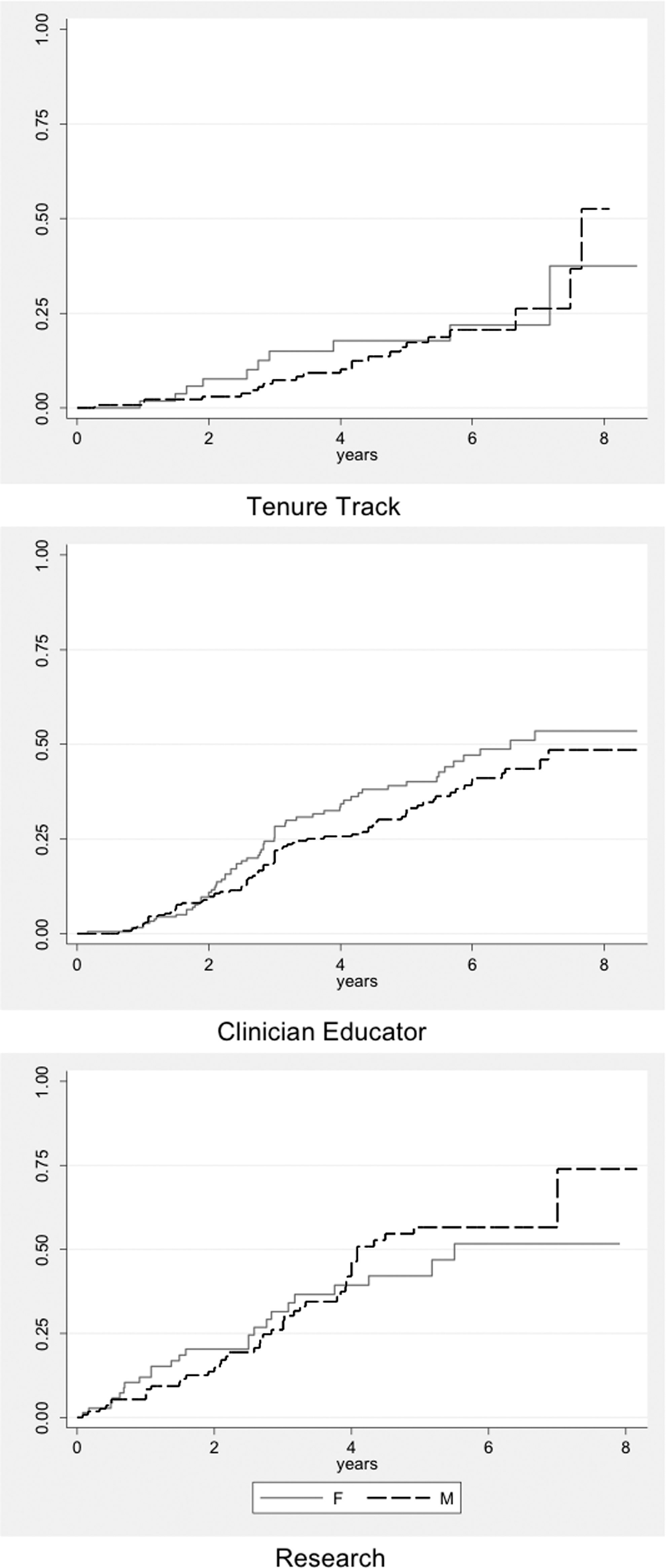
Time to departure by track and gender.
Reference group.
CI, confidence interval; HR, hazard ratio.
Discussion
The purpose of this study was to determine the rate of attrition and evaluate independent risk factors for departure in a cohort of newly hired junior faculty at a research-intensive school of medicine. Tenure track faculty experienced longevity, whereas individuals appointed on the CE and research tracks had significantly increased risks for departure. The risk of departure was increased for women compared to men faculty in the CE track, the largest track of faculty and the track with the greatest number of women.
The explanation for the higher risk of departure for individuals on the CE track cannot be determined from our data. However, evidence in the literature about faculty with significant clinical commitments can provide some context. In a qualitative study of 96 faculty from five medical schools, many faculty described institutional behaviors that led them to conclude their academic medical center undervalued excellence in clinical care and their social and educational missions. 15 Incongruence between individual and institutional values was seen across gender, career stage, race, and discipline, and female leaders appeared more likely than male leaders to identify this misalignment. Grigsby and Thorndyke 16 point to the need to formulate a discrete definition of clinical scholarship allowing for greater recognition and reward of faculty with substantial clinical responsibilities in the promotion and tenure process.
In addition, academic medical centers have come to depend, more than ever before, on clinical revenue margins to support the research, education, and service missions. 17,18 Increased demand for intense clinical productivity has changed the academic environment for most CE track faculty, leaving little to no discretionary time for scholarship unless supported by external grants for clinical release time. In turn, a competitive grant-funded career is not easily managed without the protected time afforded by tenure track startup packages and singular focus of tenure track positions. 19,20 This catch 22 is challenging for CE track faculty to navigate. When layered on a background of rigorous promotion publication expectations and a finite up or out promotion period, the competing demands of increasing clinical productivity and competitive grant requirements to buy scholarship time become difficult to reconcile for even the most talented faculty. We doubt that this dual squeeze will be sustainable for most faculty and wonder if this will lead many medical schools to gravitate to a track system where faculty are either almost exclusively research or clinical, with a disappearance of faculty who divide their time more equally.
The risk of departure for research track faculty in the present study was highest among the three tracks. An internal review of this track in 2005 found some ambiguity around the expectation of research independence vs. collaboration, and this confusion may have contributed to higher faculty turnover, although we could not specifically investigate this hypothesis in the current study. There continues to be discussion about the definition of collaborative research achievements and their value in traditional research-oriented promotions. This is clearly an area of active debate, with increasing appreciation for the individual contributions that play a key role in multidisciplinary and collaborative research. Unfortunately, when promotion criteria are in evolution, faculty can get caught in shifting expectations that are not intentional but are, nonetheless, difficult to manage.
The higher departure rate of the CE and research track faculty may also be due to differences in mentoring. An internal faculty survey of assistant professors, conducted in 2003, found satisfaction with mentoring differed by appointment track (p=0.0002). 21 On a 10-point scale, satisfaction with mentoring was highest for tenure track (mean 7.4, SD 2.4) and lower for the CE (mean 6.3, SD 2.9) and research tracks (mean 6.0, SD 3.2) and, thus, was associated with greater job satisfaction and less expectation of leaving the institution within the next few years.
Although the present study found women in the CE track experienced an increased risk of departure compared to men, attrition was similar for men and women overall. Data on such important potential factors as child and family obligations, 22 dual career marriage or partner relationships, 23 mentoring experiences, 7 salary and compensation, 24 and unconscious bias 25 were unavailable for analysis and may contribute to understanding our results. Additional data collection would aid in exploring these questions.
Difficulty balancing work and family is a risk factor for seriously considering leaving an institution. 4,26 Our data suggest that the additional flexibility afforded by use of an extension of the probationary period is protective against departure, a 64% reduced risk. From the onset of this study in 1999 up until 2006, this extension did not occur automatically but was requested in writing by the faculty member and approved by the chair and the provost. Despite that, one third of women and one fifth of men in this study cohort used the policy, indicating interest and usefulness for both women and men. Since 2006, however, this process has become more of a right than a request, and a simple form is transmitted to the provost's office with the expectation of approval unless compelling factors require its denial. In addition, when the dean solicits letters from outside reviewers for promotion, it is now explicitly stated that the candidate has taken an approved extension and that the productivity should be evaluated as if the probationary period were of normal duration, making sure that the candidate is not penalized for having received the extension. We believe that these changes have led to even further use and acceptance of this policy in enhancing the family-friendly culture of our institution. Conversely, taking a leave of absence was associated with a nearly 10-fold increased risk of departure. Of the 9 (1%) individuals who took a leave of absence, 6 departed. Use of the other available work-life policy, a reduction in duties, was also associated with a significant increased risk of departure, although also used by only 9 (1%) individuals.
Strengths of our study include the size of our cohort, individual level data on demographic and other factors, and the longitudinal design. One limitation is the restricted amount of follow-up time. In 8.5 years of follow-up (median of 3.55 years), 7% of the cohort had been promoted, and 61.5% of the sample were labeled as continuing. With additional follow-up time, it is possible that the rate of departure in the research track may become more comparable, or it could end up being higher because of their shorter probationary period. Regardless, additional follow-up would strengthen this study. Another limitation is the use of data from a single institution. It is unknown how our faculty track appointments and available work-life policies compare to those at academic medical institutions across the country.
Conclusions
Our findings demonstrate that a longitudinal analysis of assistant professor faculty can uncover risk factors for departure. This approach can guide institutional efforts to explore solutions supportive of all faculty, with individualization by track and gender. Our data suggest work-life policies, such as extension of the probationary period, should be widely publicized and considered by all faculty who qualify for their use. Infrequent use of other work-life policies, such as reduction in duties and leave of absence, should be explored and their impact measured. Institutional efforts to retain talented, newly hired junior faculty will save intellectual capital and faculty turnover costs, maximizing an institution's return on investment and allowing academic medicine to attract the best and brightest new generation of medical school faculty.
Footnotes
Disclosure Statement
The authors have no actual or potential commercial or financial disclosures to report.