




Abstract
The Centers for Disease Control and Prevention's Screen for Life: National Colorectal Cancer Action Campaign works with the Entertainment Industry Foundation's National Colorectal Cancer Research Alliance to develop public service announcements (PSAs) featuring celebrities. Selection of Screen for Life celebrity spokespersons is based on a variety of factors, including their general appeal and personal connection to colorectal cancer. Screen for Life PSAs featuring celebrities have been disseminated exclusively through donated media placements and have been formatted for television, radio, print, and out-of-home displays such as dioramas in airports, other transit stations, and shopping malls. A 2012 national survey with women aged 50–75 years (n=772) investigated reported exposure to Screen for Life PSAs featuring actor Terrence Howard. In total, 8.3% of women recalled exposure to the PSAs. Celebrity spokespersons can attract the attention of both target audiences and media gatekeepers who decide which PSAs will receive donated placements.
Introduction
A
The Centers for Disease Control and Prevention's (CDC) Screen for Life: National Colorectal Cancer Action Campaign (
Recruitment of Celebrity Spokespersons
In 2004, CDC began working with the National Colorectal Cancer Research Alliance (NCCRA), a program of the Entertainment Industry Foundation, and its cofounder, Katie Couric, to engage celebrities to appear in Screen for Life PSAs. CDC has developed PSAs featuring Ms. Couric and actors Morgan Freeman, Terrence Howard, Diane Keaton, Jimmy Smits, and Meryl Streep. Screen for Life PSAs featuring celebrities have been produced for television, radio, print, and out-of-home displays (e.g., in transit stations and shopping malls). While CDC continues to develop and promote non-celebrity PSAs, more than half of Screen for Life PSAs currently in circulation feature celebrities.
The selection of potential celebrity spokespersons is a highly collaborative process in which staff from both CDC and NCCRA identify celebrities who appeal to a broad audience, are widely recognizable, and are credible to men and women aged 50 years and older. Celebrities are identified based on these factors, as well as their own personal connection to people affected by colorectal cancer.
Once a short list of potential spokespersons is developed, NCCRA begins speaking with the selected individuals or their representatives. A critical element of securing celebrity participation is producing high-quality materials. CDC hires top-tier film and production crews. Existing Screen for Life PSAs are often shared with potential spokespersons to provide an assurance of production quality. After a celebrity consents to be featured in a Screen for Life PSA, CDC and NCCRA develop a creative approach and script, while working closely with the celebrity or his or her representatives to resolve scheduling and logistical issues.
The amount of on-set time that celebrities have donated to Screen for Life has ranged from one hour to one day. CDC and NCCRA strive to fully understand the needs, constraints, and expectations of each celebrity well in advance of the production day, to ensure that all intended production elements (e.g., video and audio recordings, still photography, etc.) are completed within the allotted time.
Recall Study
In 2012, Screen for Life explored U.S. women's recall of PSAs that featured actor Terrence Howard discussing his mother's death from colon cancer and urging others to get screened. The PSAs featuring Mr. Howard were released in April, 2009, and included television, radio, print (Fig. 1), and out-of-home display formats. The Howard PSAs were disseminated to the public exclusively through media placements that were donated (non-paid advertising). The television PSAs were distributed to 5,000 stations in all 210 U.S. media markets, as well as national networks and national, regional, and local cable systems. Radio distribution was to 3,000 stations that target older adults, as well as stations targeting African-American and Hispanic audiences. Print distribution included approximately 2,000 magazines and 5,500 daily and weekly newspapers nationwide. Out-of-home-displays were sent to shopping malls, airports, and transit authorities for installation on the sides of public buses, in transit stations, and in other locations. It should be emphasized that not all media outlets that received the Howard PSAs choose to donate placements to them.

Screen for Life print public service announcement featuring actor Terrence Howard. Free copies of Screen for Life public service announcements and consumer education materials can be ordered or downloaded online (at
Methods
The HealthStyles Fall survey 5 is an annual survey conducted by Porter Novelli (Washington, DC) that explores the health behaviors and attitudes of U.S. adults. The 2012 HealthStyles Fall survey was administered online from September 21 through October 5. Participants were recruited from the KnowledgePanel®, a 50,000-member research panel that is representative of the U.S. population. Panel members were randomly recruited by probability-based sampling, using both random-digit dial and address-based sampling methods to reach respondents regardless of whether they have landline phones or Internet access. If needed, panel members were provided with laptop computers and Internet access so they could take part in the survey.
The 2012 HealthStyles Fall survey was sent to a random sample of 4,371 panel members aged 18 years or older who responded to an earlier linked survey (HealthStyles Spring survey). A total of 3,503 participants took part in the survey, for a completion rate of 80.1%. However, the analyses reported here were limited to women aged 50–75 years with no history of colorectal cancer or polyps (N=772).
To protect participant confidentially, no individual identifiers were included in the dataset received by investigators. As a result, analyses of the HealthStyles dataset were declared exempt by the Centers for Disease Control and Prevention's Institutional Review Board.
Survey participants were asked whether and how often in the past year they had seen or heard an advertisement in which actor Terrence Howard talks about his mother's death from colon cancer. Those who reported exposure were also asked where they had seen the advertisements and what organization had sponsored them. The response options offered were those listed in Table 1.
Data were weighted to match 2012 U.S. Census estimates for age, household income, race/ethnicity, educational attainment, and geographic region.
Responses do not sum to N=772 due to missing responses.
Includes responses of “once,” “2–3 times,” “4–9 times,” and “≥10 times.”
Only participants who reported exposure to Terrence Howard PSAs during the last 12 months responded to these items (n=64); however, one respondent did not answer the media of exposure item (n=63). Multiple responses were accepted.
Investigators calculated unweighted and weighted proportions (matched to 2012 U.S. estimates on age, household income, race/ethnicity, educational attainment, and geographic region) for demographic characteristics, frequency of exposure to Screen for Life PSAs featuring Mr. Howard, media of exposure, and reported sponsoring organization. Exposure to the Howard PSAs was dichotomized (≥1 exposure vs. never exposed/not sure) and was compared by respondent race/ethnicity and age using Pearson chi-squared tests.
Results
In total, 8.3% of women recalled having seen or heard Screen for Life PSAs featuring Mr. Howard (Table 1). Reported exposure differed significantly by race: black, non-Hispanic (20.0%); white, non-Hispanic (5.6%); other, non-Hispanic (10.0%); and Hispanic (1.9%) (chi-squared=29.92, df=3, p<0.001) (Fig. 2). Reported exposure also decreased steadily with age, but these differences were not significant: 50–59 years (9.5%), 60–69 years (7.6%), and 70–75 (5.5%) (chi-squared=1.674, df=2, p<0.433) (results not shown).
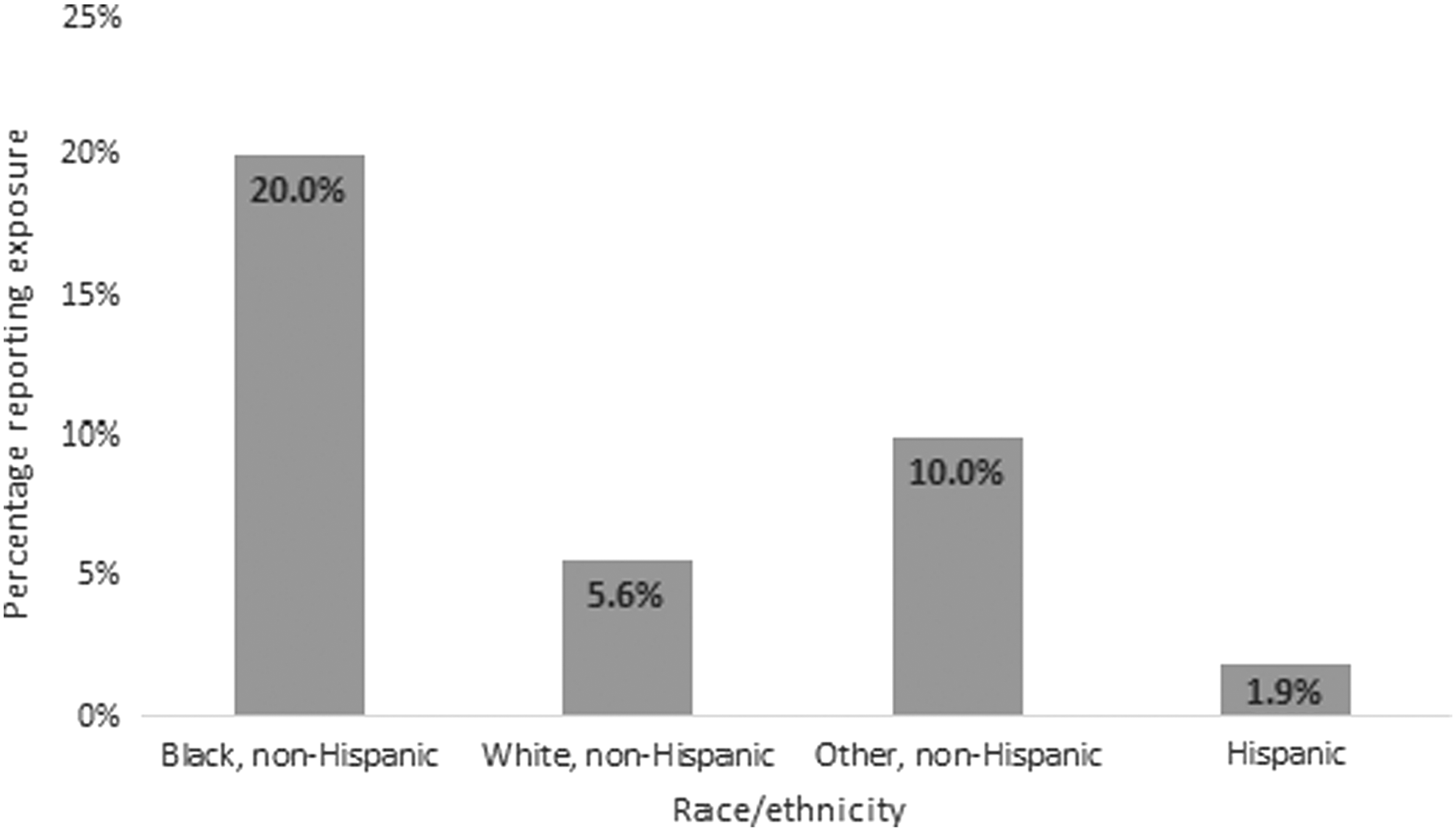
Reported exposure to Screen for Life public service announcements featuring actor Terrence Howard by race/ethnicity, U.S. women aged 50–75 years, HealthStyles Fall Survey, 2012 (n=772). Data were weighted to match 2012 U.S. Census estimates for age, household income, race/ethnicity, educational attainment, and geographic region.
The most common frequency of exposure was 2–3 times (4.6% of participants; 55.4% of those reporting exposure, data not shown), and the most common media of exposure was television (87.1% of those reporting exposure). Among women who reported having seen or heard Howard PSAs during the last 12 months, most (73.8%) were unsure what organization had sponsored them, and 20.3% attributed them to the American Cancer Society, rather than Screen for Life or CDC.
Discussion
Celebrity spokespersons can attract the attention of both target audiences and media gatekeepers who decide which PSAs will receive donated placements. Celebrities with a personal connection to a disease can be especially persuasive. Katie Couric's efforts to promote colorectal cancer screening following her husband's death from the disease were associated with a significant increase in colonoscopy use. 6 Similarly, endorsements from celebrities with a personal connection to cancer have also been found to increase the likelihood of mammography screening and prostate-specific antigen testing. 7 PSAs featuring celebrities may be especially compelling to women. Areas of the human brain involved in processing emotional stimuli were found to be more active when women saw advertisements featuring celebrities than when they were shown comparable non-celebrity advertisements. 8
In the present study, more than 8% of women in the target audience (aged 50–75 years) recalled exposure to Screen for Life PSAs featuring Terrence Howard. This result was achieved through the exclusive use of donated media placements. However, Mr. Howard is an Academy Award–nominated actor, and the PSAs included an exceptionally moving account of his mother's premature death at age 56. Further, Screen for Life is an established national campaign sponsored by a federal health agency. Thus, the reach of the PSAs in the present study may not be typical of donated-placement PSAs.
Recall of the Howard PSAs was higher among black, non-Hispanic women than among women of other racial/ethnic backgrounds. Mr. Howard is African American, as was his mother, and it is likely that the PSAs received more donated media placements in markets with substantial black populations, as media gatekeepers have reported giving preference to PSAs that are relevant to the community that they serve. 9 Also, black consumers have been found to have higher recall of advertisements that feature black actors than those with white actors. 10 Thus, the PSAs may have been more memorable to women who share the race of Mr. Howard and his mother.
Most participants who recalled the Howard PSAs could not remember the sponsoring organization. This is not entirely surprising, given that Screen for Life PSAs emphasize campaign messages rather than the Screen for Life or CDC brands. For instance, the logos of Screen for Life and its parent organizations—CDC and U.S. Department of Health and Human Services—are shown only briefly at the end of television PSAs and generally are not mentioned at all in radio PSAs.
Participants reported that television was the primary medium of exposure to the Howard PSAs, which is consistent with distribution data. In the 12 months preceding the study (September 2011–August 2012), Screen for Life television PSAs featuring Mr. Howard generated 79 million audience impressions (number of times seen), which represents the vast majority of exposure from all media during this time period.
While the study reported here was limited to women, Screen for Life PSAs are intended to appeal to both genders. The campaign will continue to produce a diverse mix of PSAs, including both celebrity and non-celebrity spots, in order to reach as broad an audience as possible.
Footnotes
Acknowledgments
The authors thank all of the Screen for Life celebrity spokespersons for donating their time to the campaign: Katie Couric, Morgan Freeman, Terrence Howard, Diane Keaton, Jimmy Smits, and Meryl Streep. We also thank Maurine Slutzky of the Entertainment Industry Foundation, for her many contributions to the production and distribution of Screen for Life celebrity PSAs, and Jennifer Chu of Ogilvy Washington, for her assistance with overall Screen for Life campaign planning.
The findings and conclusions in this paper are those of the authors and do not necessarily represent the official position of the Centers for Disease Control and Prevention.
Author Disclosure Statement
No competing financial interests exist.