




Abstract
Background:
Treatment of patients with stable angina and nonobstructive coronary artery disease (CAD) has not been well characterized. We comparatively evaluated medication use in males and females with stable angina with no CAD, nonobstructive CAD, and obstructive CAD.
Methods:
We studied all patients ≥20 years old with stable angina undergoing coronary angiography in British Columbia (BC), Canada, from January 2008 to March 2010 (n = 7,535). No CAD, nonobstructive CAD, and obstructive CAD were defined as 0%, 1%–49%, and ≥50% luminal narrowing in any epicardial coronary artery, respectively. Medication use, 3 months before and 3 months following angiography, was obtained through BC PharmaNet for angiotensin-converting enzyme inhibitors (ACE-I), angiotensin receptor blockers (ARBs), calcium channel blockers (CCBs), beta-blockers, statins, antiplatelet agents, and prescriptions for all three ACE-I/ARBs, beta-blockers, and statins (combination therapy).
Results:
Following angiography, patients with no and nonobstructive CAD had significantly lower rates of prescription use of all medications, including combination therapy, than patients with obstructive CAD (p < 0.001). Use of ACE-I/ARBs, beta-blockers, statins, and combination therapy did not differ by sex, but females had higher use of CCB in all CAD groups, and clopidogrel in nonobstructive and obstructive CAD groups, compared to males.
Conclusions:
In patients with stable angina, medication use following angiography is low in nonobstructive CAD with only 58.9% prescribed a statin and 19.4% on combination therapy at 3 months. There are no important sex differences in medication use in any CAD category post-angiography. Future studies should explore methods of improving quality of care in patients with nonobstructive CAD.
Introduction
E
Current Canadian guidelines do recommend use of medications in patients with stable CAD. The 2014 Canadian Cardiovascular Society (CCS) guidelines for the diagnosis and management of stable ischemic heart disease (SIHD) 11 recommends the use of beta-blockers or long-acting calcium channel blockers (CCBs) in patients with stable angina; these guidelines recommend that beta-blockers are first-line therapy for chronic stable angina if the patient has a history of MI, heart failure (HF), or a reduced ejection fraction. These guidelines also recommend the use of an antiplatelet agent in anyone with SIHD. Furthermore, beta-blockers are recommended in all patients with SIHD and left ventricular systolic dysfunction and an angiotensin-converting enzyme inhibitor (ACE-I) or angiotensin receptor blocker (ARB) in all patients with SIHD who also have hypertension, diabetes, left ventricular ejection fraction of <40%, or chronic kidney disease unless these medications are contraindicated. The CCS guidelines do not differentiate between angiographic findings of obstructive or nonobstructive CAD and focus on management of SIDH, which is a clinical diagnosis. In addition, the CCS 2016 guidelines for the management of dyslipidemia for the prevention of cardiovascular disease in the adult 12 recommend the use of a statin in all patients with angina pectoris or documented coronary disease by angiography with >10% stenosis.
Prior studies on medical therapy in nonobstructive CAD suggest that prescription rates of individual cardiac medications such as beta-blockers, ACE-I, ARBs, CCBs, statins, aspirin, and antiplatelets such as clopidogrel are all lower in patients with nonobstructive CAD than obstructive CAD. 1,3,4,7,13 These studies were limited, however, in that they did not differentiate stable angina from acute coronary syndrome, 13 used older data, 4,7,13 and/or did not report on medication use by sex. 3,4,13
To provide further insight into the pharmacologic treatment of patients with no CAD, nonobstructive CAD, and obstructive CAD in British Columbia (BC), Canada, we evaluated medication use in males and females with stable angina 3 months before and 3 months after diagnostic coronary angiography stratified by extent of CAD. We hypothesize that patients with nonobstructive CAD will have lower cardiac medication usage following angiography when compared to patients with obstructive CAD and that females will be treated with less medication than males irrespective of CAD severity.
Methods
Study population
We studied all patients ≥20 years old with stable angina undergoing coronary angiography from January 1, 2008, to March 31, 2010, in BC, Canada. Figure 1 illustrates patient selection and composition of the study cohort. Patients were identified using the population-based Cardiac Services BC (CSBC) Registry (cardiac procedures and patient's clinical and demographic characteristics) and then their records were linked with the BC Hospital Discharge Abstract Database (hospitalization admissions), BC Vital Statistics (death records), and BC PharmaNet (prescription records). Medication use focused on cardiac medications, including ACE-I, ARBs, CCBs, beta-blockers, statins, and antiplatelet agents, obtained for 3 months before angiography and 3 months following angiography. We chose these medications as ACE-I/ARBs, beta-blockers, and statins are evidence-based therapies for CAD, 14,15 CCBs are commonly used to treat stable angina, and antiplatelets (such as clopidogrel) are used as alternatives to aspirin in aspirin allergy or postpercutaneous coronary intervention.

Patient selection and study cohort.
Patients were excluded if they had a history of MI as this would be a clear indication for cardiac medications regardless of the angiography results. Only patients surviving for 3 months postangiography were included in the analysis.
Ethics approval was obtained from the University of British Columbia Clinical Research Ethics Board.
Definitions
Stable angina was defined as the indication for angiography within the CSBC Registry before the results of angiography being known. No CAD, nonobstructive CAD, and obstructive CAD were defined as 0%, 1%–49%, and ≥50% luminal narrowing in any epicardial coronary artery, respectively, as identified by the CSBC Registry. The level of stenosis was defined by the angiographer at the time of the angiogram with no quantitative core laboratory assessment. History of CAD was defined as a previous diagnosis of CAD or MI. Prior medication use was defined as at least one filled prescription within 3 months before angiography. Similarly, postmedication use was for a filled prescription 3 months postangiography discharge. In addition to evaluating individual medication use, we also evaluated filled prescriptions for all three medications, including ACE-I/ARBs, beta-blockers, and statins (combination therapy). We evaluated combination therapy use because prior studies on obstructive CAD have shown significant improvements in quality of life, angina frequency, and reduction in major cardiac events with concomitant use of all three medications. 14,15 While combination therapy has not been studied specifically in nonobstructive CAD, recent guidelines support prevention, angina control, and risk factor management with these medications. 11 Aspirin use was not evaluated because it is commonly obtained without a prescription (i.e., over-the-counter).
Statistical analyses
Categorical baseline characteristics were summarized as frequencies and percentages. The comparison between sexes and between CAD types was done using either the chi square test or Fisher's exact test. Any cells with five or less observations were suppressed to protect patient confidentiality. Age was summarized using mean and standard deviation (SD) and tested for differences with a Student's t-test. Chi square tests were conducted to test for differences by sex and extent of CAD in prior, after, and changes in medication use. Logistic regression models were used to assess the interaction between sex and extent of CAD on medication use postangiography for combination therapy, ACE-I/ARBs, beta-blockers, and statins (Model 1). If the interaction was not statistically significant (p > 0.05), the interaction was removed from the model, retaining sex and the extent of CAD as main effects only. To further examine the impact of sex and extent of CAD on postmedication use, clinically selected confounders, age, and prior medication use were included in the multivariable logistic regression model (Model 2). Age was categorized as [20, 55], [56, 65], [66, 75], and >75 years since the linearity assumption for age was not satisfied. Estimated odds ratios (OR) and 95% confidence intervals were reported for the factors in the logistic models. Statistical analyses were performed using SAS software, version 9.4 (Cary, NC).
Results
Patient selection and study cohort
From the 15,058 BC patients who underwent a diagnostic catheterization from January 1, 2008, to March 31, 2010, 931 cases (6.0%) were excluded. The excluded cases comprised patients with missing angiographic details (n = 303), missing sex (n = 1), MI diagnosis within a year before angiography (n = 257), and those who died within 3 months postdischarge date (n = 370). Of the remaining 14,127 patients, we selected 7,535 stable angina patients. The flowchart describing the derivation of the study cohort is shown in Figure 1.
Baseline characteristics
Of the 7,535 patients, 64.9% had obstructive CAD, 14.4% had nonobstructive CAD, and 20.6% had no CAD. Nearly 36.0% of females had no CAD compared to 13.0% of males (p < 0.001). Females also had a significantly higher proportion of nonobstructive CAD compared to males (19.0% vs. 12.1%); males had a significantly higher proportion of obstructive CAD compared to females (74.8% vs. 45.3%), p < 0.001.
Baseline characteristics for the study cohort, stratified by extent of CAD and by sex, are shown in Table 1. Patients with obstructive CAD were older than and had more comorbidities, including diabetes (p < 0.001), renal disease (p = 0.045), peripheral vascular disease (p < 0.001), and HF (p = 0.002) than patients with no CAD or nonobstructive CAD. Table 1 shows females were significantly older than males in all CAD categories: [median (IQR): no CAD 61 (14) vs. 58 (15), p < 0.001; nonobstructive CAD 68 (14) vs. 63 (14), p < 0.001; obstructive CAD 69 (15) vs. 66 (14), p < 0.001]. Females had higher rates of diabetes in all three CAD groups, but were significantly higher only in the obstructive CAD group (26.6% of females compared to 22.6% of males, p = 0.005). Furthermore, females had higher rates of COPD in the obstructive CAD group (p = 0.02). Otherwise, there were no other significant sex differences within the CAD strata.
All testing based on chi square test unless otherwise noted.
Student's t-test.
Fisher's exact test.
CAD, coronary artery disease; COPD, chronic obstructive pulmonary disease; CVA, cerebrovascular disease; HF, heart failure; MI, myocardial infarction; PVD, peripheral vascular disease; SD, standard deviation.
Medication use
Prior and postmedication use is reported in Tables 2 and 3, respectively. Before angiography, for all medication categories, including combination therapy, patients with no CAD and nonobstructive CAD had significantly lower rates of prescription use than patients with obstructive CAD (all p < 0.001). ACE-I/ARB and statin use did not differ by sex, irrespective of extent of coronary stenosis. Females had higher use of beta-blockers in both the no CAD (47.2% vs. 41.7%, p = 0.03) and obstructive CAD groups (58.2% vs. 53.8%, p = 0.01), and higher CCB use in both the no CAD (23.4% vs. 18.2%, p = 0.01) and nonobstructive CAD (31.7% vs. 25.0%, p = 0.01) groups. In addition, a higher percentage of females than males were on combination therapy for both the no CAD (14.2% vs. 10.6%, p = 0.03) and obstructive CAD (25.7% vs. 22.2%, p = 0.02) groups.
ACE-I, angiotensin-converting enzyme inhibitors; ARBs, angiotensin receptor blockers; CCBs, calcium channel blockers; combination therapy, ACE-I/ARBs + Beta-blockers + Statins.
Following angiography, in all medication categories, including combination therapy, patients with no CAD and nonobstructive CAD had significantly lower rates of prescription use than patients with obstructive CAD (all p < 0.001). Among the nonobstructive CAD group, only 59.2% of females and 58.7% of males were on statins, 54.6% of females and 53.3% of males were on ACE-I/ARB, 41.9% of females and 40.3% of males were on beta-blockers, and 19.8% of females and 19.1% of males were on combination therapy (Table 3). Regarding sex differences, more females than males were on CCBs, irrespective of extent of coronary stenosis: no CAD (22.6% vs. 17.6%, p = 0.02); nonobstructive CAD (31.0% vs. 24.0%, p = 0.01); and obstructive CAD groups (38.3% vs. 27.7%, p < 0.001). In addition, more females compared to males in the nonobstructive CAD (7.7% vs. 4.6%, p = 0.03) and obstructive CAD groups (53.7% vs. 48.7%, p = 0.003) were on clopidogrel after angiography. Medication changes following angiography are shown in Figure 2. More patients with obstructive CAD initiated medication use in all medication categories than patients with no CAD or nonobstructive CAD (p < 0.001). Regarding sex differences, significantly more males than females were found initiating ACE-I/ARB (p = 0.05) and beta-blocker use (p < 0.001) in the obstructive CAD group.

Medication change by CAD status and sex in stable angina patients.
The interaction term between sex and the extent of CAD for the use of any medication group, including combination therapy (p = 0.59), was not significant (ACE-I/ARB: p = 0.34, beta-blocker: p = 0.41, statins: p = 0.61). The OR for medication use postangiography for factors included in Model 1 (adjusting for sex and CAD status only) and Model 2 (additionally adjusting for prior medication use and age) are shown in Figure 3. In Model 1, no sex differences in medication use were found for any of the following: combination therapy, ACE-I/ARBs, beta-blockers, or statins. Subjects in the no CAD and nonobstructive CAD groups were significantly less likely to use all medications, including combination therapy, than the obstructive CAD group. In Model 2, even after adjusting for potential confounders, no sex differences in medication use were found for any of the medication groups. As well, lower prescription of all medications persisted among the no CAD and nonobstructive CAD groups compared to the obstructive CAD group. In all medication groups, prior medication use was the strongest predictor of postmedication use.
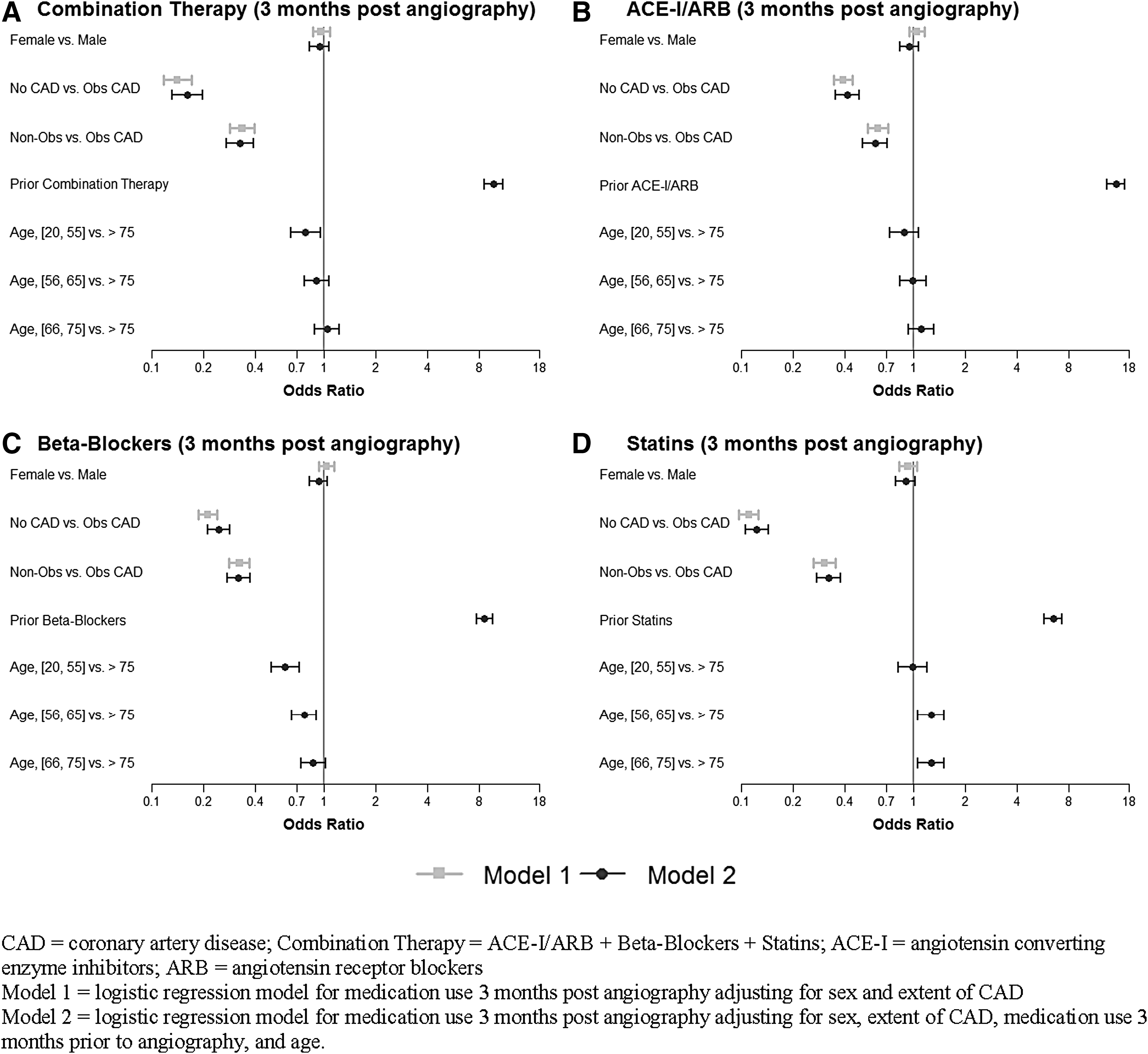
Odds ratios for medication use 3 months postangiography in stable angina patients.
Discussion
In patients undergoing coronary angiography for stable angina, medication use, including statins, ACE-I/ARBs and combination therapy, following angiography is significantly lower in nonobstructive CAD at 3 months compared to patients with obstructive CAD. Angiographic evidence of obstructive disease was associated with the greatest increase in medication use, post-angiography. However, prior medication use was the strongest predictor of medication use postangiography, irrespective of extent of CAD. Reassuringly, there were no significant sex differences in prescription use after angiography irrespective of CAD status aside from CCBs, which were prescribed more in females irrespective of extent of CAD, and clopidogrel, which was prescribed more in females with nonobstructive and obstructive CAD.
Evidence from the National Heart, Lung, and Blood Institute-sponsored Women's Ischemic Syndrome Evaluation (WISE) suggests that women with angina and nonobstructive CAD have an adverse prognosis with a 2.5% per year rate of major adverse cardiovascular events (hospitalization for acute coronary syndrome, HF, stroke, or cardiovascular death). 1,2,4 Recent evidence extends these findings to men. 6 Furthermore, Sharaf et al. demonstrated that a WISE CAD severity score, a measure of coronary atherosclerotic burden, was a useful predictor of adverse outcomes in women with nonobstructive CAD. 4 Cumulative 10-year cardiovascular death or MI rates showed progressive, near-linear increases across the severity score ranges of 5, 5.1–10, 10.1–20, 20.1–50, and >50. Furthermore, Maddox et al. demonstrated that even within a cohort of patients with angiographically nonobstructive CAD, increasing severity of stenosis correlated with an incremental increase in all-cause mortality. 6 These data suggest that these patients may benefit from cardiac medications. Furthermore, current guidelines for SIHD and for dyslipidemia both recommend therapy as discussed above.
Prior studies support the finding of lower prescription rates in nonobstructive CAD compared to obstructive CAD. These studies were limited, however, by the lack of differentiation between stable angina and acute coronary syndrome, 13 the use of older data, 4,7,13 and/or failure to report medication use by sex. 3,4,13 Sharaf et al. investigated 917 women with signs and symptoms of ischemia referred for clinically indicated angiography over a median of 9 years between 1996 and 2000. 4 They reported lower medication use postangiography in patients with no CAD or nonobstructive CAD compared to obstructive CAD, particularly with regard to aspirin and beta-blockers (p < 0.05). The likelihood of receiving a statin at a 1-year follow-up was 12%, 33%, and 53% for no CAD, nonobstructive CAD, and obstructive CAD, respectively (p < 0.0001).
Johnston et al. reported on 12,200 patients with stable angina referred for coronary angiography from 2006 to 2008 using the Swedish Coronary Angiography and Angioplasty Register (SCAAR) 7 ; 50% of men and 51% of women with nonobstructive CAD were prescribed statins 6 months postangiography, whereas 93% of men and women with obstructive CAD received statins 6 months after their diagnosis. They examined sex differences and found that men were more frequently treated with ACE-I or ARB, while women were more frequently treated with beta-blockers and diuretics. CCB use increased postangiography mainly in women with both obstructive and nonobstructive disease. Maddox et al. examined prescription rates among 1,489,745 patients undergoing cardiac catheterization in 786 US centers between 2004 and 2007. 13 They too found lower rates of statin use (60% in nonobstructive CAD vs. 80.3% in obstructive CAD) and after multivariable adjustment, nonobstructive CAD patients remained significantly less likely to receive aspirin (OR = 0.37), statins (OR = 0.45), ACE-I/ARBs (OR = 0.83), and beta-blockers (OR = 0.46) compared to obstructive CAD patients. Finally, Jespersen et al. 1 examined 11,223 patients with stable angina referred for coronary angiography and found that only 45%–65% of men and 50%–71% of women with nonobstructive CAD were prescribed a statin compared to 77% of men and 76% of women with obstructive CAD.
Our results add to prior studies, in that we provide a contemporary analysis of a large Canadian cohort of both males and females with no CAD, nonobstructive CAD, and obstructive CAD. Our findings confirm the lower use of medications in both males and females with nonobstructive CAD. Possible reasons for this include under-recognition of the importance of treating nonobstructive CAD; in addition, previous guidelines during the time period of our study were less clear on the importance of medications in nonobstructive CAD. Based on current CCS guidelines, a beta-blocker or CCB and statins are indicated in all patients with angina pectoris. In addition, ACE-I or ARB should be used in patients with certain comorbidities 11,12 and statins are recommended in patients with nonobstructive CAD as per the CCS 2016 dyslipidemia guidelines. Based on these guidelines, there is an under-prescription of these medications in our cohort, especially in the nonobstructive CAD population.
Unlike Johnston et al., 7 we do not report any significant sex differences in beta-blocker, statin, or ACE-I/ARB use. These results may indicate an increased awareness over time that women with stable angina and both nonobstructive CAD and obstructive CAD have adverse outcomes similar to and in some cases worse than men. 5 Another explanation could be that these results represent Canadian practices. The higher CCB prescription use in females in our study may be due to the recognition that females have higher rates of hypertension and/or microvascular disease or coronary vasospasm as a cause for their stable angina (particularly with no CAD or nonobstructive CAD).
Limitations
Our study has several limitations. First, our data rely on a stable angina diagnosis submitted by the treating physician, which has inherent limitations, including misdiagnosis. Despite the clinical diagnosis of stable angina, there were a proportion of patients with no CAD on their angiography. This may represent a misdiagnosis with symptoms attributable to another disease within the respiratory or gastrointestinal systems, however, may also represent microvascular disease that is not identifiable on angiography or coronary vasospasm. Furthermore, it is known that comorbidity data such as hypertension, hyperlipidemia, and smoking rates are often underreported. These conditions could be indications for medication usage in patients without obstructive CAD that has not been adjusted for in our analysis. 16 Second, medication use is presumed given if the prescription for that medication was filled, however, we were unable to test or report on compliance. Furthermore, we were unable to report on or account for contraindications to medication use. Nevertheless, it is unlikely that medication use, given the prescription was filled, differs by sex or by extent of CAD. Third, we did not report on aspirin, as it is predominantly an over-the-counter medication in BC, rather than a prescription. Fourth, only patients who survived 3 months postangiography were included in our analysis. Finally, our study reports on a population in the province of BC and may not be generalizable to other locations.
Conclusion
In patients undergoing coronary angiography for stable angina, medication use following angiography is low in nonobstructive CAD with only 58.9% of patients prescribed a statin, 41.0% prescribed a beta-blocker, 53.9% prescribed an ACE-I/ARB, and 19.4% on combination therapy at 3 months. This is significantly lower than patients with stable angina and obstructive CAD, where >80% are prescribed statins, 65.0% ACE-I/ARBs, and >40% are on combination therapy. Reassuringly, there are no important sex differences in this contemporary data set. While primary and secondary prevention guidelines support the use of statin therapy, angina control, and risk factor modification in patients with nonobstructive CAD, clearly the uptake of these guidelines in practice is low. Currently, no guidelines exist specifically to address medical treatment of nonobstructive CAD, however, recent CCS 2016 dyslipidemia guidelines and CCS 2014 SIHD guidelines both support the use of statins and beta-blockers in all patients with stable angina and consideration for ACE-I or ARB with certain comorbidities. Future studies need to explore methods of increasing quality of care in patients with angina and nonobstructive CAD, postangiography.
Footnotes
Author Disclosure Statement
No competing financial interests exist.