




Abstract
Objective:
Women are under-represented in academia. Causative factors include challenges of career–family integration. We evaluated factors reflecting institutional culture (promotion, retention, hiring, and biasing language in promotion letters) as part of an intervention to help shift culture and raise awareness of flexibility policies at the University of California, Davis (UCD).
Materials and Methods:
Data on faculty use of family-friendly policies were obtained at baseline, and surveys for policy awareness were conducted pre(2010)/post(2013) an NIH-funded study educational intervention. Data on hires, separations, and promotions were obtained pre(2007–2009, 2234 person-year data points)/post(2010–2012, 2384 person-year data points) intervention and compared by logistic regression and for gender differences. Department promotion letters (53) were also analyzed for biasing language.
Results:
Policy use was overall low, highest for female assistant professors, and for maternity leave. Awareness significantly increased for all policies postintervention. Promotions decreased, likely because of increases in advancement deferrals or tenure clock extensions. Pre/postintervention, female and male hires were near parity for assistant professors, but female hires were substantially lower than males for associate (54% less likely, p = 0.03) and full professors (70% less likely, p = 0.002). Once hired, women were no more likely to separate than men. Fewer associate/full professors separated than assistant professors (p = 0.002, p < 0.001, respectively), regardless of gender. Language in promotion letters was not gender biased.
Conclusions:
We demonstrate a shift at UCD toward a culture of work–life flexibility, an environment in which letters of recommendation show very few biased descriptions, and in which assistant professor hiring is gender equitable. At the same time, a decrease in number of faculty members applying for promotion and an imbalance of men over women at senior hires independent of policy awareness may challenge the assumption that family-friendly policies, while promoting flexibility, also have a positive impact on professional advancement.
Introduction
A
Many causative factors have been suggested to account for the under-representation of women at the higher ranks of academic medicine and science. Our previous report and studies by others note the challenges that women face in establishing academic biomedical careers at a time when they may also be seeking to start or raise their families, a difficult challenge prompting many to drop out of academic careers. 6 –8 The landmark report from the National Academies of Science “Beyond Bias and Barriers” noted that increasing career flexibility could be an effective strategy in meeting these challenges to support academic careers for women. 9 Many medical schools have implemented flexible career policies to better support women faculty members during this critical career phase, including our own school, the University of California (UC), Davis School of Medicine (UCDSOM), which more than 10 years ago established policies for tenure clock extension, childbearing/adoption, part-time appointment, family/medical leave, parental leave, modified duties, and deferral of advancement (Table 1). 10,11 But clearly, the AAMC data on advancement illustrate that institutional practices do not appear to be sufficient to keep women in academic careers. 2
Our previously published studies have shown that awareness of family-friendly policies among faculty members has been low and that policy benefits are infrequently used. 7,8 We have reported that an educational intervention can successfully increase awareness that theoretically should increase use, allowing more faculty members to experience the benefits associated with policies, improving career development, and ultimately enabling more faculty members with family needs to achieve promotion. Our previously published studies also have demonstrated many barriers, other than lack of awareness, to using policies. Although women report more barriers than men do, both genders share many similar concerns. The most frequently reported barrier is perception of appearing uncommitted to career with 21%–33% of all generations and genders reporting this as a barrier. Likewise, substantial percentages of all generations and gender (20%–29%) report that burdening colleagues is a barrier to using policies. 7,8
The reported barriers surrounding perception of commitment to career and burdening colleagues likely reflect faculty concerns related to aspects of institutional culture, including expectations surrounding “the ideal worker,” a societal expectation that arose in the early 20th century, in which the worker (usually a man) is solely dedicated to his job and someone else (usually the wife) takes full responsibility for family and home. In recent decades, the concept of the ideal worker has been increasingly challenged in many industries as more women joined the workplace, but this challenge has come at a price. Joan Williams, a distinguished professor at the UC's Hastings School of Law, notes in her book Unbending Gender: Why Family and Work Conflict and What To Do About It, “women may choose not to perform as ideal workers, but they do not choose the marginalization that currently accompanies that decision.” 12 An example of this marginalization is “the flexibility stigma,” a term that describes the negative bias and consequences associated with working flexibly or accessing benefits associated with family-friendly policies. This stigma has been shown to have a substantial negative impact on salary and career advancement for both men and women who access flexible work policies. 13 –15 The flexibility stigma may be greatest for women because policies are most often utilized by women, and may be among the many microinequities referred to in “Beyond Bias and Barriers” that contribute to the lack of advancement and poor retention of women faculty members in science, biomedicine, and engineering. 9,16 –18 This stigma may take the form of bias by others who consciously or unconsciously believe that use of a flexibility policy reflects lack of commitment to career or burdens colleagues. Manifestation of this bias may include use of stigmatizing language in the letter of recommendation that the department chair writes for a faculty member's promotion, thereby negatively impacting advancement of policy users, particularly women, and negating the intended benefits that flexible career policies are meant to provide. Concern about negative stigmatizing bias in the promotion process may underlie why our faculty report that concerns about perception of women's commitment to career is a barrier to using career policies. Biasing language, such as doubt-raiser phrases, has been found in letters of recommendation written for faculty applying for positions at a large American medical school and occurred more in the letters written for women than for men. 19
In this report, we assess three factors that we believe illustrate the impact of career flexibility on the advancement of women medical faculty members: (1) frequency of promotions, separations, and hires, including by gender, after a 3-year intervention designed to increase awareness of our school's faculty family-friendly policies; (2) use of biasing language in department chair letters of recommendation used to support faculty merit and promotion actions 18 ; and (3) impact of an educational intervention on awareness of family-friendly policies. The overarching goal of our study is to identify potential metrics that can be used at our institution and others to monitor impact of flexibility policies and progress in achieving and sustaining a flexible work culture.
Materials and Methods
Faculty surveys
The data for this analysis come from the baseline survey from the first and final years (2010 and 2013) of a 4-year NIH-funded study to evaluate the awareness, knowledge, attitudes, and use of family-friendly policies, at the UCDSOM. A 53-item “Work, Family, and Satisfaction Survey” was utilized for this study and was adapted from a 125-item survey instrument that utilized survey domains and parameters based on the institution's prior Sloan award. Use of this instrument has been validated in more than 10,000 academic faculty members, and is available for unrestricted use from the Clear Picture Corporation in partnership with the Alfred P. Sloan Foundation. The survey was enhanced with additional demographic variables necessary for the analyses proposed. The survey utilized for these studies assessed faculty's experience with use and intention to use policies, awareness of options (leave for mothers/fathers, personal disability, tenure clock stoppage, deferral of advancement, and part time appointments), and barriers to use of policies as previously described 8 and briefly summarized in Table 1. In addition, the survey assessed faculty demographics including gender and age. The survey was constructed using Survey Monkey® and was administered electronically for a 3-week period in the spring of 2010 by e-mail to all faculty members in the SOM and again in the fall of 2013 to assess interval changes. Two e-mail reminders were sent to faculty members who had not yet completed the survey before the survey close date. Completion rates were tracked to minimize excessive reminders. Participation was voluntary and responses were confidential. The study and survey were approved by the IRB.
Intervention
Previous publications from our group have addressed overall gender differences in faculty satisfaction with career and work–life balance, gender–generation interactions, and the impact of the intervention utilized. 7,8,20 The intervention, an intensive campaign for awareness of family-friendly policies, has been detailed elsewhere. 21 In brief, we implemented a longitudinal intervention in the SOM, designed to accelerate the pace of change in knowledge and awareness of family-friendly policies and career flexibility at UCD. The accelerator intervention consisted of a comprehensive dedicated educational campaign designed to promote a flexible culture by (1) publicizing and promoting the program to all current and incoming faculty members, whether they had family care giving responsibilities or not, and to administrators and staff involved in the merit/review process; (2) accelerating the pace of implementation and awareness of policies that provide increased career flexibility, and that are friendly to women with family demands; (3) helping overcome negative pressures of family demands on women's careers; and (4) assisting women in a tangible way with managing and sustaining a career while attending to family, so that there is a direct and measurable impact on career success and advancement.
Our overall desire was to help shift the academic culture from one that views use of family accommodations as indicative of a lack of seriousness or drive to one that envisions career flexibility as a necessary component to the success of all faculty members. The educational campaign was multidimensional, sustained, iterative, and utilized multiple media. Key elements of the SOM campaign included grand rounds and formal presentations, print communications, and electronic communications. Annual assessment allowed an adaptive approach to target specific components of the policy or subgroups of faculty members and administrators and to increase awareness and decrease barriers.
Advancement data and letters
For the current analysis, our primary goals were to describe patterns of advancement and hiring and to assess whether there were changes after the introduction in fall, 2010, of the intervention, and determine whether they provided evidence of bias that faculty members may be concerned about experiencing when using flexibility policies. We analyzed summary data for two 3-year periods: 2007–2009 (preintervention) and 2010–2012 (postintervention). For each year, we had data on the outcome of advancement actions (merits and promotions) and separations for SOM faculty members already at UCD, and on new hires to UCD. Data were provided by the Provost's office. We were particularly interested in the impact of our intervention on women faculty, because family concerns may have an impact on their advancement and on their hiring decisions.
Since our work demonstrated an increase in the percentage of faculty members reporting concern about being perceived as less committed to career if they used flexibility policies (unpublished data), we chose to analyze the department letters of recommendation for faculty merit and promotion actions for the presence of biasing language. These letters are part of the standard academic advancement process at the UC and are written by the department chair or division chief. The department letter summarizes the candidate's qualifications and the department's recommendation. A previous report at another institution, examining more than 300 letters of recommendation for medical faculty in the 1990s, found that letters for women applicants differed systematically from those for men applicants in features including length of letter, specificity of descriptions, and “doubt-raising” statements used within the letters. 19 Since the UC system requires merit actions every 2 years for assistant and associate professors, and every 3 years for professors, 19 every faculty member in the school was eligible for a merit action during the 4-year study period. For this analysis, a random sample of redacted letters submitted for recent promotions was provided by the Office of the Dean for Academic Personnel in the SOM (n = 53 letters). The academic series (“faculty track”) of the subjects and the letters were representative of the distribution of the academic series of faculty within our school. The letters were not identified to the study investigators by sex of the candidate. We developed a coding scheme for the letters based on the report of Trix and Penska. 19 We pilot tested the scheme with a separate sample of letters predating the 53 letters. Each letter was reviewed and coded by a master's-level statistician (Y.L.) who did not participate in the conduct or analysis of the intervention, and a subset of letters was reviewed independently by author L.A.B. Letters were analyzed for potential indicators of bias as previously described, 18 including the following: overall length, minimal reassurance use of professional title, negative language, hedges (example: “despite his wife's illness …”), potential negatives, apparent commendation, inappropriate/irrelevant language, superlatives, “grindstone comments” (i.e., commenting on effort, such as “hard-working,” rather than on ability or accomplishment), stereotyping terms (examples for women: “caring,” “compassionate”), and number of repetitions of the term “research.”
Statistical analysis
The primary analytic goals were to describe the overall patterns of advancement and hiring. We had two sets of questions: question 1 (the primary question) dealt with advancements and separations and was asked among those already on the faculty: (1a) were there differences between men and women in likelihood of advancement or likelihood of separation—overall, by rank and by year; (1b) were there changes from the preintervention to postintervention period in proportions; and (1c) did the gender differences shift. Question 2 (the secondary question) dealt with hires: (2a) what happened with new hires, (2b) was the men-to-women ratio greater than 50% overall, and (2c) did that differ by rank and did it change over time (overall or by rank). We summarized the frequencies descriptively in cross-classified tables, overall and by year. We used logistic regression models to address questions 1 and 2. SAS Version 9.4 was used for all analyses. Although many of the faculty members had multiple observations in the advancement and separation data set, we did not have individual-level data linking faculty across years, so we were unable to adjust for repeated measures. Thus our effective sample size is likely smaller than reported and used in analysis, possibly leading to standard error estimates that are biased toward 0, and the true significance levels of the hypothesis tests and precision of confidence intervals may not be as high as reported hereunder.
For the primary question (analysis of advancement and separation data), we ran two sets of logistic regression models. Set 1: Outcome = advancement ( = 1 if advancement, 0 if separation or other). Predictors of the odds of advancement were rank, sex, and year (grouped as preintervention and postintervention) and newly hired (this identifies new or very recent hires, who may have lower odds of advancement in the short term). Reference categories were assistant professor, men, not hired, and preintervention. We first fitted separate univariate models for rank, sex, postintervention, and newly hired, then examined models with all four predictors. The final model included significant predictors from the combined model, as well as an interaction term to test whether the odds for advancement for women compared with those for men differed after the intervention (primary question). We then examined the effect of the same predictors on the odds of separation, using a parallel sequence of models.
For the secondary question (analysis of hiring data), analysis was performed and restricted to a total of 497 newly hired faculty members: 253 newly hired faculty members in preintervention years 2007–2009 and 244 newly hired faculty members in postintervention years 2010–2012. We fitted univariate logistic regression models, followed by a combined model, to estimate the odds of hiring a woman, and whether the odds differed by rank, year, and rank × year.
Potential indicators of bias in advancement letters were summarized descriptively, with frequencies and percentages for categorical indicators and with summary measures (mean, standard deviation [SD], and range) for numerical indicators.
The primary question of interest for policy use and awareness was whether there were significant changes in awareness of policies after the implementation of the educational intervention. Data on survey responses for study years 1 and 3 were not available for analysis in linked form, to comply with university restrictions regarding confidentiality, so analysis treated the data as unpaired. The survey coordinator, who had access for e-mail communication, reported a 76% overlap in respondents, so the estimated standard errors are likely underestimated. Awareness was scored on a scale of 1 (unaware) to 5 (completely aware) for each policy component in Table 1, and means were compared for study years 1 and 3 by two-sample t-test. Policy use was available only for the preintervention period and was reported as number and percentage; use by men and women was compared by Fisher's exact test for policies used by 10 or more individuals.
Results
Policy awareness and utilization
We determine use of flexibility policies by men and women in our school using data provided by the Dean's office for a 3-year period before the intervention, baseline period (2007–2009). Total policy use in our school was overall very low, depending on the policy, and was significantly higher for women faculty members than for men faculty members (6.7% vs. 0%, p < 0.001; Table 2a). No men in the SOM had documented use of any of the family-friendly policies offered by the school, whereas 19 women faculty members took maternity leaves with 1 also using the tenure clock extension. We found a significant increase in both overall and specific awareness of policies after the educational intervention (Table 2b).
Faculty series in the School of Medicine (SOM).
Ladder rank = tenure track. In residence = combined clinical and research series, may have tenure, expectation for external funding. Clinical X = primarily clinical series with expectations for creative work, typically clinical research. Adjunct = research series, no clinical service, no tenure. HSCP = hospital-based clinical practice, no expectation for research, clinician educator.
UCDSOM, University of California at Davis School of Medicine.
Advancements
We performed a pre and postanalysis of recruitment, promotion, and retention to identify any gender differences in these factors related to the educational intervention on awareness and use of family-friendly policies.
Descriptive summaries
The data set for advancement and separation included 2234 person-year data points for 2007–2009 and 2384 person-year data points for 2010–2012 (Table 3). The distribution across ranks was similar in both time periods, with a little less than a quarter of the faculty members being assistant professors, 35%–40% associate professors, and about 40% full professors. Women comprised about one-third of the faculty members during these years, with a higher proportion at the assistant professor rank (data not shown.) About one-third of the faculty-years included had a merit or promotion advancement over this period. There were 497 new hires over the 6-year period, roughly equally divided between preintervention and postintervention (Table 4), whereas there were only 143 separations. The hires, advancements, and separations for men and women faculty members before and after the intervention are summarized in Figure 1.
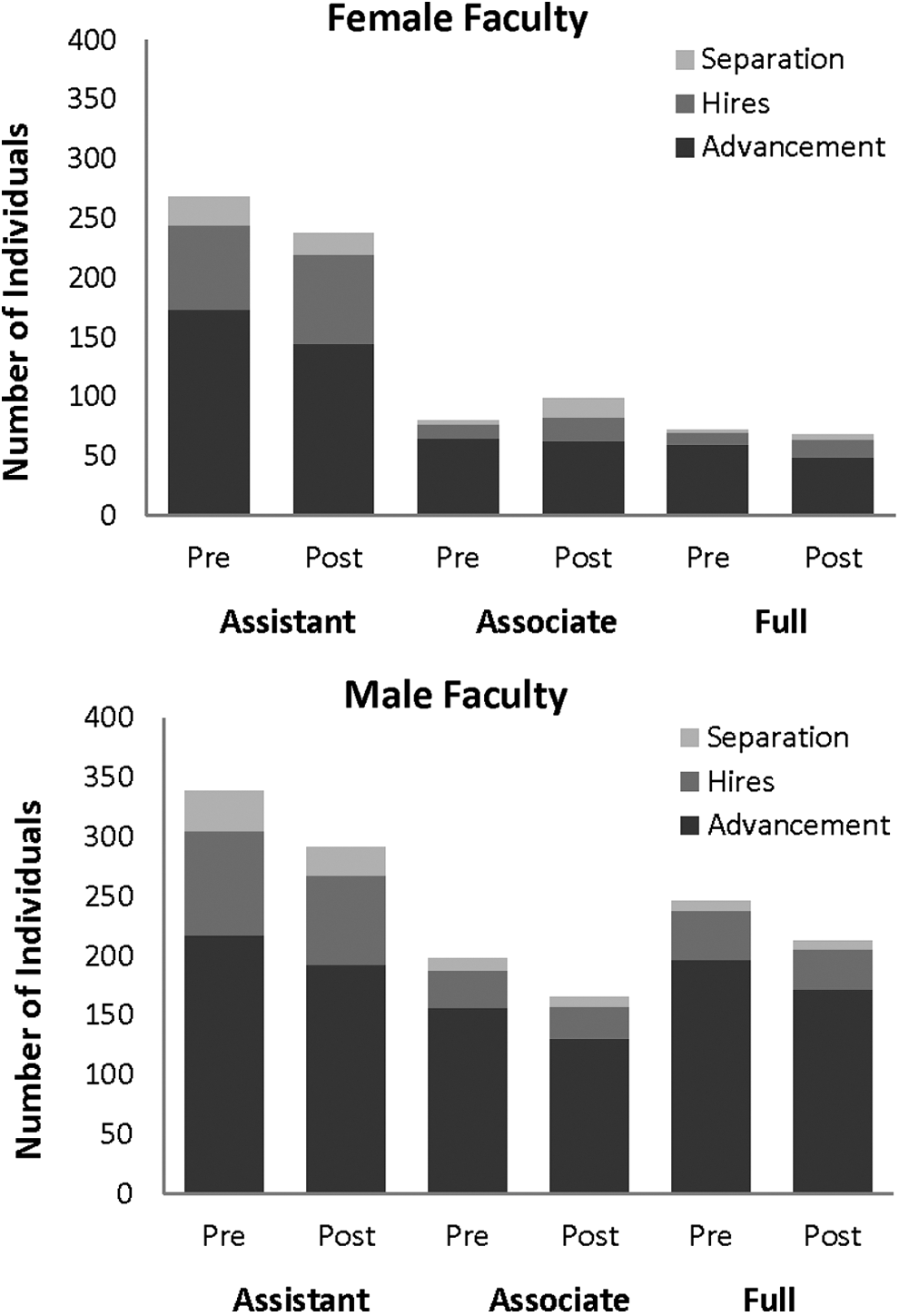
Faculty advancement, hires, and separations for men and women assistant, associate, and full professors. Preintervention years (2007–2009) versus postintervention years (2010–2012). See text for details.
One faculty member may contribute more than one person-year and, therefore, person-year totals may not match faculty totals in Table 2.
Merits and promotions
In any given year, after adjusting for other factors, full professors were 60% less likely to have an advancement (a merit or promotion action) compared with assistant professors. Advancement for associate professors was comparable with that for assistant professors (Table 5a). This reflects the merit schedule in the UC system, under which advancement is typically considered every 2 years at the earlier career levels (assistant and associate professor) and every 3 years at the full professor level. Newly hired faculty members had very little chance for advancement in the year of hire, as would be expected because the first merit advancement typically occurs in the second year (odds 89% lower, p < 0.001). There was no significant difference between women and men after accounting for rank and whether they were newly hired. There was a 26% decrease in the odds of successful advancement after the intervention (p < 0.001), with no significant difference between men and women, or between assistant and associate professors, in this decrease.
Separations
Faculty members who had attained the ranks of associate or full professors were far less likely to separate from the university than assistant professors (p = 0.002, <0.001, respectively), regardless of sex (Table 5b). There were no differences between women and men in the odds of separation (p = 0.51) and no difference between preintervention and postintervention in the gender ratio for separations. There was a slight reduction in separations in the postintervention period but it was not statistically significant compared with preintervention period.
Hires
Overall, about 40% of new hires were women, with near-equal numbers at the assistant professor rank. Compared with the odds of hiring a woman at the assistant professor level, the odds of hiring a woman were substantially lower at the associate professor rank (54% less likely that a new hire would be a woman, p = 0.03) and full professor rank (70% less likely that a new hire would be a woman, p = 0.002; Table 5c). After adjusting for rank of hiring, there was no difference after the intervention. The odds of hiring a woman remained significantly lower for associate and full professor ranks, and there was no change in this finding from preintervention to postintervention.
Advancement letters
We performed a “point in time” analysis of department promotion letters to assess for gender-biased language. Advancement letters were analyzed for 53 faculty members in 23 of the 24 SOM departments. Utilizing criteria described in Materials and Methods section, practices characterized as potentially biasing were rare in these letters (Table 6). All 53 letters contained specifics and evaluative comments, and all but 2 letters consistently used the professional title of the faculty member being advanced. Inappropriate comments, irrelevancies, commendations, and unexplained statements, all of which are considered to be potential biasing phrases by Trix and Psenka, had an overall frequency of only 2% (1 letter out of 53 letters). Doubt raisers were generally uncommon, although negative language was used in 15% of letters and hedges or potential negatives in 6% of letters. The letters were redacted by the Dean's office before analysis, including removal of references to gender identification, so we did not assess that explicitly. References to success and achievement were common in more than half of the letters and references to stereotypical women terms such as compassion or nurturing were less common in about a quarter of the letters, half of which also focused on success. Letters varied substantially in length and in how much emphasis was placed on research, the latter chiefly reflecting the research-intensive nature of the faculty member's academic series, and in degree of praise of the candidate. Thirty-eight percent of these letters were for users of policies and the remainder (62%) were for nonusers. However, given the low overall incidence of biasing language or content in the letters, comparison of policy users with nonusers was not performed.
SD, standard deviation.
Discussion
The high rate and the high cost of faculty turnover at U.S. medical schools have been previously well described. 22,23 Career choice, including the choice to leave academic medicine, has been shown to be influenced by a number of factors, including traditional sex roles, attitudes toward work and integration with family life, and others. 14,24,25 The implementation of career family-friendly policies by many medical schools represents efforts to address many of these factors that can negatively affect career trajectory and prompt a faculty member to leave or seek a career outside of academia. The adoption of policies is not enough to demonstrate a culture of flexibility, however, because policy effectiveness relies on policy use. Measuring culture is not easy, but we believe that faculty promotions, separations, and subsequent hires and the frequency of biasing language within letters written by department chairs for faculty promotions are measurable elements that reflect at least some facets of a school's culture. Our findings indicate a culture of gender neutrality in promotions and letters of recommendation, and that the availability of flexible options did not impact the hiring or promotion of women.
In our study, we noted an overall decline in promotions in our school during the period of the intervention. This decline occurred at all ranks and did not differ by gender. It is unclear why the rate of promotion dropped. It is possible that it was attributable to more faculty members starting to delay their tenure clock or promotion path, but because the rate dropped for men and women, yet women are more likely to use the policies, this may not be the explanation. As there was no increase in promotion denials or separations, this downward trend in promotion is likely because of more faculty members choosing to defer promotion or use tenure clock extensions, both of which are options among our school's career policies. Our intervention to accelerate awareness of policies likely influenced this phenomenon, because our previously published reports pointed out a substantial increase in faculty awareness of policies during the study period. 7 Data on deferrals and extensions were not available for our analysis, however, and thus limit a definitive conclusion. Given that our study period coincided with a period of growing limitations in federal research funding, we surmise that using flexible career policies for tenure clock extensions or deferrals was likely an important career safety valve for many faculty members, especially those with families, enhancing retention and hopefully ultimately leading to future promotion.
A key finding of our study is that rank has a strong relationship with retention because faculty members are less likely to separate once they achieve the rank of associate professor, and still less likely at full professor. Measuring and ensuring retention are important 28 because the cost of faculty turnover in healthcare is staggering, 23 and physician workforce shortages are predicted in the near future at academic health centers. 26 The attrition of assistant professors from academic medicine, and science and engineering, is relatively high regardless of gender. 28,32,33 As women are disproportionately in this rank, this will diminish the available pool of senior women faculty members for academic medicine. In our study, however, we were surprised to find that once women are hired, they do not experience any differences in promotion or separation compared with men of the same rank. This may reflect at least, in part, an equitable institutional climate for women regarding promotion and retention. We did not find any significant changes in these patterns and trends after our intervention, even though our intervention was effective in improving knowledge and awareness of career policies, 7 perhaps again reflecting a favorable institutional culture.
We also found a significant gender difference by rank in replenishing faculty positions made vacant by separations for men and women. Hiring was comparable at the assistant professor level. However, at the associate and full professor levels, women were less likely to be hired than men faculty members. This may be an issue related to the length of the pipeline for academic medicine. Women have constituted close to 50% of medical school classes for more than a decade. 29 However, they are not drawn into academic roles at the same rate as student recruitment and may not be drawn in at proportional rates by gender. Therefore, a decade has likely not been long enough for the hiring pool to reach parity for associate and full professors. The gender distribution across ranks at UCDSOM (i.e., fewer women at associate and full professor ranks than men) illustrates the substantial effect of this trend in our school. If differences in hires of women at the level of associate professor and above are also occurring at other institutions nationally, we may have identified an important contributing factor to explain the well-described deficit in the percentages of women faculty members at higher academic ranks. To address this, we are exploring new initiatives at our school to increase women hires at the levels of associate and full professor and to determine their impact on the school's women demographic composition over time. Through the creation of a Women in Medicine and Health Science Advisory Board, we are collaboratively developing focused programs to retain women in the early career stages, as well as attract more mid-career and senior women faculty members. An example includes our new leadership symposium, launched in 2016 and designed as an annual event with the intent of investing in and cultivating women's careers in academia and growing them into leaders. We believe that this and other new programs in development will further augment our school's culture, support women's careers, help to retain top talent, and attract women faculty members at mid-career stage.
In our study, promotion did not appear to be impacted by gender bias or biasing language in faculty promotion letters because we found few attributes previously shown to be indicative of bias present in the promotion letters that we reviewed. 19 In fact, there were such few of these attributes that it was not deemed necessary to evaluate whether these attributes occurred more often in policy users versus nonusers; the number of attributes was too small to provide statistical power. Such apparent lack of biasing language would be consistent with the equal rates of promotion for men and women in our school. We regard this as a positive sign reflecting years of work on the part of the authors and their colleagues for an equitable institutional culture surrounding gender that positions our school well to leverage benefits from additional future culture change efforts. A limitation of this aspect of our study, however, is that a review of promotion letters would miss bias or inequities related to gender of policy use that occurred earlier and before promotion, causing early career dropout. The fact that few faculty members who received letters related to advancement used the career flexibility options is another consideration, in that 3 years may be too soon to see utilization even with culture change, because many of the options would be taken the year that a child is born, and children are born each year only to a small proportion of faculty members. A limitation of our study is that we did not measure policy utilization after 3 years, in part because use was low at baseline.
We demonstrated that the culture for advancement at our institution is gender neutral in that women in the earlier career ranks are hired at the same rate as men, separate at the same rate as men, and are promoted at the same rate as men (but not hired at senior levels like men). This may imply that the hirers are not biased by the availability of flexible policies that are more likely to be taken by women. However, because there was a gender difference in policy use, the culture may support flexibility for women more so than men. In a separate publication, 21 we report that many barriers to using policies were reported by our faculty. The barriers reported by faculty may be perceptions more than realities because our data did not support reported barriers as significant barriers. Perceptions are nonetheless important because negative perceptions can be seen as reality and potentially adversely influence recruitment and retention. A number of strategies have been proposed to improve the hiring and retention of clinical faculty, 30 and our school has implemented many of these, including programs related to promoting diversity and inclusion, providing and publicizing career flexibility and family-friendly options, creating programs specifically designed to support the careers of women such as our Women in Medicine and Health Sciences program, 31 and providing mentoring such as through our Mentoring Academy. 32 To change faculty's perception regarding our school's culture, we need to better communicate the success of these efforts, and this article represents one of our many efforts to improve that communication.
Limitations to our study include the fact that assessing the impact of any single set of interventions may provide only a limited view of institutional culture because there are many variables that influence career decisions or work environment. In addition, the period of measurement in our study was relatively short (3 years) and inclusive of the intervention period; thus additional time might have demonstrated more impact, such as increased utilization of our school's family-friendly policies, or revealed more opportunity for action or intervention. Although it is encouraging that only a single letter contained biasing language, this small sample precluded a deeper examination of the relationship to utilization of family-friendly policies. We also were not able to directly connect family leave policies to hiring or separation of faculty because our study did not include exit interviews or opportunity to assess interest in flexibility as part of the hiring process.
In conclusion, many of our metrics demonstrate a positive shift in the culture of flexibility after our educational intervention on flexibility policies. Important elements in creating this shift include ensuring awareness and knowledge of flexibility policies, addressing barriers to policy use, evaluating the presence and impact of the “flexibility stigma,” and assessing perceptions of institutional support for faculty members who utilize flexibility options. However, our outcomes do not support a hypothesis that the policy awareness has an association with promotion, retention, or recruitment. The lack of gender differences in retention, recruitment, and advancements, the deferral and “stop the clock” career policies, and the lack of biasing attributes in department letters written for promotion at our school are all good news and contribute to academic success and advancement in the academic career ladder. Nonetheless, considerable work remains to be done. Losing women at the assistant professor level has a significant adverse effect on a school's gender diversity because, as we have shown in this study, their replacements are infrequently other women, because of hiring disparities and a smaller hiring pool because departures of women in STEM fields are much more likely to women leaving academia than men. 27,32
A major lesson learned from our work, likely generalizable to other institutions, therefore, is that retaining women at the assistant professor level, as well as hiring more women at the associate and higher level, is key to growing the women workforce in academia. It is also important to developing a more robust pool of future women leaders within academic medicine, as well as ensuring an adequately diverse biomedical academic workforce for the future and enhancing gender diversity at all ranks within our school. We encourage other schools to consider similar efforts.
Footnotes
Acknowledgments
The authors wish to thank the UCD Office of the Provost and School of Medicine Office of Academic Personnel for providing the faculty advancement data and redacted promotion letters, respectively.
Funding/Support
This study was funded, in part, by NIH award GM 088336—in partnership with the Office of Women's Health Research—with the goal of supporting “Research on Causal Factors and Interventions that Promote and Support the Careers of Women in Biomedical and Behavioral Science and Engineering.” This publication was also made possible by the Frances Lazda Endowment in Women's Cardiovascular Medicine to A.C.V.
Ethical Approval
This study was approved by the institutional review board of the University of California, Davis.
Disclaimers
The opinions expressed in this article are those of the authors alone and do not reflect the views of the National Institutes of Health or the National Institute of General Medical Sciences.
Author Disclosure Statement
No competing financial interests exist.