




Abstract
Background:
Many studies find that female faculty in academic medicine, science, and engineering experience adverse workplace climates. This study longitudinally investigates whether department climate is associated with future research productivity and whether the associations are stronger for female than male faculty.
Method:
Two waves of a faculty climate survey, institutional grant records, and publication records were collected for 789 faculties in academic medicine, science, and engineering at the University of Wisconsin-Madison between 2000 and 2010. Research productivity was measured as Number of Publications and Number of Grants awarded, and department climate was measured with scales for professional interactions, department decision-making practices, climate for underrepresented groups, and work/life balance. Ordinary least squares and negative binomial regression methods were used to assess gender differences in productivity, influences of department climate on productivity, and gender differences in effects of climate on productivity.
Results:
Female faculty published fewer articles and were awarded fewer grants in the baseline period, but their productivity did not differ from male faculty on these measures in subsequent years. Number of Publications was positively affected by professional interactions, but negatively affected by positive work/life balance. Number of Grants awarded was positively affected by climate for underrepresented groups. These main effects did not differ by gender; however, some three-way interactions illuminated how different aspects of department climate affected productivity differently for men and women in specific situations.
Conclusions:
In perhaps the first study to assess the longitudinal impact of department climate on faculty research productivity, positive department climate is associated with significantly greater productivity for all faculty—women and men. However, some positive aspects of climate (specifically, work/life balance) may be associated with lower productivity for some female faculty at specific career periods. These findings suggest that departments that wish to increase grants and publications would be wise to foster a positive workplace climate.
Introduction
M
In this study, we investigated whether there is a relationship between department climate and research productivity and whether the relationship is different for male and female faculty. Hiring, promotion, tenure, leadership opportunities, and other institutional rewards are based largely on faculty productivity. 16,17 If lower academic productivity is impeding women's professional progress, could a more negative department climate be the root cause? Can individuals and departments achieve greater productivity and success if their climates are improved?
To investigate whether department climate is related to faculty productivity, the question must be examined longitudinally. Previous studies have measured climate and productivity at a single time point, which cannot disentangle the directionality of the relationship; it is possible that department climate is worse for the faculty who produce less research, rather than the negative climate leading to lower productivity. Previous studies have also been limited by self-report of productivity. 1,18 –22 In addition, different aspects of department climate could contribute differently to productivity for men and women faculty, and these elements may change at different stages of faculty careers. 23 –25 We conducted a longitudinal study of department climate and used publication and grant databases to obtain objective measures of academic productivity to ascertain whether faculty who report a more positive department climate write more articles and get more grants.
Materials and Methods
Sample
Participants in this study were tenured or tenure-track faculty members at the University of Wisconsin-Madison (UW-Madison) who responded to the Study of Faculty Worklife survey 26 in one or both of the Wave 1/2003 and Wave 2/2006 rounds of data collection and whose faculty tenure home is in a Biological (BIO, n = 43 departments) or Physical (PHY, n = 19 departments) science department. We retained identifiers in these two waves of the study, so that responses could be tracked over time and linked to publicly-available data to obtain the productivity measures used in this study. The Institutional Review Board at the UW-Madison approved the longitudinal collection of climate survey data, as well as the matching of productivity records to the climate data.
Seven hundred eighty-nine faculty responded to at least one of these surveys. In 2003, 57.5% (n = 622 of 1082) of BIO and PHY faculty responded to the climate survey and in 2006, 53.5% (n = 574 of 1072) responded. Of the 789 in the total response group, 407 BIO and PHY faculty responded to both climate surveys. Respondents with no productivity records (e.g., the total Number of Publications) during each time period (e.g., 2000–2003, 2004–2006, and 2007–2010) were excluded from relevant analysis because they were likely to have a different level of involvement in publication and grant activities. Women were more likely to be respondents to our survey and, therefore, are overrepresented in our sample; otherwise, the analysis sample is comparable in rank and discipline to the population of faculty in BIO and PHY disciplines at UW-Madison. Sample characteristics are reported in Table 1.
Ns for gender and other variables may not sum to the TOTAL due to item nonresponse.
Nonwhite faculty indicate Hispanic ethnicity, and/or Southeast Asian, Other Asian/Pacific Islander, African American, or Native American racial identity on the Study of Faculty Worklife survey.
HEALTH science disciplines are in the School of Medicine and Public Health and the School of Veterinary Medicine.
OTHER science disciplines are in the College of Agricultural and Life Sciences and the College of Letters and Science.
ENGR is the College of Engineering.
Measures
Climate
Thirty-two questions from the Study of Faculty Worklife surveys were selected to measure perceived department climate. Climate measurement related to faculty work/life research often includes positive elements, such as engaging in regular and collegial dialogue with other members of the department; feeling valued and supported in the department; feeling effective in one's position; having positive balance between work and home life; and feeling that the atmosphere of the department is welcoming. These measures also include negative perspectives of climate, such as feeling excluded or devalued in the department; experiencing demeaning or aggressive behaviors from others; experiencing discrimination; and perceiving the environment as hostile, competitive, or unwelcoming. 16,19,20,22,27 –31
The questions for this study were originally derived from interviews with 26 female faculty and a review of research on academic department climate. 32 Except for one item, all were measured on a 4-point Likert scale (Agree strongly, Agree somewhat, Disagree somewhat, and Disagree strongly). Items were coded so that a higher value indicates a more positive experience of climate. Twenty-nine of the variables were identical in 2003 and 2006, and three variables were unique to the 2006 survey. Ultimately, 24 of the 32 variables were included in the analysis. Table 2 reports the means and standard deviations of the final 24 variables used in the analysis. The complete survey instruments from the Study of Faculty Worklife are available on the study website. 26
CS15 is measured on a 5-point Likert scale. All other measures are 4-point Likert.
We used both exploratory and confirmatory factor analysis to determine the underlying structure of the climate variables, finding that a four-factor model for each survey year best fit the data. The first factor, Interact, was measured by seven items (eight in 2006) and represents collegial interactions and general feelings of “fit” in the department (e.g., “I am treated with respect by colleagues”), with a Cronbach's alpha of 0.89 in 2003 and 0.88 in 2006. The second factor was Decision. This factor was measured by six items in 2003 and seven items in 2006 and measured variability in departmental decision-making practices (e.g., “I feel like a full and equal participant in the decision-making in my department.”) Cronbach's alpha for Decision was 0.88 in 2003 and 0.89 in 2006.
The third factor, Climate for Underrepresented Faculty (URClim), consists of two items measuring general department climate for underrepresented faculty with items such as “The climate for women in my department is good” and “the climate for faculty of color in my department is good.” Cronbach's alpha for URClim was 0.72 in 2003 and 0.77 in 2006. Finally, a fourth factor measured the receptivity of the department to work–life Balance and included seven items such as “the department is supportive of family leave.” Cronbach's alpha for Balance was 0.77 in 2003 and 0.80 in 2006. Eight variables were dropped from further analysis due to lack of significant factor loadings. Using the means of the items loading on each of the four climate factors, we created our four measures of department climate. The means of these scales are reported in Table 2.
Productivity
Using the list of 789 faculty who responded to one or both of the Wave 1/2003 and Wave 2/2006 climate surveys, we searched for two types of research productivity as follows: publications and grants.
Publications
We searched four electronic database platforms (EBSCO Information Services, Engineering Village, PubMed, and Thomson Reuters Web of Knowledge) that index thousands of academic journals and other peer-reviewed materials for all publications and presentations published between 2000 and 2010. We merged the publications from all four sources into a single database and removed duplicates. We then grouped the publications into three time periods. Time 0 indicates publications from 2000 to 2003 and acts as a baseline measure of the faculty respondent's presurvey publication record. Time 1 indicates publications from 2004 to 2006, and Time 2 indicates publications from 2007 to 2010. Within each time period, we created variables for numbers of the following: total publications, first-authored publications, last-authored publications, and sole-authored publications.
Grants
We used UW-Madison's database of grant submissions and awards to create four grant-related variables for the three time periods. For each period, we collected the following: number of submitted grants, total dollar amount of submitted grants, number of awarded grants, and total dollar amount of awarded grants. At UW-Madison, awarded grants include internal funding.
When investigating productivity, we included different types of academic products that determine success in a faculty career—research publications and grants (Supplementary Appendix 1). Although we collected several measures of each type of productivity, we report only findings for total Number of Publications and Number of Grants awarded. While there are some significant variations among each measure of publications and grants, they show generally similar patterns of findings. Results for other publication- and grant-related variables are available upon request.
Control variables
Our models include a number of control variables, including tenure status of the faculty member (dichotomous, with 1 = Untenured), an indicator for whether the faculty was in a PHY or BIO department (with 1 = PHY), an indicator for whether the faculty member is nonwhite * , an indicator for whether the respondent is not a US citizen, department size (log), the percentage of women faculty in the department, and the year hired at the University. A dichotomous Gender variable (1 = Female) is our primary independent variable of interest. Faculty who left the University (either through retirement or attrition) were distinctive from their colleagues who stayed regarding their research productivity. Thus, an indicator for those who left after the first climate survey in 2003 was included as a control variable in predicting faculty's research productivity. Means and standard deviations for all variables used in our regression models are reported in Table 2.
Statistical analysis
We measured faculty research productivity across three time points, Time 0/Baseline (2000–2003), Time 1 (2004–2006), and Time 2 (2007–2010). Two climate surveys collected faculty member's responses to perceived climate in 2003 (Wave 1) and 2006 (Wave 2). Longitudinal data allowed us to test whether faculty research productivity changed due to their perceived climate.
First, we modeled a baseline research productivity at Time 0 to test the existing association of research productivity with gender and other covariates. Second, controlling for this baseline research productivity at Time 0, we primarily focused on faculty research productivity at Time 1 (2004–2006), which was predicted by gender and climate measured in 2003 (Wave 1). This specification represents a function of research productivity change between Time 0 and Time 1. Third, because it is plausible that the single time point measure of research productivity (Time 1, 2004–2006) could not appropriately account for the lengthy publication and grant application process (1–2 years), we further constructed cumulative research productivity measures by combining Time 1 and Time 2 (2004–2010) to test the robustness of our findings.
The preliminary analysis indicated that faculty member's research productivity functions were largely reliant on their seniority. Using a measure of the year hired at UW-Madison, we created a year of seniority for each faculty member and fitted it to their research productivity functions (e.g., the total Number of Publications). We found that research productivity was not simply linearly associated with a year of seniority. Rather, cubic functions of seniority year provided the best fit to our productivity data (results available upon request).
It appeared that most variations in research productivity occurred during faculty members' junior years (e.g., less than 10 years after being hired), and when controlling for previous research productivity, senior faculty members' research productivity tended to slightly decrease over time. Based on the cubic specification of seniority year, we added gender, climate variables, and other covariates, respectively, in each analytic model predicting Number of Publications and Number of Grants.
We first examined the relationship of gender and productivity. With relevant covariates, we estimated (1) preexisting gender differences using baseline research productivity, (2) gender differences in research productivity changes (e.g., predicting Time 1 productivity controlling for Time 0 productivity), and (3) cumulative gender differences over 6 years (e.g., combining Time 1 and Time 2 productivity controlling for Time 0 productivity). Then, we tested whether gender effects are heterogeneous across covariates such as department, race/ethnicity, citizenship, tenure status, and the percentage of women faculty in the department by including interaction terms of gender with each covariate. Second, we tested the relationship of faculty climate and productivity by adding four climate variables to each productivity model.
For the Time 1 productivity measures (2004–2006), we used only the 2003 (Wave 1) climate survey data. For the combined Time 1 + Time 2 productivity measures, we also modeled climate changes predicting cumulative research productivity by further adding parameters for climate changes between 2003/Wave 1 and 2006/Wave 2. This model tested whether or not changes in perceived climates over time led to changes in faculty research productivity. Finally, we tested the heterogeneous effects of faculty climate by gender with interaction specifications. We observed that the effects of climate could differ depending on faculty members' individual or departmental characteristics; thus, we tested three-way interactions among gender, climate, and other characteristics (e.g., faculty seniority and the percentage of women faculty in the department).
The two outcome variables Number of Publications and Number of Grants are count data with high positively skewed distributions with some zero values. The log-transformation of total Number of Publications approximates a normal distribution; thus, we used ordinary least squares (OLS) linear regression for models predicting Number of Publications. Even after log-transformation of Number of Grants, however, the distribution was still highly right-skewed with excessive zero values. Because the conditional variance exceeded the conditional mean, we used the negative binomial regression (NBR) to take account for the overdispersion. 33,34 Models used clustered standard errors which allow for correlation within department.
Results
Relationship between gender and productivity
In Table 3, we present OLS regression results with Number of Publications as the dependent variable. Model 1 computes the relationship with only the gender variable, while Model 2 includes all control variables. We found that women faculty had significantly fewer publications at baseline/Time 0. However, in subsequent time periods and taking account of the differences at Time 0, there was no significant gender difference in Number of Publications for women and men, both with and without control variables in the model. Those who left the university after the first climate survey also had significantly fewer publications.
Regression coefficients that are significant at the p < 0.05 level are shown in boldface.
Table 4 shows a similar relationship when the productivity variable is Number of Grants, using NBR. At the baseline, women faculty had significantly fewer grants, but in subsequent time periods and taking account of the differences at Time 0 there is no significant gender difference. Control variables, such as being a US citizen, being untenured, and leaving the university after the 2003/Wave 1 climate survey, had additional significant effects on grant awards.
Regression coefficients that are significant at the p < 0.05 level are shown in boldface.
Investigating these relationships further, we calculated additional regressions that added interaction effects of gender with our control variables. When productivity was measured as Number of Publications, we found no gender interactions at the baseline/Time 0, but for subsequent time periods we found some interesting patterns. Specifically, for men, nontenured faculty had significantly more publications than nontenured men (b = 0.318, p < 0.05 in the Time 1 + Time 2 period), while this was not the case for women (p > 0.10).
The previous publication record mattered significantly more for men faculty than for women in predicting Number of Publications beyond the baseline (b = −0.188, p < 0.05 for Time 1; b = 0.226, p < 0.05 for Time 1 + Time 2). Finally, women and men faculty reacted in opposite ways to the gender composition of their departments. Men in departments with a higher percentage of women produced fewer publications, while women in such departments produced more (b = 0.330, p < 0.01 for Time 1; b = 0.374, p < 0.01 for Time 1 + Time 2).
In contrast, for the models where the productivity measure is Number of Grants, interaction effects for gender were only significant at the baseline/Time 0. Women in PHY departments secured more grants than men in these departments (b = 0.754, p < 0.001), and women in departments with a higher proportion of women secured more grants than men in these departments (b = 0.365, p < 0.05). All of these interaction effects became insignificant in the subsequent time periods. All interaction results for the productivity models are available upon request.
Relationship between climate and productivity
Table 5 displays the results of regressions that predict productivity using our four scales of department climate. These models include all covariates included in Tables 3 and 4, but those coefficients are not shown. At Time 1 (2004–2006), we found significantly positive effects of climate measured in 2003/Wave 1 on productivity; Interact on the Number of Publications and Climate for Underrepresented Faculty (URClim) on the Number of Grants awarded. However, we also found that positive climate for Balance measured in 2003/Wave 1 was significantly associated with fewer number of publications in 2004–2006.
Regression coefficients that are significant at the p < 0.05 level are shown in boldface. All covariates, including previous productivity, are controlled but results not shown.
Refers to pseudo-R-square, the proportional improvement in the log-pseudo likelihood, which is not comparable with R-square statistics obtained from OLS regression (Long & Freese 2014).
OLS, ordinary least squares; NBR, negative binomial regression.
Subsequent interaction and subgroup analyses revealed that this negative Balance effect was most pronounced in departments with low levels (mean of Interact is less than 3.2) of collegial interaction (b = −0.240, p < 0.001 for low Interact and b = −0.008, p > 0.10 for high levels of Interact) and only found among Tenured faculty (b = −0.161, p < 0.001 for Tenured faculty and b = 0.135, p > 0.10 for Untenured faculty † ). After taking into account the climate in 2003, we looked at the change in climate between 2003 and 2006. The only element of climate for which changes affected productivity was in the URClim scale. Between 2003 and 2006, a positive change in URClim increased subsequent productivity on the Number of Publications (Time 1+Time 2). No changes in climate between 2003 and 2006 were associated with productivity changes on the Number of Grants awarded (Time 1 + Time 2).
Gender differences in effects of climate on productivity
When we added interaction effects for gender and each of the climate scales, we found no significant differences between men and women faculty in the effects of Interact, Decision, URClim, and Balance on either Number of Publications or on Number of Grants.
However, because we uncovered significant two-way interaction effects in the productivity functions as reported above and significant two-way interactions of climate variables in our models that included climate measures, we investigated whether three-way interactions can help us understand the positive impact of Interact and the negative impact of Balance on Number of Publications—the productivity outcomes that appear to be most affected by department climate.
Recalling that men and women faculty had different Number of Publications depending on the gender composition of their departments, we looked at how the Interact scale might differently affect women and men depending on whether they were in a department with a low percentage of female faculty. We found that male faculty in departments with a lower percentage of female faculty benefitted greatly from collegial interactions, while this is not the case for female faculty in those departments; the effect of Interact is negative for women in departments with very few women. Conversely, in departments with a higher percentage of female faculty, the Number of Publications is not substantially different between men and women according to their perceived climate of collegial interactions (Fig. 1.)
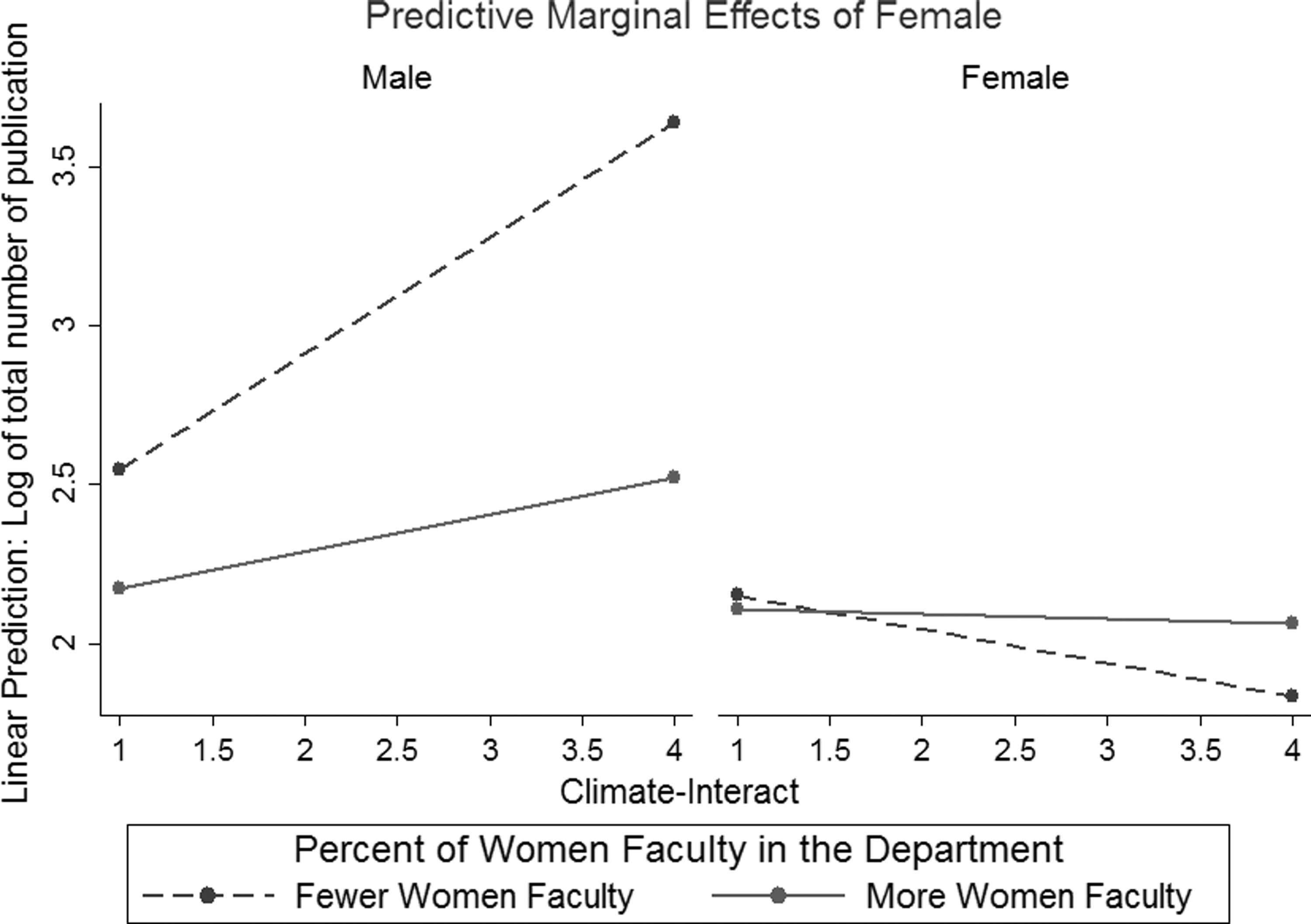
Predictive marginal effects from three-way interaction among gender, climate/Interact, and percent of women faculty in the department.
Because we found that tenure status was related to the negative effect of the Balance climate variable, we investigated whether some function of seniority/time at UW-Madison could illuminate how having a positive work/life balance climate in the department could negatively affect Number of Publications. When we looked at whether the Balance variable impacted Number of Publications differently for women and men faculty depending on whether they were junior (less than 12 years at the University) or senior, we found that it was specifically an effect for senior women faculty—women faculty who had been at the University for more than 12 years had a significantly negative effect of Balance on their Number of Publications, while there was no such effect for women faculty who were more junior (Fig. 2.)
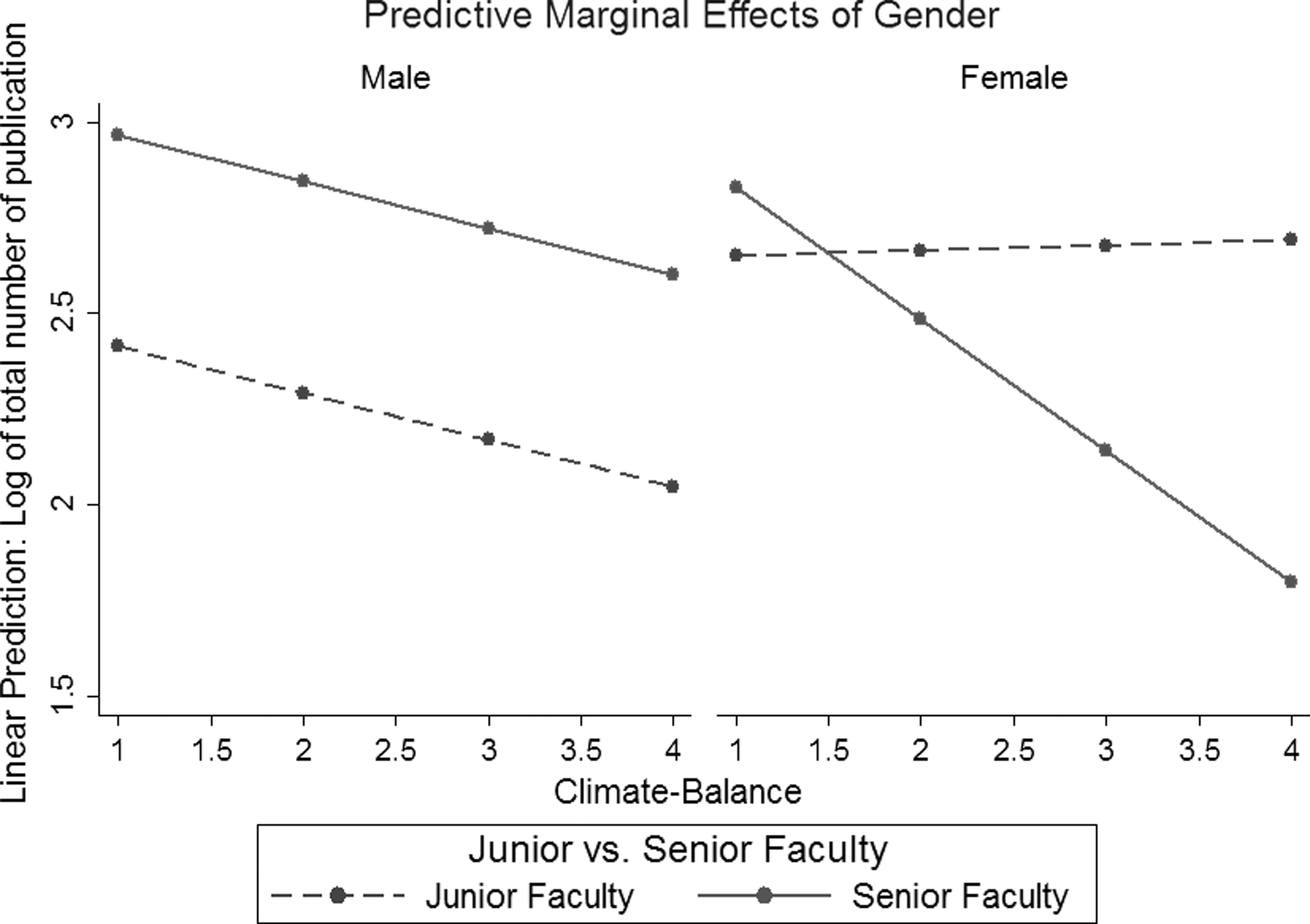
Predictive marginal effects from three-way interaction among gender, climate/Balance, and faculty seniority.
Discussion
Many studies have found that female faculty have lower productivity compared to their male colleagues, referring to this as the “productivity puzzle.” 13 We also found this relationship in our data, but only at the baseline for both Number of Publications and Number of Grants. After accounting for the difference at baseline, the gender difference in productivity disappeared, indicating no further inequality after the initial gap. Our finding is congruent with studies that find that women and men have different publication trajectories in their careers, with women publishing less 35 at the early stages but showing more equity later in the career. 8,14,35,36 Xie and Shauman 14 argue that these factors must be controlled when examining gender differences in research productivity, and our findings confirm this recommendation.
In our examination of the effects of department climate on future productivity, we used a greater range of climate-related concepts than in previous work, both validating those results and suggesting other areas of climate that might have distinct relationships to faculty productivity. We found a significant positive effect of collegial interactions (Interact) on the Number of Publications for both male and female faculty in our climate survey data. This finding is supported by previous research such as that of Fox, whose emphasis on “collegial dialog” 16,19 was measured by several items in our Interaction variable, such as “Colleagues in my department solicit my opinion about work-related matters” and “I feel that my colleagues value my research.”
A department where colleagues get along and respect each other leads to increased numbers of publications for both genders equally. However, three-way interaction analysis suggested that the effect of the Interact climate indicators differs between female and male faculty according to the gender proportion in their departments. Women and men faculty produced more publications in departments with higher representations of their own genders as they perceived more positive collegial interactions. As illustrated in Figure 1, men's productivity received a large boost as collegial interactions improved in departments with few women. In contrast, women's productivity increased with a good collegial environment only in departments with higher percentages of women; in these departments, their productivity in relation to increases in Interact was similar to men's.
In low-percentage female departments, women's Number of Publications actually decreased. It seems to take more than just good collegial interactions in a department to improve productivity for women faculty. Female faculty in departments with few or no other women must still battle isolation, and perhaps a lack of mentors, despite feeling their collegial interactions are generally positive. If their colleagues respect them, but they still feel unsupported or excluded from informal networks, this disconnect may contribute to the lower productivity. 29,37
We also found a significant positive effect of a general climate indicator (URClim) that measured the climate for underrepresented faculty in the department and found that this affected both men's and women's grant awards. To our knowledge, an indicator like this has not been used in prior research on faculty productivity. While this indicator primarily denotes perceived climate for minority members of the department (women, underrepresented minority men and women), our findings suggest that everyone in the department could benefit when department members perceive their department as good places for women and faculty of color.
We also found that improvements in the climate for underrepresented faculty were associated with an increase in Number of Publications for all members of the department. Some scholars have suggested that women and/or underrepresented minority faculty are “canaries in the coal mine” in their departments 38 –40 ; that is, they are more sensitive to climate issues than majority faculty, who have more outlets for finding positive collegial interactions. Although our URClim measure reflects an individual faculty member's perceived climate for women and faculty of color, the lack of a significant interaction effect for gender and race may lend support to the argument that improving climate for women and minority faculty improves climate for everyone.
Finally, we found that having a good department climate with regards to supporting work/life balance (Balance) was negatively associated with the Number of Publications for both men and women faculty, but this effect was most pronounced for senior women faculty. Prior research has found that women faculty with children produce fewer articles, 23,24 so it seems counterintuitive that departments that give faculty the opportunity to balance those demands would also see fewer publications from their faculty. However, we note that junior faculty do not show this effect, especially junior women faculty.
Women faculty often delay family formation until after tenure; 41,42 it is possible that female faculty in departments with a good work/life balance climate benefit from these policies and focus more on their families later in their careers. Qualitative data collection and analysis in future work could help illuminate the changing significance of good work/life balance climates over the faculty career. Future studies might also model faculty attrition to discover whether the disadvantage of fewer publications is balanced by better retention of women faculty.
Interestingly, in none of our models did climate variables relating to department decision-making have any effect on future productivity. Department decision-making is related to job satisfaction in many studies; 43,44 so this was a somewhat surprising finding if we think that job satisfaction (which is not measured directly in these models) is related to faculty productivity. Future work should add job satisfaction measures to these models.
The strengths of our study include its longitudinal design and collection of productivity measures from reliable outside sources rather than self-report. However, there are a number of limitations to our study. Although we made every effort to cast our net widely by examining four of the largest and most extensive academic databases available, we may have missed some publications. We made no effort to adjust or control for faculty who are part of hyper-author hyper-publishing groups (e.g., high energy physics) and have hundreds of articles to their name each year. We included only faculty from one university in our sample, although there is no reason to believe that the relationships among gender, department climate, and faculty productivity would be different in institutions similar to the UW-Madison.
Another limitation is that unobserved covariates that could influence faculty productivity are omitted from our analyses. Faculty members who responded to our survey may be different from those who did not respond creating a selection bias that could affect the results; for example, if very-high productivity faculty are underrepresented in the sample, this could affect our findings, especially if there is a gender disparity in response for those faculty. Other aspects of field of study (such as applied vs. basic science, faculty who do clinical work, and so on) were not measured and could provide a more nuanced understanding of productivity differences by field, not measured by our binary “biological vs. physical science” field variable.
Conclusion
Our results indicate that department climate is not something to pay attention to because it is “nice” or because it only helps underrepresented faculty. Departments where faculty have collegial respectful interactions have higher numbers of publications for both men and women faculty, and both genders benefit equally from the collegial environment overall. When faculty perceive that underrepresented faculty are treated well in their departments, they have higher grant production.
Because department climate was positively related to higher research productivity for all faculty, our results should motivate chairs, administrators, and individual faculty members to improve working conditions and relationships within academic departments. Higher faculty productivity implies improved career progression for individual faculty and improved rankings for departments, outcomes that are valued by department chairs and faculty alike. Although a better climate for work/life balance was negatively associated with Number of Publications, especially for senior women faculty, departments that gain a reputation for promoting work/life balance for their faculty may find themselves at an advantage at recruiting and retaining faculty who, more and more, believe that an academic career should not be incompatible with having a satisfying life outside the academy. 45
Footnotes
Acknowledgments
The authors thank David Kaplan, Doug Hemkin, Jessica Winchell, Virginia Valian, and two anonymous reviewers for their statistical advice, database searching assistance, and helpful comments. This work was supported by National Institutes of Health grant R01 GM088477.
Author Disclosure Statement
No competing financial interests exist.
References
Supplementary Material
Please find the following supplemental material available below.
For Open Access articles published under a Creative Commons License, all supplemental material carries the same license as the article it is associated with.
For non-Open Access articles published, all supplemental material carries a non-exclusive license, and permission requests for re-use of supplemental material or any part of supplemental material shall be sent directly to the copyright owner as specified in the copyright notice associated with the article.
