




Abstract
Background:
The Association of American Medical Colleges reports continued low rates of female faculty as professors and in leadership positions. While attrition and discrimination have both been proposed as explanations, recent literature has suggested that women's professional motivations, ingrained behavior, and perceptions of organizational support may also play a role.
Methods:
The authors employed a series of scales informed by the turnover theory (which predicts intent to leave an organization), previously validated and used in business and engineering studies, but rarely used in academic medicine. The authors proposed and tested a multiple regression model to assess predictors (role strain, work–life balance, and organizational climate) for three outcome variables: seeking promotion, seeking leadership, and intent to leave.
Results:
Survey results from 614 faculty members indicated that gender significantly influenced both promotion and leadership seeking, but not intent to leave. Perceived work–family conflict was negatively correlated with leadership seeking for women, but not for men. Positive views of organizational support and commitment were associated with promotion seeking and persistence for all participants. Role strain was positively correlated with desire for promotion and leadership, as well as with intent to leave.
Conclusions:
Female faculty may not be leaning in to promotion and leadership roles because of increased role conflict, work–life concerns, and organizational factors; this seems to be more of a factor for female clinical rather than research faculty. Work–family conflict affects male and female faculty differently and should be addressed in efforts to retain faculty and to remove barriers for female faculty seeking leadership opportunities.
Introduction
T
The leadership gap between women and men is further widened by the increasing attrition of physicians from academic medicine. 15 –17 Female physicians disproportionately drop out of academic careers, with role strain 18 –21 and work–life conflict 22 –24 as contributors, and are consequently significantly underrepresented in senior ranks and leadership positions in academic medicine. 14,25 Taken together, these trends point to both personal and environmental variables that may be experienced differently across gender. The interconnectedness of women leaders in academic medicine and improvements in women's health 25 underscore the importance of such interventions for advancing female physician faculty. Research guided by conceptually sound models is needed to develop evidence-based interventions that can engage and retain physician faculty in academic medicine.
The purpose of this study was to identify factors that promote physician faculty engagement and to determine gender differences in these factors. We proposed and tested a conceptual model using the turnover theory, 26 which has shown that individuals with low role strain, high organizational commitment, and favorable organizational support report a lower propensity to leave their environment. 27,28 Fouad et al. studied these predictors in female engineers who either stayed in or left engineering careers and found that those who persisted in engineering careers had greater perceptions of both workplace supports and organizational commitment. 29 Furthermore, Settles et al. 30 explored workplace climate factors' effects on job satisfaction, felt influence, and productivity. They defined felt influence as influence over curriculum decisions, resources, and climate and defined productivity in terms of external grants and peer-reviewed publications, which then translated into promotion as defined by gains in rank. Settles et al. 30 determined that job satisfaction, felt influence, and productivity were all predicted by departmental support, particularly chair leadership, and climate variables.
This study was undertaken at one large private medical college as part of an institutional effort to support all faculty members, particularly female faculty, toward advancement in academic rank and leadership positions while retaining these valuable members of the academic medical community. Extant research on physician faculty promotion, leadership, and attrition is dominated by largely descriptive studies that provide summaries and frequencies of physician faculty behaviors, giving less attention to the psychological correlates of seeking promotion, leadership, and intent to leave or stay. We hypothesized that female faculty would endorse both seeking leadership and seeking promotion at lower rates than men and endorse equal or lower rates of intent to leave. This exploratory study employed theoretically derived validated measures and multivariate analysis to investigate psychological factors that have been shown to predict intent to leave and may shed light on promotion and leadership seeking.
Methods
Institutional Review Board approval was granted for this study.
To assess faculty experience and aspirations in their academic careers, we used validated measures assessing constructs consistent with the turnover theory. The complete list of scales, their definitions and internal reliability estimates, and scale sources 31 –36 are summarized in Table 1. We posited four constructs as predictor variables; role strain, work–family conflict, organizational commitment and support, and departmental commitment and support. For example, to assess faculty's experience of family into work conflict within the larger construct of work–life balance, five scale items from the study by Netemeyer et al. 33 were used, including “I have to put off doing things at work because of the demands on my time at home,” and “Things I want to do at work don't get done because of the demands of my home/family life.” Participants rated their level of agreement with an item on a scale ranging from 1 (strongly disagree) to 5 (strongly agree). Mean responses to scale questions for each participant were calculated, with higher scores indicating more of that factor, for example, more family into work interference. The three outcome variables were leadership seeking and promotion seeking (also assessed on the strongly disagree to strongly agree scale) and intent to leave in 1–2 years, for which faculty were asked to indicate yes, no, or unsure.
Employed variables and their definitions, Cronbach's α coefficient values, and scale sources.
MCW, Medical College of Wisconsin.
The authors designed an anonymous web-based survey using Research Electronic Data Capture. Between June and August 2013, an email invitation containing an untraceable hyperlink to the survey was sent to all faculty members at or above the rank of assistant professor. The only required survey questions were the consent question and a question indicating whether faculty self-identified as primarily clinicians or researchers. Methods to maximize the response rate included anonymity, known sender (Medical College of Wisconsin [MCW] Women's Faculty Council), long open-survey period (6 weeks), three reminders with link reembedded, and salience of the issue to especially our female faculty.
Data were analyzed using IBM SPSS (Statistical Package for the Social Sciences) software, version 22. A multiple linear regression model was developed, in which variables were sequentially added in a total of six groups of like variables (Fig. 1). Visual inspection of the scatter plots and variable histograms indicated that the residuals were independent and that the variables were relatively normally distributed. Because the study was exploratory, an alpha level of p < 0.05 was set as the significance level, although the data are also reported in terms of practical effect sizes.
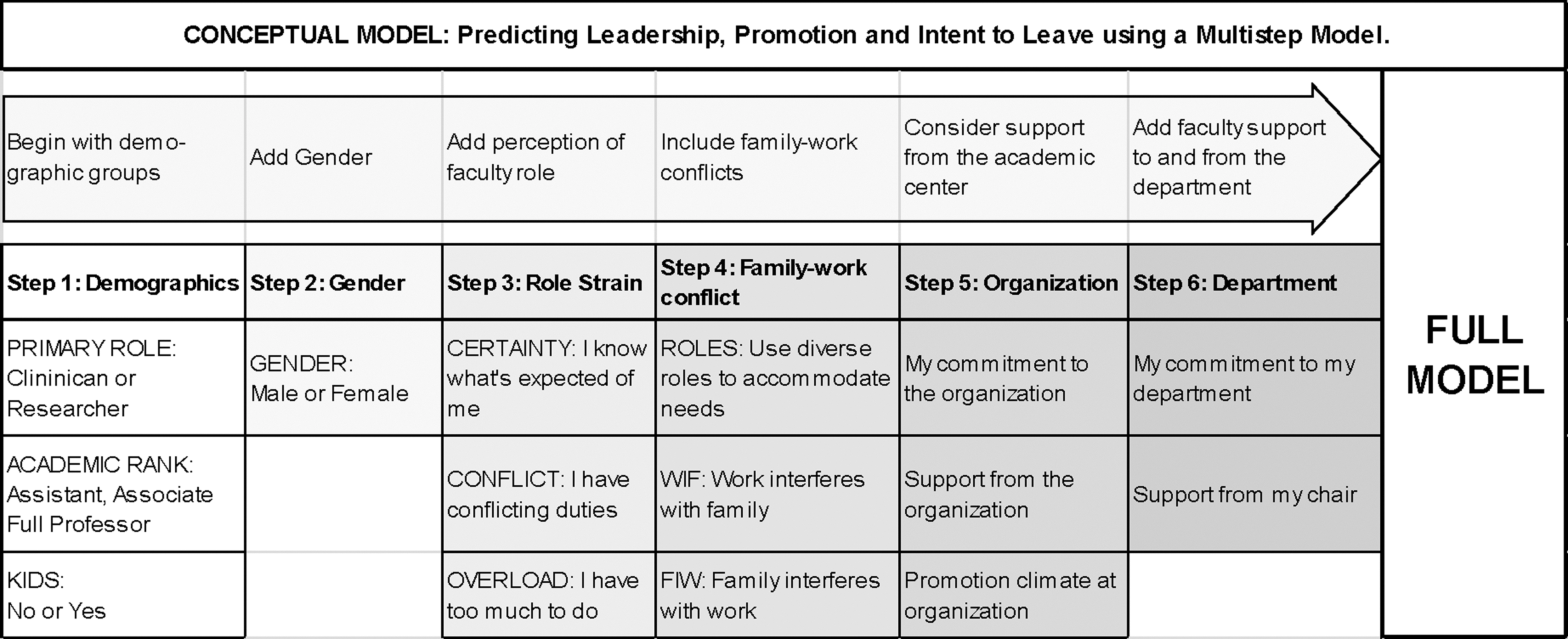
Conceptual model for regression analysis. Steps in the regression were entered from left to right. The figure represents the original model. The final model did not include gender. Instead of gender, we elected to perform separate regressions for male and female participants. FIW, family into work; WIF, work into family.
Results
Of the 1456 employees who received the web-based link to the survey, 614 usable responses were obtained, representing a response rate of 42% overall. Three hundred eleven men and 227 women indicated their gender in the survey (60 did not report), representing 35% and 43% of male and female faculty, respectively. We were concerned about our relatively low, although not atypical, response rate and therefore searched for response bias in two ways. First, we compared our respondents with the known MCW faculty population. Overall, we had relatively more women responding than men and more professors than associates or assistants (Fig. 2). Professors responded at greater rates than assistant professors. Our lowest percentage response was from male assistant professors at 27% (n = 97). Our highest response was from female full professors at 68%, representing 46 of the 68 female professors at that time. Even this strong response rate still left unequal numbers (46 female vs. 129 male professors answered the survey), reflecting the disparity in numbers of male and female senior faculty. Overall, we had relatively equal numbers with no obvious faculty groups missing, and we believed it to be a representative sample. Second, we were unable to directly survey nonresponders because of survey anonymity and instead compared the first half of respondents (early responders) with the second half (late responders) to see if they differed; the counts for the respondents by rank and gender for the first and second halves of the survey were nearly identical.
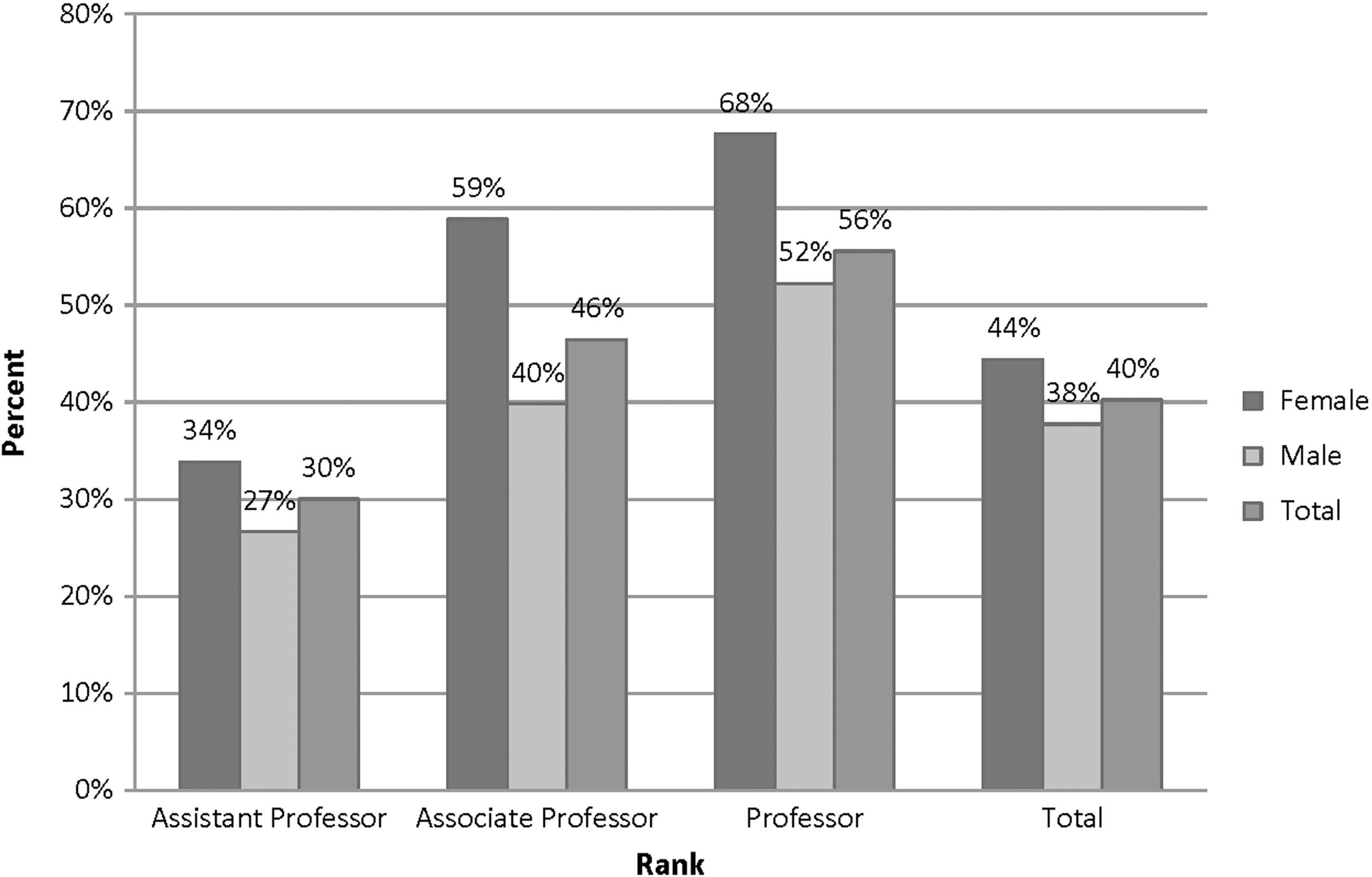
Respondents as a percentage of MCW faculty. Looking for patterns or specific deficits in respondents, we compared respondents with known MCW faculty counts by rank and gender and found no specific deficits. MCW, Medical College of Wisconsin.
We collected self-reported race and ethnicity, but the number of faculty identifying as other than white/Caucasian was so small that we could not make meaningful statements about responses by racial/ethnic group and, thus, this information was omitted from the analyses. Similar to other studies, 13,28,29,37 we hypothesized that both rank (assistant, associate, full professor) and type of faculty (research vs. clinical) would strongly affect both leadership seeking and promotion seeking and that having children would be an impediment to leaving one's field, if not the institution. Although gender differences on the mean responses were analyzed, we also wanted to investigate the effects of our predictor variables on the outcomes without gender's influence; therefore, gender appears as a separate step in the regression analysis immediately following the demographic variables.
Because gender emerged as a significant predictor of both promotion and leadership seeking, we performed separate regression analyses for both genders, determining whether predictors for women were different than for men, dropping the gender step from the regression analysis.
Relationships between study variables and control variables were initially explored using mean comparisons. These results appear in Table 2. Gender differences were found in rank (more men are full professors than women) and having children (90% of men and 77% of women had kids). Additionally, women endorsed using their multiple roles to obtain a more flexible schedule at greater rates than men. In our outcomes, only seeking leadership significantly differed by gender, with women endorsing leadership seeking at lower rates than men.
Demographic comparisons (chi-square) are expressed in percentages. Bolded values indicate p < 0.05.
Clin, clinicians; Res, researchers; Assist, assistant professors; Assoc, associate professors. Predictor variables and outcome scale gender comparisons (t-test) were measured on a five-item scale (1 = strongly disagree; 5 = strongly agree), except intent to leave, which was measured as 1 = no intent, 2 = unsure, and 3 = intend to leave in 1–2 years. In all scales and outcomes, higher numbers indicate more of that construct.
Dept., department; FIW, family interferes with work; SD, standard deviation; WIF, work interferes with family.
Next, we investigated potential gender differences on the outcome variables between self-described research and clinical faculty, hypothesizing that researchers would seek promotion out of necessity to maintain their positions (although there is no time limit a faculty can hold a given rank at the institution under study). The results (Table 3) indicated that while both female researchers and clinicians sought leadership at lower rates than their male colleagues, this disparity was larger in clinical than research women. In promotion seeking, only the clinical women sought promotion at lower rates than men. This finding confirmed our decision to control track (research vs. clinical) in the regression analysis.
Predictor variables and outcome scale gender comparisons (t-test) were measured on a five-item scale (1 = strongly disagree; 5 = strongly agree), except intent to leave, which was measured as 1 = no intent, 2 = unsure, and 3 = intend to leave in 1–2 years. In all scales and outcomes, higher numbers indicate more of that construct. Bolded values indicate p < 0.05.
The results of the hierarchical regression analyses are reported in Tables 4 –6 for each of the dependent variables (seeking promotion, seeking leadership, and intention to leave). In the final model, the predictor variables were entered into the regression in five steps (see Fig. 1): step 1: Control Variables: faculty track (clinician vs. researcher), rank (assistant professor, associate, and full professor), and having children (yes or no); step 2: Role Strain Variables: role conflict, role certainty, and role overload; step 3: Work–Life Integration Variables: use of multiple roles to balance time for work and family, work into family conflict, and family into work conflict; step 4: Organizational Factors: commitment to the organization, support from the organization, and promotion climate at the institution; and step 5: Departmental Factors: commitment to the academic department and support from the chair of the department.
Predictor variables for each step, their beta weights, and effect size (R 2) are presented. Bolded results were significant, at least at the p < 0.05 level.
p < 0.05; ** p < 0.01.
Assist, assistant; C, clinicians; Prof, professor; R, researchers.
Predictor variables for each step, their beta weights, and effect size (R 2) are presented. Bolded results were significant, at least at the p < 0.05 level.
p < 0.05; ** p < 0.01.
Predictor variables for each step, their beta weights, and effect size (R 2) are presented. Bolded results were significant, at least at the p < 0.05 level.
p < 0.05; ** p < 0.01.
Seeking promotion
Among the control variables, rank was an independent predictor for men, with lower ranks unsurprisingly endorsing greater promotion seeking. However, this accounted for very little of the variance and this step was not a significant predictor. When role strain variables were introduced, 9% of the variance for men was explained, largely through positive associations between role certainty, role conflict, and promotion seeking. The work–family conflict step did not contribute to the variance for either men or women. Organizational variables explained an additional 3% of variance for men. Departmental variables contributed minimal additional variance. The final model for men accounted for 15% of the total variance in seeking promotion, with rank, gender, role conflict, role certainty, and promotional climate showing significant contribution to this variation. Note that the strongest predictors in seeking promotion for men were increasing role certainty and conflict and the perception of a climate supportive of seeking promotions, although the overall effect size is small. The model for female faculty included neither significant predictors nor significant steps, indicating that these predictors did not explain promotion seeking for women (Table 4).
Seeking leadership
This regression model explained 12% and 26% of the male and female model variance, respectively. For men, the demographic and role strain steps added significant increases in variance accounted for, with the greatest contributor being role conflict, contributing 5% of the variance; endorsing greater conflict predicted greater leadership seeking. In the model for women, both higher rank and having kids predicted leadership seeking, as did both role conflict and organizational support. Interestingly, family into work conflict explained 4% of the variance for women, but none for men, emphasizing the salience of that variable for women (Table 5).
Intent to leave
The regression model explained the greatest amount of variance of the three dependent variables, predicting 37% of the variance for men and 25% of the variance for women. For both genders, increased role conflict and decreased perceptions of organizational support were associated with intent to leave, contributing about 20% of the variance for both groups. For women, being a researcher contributed additional variance, whereas for men, additional contributors included lower rank, not having kids, and increased family into work interference. Counterintuitively, increased perceptions of family into work conflict were associated with decreased intent to leave for men, but not for women (Table 6).
Discussion
The current study employed validated scales informed by turnover theory to predict three models of intent to leave, seeking promotion, and seeking leadership for men and women in academic medicine. We hypothesized and found that women would have equal or lower intent to leave the institution than men and would endorse leadership and promotion seeking at lower rates than men. Furthermore, we hypothesized that scales previously used for intent to leave would also predict leadership and promotion. We found that variables related to perceived organizational support and role strain were salient in nearly all models, while work–family variables had gender-specific effects in physician faculty's persistence, promotion, and leadership experiences. Several gender differences emerged that we highlight below.
First, in the regression model and in the mean comparisons for clinical faculty, male respondents were more likely than female respondents to seek promotion. Overall, controlling for rank and gender, those with role certainty, more role conflict, and better perceived promotion climate were more likely to seek promotion. Whether or not early career men (and particularly male clinical faculty) are entering academia with greater clarity about their goals and expectations as a faculty member or are receiving more role clarity from the organization merits further investigation. Overall, the regression equations predicted only 15% of the variance for men, and disappointingly, the women's model predicted none of the variance, indicating that there are unmeasured aspects of this variable not captured in the present study. Professional advancement, including promotion seeking, is tied to having informal networks and supports and to garnering sponsorship—someone in a position of power to advocate for one's career advancement—and men are more likely to have more of these resources than are women. 38 –40 Future studies would do well to include measures of these types of social capital resources as well as investigate women's social integration and collegiality in the academic community. 38 Qualitative investigations of female faculty regarding their promotion seeking and promotion attainment experiences would be particularly informative.
Second, results of the seeking leadership model revealed gender differences parallel to those in the seeking promotion model. Unlike the promotion model, however, the leadership model explained 26% of the variance for women and only 12% of the variance for men. Men were more likely to seek leadership, which is consistent with the gendered landscape of administrative leadership at the institution in this study, at which only 3 of 29 chairs are female. Higher rank and increased role conflict were associated with leadership seeking for women. Increased role conflict was a significant predictor of leadership seeking in both models, indicating that role conflict is either a driver or a consequence of leadership, capturing the challenges of meeting family needs and career demands that may come with choosing to move up the academic ladder. 41 The salience of family variables for female faculty's seeking leadership experiences is consistent with previous research 25,37,42 and poignant observations raised by Cooke and Laine 43 in their article titled, “A woman physician–researcher's work is never done.” Other factors must account for unexplained variance. Factors such as confidence (unrelated to actual skills) might play a role. 44 Alternatively, it is possible that the wording of the survey's leadership question could have complicated the response of female faculty. In seeking to assess leadership ambition, we asked for response to the very direct statement, “I desire to be promoted to a leadership role.” Women may respond differently to leadership questions phrased as interest in moving one's department in new directions or in improving department practices rather than statements invoking traditionally androcentric roles regarding leading. 45 There are complex reasons that female faculty, particularly female clinical faculty, are not leaning in to leadership, at least at this institution, and further research is needed to determine why.
Finally, results from the intent to leave model indicated that although role conflict was positively associated with seeking advancement (promotion and leadership), it was also associated with intent to leave for all respondents. If faculty who are working toward promotion diversify or add to their responsibilities as part of that process (e.g., take on additional leadership, teaching, or research roles), and if those additional activities also increase their role conflict, then that could represent a risk factor for the loss of the very faculty that the academic center desires to retain. Since men hold a greater share of leadership positions in academic medicine, and they may view family–work conflicts as part of an academic career, those men may be less sympathetic to women's need to accommodate their families if they accept a leadership position. As Bickel 38 stated in a recent publication, “Men's ability to effectively mentor women depends to a great extent on their understanding of the challenges that women disproportionately face in developing their careers.” These gendered patterns of family–work dynamics, coupled with the association between organizational support and intent to leave, point to the organization's responsibility and accountability in establishing practices that can facilitate embeddedness or a reason to stay, such as a positive promotion climate. It is worth noting that opportunities for advancement are necessary, but not sufficient to increase retention for all faculty members, as promotion climate was not a positive reason to stay for female respondents.
Our results have several implications for organizational policy and practice aimed at faculty retention and career development toward leadership advancement. Interventions aimed at enhancing physician faculty's planning and confidence for engaging in the intrinsic conflicts in multiple-role management may be beneficial in increasing their embeddedness in academic medicine, particularly for female faculty. 32 This includes recognition of the complexities and stressors associated with simultaneous work and family involvement and the subsequent need for deliberate planning to manage the demands from both domains early in one's career. This may require not only developmental programming for emerging or at-risk faculty but also the engagement of senior faculty in understanding unique work–life balance needs of female faculty as they seek leadership opportunities. These processes may assist in both the retention of valuable faculty talent and the realization of increased opportunities for women's leadership.
Strengths and limitations
To the author's knowledge, this study was the first to explore academic medicine using the turnover theory, 26 bringing a theoretical approach to an area most often explored atheoretically, and the first to suggest that intrinsic motivations toward leadership and professorship might be obstacles for women's advancement, as well as organizational barriers. Longitudinal studies that identify which factors are predictive of the outcome variables over time would help clarify when and how salient these are over a career. This study employed a cross-sectional research design in a single academic institution, and as such, we are unable to establish causation among the variables, nor able to truly extrapolate to other institutions. Additional work in other institutions would broaden generalizability. Furthermore, while a relatively low response rate might indicate nonresponse bias, it is also typical of email-based studies 46 and representative of both a generally falling survey response rate over the last 10 years 47 and the difficulty of surveying physicians in general. 48 Our checks for bias did not indicate systematic nonresponse. Another limitation was the lack of racial/ethnic diversity in our sample, a concern because racial/ethnic minority female faculty are the most vulnerable groups to inequities in academic medicine. 6,49 Although we were unable to examine racial and ethnic differences among our male and female respondents, future research would do well to investigate the intersections of race/ethnicity and gender relative to faculty engagement.
Footnotes
Author Disclosure Statement
No competing financial interests exist.