




Abstract
Background:
Our objective was to understand maternal functioning and psychological distress among mothers of young children in the United States during April/May 2020, early in the coronavirus disease 2019 (COVID-19) pandemic.
Materials and Methods:
Participants were 862 moms of children aged 0–3 years old who completed an online survey. We examined maternal functioning (maternal competency and self-care subscales from the Barkin Index of Maternal Functioning) and psychological distress (depression, anxiety, and stress subscales of the DASS-21), and then examined interaction effects of COVID-19 impact and socioeconomic status (SES; represented by income and education).
Results:
Mothers' reports of higher maternal functioning correlated with lower psychological distress and both sets of factors varied substantially by SES and COVID-19 Impact. Higher COVID-19 Impact was associated with lower functioning and greater distress. Higher income and education were associated with better maternal self-care, but not maternal competency. Although we expected high SES to buffer mothers from a higher impact of COVID-19, we found that mothers with high SES reported a lower level of maternal competence and more stress than low-SES mothers. Interactions between COVID-19 impact and SES predicting maternal functioning and psychological distress revealed that when COVID-19 impact was low, high SES was associated with high functioning scores and less distress.
Conclusions:
This work challenges the assumptions that a stressful event will be uniformly experienced by mothers of young children as well as the stress-buffering role of higher SES. This study highlights the importance of considering SES when characterizing maternal functioning and psychological distress during times of high stress. Further research is needed to examine the processes contributing to these discrepancies.
Introduction
Families have faced tremendous challenges during the coronavirus disease 2019 (COVID-19) pandemic. Many report that increased childcare responsibilities have been shifted onto mothers by default. 1 Mothering young children during COVID-19 has presented significant obstacles such as disruption to routine health care, challenges in acquiring food, 2 lack of childcare, and school closures, 3 and moms often fulfill increased responsibilities with less social support and financial resources. 4,5 This research aims to better understand the perspectives of mothers of young children early in the pandemic. In addition to considering the potential challenges posed to mothers' mental health, we also want to better understand mothers' functioning, including their ability to care for themselves emotionally and physically as well as carry out necessary tasks to care for their children.
Emerging evidence highlights the mental health toll of the pandemic for parents, and especially mothers. In an online survey of 2365 Australian parents, compared with prepandemic times, parents have reported significantly higher rates of anxiety and depression symptoms in addition to irritability, and alcohol consumption 6 in the early phase of the pandemic, April 2020. A separate study compared data collected in 2016 with values from the early pandemic, finding that twice as many caregivers reported mental distress in the pandemic. 7 This finding is similar to research conducted specifically with new mothers in northeastern Italy who gave birth at the beginning of the COVID-19 pandemic who endorsed significantly higher levels of depression than a matched comparison group from the same time period in the previous year. 8 In addition, a cross-sectional study of mothers with children aged 0–18 months old during April 2020 also found higher levels of symptomology than in prepandemic times, reporting clinically relevant depression in 33.16% and anxiety in 36.27% of its sample. 9 Collectively these studies highlight parents' significant psychological strain during the pandemic.
However, although the novel challenges of the early phase of the COVID-19 pandemic may have increased psychological distress for all mothers of young children to some extent, additional factors may heighten vulnerability. For one, the extent to which mothers were specifically affected by the pandemic in terms of the financial, logistical, social, and psychological impact may have increased psychological distress. An early study indicated that the risk for depression and anxiety disorders increased for postpartum women during COVID-19, especially when quarantined and for those lacking social support. 10
In addition, low socioeconomic status (SES) may contribute to psychological distress among mothers of young children. This has been shown before the pandemic, such as a study that found that mothers who had a low income, less than a college degree, were unmarried, and unemployed, were 11 times more likely to endorse clinically elevated depression scores 3 months after giving birth than mothers who had none of these risk factors. 11 Likewise, Leach et al 12 found that socioeconomic disadvantage is a prominent risk factor, among others, for perinatal anxiety.
We would expect that low SES would similarly increase mothers' vulnerability to psychological distress during the pandemic and that high SES would serve as a buffer from stress and be protective. For example, several indicators of high SES have been linked to lower risks of COVID infection among pregnant women in New York City. 13 Preexisting socioeconomic hardship has been shown to be magnified by pandemic-related job loss or financial insecurity and increased caregiver's psychological distress, parenting stress, and mental health symptoms which in turn, is likely to disrupt family systems. 14 A comparison with prepandemic levels found that the combination of preexisting financial strain and COVID-19 stressors was associated with parental and child mental health symptoms, parental emotion dysregulation, and conflict within the family. 6
However, it must be noted that low SES has not been uniformly found to increase vulnerability to psychological distress in the early phase of the pandemic among peripartum samples. 15 It may be that although lower SES poses disadvantages, it may increase resilience in the face of stressful events. On the other end of the spectrum, several studies support that for families with high income, high SES is purported to play a buffering role in the face of pandemic challenges. 16,17
In addition to the research on mothers' elevated psychological distress during the pandemic described previously, we propose that maternal functioning 18 is an important construct to help characterize mothers' experiences. Maternal functioning broadly captures mothers' adjustment to the maternal role, 19,20 including their perceptions of their abilities as a mother (referred to as Maternal Competency) and their perceptions that they are fulfilling their own needs while caring for others (Maternal Self-Care). 21 Maternal functioning also taps into mothers' perceptions of their own responsibilities and contexts and factors that help them feel more or less successful in motherhood (e.g., engaging in self-care, utilizing social support). 18 An understanding of a mother's functioning during the pandemic is valuable because it offers information about a mothers' relationship to her infant/child and the degree to which she is attending to her own self-care needs. How well or poorly she is attending to her own and her child's emotional and physical needs is especially important in the postpartum period because it plays a role in determining longer term maternal 22 and child health outcomes. 23,24
Given the salience of challenges of parenting in the early pandemic (e.g., owing to loss of daycare, school closures, financial hardship), and the evidence that parents were experiencing increased psychological distress at this time, we wanted to know more about mothers' perspectives on their parenting. Examining maternal functioning during the pandemic offers insight into mothers' perceptions of their success as caregivers and of their ability to care for themselves while parenting during the pandemic, which was highly stressful for some, but not for others.
In prepandemic research, maternal functioning has been found to correlate with mental health in general 25 as well as psychopathology such as depression, 26 but it is distinct. Although research on self-care with mothers during the COVID-19 pandemic is emerging, a prepandemic study examining stress and self-care behaviors with front-line family service providers found that when stress levels were high, people engaged in less self-care. 27 Additional research links excessive demands on working mothers' time with increased stress and less opportunity to engage in self-care, which is especially unfortunate as self-care was shown to reduce stress. 28
Research also suggests that for mothers with postpartum depression, sociodemographic variables, such as race or education, are associated with maternal functioning. 29 Therefore, in addition to the predictions that greater COVID Impact and lower SES would heighten the potential for mothers of young children to experience psychological distress, we hypothesize that these factors would also undermine mothers' perceptions of their own functioning overall, as well as their sense of maternal competency and maternal self-care specifically. Furthermore, we hypothesize that COVID Impact and SES would interact to predict mothers' levels of psychological distress (depression, anxiety, and stress) and maternal functioning, such that higher COVID Impact and lower SES would combine to predict even higher levels of psychological distress and lower levels of maternal functioning compared with those with lower COVID Impact and/or higher SES.
This study contributes to the growing literature on the challenges of parenting young children during the early phase of the pandemic with specific addition of maternal functioning construct. We address two aims to understand the impacts of the unprecedented stressors of the pandemic on mothers of young children's wellbeing and on their adjustment to the maternal role. First, we want to better understand the experiences of mothers of young children early in the pandemic. To do this, we examine women's perceptions of their maternal functioning, including maternal competency and maternal self-care, as well as their psychological distress (depression, anxiety, and stress) early in the pandemic, and explored relationships among these variables, ratings of COVID impact, and mothers' SES (income and education).
Second, we ask whether factors including COVID impact and SES increase mothers' vulnerability, potentially undermining maternal functioning and exacerbating distress. Accordingly, we examine the interaction between COVID impact and SES as a predictor of mothers' reported maternal functioning and psychological distress given the potential for heightened vulnerability for mothers more affected by the pandemic and for those with lower income or education.
Materials and Methods
Participants
Participants were recruited through social media advertisements targeting mothers in the United States between April 25 and May 14, 2020. In late April, 42 states or ∼94% the U.S. population were either under stay-at-home orders or urged to stay at home to slow the spread of COVID-19 and by May 14 restrictions were relaxed for 14 states. 30 To be included, participants had to be at least 18 years old and have a child younger than 3 years old. In total, 1556 participants entered the survey, and the 861 (55%) participants who provided complete responses on the Barkin Index of Maternal Functioning (BIMF) were included in this analysis. Table 1 presents sociodemographic characteristics.
Sociodemographic Participant Characteristics
M, mean; SD, standard deviation.
Procedures
After giving consent, participants completed a secure and encrypted Qualtrics survey. The survey included questions about demographics, COVID-19, depression, anxiety, stress, physical health, mental health, and maternal functioning. The study was approved by the ethics committee of Hofstra University's Institutional Review Board (Register No. 20200420-PSY-HCL-WEI-1).
Measures
Demographics
We collected the participant's age, their children's age, the participant's highest level of education, ethnicity, race, gender, sexual orientation, household income, employment status, working inside or outside of the home, zip code, type of location they live in (urban, suburban, or rural), and marital status (Table 1).
Coronavirus Impacts Questionnaire (COVID Impact)
The COVID Impact questionnaire contains six self-report items. 31 This measure assesses on a 7-point scale anchored by 1 = “not true of me at all” and 7 = “very true of me,” the degree to which a respondent has been impacted financially (e.g., COVID-19 has impacted me negatively from a financial point of view), psychologically (e.g., I have become depressed because of COVID-19), and accessibility to resources (e.g., I have had a hard time getting needed resources [food, toilet paper] due to COVID-19). Total scores on this measure range from 1 for the lowest impact and 42 indicating the greatest impact. Table 2 presents internal consistency as determined by Cronbach's alpha.
Internal Consistency (Cronbach's Alpha), Descriptive Statistics, and Bivariate Correlations for Study Variables
N = 861.
p < 0.01.
p < 0.05. Correlation is significant at the 0.05 level.
BIMF, Barkin Index of Maternal Functioning; DASS, Depression Anxiety and Stress Scales.
Barkin Index of Maternal Functioning
The 20-item BIMF self-report measure examines a mother's functioning in the 12 months after giving birth. 18 The measure includes validated Mom's Competency (e.g., I am a good mother) and Mom's Needs (Maternal Self-Care; e.g., There are people in my life that I can trust to care for my baby/toddler when I need a break) subscales as well. 21 We modified this questionnaire slightly by changing the language from baby to baby/toddler. A score <80 is conceptualized to be in the lower bound of the ideal range with a maximum score of 120 indicating optimal functioning. 26
Depression, Anxiety, and Stress Scales-21
The Depression, Anxiety, and Stress Scales-21 (DASS-21) is a self-report measure with 21 items that screens for global depression (e.g., I couldn't seem to experience any positive feeling at all), anxiety (e.g., I experienced breathing difficulty [e.g., excessively rapid breathing, breathlessness in the absence of physical exertion]), and stress (e.g., I was intolerant of anything that kept me from getting on with what I was doing). 32 Scores on each scale were then categorized into normal, mild, moderate, severe, and extreme ranges. The DASS-21 was validated for use during the peripartum time period as well. 32,33
Data analysis
To address our research questions, we ran a series of bivariate correlations and multiple regression analyses. For the multiple regression analyses involving interactions, we used the PROCESS macro, 34 which uses a standard stepwise regression approach for testing interactions by entering two main effects in the first step or model, followed by their interaction in the second.
Results
Descriptive statistics
Descriptive statistics for the COVID Impact scale, total maternal functioning (BIMF) score, two BIMF subscales, and three DASS-21 subscales are given in Table 2. Additional descriptives based on key demographics are provided in Table 3.
Sociodemographic Characteristics of Participants and Measures of COVID-19 Impact, Maternal Functioning, and Psychological Distress
n refers to sample size for BIMF and DASS measures.
Am, American; Grad, graduate; HS, high school.
Based on clinical cutoffs of the DASS-21, the average depression score (mean [M] = 13.5, standard deviation [SD] = 10.4) fell in the mild range with 42.4% in the normal range, 13.4% in the mild range, 20.7% endorsed moderate depression, 10.4% scored in the severe depression range, and 13.1% had scores in the extreme depression range. On average our sample scored in the mild range of anxiety (M = 9.1, SD = 8.3) with 51.4% in the normal range, 7.0% endorsed mild anxiety, 17.9% in the moderate range, 10.1% in the severe range, and 13.6% in the extreme anxiety range. Mean stress scores (M = 20.7, SD = 10.1) fell in the moderate stress range with 30.3% in the normal range, 13.5% in the mild range, 21.5% in the moderate category, 21.6% in the severe range, and 13.1% endorsed extreme stress.
Associations among variables
The first aim was to explore associations among maternal functioning, psychological distress, COVID Impact, and SES. As predicted, higher maternal functioning was associated with lower psychological distress, as given in Table 2. Specifically, higher maternal functioning overall, as well as the higher levels of maternal competency and maternal self-care, were each associated with lower depression, anxiety, and stress. Higher levels of COVID-19 Impact were associated with lower levels of overall maternal functioning, maternal competency, and maternal self-care. Higher levels of COVID-19 Impact were associated with higher levels of depression, anxiety, and stress. As given in Table 2, higher participant household income and education levels were associated with higher maternal self-care but not maternal competency. Likewise, higher income and education levels were associated with lower levels of depression, anxiety, and stress.
SES and COVID Impact
Our second aim was to explore low SES as a source of additional vulnerability. In line with other recent research 35 we predicted that women with lower income or lower education might report lower maternal functioning, greater psychological distress, and higher COVID Impact, and that COVID Impact would moderate the associations between income, education, and our indicators of maternal functioning and psychological distress. We used Model 1 in our regression analyses to examine the potential interactions between household income or education and COVID-19 impact to predict the maternal functioning and psychological distress subscales, Results for these analyses are described for maternal functioning and psychological distress.
Maternal functioning
Regressions showed that income was not associated with any of the maternal functioning variables (Table 4). Education was not associated with maternal functioning overall or maternal competency, but higher education was linked to reports of more self-care (Table 4). Regressions also indicated a significant main effect of COVID-19 impact on each of the three variables representing maternal functioning (Table 4). As predicted, lower COVID-19 Impact was associated with reports of greater maternal functioning overall, higher maternal competence, and more maternal self-care.
Regression for Socioeconomic Status Predicting Maternal Functioning, Competency, and Self Care
Note. We examined the effects of SES indicators on Maternal Functioning, Maternal Competency, and Maternal Self-Care.
n = 822.
n = 860.
p < 0.01.
p < 0.05.
However, each of the main effects was qualified by significant interactions between SES indicators and COVID-19 Impact. First, the overall model including income and COVID-19 Impact accounted for a significant amount of variance in maternal functioning overall, R 2 = 0.10, F(3, 818) = 29.8, p < 0.001. The interaction between income and COVID-19 impact explained a significant amount of variance in maternal functioning over and above its constituent main effects, ΔR 2 = 0.01, F(1, 818) = 8.06, p = 0.005 (Fig. 1a). Although explained 1% of variance in an outcome may seem trivial, recall that it corresponds to a “small” effect size (i.e., r = 0.10, d = 0.20) by most standards (e.g., Cohen, 1992 36 ), and our large sample of moms was specifically designed to be able to detect such small effects. As given in Figure 1a, when COVID-19 Impact was low (−1 SD), reports of maternal functioning were higher overall, and mothers with higher incomes reported the highest levels, but when COVID-19 Impact was high (+1 SD), mothers with higher incomes reported lower levels of functioning than mothers with lower incomes.
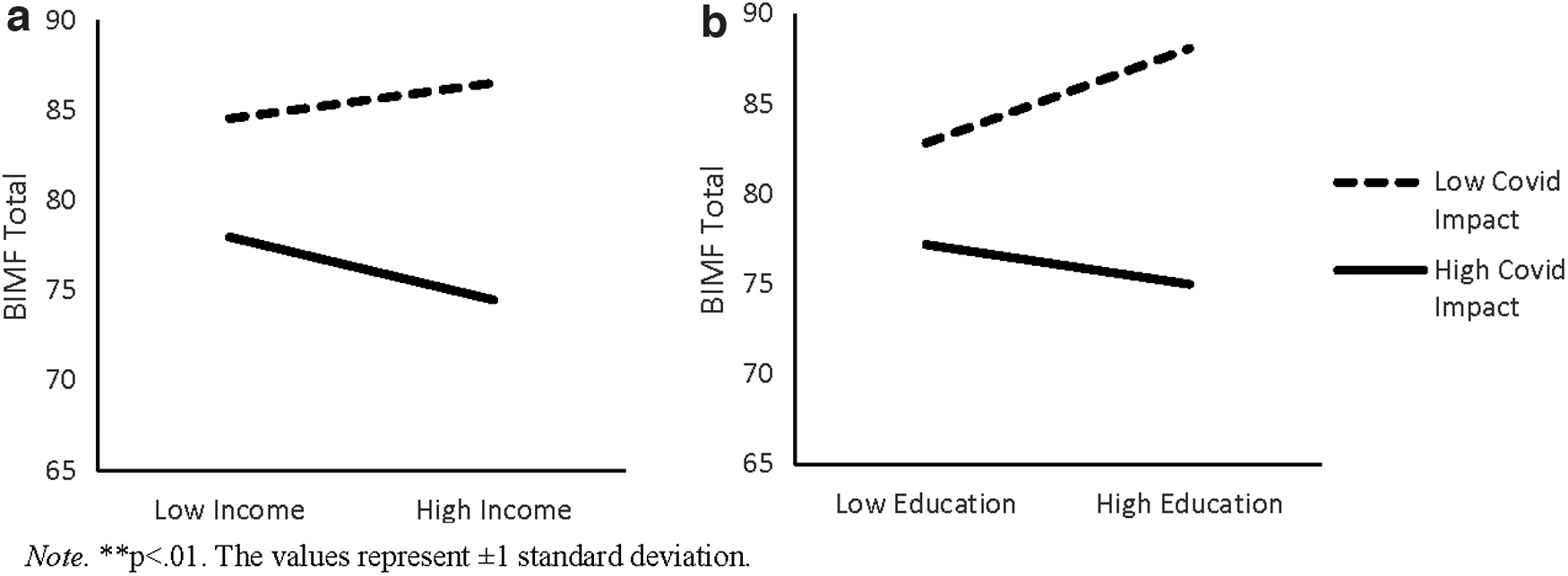
Interactions between SES and COVID-19 Impact predicting maternal functioning.
Similarly, income and COVID-19 Impact accounted for a significant amount of variance in maternal competency, R 2 = 0.04, F(3, 818) = 9.92, p < 0.001, and the interaction between income and COVID-19 impact explained a significant amount of variance in maternal competency, ΔR 2 = 0.01, F(1, 818) = 5.43, p = 0.02 (Fig. 2a). As given in Figure 2a, when COVID-19 Impact was low (−1 SD), maternal competency was higher regardless of income, but when COVID-19 Impact was high (+1 SD), mothers with higher incomes reported lower levels of competency than mothers with lower incomes.

Interactions between SES and COVID-19 Impact predicting maternal competency.
Income and COVID-19 Impact also accounted for a significant amount of variance in maternal self-care, R 2 = 0.10, F(3, 818) = 31.0, p < 0.001, and the interaction between income and COVID-19 impact explained a significant amount of variance in maternal competency, ΔR 2 = 0.01, F(1, 818) = 5.36, p = 0.02 (Fig. 3a). As given in Figure 3a, when COVID-19 Impact was low (−1 SD), maternal self-care was higher and slightly more so for higher income mothers, but when COVID-19 Impact was high (+1 SD), mothers with higher incomes reported lower levels of self-care than mothers with lower incomes. Most of these interactions were contrary to hypotheses.

Interactions between SES and COVID-19 Impact predicting maternal self-care.
Next, education and COVID-19 were examined as predictors of maternal functioning. The overall model including education and COVID-19 Impact accounted for a significant amount of variance in maternal functioning overall, R 2 = 0.12, F(3, 856) = 37.7, p < 0.001. The interaction between education and COVID-19 impact explained a significant amount of variance in maternal functioning overall, ΔR 2 = 0.02, F(1, 856) = 16.28, p < 0.001 (Fig. 1b). As given in Figure 1b, when COVID-19 Impact was low (−1 SD), reports of maternal functioning were higher overall, and mothers with more education reported the highest levels, but when COVID-19 Impact was high (+1 SD), mothers with more education reported lower levels of functioning than mother with less education.
Similarly, the overall model including education and COVID-19 Impact accounted for a significant amount of variance in maternal competency, R 2 = 0.05, F(3, 856) = 14.6, p < 0.001, and the interaction between education and COVID-19 impact explained a significant amount of variance in maternal competency, ΔR 2 = 0.02, F(1, 856) = 16.8, p < 0.001 (Fig. 2b). As shown in Figure 2b, when COVID-19 Impact was low (−1 SD), reports of maternal competency were higher overall, especially among mothers with higher levels of education, but when COVID-19 Impact was high (+1 SD), mothers with more education reported lower levels of competency than mother with less education.
Finally, the overall model including education and COVID-19 Impact accounted for a significant amount of variance in maternal self-care, R 2 = 0.12, F(3, 856) = 39.32, p < 0.001, and the interaction between education and COVID-19 impact explained a significant amount of variance in maternal self-care, ΔR 2 = 0.004, F(1, 856) = 4.09, p < 0.04 (Fig. 3b). As given in Figure 3b, when COVID-19 Impact was low (−1 SD), reports of maternal self-care were higher overall, and mothers with higher levels of education reported the highest levels, but when COVID-19 Impact was high (+1 SD), mothers' reports of self-care were more similar regardless of education.
Psychological distress
Regressions (Table 5) showed that income was not associated with depression or stress, but that more income was associated with lower anxiety. More education was associated with lower levels of depression and anxiety, but not stress. The regression analyses once again indicated a significant main effect of COVID-19 impact on each of the three DASS variables. Only the results for the stress subscale were qualified by significant interactions between income, education, and COVID-19 Impact.
Regression for Socioeconomic Status Predicting Depression, Anxiety and Stress
N = 822. We examined the effects of SES indicators on Depression, Anxiety, and Stress.
n = 822.
n = 860.
p < 0.01.
p < 0.05.
Specifically, the overall model including income and COVID-19 Impact accounted for a significant amount of variance in stress, R 2 = 0.17, F(3, 818) = 57.3, p < 0.001. The interaction between income and COVID-19 impact explained a significant amount of variance in stress, ΔR 2 = 0.01, F(1, 818) = 5.11, p = 0.02 (Fig. 4a). As given in Figure 4a, like the patterns observed for maternal functioning, when COVID-19 Impact was low (−1 SD), reports of stress were lower overall, and mothers with higher incomes reported the lowest levels. However, when COVID-19 Impact was high (+1 SD), mothers with higher incomes reported more stress than mothers with lower incomes.

Interactions between SES and COVID-19 Impact predicting stress.
Similarly, the overall model including education and COVID-19 Impact accounted for a significant amount of variance in stress, R 2 = 0.17, F(3, 856) = 60.0, p < 0.001, and the interaction between education and COVID-19 impact explained a significant amount of variance in stress, ΔR 2 = 0.01, F(1, 856) = 8.06, p = 0.008 (Fig. 4b). As given in Figure 4b, similar to the patterns observed for maternal functioning, when COVID-19 Impact was low (−1 SD), reports of maternal stress were lower overall, and mothers with more education reported the lowest levels. However, when COVID-19 Impact was high (+1 SD), higher stress was reported, regardless of education level.
Discussion
This study contributes to the growing literature on the challenges of parenting young children by examining maternal functioning and psychological distress during the COVID-19 pandemic. Our first aim was to understand associations among the maternal functioning variables, psychological distress, COVID-19 Impact, and SES. We found that, on average, participants endorsed a moderate amount of financial, resource, and psychological impact related to COVID-19. As predicted, there was wide variability with regard to COVID-19 impact and this finding makes sense given the demographic, geographic, and socioeconomic diversity of our sample. 37
In line with our hypotheses, higher levels of maternal functioning, maternal competence, and self-care were associated with lower levels of psychological distress. Higher COVID-19 Impact was associated with both poorer maternal functioning and greater psychological distress. Although the cross-sectional nature of the data do not allow for causal interpretations, these findings highlight the interconnected nature of the magnitude of the pandemic as a stressor for individuals, mothers' perceptions of their parenting and self-care, and their reports of psychological distress. Moreover, extant literature examining traumatic events suggests that chronicity of the stressor plays a role in one's recovery. 38
When we explored relationships between mothers' SES, psychological distress, and correlates of their functioning, we found that lower SES was associated with higher levels of COVID-19 impact, lower levels of maternal functioning, competency, and self-care, as well as greater psychological distress. Our result that lower SES was associated with more psychological distress differs from other data collected during the pandemic 15 and suggests that lower SES contributes to vulnerability in certain ways. However, our finding that lower SES mothers were not more likely to endorse lower levels of maternal competence was contrary to our hypothesis and indicates that socioeconomic disadvantages do not undermine mothers' perceptions of their skill and success in parenting.
The findings that lower SES mothers were more likely to experience more COVID-19 impact 13 and lower levels of self-care 28 fit with the emerging literature. Moreover, for mothers with lower SES, the range of possible self-care activities available to them may have been reduced by social isolation, disruption of services owing to the pandemic, and financial limitations. Comparing our two indicators of SES, it is interesting to note that education was more strongly correlated with self-care than income. Whereas the common conception of self-care activities is that they are expensive, this unanticipated finding suggests that self-care includes a broader range of activities.
Finally, we examined the influence of COVID-19 impact to examine how mothers across the SES spectrum experienced this period of high stress. It is no surprise that when COVID-19 impact was low, high-SES mothers had more favorable outcomes than low-SES mothers. In probing the findings further, we found that COVID-19 impact moderated the relationship between SES and one's rating of their maternal competency such that when COVID-19 impact was low, high-SES moms endorsed higher levels of competency relative to moms of low SES; however, when COVID-19 impact is high, high-SES mothers endorsed lower levels of competency relative to moms with low SES. A similar pattern was observed for mothers' ratings of stress. These findings suggest that high SES is not serving as a buffer against stress and threats to maternal competency when COVID-19 impact is high.
These results may be explained by the endowment effect that posits that high resource individuals' expectation that they will have a consistent availability of resources may set them up for experiencing greater declines in wellbeing in times of crisis when their resource supply may be threatened or diminished. 39,40 For high-SES mothers specifically, the significant reduction in access to outsourced childcare or housework may have been experienced more acutely because they were dependent on these supports for daily functioning 41 as a parent before the pandemic. In prepandemic dual-earner, different-sex couples, mothers report that the bulk of the childcare was relegated to them during COVID-19 by default largely because of gendered cultural and societal structures that discouraged negotiation about childcare with their partners or seeking nonparental childcare support. 1
It is possible that low-SES mothers do not hold the same expectation of consistent access to resources because they have experienced precarity before. 42,43 Likewise, this finding may be further explained by low-SES mothers use of more informal childcare such as obtaining support from family members or neighbors 44 and as such, these sources of childcare may not have been as impacted as formal daycare centers during the pandemic. 45 In addition, this result supports emerging research suggesting that lower SES may engender greater resilience in the face of stressful events. 15
In line with our hypotheses, we also found that COVID-19 impact moderated the relationship between education, income, and maternal self-care. When COVID-19 impact was low, moms with higher levels of education or income reported more self-care, but when COVID-19 impact was high, all moms endorsed lower levels of self-care. A prepandemic study examining stress and self-care behaviors with front-line family service providers similarly found that when stress levels were high, people engaged in less self-care. 27 However, they did not control for people's income or education, so more research is needed to examine the interplay of SES, stress, and self-care.
This study has several strengths and limitations. A first strength is that we examined maternal functioning and psychological distress with mothers with varied incomes and education across the socioeconomic spectrum early in the COVID-19 pandemic. Despite using strategies to target women from diverse racial backgrounds with multiple iterations of our social media ad campaigns, our study failed to recruit a sufficiently diverse racial or ethnic sample, so future research that explores these outcomes with mothers from minority backgrounds is needed.
Another strength of this work is that it adds to the growing body of research on maternal functioning. A systematic review showed that monitoring maternal functioning throughout the postpartum period is a useful indicator of physical and psychological recovery following birth. 46 However, research on maternal functioning has tended to lack socioeconomic diversity, rarely presenting the opportunity to compare women with high and low resources. This study contributes to filling this gap. Also, whereas previous research focuses on a narrower timeframe, our investigation expands the study of maternal functioning to include mothers of young children beyond the postpartum period.
In terms of limitations, this is a cross-sectional study that captures a snapshot of the COVID-19 pandemic experience, and as such it cannot be inferred that maternal functioning and psychological distress are determined by socioeconomic factors alone. Future research using longitudinal designs would offer stronger contributions to the literature by elucidating trajectories of maternal functioning and mental health during the pandemic. Finally, our sample is not representative of U.S. sociodemographics; results for each group should be interpreted cautiously. Moreover, future studies may benefit from examining race with a more specific lens of racial identity and intersectionality 47 to capture the nuance and improve applicability to postpartum mothers from minority backgrounds.
Conclusion
This study reveals the importance of examining socioeconomic factors such as education and income when characterizing maternal functioning during the pandemic. Income and education were positively correlated with maternal self-care, but not maternal competency. However, the impact of COVID-19 on these factors is important to consider. Contrary to predictions, we found that when highly impacted by COVID-19, mothers with high SES endorsed lower levels of functioning, maternal competence, and higher levels of stress. Future research is needed to understand how mothers across the SES spectrum experience prolonged periods of stress to develop prevention and treatment strategies to address the needs of this vulnerable population.
Footnotes
Disclaimer
The results of this project have not been published previously in any form. No outside contributors/sponsors were involved in the preparation or submission of this work.
Author Disclosure Statement
No competing financial interests exist.
Funding Information
This research was funded by a Faculty Research and Development Grant from Hofstra University.