




Abstract
Background:
This study examined the association between sedentary behavior, sleep duration, breakfast skipping, and abdominal obesity among postmenopausal women in South Korea.
Materials and Methods:
A total of 7,270 postmenopausal women were included in this cross-sectional, secondary analysis study, using a nationally representative dataset from the Korea National Health and Nutrition Examination Survey.
Results:
Sleep duration of fewer than 5 hours/day was associated with an increased risk of abdominal obesity (odds ratio [OR] = 1.29; 95% confidence interval [CI], [1.02–1.63]), compared to sleep duration of 6–8 hours/day after controlling for covariates. Additionally, breakfast skipping was associated with an increased risk of abdominal obesity (OR = 1.45; 95% CI [1.02–2.06]), compared to breakfast eating after covariate adjustment. There was no significant association between sedentary behavior and abdominal obesity.
Conclusions:
The findings of this study demonstrate that special consideration should be given to behavior modification strategies to improve sleep duration and decrease breakfast skipping to decrease the risk of abdominal obesity in postmenopausal women.
Introduction
The fourth industrial revolution led to global changes in industry and urbanization that dramatically changed people's lifestyles, which included long periods of sitting, short sleep duration, and fast-food consumption that pose a significant health threat and increase obesity. 1 However, these lifestyle changes pose a significant health threat and have affected obesity. Obesity prevalence in South Korea (hereafter, Korea) increased from 35.6% in 2009 to 45.4% in 2018. 2 As time spent at home increased due to the COVID-19 pandemic, obesity is becoming a more severe problem, and it is reported that 4 in 10 adults gained 3 kg or more in weight compared to before the pandemic as of April 2021. 3
Obesity is largely divided into gluteal and abdominal types, with the latter being more problematic. Even with normal or identical body mass index (BMI) values, metabolic risk increases as waist circumference increases. 4 Subsequently, waist circumference is more critical as a measure of cardiovascular disease, some cancers, and risk of deaths 5,6 as opposed to BMI, and more attention needs to be paid to abdominal obesity than gluteal obesity. Premenopausal women usually have more gluteal obesity, but after menopause, the obesity pattern shifts to abdominal obesity. 7 This is believed to be due to changes in adipose tissue metabolism caused by relative hyperandrogenemia after a decrease in estrogen. 7 A previous study also demonstrated that waist circumference increased more in postmenopausal women than in premenopausal women. 8 Therefore, it is necessary to examine the risk of abdominal obesity according to postmenopausal women's lifestyles.
One of the causes of abdominal obesity is the recent increase in sedentary behaviors, 2 which are associated with a lack of physical activity, a risk factor for diseases. 9 The longer the sedentary time, the higher the obesity risk, 10 and a significant association between long sedentary time and abdominal obesity in women has been reported. 11 However, it should be noted that the correlation between sitting during work or leisure time and obesity was not significant among working women. 12 While studies on sedentary behavior and abdominal obesity have primarily targeted adult women of certain age groups 11 and working adult women aged 18–59 years, 12 few studies have demonstrated how the waist circumference changes according to postmenopausal women's sedentary behaviors.
Among the lifestyle factors that contribute to abdominal obesity, previous research on sleep duration 13,14 has been inconsistent. A study using the Korea National Health and Nutrition Examination Survey (KNHANES) reported that the risk of abdominal obesity was higher in a group with less than 5 hours of sleep and a group with more than 9 hours of sleep compared to a group with 6–8 hours of adequate sleep in adult women under the age of 65. 13 However, a study of adults aged 20–80 demonstrated that sleep duration was a risk factor for increased waist circumference only in the short sleep duration group. 14
Having breakfast plays a role in maintaining the meal balance of a day. Breakfast skipping also affects lunch and dinner, 15 and is thought to impact weight loss. Paradoxically, however, it can cause weight gain 16 and obesity risk, 17 and abdominal obesity risk. 18 As previous studies on breakfast skipping and abdominal obesity have mainly targeted adults, 18 the present study focused on whether breakfast skipping affects abdominal obesity among postmenopausal women.
Previous studies on the association between menopause and abdominal obesity have targeted middle-aged women 19 or certain age groups. 20 Only one study has targeted abdominal obesity in Korean postmenopausal women. 21 No previous studies have examined the association between lifestyle habits, such as sitting, sleeping, and eating, and abdominal obesity only among postmenopausal women in Korea. Therefore, this study addresses a gap in the literature by providing basic data on factors related to lifestyle habits associated with abdominal obesity in postmenopausal women using data from the KNHANES, which includes a nationally representative sample of the Korean female population. The findings will have utility for interventions and prevention related to abdominal obesity in postmenopausal women.
The purpose of this study was to identify the factors related to lifestyle habits affecting abdominal obesity in postmenopausal women.
Materials and Methods
Study data and study participants
The KNHANES has been conducted since 1998 by the Korea Centers for Disease Control and Prevention (KCDC) to identify the health and nutritional status of Koreans. It is a cross-sectional and nationally representative study targeting non-institutionalized Korean people that consists of health, nutrition, and checkup surveys. The health survey and nutrition survey were conducted through one-on-one interviews and a self-administered questionnaire. The checkup survey is a physical examination conducted by the Center for the KCDC's specialized survey team. A stratified multistage cluster probability design was used to draw samples from the entire population to represent the Korean people.
This study used data from the second year of the sixth (2014) to the first year of the eighth (2019) KNHANES, which included 47,309 participants. Among these participants, postmenopausal women aged 19 or older were selected first. Then, women diagnosed with cancer or with thyroid disease were excluded because chemotherapy and radiation therapy due to cancer may affect menopause and weight loss. Additionally, premenarchal women, pregnant women, and women with artificial menopause were excluded. Finally, cases with missing values were excluded. The final sample consisted of 7,270 postmenopausal women (Fig. 1).
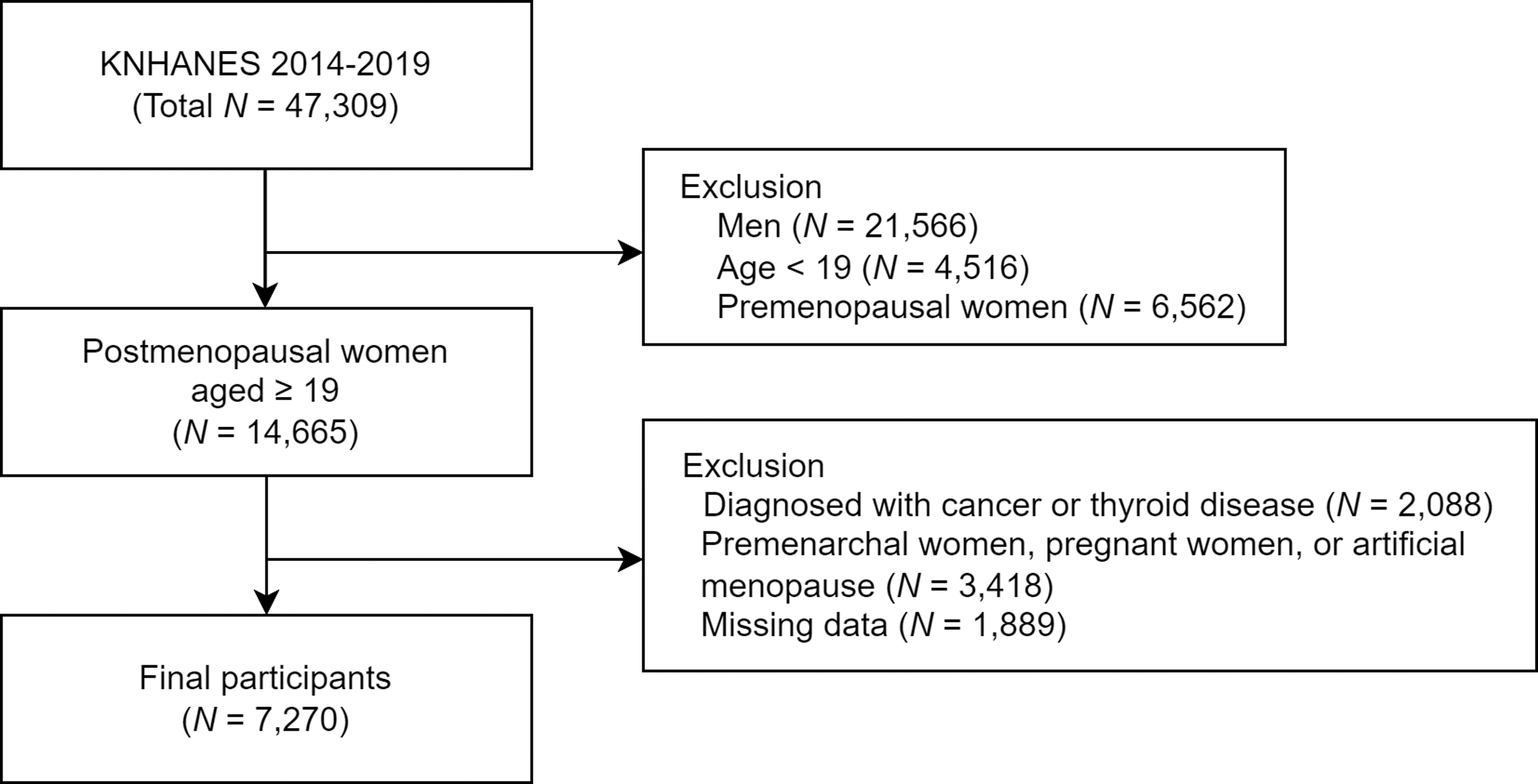
Flow chart of the study population. KNHANES, Korea National Health and Nutrition Examination Survey.
Measures
Abdominal obesity
The waist circumference value from the physical examination was used to assess abdominal obesity. Abdominal obesity was defined as a waist circumference of 85 cm (33.46 inches) or more according to the abdominal obesity criteria for Korean women presented by the Korea Society for the Study of Obesity (KSSO). 22 Those participants with a waist circumference of less than 85 cm were considered as not having abdominal obesity.
Sedentary behavior
For sedentary behavior, answers to the question “How many hours do you usually sit or lie down in a day (excluding sleeping time)?” were used. The answers were written in hours and minutes, which were converted into hours per day for use in this study. Regarding the report of a previous study that the average sedentary time of adult women is 8.1 hours, 23 and findings illustrating that sedentary time of 9 hours or more increases the 10-year risk of cardiovascular disease, 24 sedentary behavior was classified into 5 hours or less, 6–8 hours, and 9 hours or more.
Sleep duration
For sleep duration, answers to the question “How many hours do you usually sleep in a day?” were used. In the 8th (2019) and seventh (2016–2018) KNHANES, the questions were divided into weekdays and weekends, so the weekdays and weekends were calculated according to the ratio of days. In the sixth (2014–2015) KNHANES, questions were not divided into weekdays and weekends, so the answers were used as they are. Sleep duration was classified into 5 hours or less, 6–8 hours, and 9 hours or more. 13
Skipping breakfast
For breakfast skipping, answers to the question “How many times a week did you eat breakfast last year?” were used. If the participant responded with “0 times a week,” they were classified into the breakfast skipping group and the remaining participants who responded with “at least once a week” were classified into the breakfast eating group.
Covariates
Concerning variables related to abdominal obesity in previous studies,
2,4,21,25
–27
general characteristics were selected from the demographic, socioeconomic, and health behavior factors of the study population. Age was included as a demographic factor, and household income, education level, marital status, and occupational status were included as socioeconomic factors. Household income was classified into lower, lower-middle, upper-middle, and upper using monthly average household equalized income (monthly average household income/
Health behavior factors included drinking frequency, smoking status, physical activity, BMI, hypertension, and diabetes. Based on the answers to drinking frequency for 1 year, drinking frequency was classified into four groups: no drinking at all in the last year, less than once a month, two to four times a month, and more than twice a week. Smoking status was classified into non-smokers, former smokers, and current smokers. Regarding physical activity, participants who performed at least 2 hours and 30 minutes of moderate-intensity physical activity per week, or more than 1 hour and 15 minutes of high-intensity physical activity, or a mix of moderate-intensity and high-intensity physical activities were classified into “Yes,” and others were classified into “No.” The BMI was calculated using weight (kilogram) as the square of the height (meter), 2 and the presence or absence of hypertension or diabetes was based on a doctor's diagnosis.
Statistical analysis
The mean and standard error for the continuous variables and percentage and standard error for the categorical variables were calculated. Differences in abdominal obesity for the general characteristics were tested using the t-test and χ 2 test. The χ 2 test was used to determine abdominal obesity differences according to sedentary time, sleep duration, and breakfast skipping. A logistic regression analysis was performed to explain the association of abdominal obesity with sedentary time, sleep duration, and breakfast skipping after adjusting for the covariates that were found to be significant. SAS 9.4 (SAS Institute Inc., Cary, NC, USA) was used to analyze the data. The level of statistical significance was set at .05.
Ethical approval
All processes of the KNHANES were carried out in compliance with the 1964 Helsinki declaration and were performed with the approval of the Institutional Review Board of the Korea Centers for Disease Control and Prevention (No. 2013-12EXP-03-5C, 2018-01-03-P-A, 2018-01-03-C-A). However, according to the Institutional Review Board of the Korea Centers for Disease Control and Prevention, the third year of KNHANES VI (2015) and the first and second years of KNHANES VII (2016, 2017) correspond to government research conducted by the government for public welfare, so it was possible to carry out without deliberation in that year. This study used data from KNHANES VI (2014–2015) to VIII (2019), which received official ethical approval.
Results
Abdominal obesity according to general characteristics
The general characteristics of the participants with abdominal obesity were compared to the characteristics of the participants who did not have abdominal obesity. There were statistically significant differences between the two groups concerning age, household income, education level, marital status, occupational status, drinking frequency, physical activity, BMI, and presence or absence of hypertension and diabetes. The abdominal obesity group's average age was higher, and the mean BMI was also higher. Abdominal obesity was higher in women with low household income and level of education; those who were single, divorced, separated, or widowed; unemployed; physically inactive; diagnosed with hypertension or diabetes; and who did not drink alcohol in the past year. There was no significant difference according to smoking status (Table 1).
Abdominal Obesity in Postmenopausal Women According to General Characteristics (N = 7,270)
Results in boldface indicate a statistical significance.
Data were analyzed using a Student's t-test and chi-squared test.
BMI, body mass index; SE, standard error.
Abdominal obesity according to sedentary behavior, sleep duration, and breakfast skipping
There was a significant difference in abdominal obesity according to sedentary time and sleep duration. With sedentary behavior of 5 hours or less, the prevalence of abdominal obesity was 26.4%, which was lower than that of the group without abdominal obesity (36.0%). At 9 hours or longer, the prevalence of abdominal obesity was 44.6%, which was higher than that of the group without abdominal obesity (35.3%). With sleep duration of 5 hours or less, the prevalence of abdominal obesity was 20.6%, which was higher than that of the group without abdominal obesity (15.1%). At 9 hours or longer, the prevalence of abdominal obesity was 11.1%, which was higher than that of the group without abdominal obesity (9.9%). The prevalence of abdominal obesity according to breakfast skipping did not demonstrate a significant result (Table 2).
Abdominal Obesity According to Sedentary Behavior, Sleep Duration, and Breakfast Skipping
Results in boldface indicate a statistical significance.
Data were analyzed using a chi-squared test.
Association of sedentary behavior, sleep duration, breakfast skipping, and abdominal obesity
A logistic analysis was performed to verify the association of sedentary behavior, sleep duration, breakfast skipping, and abdominal obesity. Before adjusting for the confounding variables (Model 1), sedentary time had a significant association with abdominal obesity, but it was found that there was no association after adjusting for the confounding variables (Model 2). Concerning sleep duration, less than 5 hours of sleep and more than 9 hours of sleep had a significant association with abdominal obesity before adjusting for the confounding variables. In the adjusted model, only less than 5 hours of sleep duration had a significant association with abdominal obesity. The risk of abdominal obesity was 1.29 times higher in the group with less than 5 hours of sleep duration than the group with 6–8 hours. In the unadjusted model, breakfast skipping did not have a significant association with abdominal obesity, but there was a significant association after adjusting for the covariates. The risk of abdominal obesity was 1.45 times higher for those who skipped breakfast than those who ate breakfast (Table 3).
Association of Sedentary Behavior, Sleep Duration, Breakfast Skipping, and Abdominal Obesity
Model 1 was not adjusted. Model 2 was adjusted for age, household income, education, marital status, occupation, drinking, physical activity, BMI, hypertension, and diabetes mellitus. Data were analyzed using logistic regression. Results in boldface indicate a significant association with abdominal obesity.
CI, confidence interval; OR, odds ratio.
Discussion
This study provided basic data for interventions and prevention relative to abdominal obesity in postmenopausal women by identifying the association between abdominal obesity and sedentary behavior, sleep duration, and breakfast skipping. This study's findings demonstrated differences in abdominal obesity according to age, household income, education level, marital status, occupational status, drinking frequency, physical activity, BMI, and presence or absence of hypertension and diabetes. Specifically, compared to women with no abdominal obesity, women with abdominal obesity have a lower level of household income and education, which is consistent with Zhang et al's study. 26 Additionally, in this study, abdominal obesity was more common in divorced, separated, or widowed women, which is consistent with the findings of a study on Asian American adults reporting that 12.5% of divorced, separated, or widowed women had abdominal obesity compared to 6.6% who did not have abdominal obesity. 25
However, in this study, there was no significant association between abdominal obesity and smoking status, which differs from a previous study in China 28 that demonstrated a difference in the prevalence of abdominal obesity according to non-smoking, past smoking, and current smoking among adult women. In China, women aged 18 or older had higher abdominal obesity in the order of former smokers, current smokers, and non-smokers, while in the present study, it was higher in the order of non-smokers, former smokers, and current smokers. This difference is related to the tendency that the smoking rate among Korean women decreases after their 40s. Thus, the results may differ because this study targeted postmenopausal women with a relatively low smoking rate.
This study also demonstrated that the risk of abdominal obesity decreased when sedentary behavior was less than 5 hours, and the risk of abdominal obesity increased when sedentary behavior was more than 9 hours, which was not statistically significant, after adjusting for covariates. Although it is difficult to make a direct comparison because there is no study on only postmenopausal women, these results are partially consistent with the findings of Yuan et al, 12 in which there was no association between sedentary time and obesity or weight gain in working women. Contrary to the findings of this study, Zhang et al 11 found that sedentary time affected abdominal obesity in more than 9 hours compared to less than 6 hours in women aged 20–64.
However, the difference in the results may be due to the inclusion of premenopausal women as participants, and the study population was women from the United States with a different average sedentary time and the prevalence of abdominal obesity than in Korea. Additionally, sedentary time was found to be associated with abdominal obesity when it was more than 8 hours compared to less than 8 hours in a sample of men and women aged 65–80. 10 However, this result differs from the present study because the prevalence of abdominal obesity is relatively higher in men, 2 and the study population included men and women. 10 If the fact that reduced energy consumption in postmenopausal women may cause obesity 8 is considered together with the findings of this study, it is thought that the intensity of physical activity, physical activity status, or other factors have a greater influence on abdominal obesity of postmenopausal women than sedentary time.
This study's findings demonstrated that the prevalence of abdominal obesity according to sleep duration was higher in the group with less than 5 hours of sleep compared to the group with 6–8 hours and the group with more than 9 hours. However, after adjusting for the confounding variables in the general characteristics, there was a significant association only in the group with less than 5 hours of sleep. These findings are similar to the findings of a study of Chinese adults that found those who slept for less than 6 hours had an increased risk of abdominal obesity compared to those who slept for 7 hours. 29 Additionally, the findings are partially consistent with the findings of Mamalaki et al. 30 demonstrating a negative relationship between sleep duration and waist circumference in women over the age of 65, and Haghighatdoost et al's study 31 of female college students in which those who slept for less than 6 hours had an increased risk of abdominal obesity compared to those who slept for more than 8 hours.
However, it is difficult to make a direct comparison because of the participants' differences in age and menopausal status. Additionally, the present study's findings are contrary to those of a previous study targeting middle-aged women after menopause in which no association was found between sleep duration and abdominal obesity. 21 That study targeted only middle-aged women and set the sleep duration to be less than or more than 8 hours, so these differences between the studies are thought to contribute to the different findings.
The increased risk of abdominal obesity in short sleep can be explained by how the lack of sleep affects circadian rhythms. 32 Lack of sleep can decrease leptin, an appetite suppressant hormone, and increase the level of ghrelin, an appetite promoting hormone, affecting weight gain. 33 Additionally, the findings of this study are partially consistent with the results of an experimental study demonstrating that a sleep restriction of fewer than 5 hours affected weight gain in healthy adult women. 34 Therefore, to reduce abdominal obesity in postmenopausal women, it is necessary to educate and promote proper sleep time.
This study's findings demonstrated that the risk of abdominal obesity in postmenopausal women was significantly higher in the breakfast skippers compared to the breakfast eaters. Although a direct comparison is difficult due to the lack of prior studies targeting postmenopausal women, one study demonstrated that breakfast skipping increases the risk of abdominal obesity in adult women 18 and another demonstrated it increases the risk of obesity. 35 Although the mechanism underlying the relationship between breakfast skipping and abdominal obesity is unclear, it is believed that breakfast skipping affects the hepatic circadian clock (the liver clock), which affects metabolism. 36 Another explanation is that breakfast skipping increases overeating at lunch and dinner as a compensatory metabolic mechanism, 15 thereby affecting abdominal obesity. Nevertheless, the research and present findings suggest that it is important for women after menopause to develop a habit of eating breakfast.
However, the results of a 5-year longitudinal study indicated that breakfast skipping was not associated with abdominal obesity in women, 37 and the findings of a cohort study demonstrated that breakfast skipping was not associated with obesity. 38 The reason for this discrepancy with this study's findings might be due to the difference in the definition of breakfast skipping. 39 For example, the frequency of skipping breakfast in the longitudinal study 37 was categorized as “lower skipping frequency (0–3 times/week), and higher skipping frequency (4–7 times/week),” while that of the cohort study 38 was categorized as “eating almost every day, skipping occasionally, skipping often, and usually skipping.” However, this study's breakfast skipping group consisted of those who responded with “0 times/week.”
Furthermore, the calories and quality of meals were not considered. Additionally, an important consideration is the reason for breakfast skipping. Surveying the reasons for skipping meals would provide more specific content when developing a program to prevent abdominal obesity in postmenopausal women. Given that overeating in the late evening is associated with obesity, 40 it is necessary to examine the effect of overeating in the late evening and breakfast skipping on abdominal obesity together. Therefore, a follow-up study is required to understand the association between breakfast skipping and abdominal obesity in postmenopausal women in consideration of these factors.
This study has the following limitations. First, while examining the association between sleep duration and abdominal obesity, sleep quality was not considered. Second, breakfast skipping was dichotomized into those who skipped and those who did not, but the frequency per week, quantity, and quality of the meals were not assessed. Third, because the study was based on a cross-sectional survey of Koreans, the results might not be generalizable to postmenopausal women from other countries. Lastly, data on the main variables were collected through self-report of prior behavior. There is the possibility of recall bias.
Despite these limitations, this study is of significance as it analyzed the risk of abdominal obesity based on lifestyle habits, such as sedentary behavior, sleep duration, and breakfast skipping, in postmenopausal women using the KNHANES dataset, a survey that provides standardized data on representative samples of the Korean population and has utility for public health initiatives. This study's results are useful when developing education or intervention programs to reduce the risk of abdominal obesity in postmenopausal women.
Conclusion
This study analyzed the association between sedentary behavior, sleep duration, and breakfast skipping, which are important lifestyle habits, and abdominal obesity in postmenopausal women. The results demonstrated that short sleep duration and breakfast skipping were abdominal obesity risk factors, whereas sedentary behavior was not a significant risk factor. Thus, a healthy lifestyle is an important factor in preventing abdominal obesity in postmenopausal women. Getting an adequate amount of sleep and eating breakfast can lower the risk of abdominal obesity in postmenopausal women. Public health education and promotion are required to address this health-related issue, and this study's findings have utility for developing abdominal obesity prevention and intervention programs for women after menopause. We also suggest further research to determine the effect of breakfast skipping and overeating at night on abdominal obesity in postmenopausal women.
Footnotes
Acknowledgments
The authors cordially thank the Korea Centers for Disease Control and Prevention for conducting the Korea National Health and Nutrition Examination Survey and all participants.
Author Disclosure Statement
No competing financial interests exist.
Funding Information
This research was supported by a Chung-Ang University Graduate Research Scholarship in 2021.