




Abstract
Objective:
The gendered impact of the COVID-19 on scientific productivity has been primarily studied in nonclinical academic fields. We investigated the gendered effect of the pandemic on diverse measures of research participation among physician faculty, who experienced an increase in clinical duties concomitant with pandemic-era challenges to research.
Materials and Methods:
Physician faculty employed in both 2019 (prepandemic) and 2021 (pandemic era) were identified at one U.S. medical school. Annual outcomes included scientific publications, Institutional Review Board (IRB)-approved protocols, and extramural funding submissions (funding data were unavailable for 2019). Mixed-effects Poisson regression models compared the pandemic impact by gender.
Results:
The study included 105 women and 116 men, contributing to 122 publications, 214 IRB protocols, and 99 extramural funding applications. Controlling for potential confounders such as faculty rank and track (tenure vs. nontenure), women's publication count increased by 140% during the pandemic (95% confidence interval [CI]: +40% to +310%, p = 0.001) but was unchanged among men (95% CI: −30% to +50%; p > 0.999). The number of IRB protocols decreased from 2019 to 2021, but to a greater extent among men than women. In 2021, there was no gender difference in the number of extramural funding submissions.
Conclusions:
Among physician faculty at our medical school, women achieved parity with men on multiple measures of scholarly activity, and women's research productivity outpaced that of men in the same faculty track and rank. Targeted initiatives to support research among women faculty, junior investigators, and clinical investigators may have helped avert exacerbation of prepandemic gender disparities in research participation.
Introduction
The scientific response to the COVID-19 pandemic has generated an unprecedented volume of research activity, 1 –3 but the pandemic has also profoundly disrupted scientific careers. 4,5 From the initial impact of lockdowns and travel restrictions to the ongoing consequences of remote work and reallocation of research funding, the pandemic's effects have halted many ongoing scientific projects while limiting researchers' ability to pursue new directions in their work. Notably, some effects of the pandemic on scientific activity have amplified gender inequities in science, restricting women's participation in research more so than that of men.
Several reports have described that during the pandemic, women submitted disproportionately fewer articles to peer-reviewed journals and were underrepresented as authors and principal investigators (PIs) on pandemic-related research. 6 –9 These disparities in scholarly activity were likely due to women's significantly higher participation in caregiving during the pandemic (including child care, homeschooling, and elder care or care for sick family members), as compared with men. 10,11 Cumulatively, disparities in scientific activity during the pandemic present a risk for a “lost generation” of early career women investigators. 12,13
The gendered impact of the COVID-19 pandemic on scientific careers has been primarily studied in science, technology, engineering, and mathematics (STEM) fields, or in academia as a whole. 14,15 However, the consequences of the pandemic for research activity may have been especially severe for investigators in academic medicine. 16 First, this group of researchers faced not only pandemic-related restrictions on research activity, but also a concomitant increase in clinical duties. 16 Second, outside of a small number of well-funded institutions, physicians were limited in their ability to participate in pandemic-related research. 17
Therefore, it is possible that gender inequities in the pandemic's impact on research careers may have been especially pronounced among physician investigators. In this study, we analyzed gender differences in several measures of research productivity before and during the pandemic among physicians at a community-based U.S. medical school. We hypothesized that the prepandemic gender gap in physicians' scholarly publication 18 has widened during the COVID-19 pandemic, accompanied by lower rates of Institutional Review Board (IRB) protocol submission and extramural funding proposal submission among women as compared with men.
Materials and Methods
This study was approved with a waiver of consent by the IRB at East Carolina University (ECU). The Brody School of Medicine (BSOM) at ECU is a community-based medical school serving a predominantly rural area in eastern North Carolina, with a threefold mission of increasing the supply of primary care physicians for the state, improving the health of the eastern NC region, and increasing access to medical education for students from underrepresented and disadvantaged backgrounds. 19 A list of faculty eligible for this study was obtained from Health Sciences Human Resources (HSHR).
After a prior study of scholarly activity at our institution, 18 we included physician faculty appointed at >50% full-time equivalent (FTE) in BSOM before January 1, 2019, and still employed at BSOM as of December 31, 2021. Faculty without a medical degree, faculty with a primary appointment in BSOM administration, faculty appointed in the basic science departments, and faculty with part-time appointments at the beginning of the study period were excluded. Faculty at ≤0.50 FTE were not included as these faculty were likely to hold outside roles (e.g., private practice physicians with a part-time teaching appointment), and we were not able to account for the impact of these outside roles on faculty opportunities or barriers for research participation.
Research participation was analyzed in two periods: prepandemic (calendar year 2019) and pandemic-era (calendar year 2021). We did not analyze data from 2020 (the year in which pandemic-related lockdowns began in North Carolina) because publications and other research activity in this year were likely based on efforts begun before the pandemic. 20
The primary outcome was the number of publications recorded for each faculty member in the Scopus database. 18 The Scopus database was queried on January 1, 2022 for all BSOM-affiliated publications in 2019 and 2021, and article author data were cross-referenced with the list of BSOM faculty. Data were manually reviewed to resolve ambiguous or implausible match results. Secondary outcomes included the number of IRB protocols approved in each year, categorized by role (PI or faculty advisor, vs. co-investigator [Co-I]) and type of submission (full board review, expedited review, certified exempt, or certified not human subjects research); the number of submitted extramural funding proposals, categorized by role (PI vs. Co-I) and type of proposal (industry-funded clinical trials; federally funded projects; other sponsored projects).
Data on new IRB protocol approvals were obtained from the ECU IRB and cross-referenced with the list of physician faculty. Data on extramural funding proposals were obtained from a school-wide electronic research administration (eRA) system. Because the school adopted a new eRA in October 2019, extramural funding data were only reviewed in the pandemic-era period. Faculty characteristics were obtained from HSHR and included gender, race/ethnicity, faculty track (tenured/tenure track vs. nontenure track), faculty rank (junior rank [instructor or assistant professor] vs. senior rank [associate or full professor]), specialty (primary care vs. others), and % FTE appointment (100% vs. <100%). 18
Categorical data and continuous data were summarized separately for the prepandemic and pandemic-era periods, using counts with percentages, or medians with 10th–90th percentile ranges, as appropriate. Gender differences in study variables were evaluated in each period, using chi square tests, Fisher's exact tests, and rank-sum tests. To analyze the impact of the pandemic, we treated each year of data as a separate observation, and fit mixed-effects Poisson models that regressed the number of publications (or number of new IRB protocols) on era, gender, the interaction between era and gender (to estimate the differential impact of the pandemic), and other faculty characteristics.
A random intercept was included at the faculty level to account for other unobserved sources of variation in research activity across faculty members. Multivariable analysis of extramural funding in the 2021 data used a Poisson regression model of the number of submitted proposals, regressed on faculty gender and other characteristics. Data analysis was performed in Stata/SE 16.2 (StataCorp, LP, College Station, TX, USA), and p < 0.05 was considered statistically significant.
Results
We identified 221 faculty (including 105 women and 116 men) eligible for study inclusion. Demographic characteristics for the whole sample and stratified by gender are summarized in Table 1. Women were less likely than men to be appointed on the tenure track (34% vs. 52%, p = 0.009), and were more likely to hold a junior faculty rank (52% vs. 32%, p = 0.002). In addition, women were more likely than men to hold appointments at <100% FTE (12% vs. 3%, p = 0.008). There were no differences by gender in specialty (primary care vs. all others) or race and ethnicity. Among the 221 faculty included in our study, we identified 49 unique publications and 129 IRB protocols in 2019; and 73 publications, 85 IRB protocols, and 99 extramural funding applications in 2021.
Characteristics of Faculty Included in the Study (N = 221 Faculty)
Family medicine, general internal medicine, or general pediatrics.
FTE, full-time equivalent.
Figure 1 summarizes faculty participation in each type of research activity by year and gender. In 2019, 10% of women faculty compared with 22% of men had a publication recorded in the Scopus database (p = 0.014), although by 2021, there was no longer a gender difference in whether faculty members had any publications (26% of women and 28% of men, p = 0.753). Considering the proportion of faculty with at least one IRB protocol approved in each year, this decreased from 37% in 2019 to 29% in 2021, although with no gender difference evident at either time point (p = 0.789 in 2019 and p = 0.225 in 2021). Data on extramural funding submissions likewise indicated that a similar proportion of women and men submitted at least one proposal in 2021 (22% vs. 21%, p = 0.826; data were not available for 2019). Additional bivariate comparisons of continuous study outcomes are shown in Supplementary Appendix Table SA1.
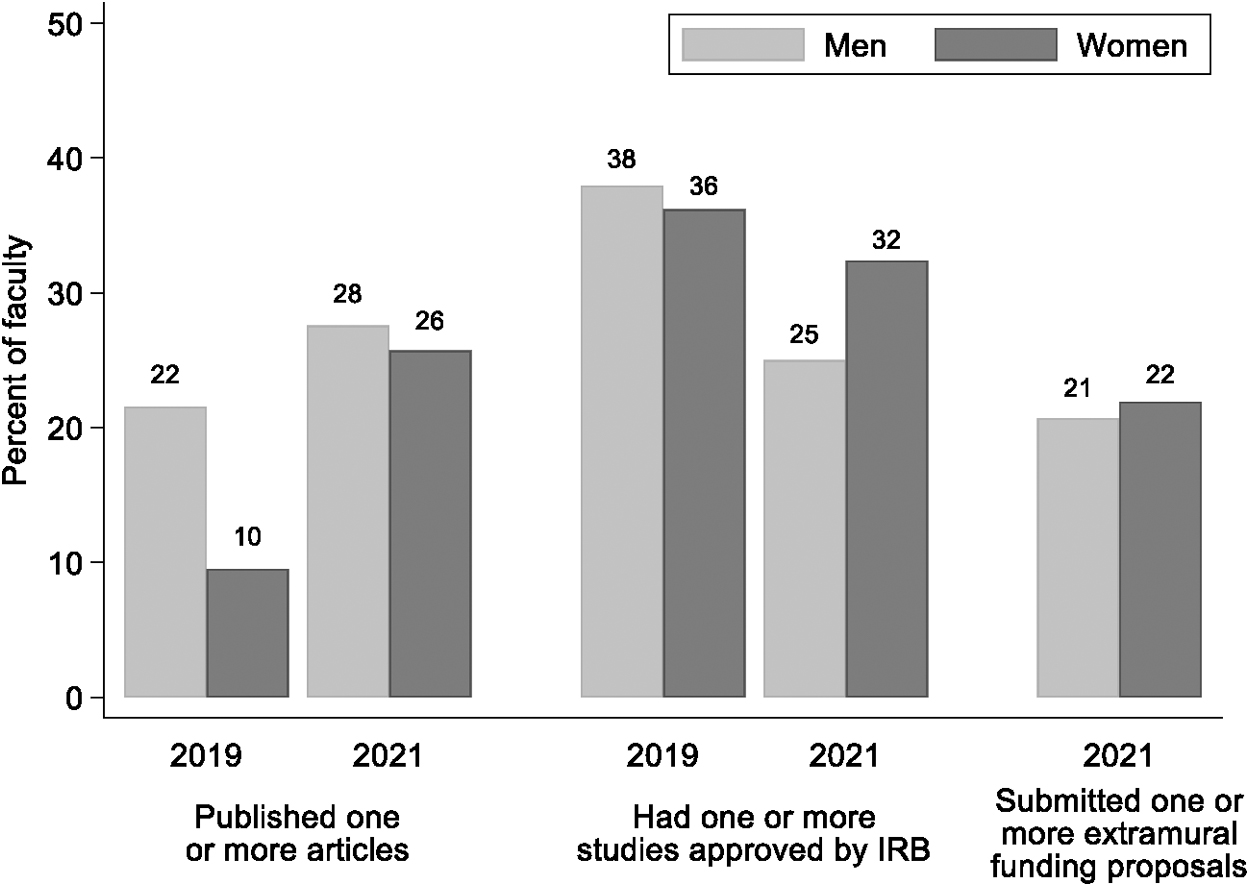
Clinical faculty research participation, by gender and year (N = 221 faculty).
Multivariable analyses of publications and IRB submissions are summarized in Table 2. Among women, the number of publications increased by 140% from 2019 to 2021 (incidence rate ratio [IRR]: 2.4; 95% confidence interval [CI]: 1.4–4.1; p = 0.001), whereas among men, there was no change in the number of publications during this period (p > 0.999). As a result, by 2021, women had ∼70% more publications than men after controlling for other faculty characteristics, although this difference did not reach statistical significance (IRR: 1.7; 95% CI: 1.0–2.91; p = 0.069). Considering other independent variables in this analysis, Asian as compared with White race/ethnicity; appointment in a tenured or tenure-track position; and senior as compared with junior faculty rank were each associated with increased number of publications each year (full model results, including covariate IRRs, are presented in Supplementary Appendix Table SA2).
Multivariable Mixed-Effects Poisson Regression Models of Number of Publications and Study Protocols Approved by the Institutional Review Board in Each Year (N = 442 Faculty-Years)
Each outcome was evaluated in a separate regression model. All models controlled for faculty race and ethnicity, track, rank, specialty, and %FTE.
The subset of IRB submissions certified “not human subjects research” was not analyzed separately due to low number of study applications in this category.
CI, confidence interval; Co-I, coinvestigator; FTE, full-time equivalent; IRB, institutional Review Board; IRR, incidence rate ratio; PI, principal investigator.
Considering the number of IRB submissions approved in each year, our multivariable analysis indicated that this number decreased from 2019 to 2021 by about 30% among women (IRR: 0.7; 95% CI: 0.6–0.097; p = 0.029; Table 2) and by about 40% among men (IRR: 0.6; 95% CI: 0.4–0.8; p < 0.001). Consequently, by 2021, women's number of approved IRB submissions was more than double that of men, after controlling for study covariates (IRR: 2.1; 95% CI: 1.2–3.5; p = 0.008). Examining the trend in IRB submissions by faculty role and study type, we found that the decreasing number of IRB submissions among women from 2019 to 2021 was most evident for studies on which they were listed as Co-Is (rather than PIs), and for studies requiring full board review and exempt review, rather than studies requiring expedited review (full results from these multivariable analyses are available from the authors on request).
Finally, we performed multivariable analyses of gender differences in 2021 extramural funding proposal submissions, as summarized in Table 3. After controlling for other faculty characteristics, women submitted a significantly greater number of proposals for extramural funding than men (IRR: 2.5; 95% CI: 1.7–3.7; p < 0.001), including both as PIs and as Co-Is. However, disaggregating submitted proposals by type, we found that this difference was concentrated among industry-sponsored clinical trials (IRR comparing women with men: 4.5; 95% CI: 2.6–7.8; p < 0.001), whereas gender differences in submissions of proposals to Federal sponsors or other sponsor types were not statistically significant.
Multivariable Poisson Regression Models of Number of Extramural Funding Submissions in 2021 (N = 221 Faculty)
Each outcome was evaluated in a separate regression model. All models controlled for faculty race and ethnicity, track, rank, specialty, and %FTE.
CI, confidence interval; Co-I, coinvestigator; FTE, full-time equivalent; IRR, incidence rate ratio; PI, principal investigator.
Discussion
Despite an existing gender gap in scholarly activity in the prepandemic era, women faculty achieved parity with, and even surpassed, the research activity metrics of men faculty at our institution. This finding contradicts both our hypothesis as well as trends reported in many other areas of STEM. 10,21 –23 We attribute this contradiction to the implementation of several structures at BSOM that supported research productivity: the creation of a junior faculty mentoring program whose mentees were primarily women, the involvement in a federally funded multicenter project to support women in STEM, and the installation of a centralized research team in one of the largest clinical departments in the medical school.
During the pandemic, women faculty at our institution equally authored articles, and outperformed their male colleagues in number of IRB-approved studies and number of extramural funding proposals submitted, after adjusting for differences in faculty track and rank. Although challenges related to sustaining research activity during the pandemic have been extensively documented, the pandemic may also have created an opportunity for new research directions by prompting clinical faculty who would not have ordinarily engaged in research to share the local impact of COVID-19. We believe that to sustain this level of academic productivity and ensure equity in faculty advancement, academic medical centers and STEM programs should ensure that women faculty are receiving the proper support and mentorship in the early stages of their career, regardless of faculty track.
Opinion pieces have been warning about the potential for the pandemic to set a whole cohort of women behind their male peers in terms of career advancement due to the gap in scholarly productivity caused by the pandemic. However, this literature does not focus on medical school faculty who often have primary responsibilities outside of research. 14,21,22 In addition, existing literature focuses on disparities in externally visible metrics such as publications, but does not consider other ways in which clinical faculty can participate in research activities within their own institutions (e.g., applying for extramural funding or running clinical trials).
As such, studies demonstrating a decline in women's authorship across all STEM fields miss the wider range of metrics capturing research activity in which clinical faculty may participate. 23 Studies have also documented how compared with men, women report higher productivity expectations or perceive the need to work harder, although often lacking the resources or support to achieve parity with their male peers. 24,25 Although this difference in support for scholarly activity may have been experienced by some faculty at our institution, our overall findings reveal a picture of women in academic medicine transcending barriers associated with junior faculty rank and nontenure-track appointments to sustain, and in some ways, expand their participation in scholarly activity during a worldwide pandemic.
A key strength of our study was our approach to tracking research participation and scholarly activity through metrics other than number of publications. Both men and women faculty at our institution saw a decline in number of IRB-approved protocols, with women's protocols more often being expedited review studies rather than full board review. Women faculty also demonstrated a shift in roles from Co-Is to PIs on protocols, signaling they took on a greater level of leadership for the planned research activities. Likewise, women's increase in extramural funding was largely driven by participation in industry-sponsored clinical trials, which do not always carry the prestige of receiving federal funding for investigator-initiated research.
However, this choice may be due to an increased number of industry-sponsored clinical trials available during the pandemic, as well as lower barriers to entry for industry-sponsored clinical trials as compared with other sources of research funding. Future assessments of faculty participation in research should consider these measures of research activity and perhaps additional outcomes to develop a holistic assessment of trends in faculty academic productivity.
Several initiatives at our institution may have impacted the gender gap in scholarly productivity during the study period. In 2019, our medical school launched a mentoring program for junior women and underrepresented minority (URM) faculty, enrolling up to 13 faculty (primarily women) each year. Participants were paired with a senior mentor and completed a research or quality improvement project. In addition to meeting monthly with their mentor, participants also attended a series of workshops that covered diverse topics in study design, research administration, the publication process, and grant and article writing. Workshop themes also included career development and support topics such as curriculum vitae management, work-life balance, virtual learning strategies, conflict management, and professional branding on social media platforms.
In 2021, the institution also joined a federally funded multicenter project to support women and URM faculty and learners in STEM fields. As part of this initiative, the institution educated faculty on identifying and interrupting gender bias in academia, and launched an advocate and ally program that equips men to promote gender equity at the institution. Apart from these institution-wide programs, one of the largest clinical departments in the medical school introduced a new centralized research team in 2018, 26 which increased research activity among tenure- and nontenure-track clinical faculty, including investigator-initiated research and participation in industry-sponsored clinical trials.
In previous study, several academic medical centers described reduced rates of research activity and promotion among women faculty, and initiatives taken to address these disparities. One program involved peer mentoring of women physicians by other junior faculty, with the support and supervision of a smaller pool of senior women mentors. 27 Participants attended research-related programming and developed their own study protocols, with increased academic productivity reported on self-assessment surveys. At another center, a 1-year peer mentoring program matched women faculty to mentors with similar research and clinical interests, resulting in improvements in writing skills and increased article submissions. 28
Whereas these initiatives were undertaken at the department level, another medical school implemented a Federally funded, institution-wide mentoring program for junior women, where participants attended on-site and off-site faculty development seminars and received ongoing mentorship from a senior mentor. Although academic productivity outcomes were not evaluated, some mentees reported that the program helped to contribute to their promotions. 29,30 A combination of logistical support for research activities with institution-wide mentoring programs may be especially effective for increasing equitable participation in research among junior clinical faculty.
This study was limited by a few key factors. Owing to a change in the institutional eRA system, we were unable to assess extramural funding in the prepandemic era. Likewise, many initiatives were launched at our institution to address the gender gap in scholarly activity around the same time, so we were unable to isolate which program most directly impacted the increase in scholarly productivity among women faculty. The single center design of the evaluation limits our findings' applicability to other institutions, especially larger well-resourced universities with a research focus. We also lack faculty-reported data, which limits our understanding of what faculty perceive to be the biggest facilitators and barriers to completing research and scholarly activity.
For example, information about caregiving responsibilities was not available from the retrospective data sources used for this study. Our data also do not reflect the experiences of part-time faculty (appointments ≤0.50 FTE), although they often participate in scholarly activity and have access the programming we mentioned. As such, we may have missed faculty who had to reduce their workload to accommodate caregiving (or other) responsibilities, while still being employed primarily by our institution. To enhance confidentiality protections in our study, we did not attempt to link IRB submissions, funding, and publication of the same projects, although this “life cycle” approach to evaluating project initiation and completion may be worth pursuing in future study. We also did not manually search PubMed by author name to identify additional pandemic-era publications not yet indexed in Scopus at the time of data collection.
Conclusion
Despite strong evidence to suggest the pandemic would limit women faculty's participation in research, initiatives to foster scholarly productivity have allowed women clinical faculty at our institution to lead research at equal and greater rates to their male peers. Recognizing that there may have been differences in opportunities for clinical faculty to participate in research throughout the COVID-19 pandemic as compared with their nonclinical peers, data from several different stages and types of research nevertheless show significant increase in women's scholarly productivity at our institution. More study should be done to ensure that the gain seen by our women faculty are sustainable and that scholarly productivity is fostered over the course of their careers. In addition, equity assessments should be built into initiatives meant to increase research activity among the faculty as a whole.
Footnotes
Acknowledgments
We would like to thank the teams that helped us get the source data, including the Human Resources division, the UMCIRB staff, and the Research, Economic Development, and Engagement team.
Authors' Contributions
Conceptualization, methodology, data acquisition, interpretation of data, drafting of the article, and supervision by C.B. Interpretation of data, critical revision of the article, and approval of final article for submission by A.F. and S.S. Conceptualization, methodology, data acquisition, data analysis, drafting of the article, approval of final article for submission, and supervision by D.T.
Author Disclosure Statement
No competing financial interests exist.
Funding Information
No funding was received for this article.
Supplementary Material
Supplementary Appendix Table SA1
Supplementary Appendix Table SA2
References
Supplementary Material
Please find the following supplemental material available below.
For Open Access articles published under a Creative Commons License, all supplemental material carries the same license as the article it is associated with.
For non-Open Access articles published, all supplemental material carries a non-exclusive license, and permission requests for re-use of supplemental material or any part of supplemental material shall be sent directly to the copyright owner as specified in the copyright notice associated with the article.
