




Abstract
There is a critical need for interdisciplinary and translational scientists to apply sex as a biological variable (SABV) research to address knowledge gaps in the health of women. In 2018, the Office of Research on Women's Health (ORWH) partnered with several National Institute of Health (NIH) Institutes and Centers to expand the Specialized Centers of Research (SCOR) Excellence (SCORE) Programs (together referred to as SCOR/E) with an important feature—the Career Enhancement Core (CEC). The SCORE CEC mentors early career investigators to become the next generation of biomedical and behavioral researchers focused on SABV and women's health. In this article, we outline our approach at the Yale University SCORE to support early career trajectories through the provision of salary support, educational curricula, translational mentorship, pilot project funding, and professional development. Using the Yale-SCOR/E CEC Programs as instructional models, we highlight critical measures of academic success, namely grant funding and publications, among early career investigators. At Yale University, 12 pilot projects funded by the SCOR/E Programs resulted in 14 extramural grants, amounting to an $80 return on every $1 invested in “seed” funding. So far, our SCOR/E Programs have resulted in 129 publications, 83% of which were first-authored by trainees, and 100% of trainees continued research careers with an emphasis on SABV. Finally, we provide recommendations on how biomedical scientists can apply SABV in their studies of major medical conditions in an interdisciplinary and integrative way.
Introduction
It is essential for interdisciplinary and translational scientists to carry out sex as a biological variable (SABV) research to address knowledge gaps in the health of women. Several major regulatory changes from the National Institutes of Health (NIH) over the last three decades have paved the way for integrating SABV into medical research. In 1990, the NIH established the Office of Research on Women's Health (ORWH) to increase the representation of female subjects in research. In 1993, the NIH Revitalization Act mandated the inclusion of women in clinical research. 1 In 2002, the Specialized Centers of Research (SCOR) was established, becoming the first NIH disease-agnostic center program on sex differences. In 2016, an NIH policy took effect requiring the consideration of female inclusion for studies with vertebrate animals and humans. 2
Most recently, in 2018, the ORWH partnered with several NIH Institutes and Centers, converted the SCOR to the Specialized Centers of Research Excellence (SCORE), and expanded it to include an important new feature—the Career Enhancement Core (CEC). The purpose of the SCORE CEC is to support and train the next generation of scientists in the study of SABV and to promote the integration of SABV in research.
The SCORE program aims to serve as a national resource to expedite the development and application of new knowledge to human diseases that affect women, to learn more about the etiology of these diseases, and to foster improved approaches to treatment and/or prevention. Specifically, the goal of the Yale-SCORE Program on Sex Differences in Alcohol Use Disorder is to provide a focused, highly integrated, mechanistic approach to expedite the development of novel therapeutics that target sex-dependent factors that differentially maintain alcohol consumption in women and men. This is based on the critical health disparities between men and women who drink alcohol, including increasing rates of alcohol use disorder and exacerbated health risks for women.
The CEC component of the SCORE aims to mentor early career investigators to become the next generation of biomedical and behavioral researchers focused on SABV and women's health spanning the T1 to T4 translational spectrum, that is, spanning basic research in animals and humans, clinical trials, and public policy. To do so, the SCORE CEC offers several mechanisms of career enhancement, including 2 years of salary support with 50% protected time, a core educational curriculum, mentorship via a translational team with a broad range of expertise in SABV, pilot project funding, and professional development. Providing this type of support allows junior faculty to add SABV to their research portfolio, thereby addressing critical knowledge gaps in the health of women.
The goal of this article is to inform the academic community about SCORE CEC Programs and provide practical examples (from the 2 SCOR/E Center Programs at the Yale School of Medicine focusing on SABV and addiction) for supporting career trajectories that focus on SABV. Here, we outline the structure of the Yale-SCORE CEC Program and how each component contributes to the development of researchers with expertise in SABV. Using the Yale-SCOR/E CEC Programs as instructional models, we highlight critical outcome measures of academic success, namely grant funding and publications, among early career investigators. Finally, we provide recommendations on how biomedical scientists can apply SABV in their studies of major medical conditions in an interdisciplinary and integrative way.
Program Overview
The SCORE CEC at Yale School of Medicine (NIAAA/ORWH U54AA027989; funded 2020–2025) provides a cohort of qualified PhD and MD junior faculty with 50% salary support per year for 2 years. This support provides protected time to engage in career enhancement activities, including (1) mentored basic/clinical research, leading to K- or R-type award submissions, (2) a curriculum dedicated to education regarding SABV and alcohol, (3) access to pilot funds supporting research focused on SABV and alcohol, and (4) professional development and leadership skills necessary for an academic career.
The prior SCOR at Yale School of Medicine (NIDA/NIAAA/ORWH P5DA033945/P01AA027473; funded 2012–2020) also provided mentorship to trainees and early career investigators, pilot project funding, and other research resources to translate and disseminate findings on SABV and tobacco use. A high priority for both programs is the recruitment of qualified individuals from groups currently underrepresented in biomedical and behavioral research to enhance diversity, equity, and inclusion.
One of the major strengths of the Yale SCORE CEC Program is its synergy with other Centers at our institution to foster career development opportunities. For example, SCORE CEC trainees participate in activities provided by the Yale Clinical Translational Science Award (CTSA), which provides an umbrella organization at the medical school for all trainee programs, including core didactics (i.e., Responsible Conduct of Research, Grant Writing), resources, and opportunities to present research findings. Additionally, trainees from the CTSA as well as the Yale Translational Alcohol Research Program (TARP) T32 training program, are invited to attend Yale SCORE Seminars to interact with our trainees and discuss the application of SABV to their research.
SCORE early career investigators also attend seminars at Yale, including the weekly Division of Addictions Research Seminar and the Department of Psychiatry Grand Rounds. Through these interactions with the broader Yale community, SCORE early career investigators learn about other areas of investigation, potentially leading to collaborations, and the dissemination of new information to others about SABV.
Educational Curriculum
Education and training are critical for disseminating and implementing SABV considerations into research, especially for early career investigators. The Yale-SCORE CEC educational curriculum includes educational training on research design and development, study procedure implementation, Institutional Review Board approvals, research assessments and interventions, data and safety monitoring, statistical analyses, and grant writing. Structured didactic courses are combined with seminar participation and presentations, as well as professional development workshops to enhance educational opportunities. For example, a structured didactics course on the “ABCs of Alcohol and SABV” is offered to early career investigators (and the Yale community more broadly) covering the following topics: pharmacokinetics and pharmacodynamics, health-risks and consequences, risk factors of initiation and maintenance, neuroadaptation, withdrawal neurotoxicity and symptoms, stress-reactivity, psychiatric comorbidities, cultural factors, epidemiology, pharmacology, prevention, behavioral and pharmacological treatment approaches, and policy.
In addition, the Yale-SCORE seminar series invites internationally known speakers to provide interactive presentations related to ongoing collaborative interdisciplinary work on SABV, women's health, and alcohol use. In conjunction with professional development and leadership workshops spanning topics such as developing a funded research program, career mapping, and work-life balance, early career investigators are provided tools and support to successfully navigate the academic tracks and develop strategies to become leaders in senior faculty ranks. This not only benefits the community broadly but also encourages others to become interested in SABV.
The curriculum also provides opportunities in rigorous research methodologies and transparency in experimental design and reporting. As part of the program, early career investigators learn to incorporate SABV into analyses prospectively and successfully carry out pilot projects. Investigators also learn to incorporate SABV into analyses retrospectively via various methodological options, including reporting main effects by sex, stratifying analyses, or providing sex-specific data for a subsequent meta-analysis, 3 consistent with NIH guidelines. This highlights the importance of translational mentorship (see next section) and having a mentor with statistics expertise for both prospective and retrospective SABV analyses.
Translational Mentoring
Mentoring plays a critical role in faculty development and academic success. Faculty who are mentored are more likely to pursue and remain in an academic career 4,5 and two to three times more likely to become a principal investigator on research grants. 6,7 Mentored faculty also report greater job satisfaction, 8 improvements in annual performance reviews of research, teaching, and patient care, 9 and are more than twice as likely to be promoted to Professor. 10 Mentoring shapes research careers include increasing allocation of time to research and academic productivity. 6 Team mentoring, in particular, has been shown to be an effective strategy for enhancing career development and research progress 11 among 27 active NIH-funded K12 Building Interdisciplinary Research Careers in Women's Health (BIRCWH) programs. Other quantitative and qualitative studies 12 –14 repeatedly show similar advantages of team mentoring to interdisciplinary research environments that help prepare early career investigators for a broad diversity of careers.
The Yale-SCORE CEC program uses a team mentoring approach with access to more than 36 core faculty representing a broad range of research interests and expertise in alcohol and SABV research across T1 to T4 translation. Faculty provide expertise and guidance in research design, measurement techniques, study coordination, data management, biostatistical analysis, research dissemination, and grant writing. Research opportunities for early career investigators involve a range of laboratory (animal, human) and clinical (addiction treatment programs, medical and psychiatric clinics, school systems) settings, focused on basic, translational, and clinical research with institutional support. The depth and breadth of expertise in research on alcohol and SABV, combined with our commitment to training, provide an ideal interdisciplinary and translational context within which junior faculty investigators can launch their research careers. Decreasing the time necessary for junior investigators to obtain their first R01 or comparable grant is a key outcome for the SCORE CEC.
Early career investigators are supported by Primary and Secondary Mentors: (1) one with the research expertise in alcohol use and women's health most closely aligned with the trainee's interests and discipline; and (2) one from a discipline and translational focus that is different from that of the trainee and Primary Mentor to enhance the breadth and depth of the early career investigators' primary interests and interdisciplinary and translational experience. Additional mentors needed for training are appointed as needed. For example, trainees in need of developing quantitative analytical skills may appoint a statistical mentor. Statistical mentors also support early career investigators in prospective experimental designs and retrospective analyses that allow for the examination of SABV, such as how to incorporate menstrual cycle information in research. All mentors have active federally funded clinical or basic research and a successful record of mentorship to provide a supportive environment.
Pilot Project Program
The Yale SCORE CEC Pilot Project program supports promising new research that has the potential to advance women's health outcomes and generate preliminary data for external funding applications. This “seed” money is competitively awarded to early career investigator applicants for studies that broadly (1) advance women's health regarding alcohol use, (2) represent a new direction in SABV research in alcohol use, and (3) use an interdisciplinary and translational perspective. The Pilot Project mechanism funds projects focused on SABV and alcohol use that cross disciplines and span T1 to T4 translation, including molecular/genetic investigations in rats and mice, neuroimaging studies, pharmacological and behavioral treatments for clinical populations, and policy and population research. Pilot projects stimulate the development of new translational research teams that cut across the traditional boundaries of categorical disease centers, expand support and broaden expertise for junior investigators, stimulate the development of new technologies, and promote research in the community.
Pilot projects are used as a vehicle to provide mentorship to early career investigators around SABV to accelerate early-stage careers. SCOR/E pilot project support of early career investigators has contributed significantly to future successful grant funding and publications.
Measures of Academic Success
We evaluated two measures of academic success that directly resulted from SCOR/E program funding at the Yale School of Medicine. Our first outcome measure of success is number and total dollar amount of successfully funded grants that resulted directly from the SCOR/E Center programs at the Yale School of Medicine. The number of pilot projects and amount of pilot project funding were totaled for the prior SCOR Program on Tobacco and the current SCORE Program on Alcohol, thus far. Pilot projects ranged from $17,500 to $20,000 each. Each individual pilot project was tracked to determine if it led to future grants and spin-off projects. Twelve pilot projects funded by the SCOR/E Programs totaling $225,500 resulted in 14 extramural (4 NIH K-type, 7 NIH R-type, 3 Foundation) grants totaling $17,820,780 (Fig. 1). Every $1 invested in pilot project “seed” funding of early career investigators resulted in $80 of extramural funding.
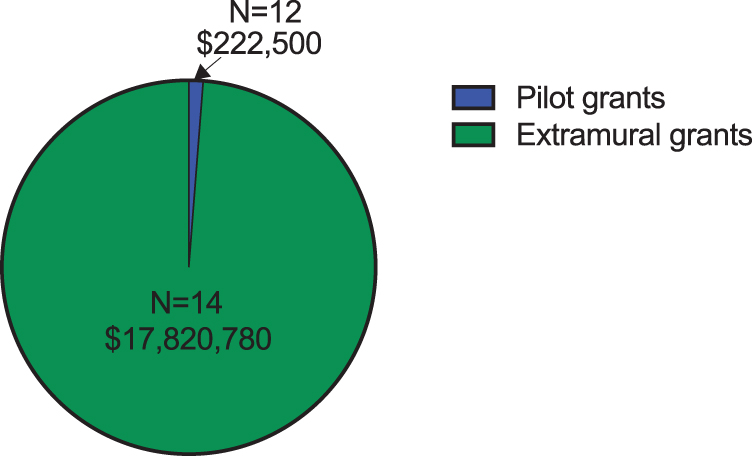
Grants—Twelve pilot projects funded by the SCORE CEC Program totaling $225,500 resulted in 14 extramural (4 NIH K-type, 7 NIH R-type, 3 Foundation) grants totaling $17,820,780. Every $1 invested in pilot project funding of early career investigators resulted in $80 of extramural funding. CEC, Career Enhancement Core; NIH, National Institute of Health; SCORE, Specialized Centers of Research Excellence.
Our second outcome measure of success is number of publications that resulted directly from the SCOR/E Center programs at the Yale School of Medicine. Publication numbers were tallied from our current and prior SCOR/E grants. Of the 129 publications, 90 (70%) were original contributions, 29 (22%) were reviews, and 10 (8%) were policy-related, including perspectives, commentaries, and editorials (Fig. 2). In total, these 129 publications were cited by 3,698 publications, with 20 high-impact articles cited by more than 50 publications. Of these publications, 107 (83%) were first-authored by an early career investigator, including junior faculty, postdoctoral fellows, and other trainees (Fig. 2).
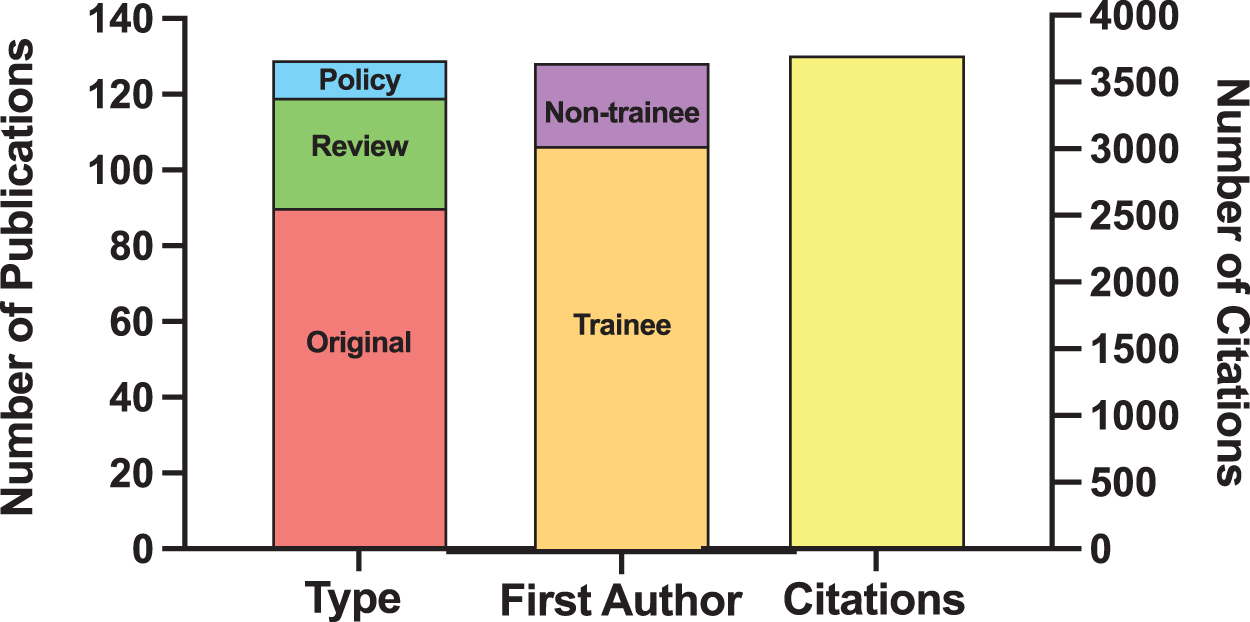
Publications—The SCOR/E programs have output 129 publications so far with 90 original contributions, 29 reviews, and 10 policy-related articles; 107 (83%) were first-authored by trainees; and were cited by 3,698 of publications.
Finally, we would like to highlight that 100% of our SCOR/E-supported trainees have continued research careers with an emphasis on SABV.
The Next Generation of SABV Researchers
As part of our SCOR/E programs (2012–2025), 49 junior faculty members and postdoctoral trainees and 5 undergraduates were mentored by 65 mentors, so far. Of these trainees, 71% were female and 29% were from racial and ethnic groups underrepresented in health-related sciences (per National Science Foundation). As an example of one successful trainee, Dr. Smith published 26 articles (4 of these articles are in the top 1% of citations according to the Web of Science 15 –18 ), successfully transitioned to a faculty position at the City College of New York School of Medicine, and obtained two extramural grants focused on SABV and tobacco (NIH R03 DA040093; Foundation GRAND grant from Pfizer). Dr. Smith received robust training on SABV and tobacco use and translational mentorship as part of the SCOR program.
Below are two first-hand accounts from Yale-SCORE CEC Early Career Investigators. These vignettes highlight the value of the translational mentorship and pilot program projects in the academic success of these two junior investigators.
“I am a neuroscientist and an Assistant Professor of Psychiatry at the Yale School of Medicine dedicated to studying the neurobiological mechanisms of addiction using multimodal neuroimaging techniques. Although I had been an addiction researcher for several years, I was a relative novice to the alcohol field.
The SCORE CEC Program at the Yale School of Medicine provided a structured framework to develop the scientific knowledge and skills to launch my academic career as an alcohol researcher highlighting the critical role of SABV. As an Early Career Investigator on the SCORE CEC Program, I was mentored by senior faculty members with methodological, statistical, and application-based expertise in alcohol and SABV. The SCORE CEC also provided an education curriculum and specialized training devoted to SABV and alcohol. Most importantly, the SCORE CEC pilot funds defrayed the cost of pilot data to strengthen my grant applications. This led to several successfully funded grant applications including an NIAAA K01 grant, as well as a private foundation grant to support a spin-off project. Due to numerous collaborations formed as part of the SCORE CEC program, I also published 12 manuscripts during this time, all of which considered SABV. The SCORE CEC program was an integral part of my scientific training and has continued to support my academic success as a neuroimaging addiction researcher.”
-Yasmin Zakiniaeiz, PhD, Assistant Professor, Yale School of Medicine, Psychiatry Department.
“I am a licensed Clinical Psychologist and an Assistant Professor of Psychiatry within the Yale School of Medicine. To date, my research program has focused on sex differences in substance use disorders (SUDs), including alcohol use. My research has largely operated in parallel to my clinical work treating men and women with SUDs and concurrent disorders, including Posttraumatic Stress Disorder (PTSD).
The SCORE CEC Program at Yale School of Medicine provided me protected time from my clinical responsibilities to devote to my research efforts. It afforded me the opportunity to merge my research program and clinical interests in order to pursue competitive, independent research funding. I received mentorship from national leaders in alcohol use, as well as invaluable methodological and analytic training to study the interaction of sex-related variables, PTSD, and medication response to develop novel interventions for alcohol use. In addition to these important training opportunities, the Yale-SCORE CEC program provided me pilot funds to collect data to inform future grant applications. As a direct result of the SCORE CEC, I have been awarded a VA New England Career Development Award and a planning grant from the Pharmacotherapies for Alcohol and Substance Use Disorders Alliance (a research network for the Department of Defense). Additionally, I have published 12 manuscripts via SCORE CEC collaborations, all of which are related to alcohol and explore SABV. Because of the Yale SCORE CEC, I am a well-equipped, scientist-practitioner, who is prepared to continue to pursue scientific opportunities, to develop novel, sex-specific interventions to improve treatment for patients with SUDs and concurrent disorders.”
-MacKenzie R. Peltier, PhD, Assistant Professor, Department of Psychiatry, Yale School of Medicine.
Recommendations for Training
The Yale-SCOR/E CEC can be used as an instructional model for other institutions. Our funded centers exemplify how biomedical scientists can apply SABV in their studies of major medical conditions in an interdisciplinary and integrative way. By bridging basic and clinical research on sex differences and forming interdisciplinary collaborations through SCOR/E Programs, we can develop the next generation of scientists with expertise in SABV. Here, we share the best practices and novel ways to enhance studies of women's health and SABV with the broader academic community.
Seed money for pilot grants is the key to future successful grant applications
Pilot grants provide opportunities to build research capacity. Pilot studies also help investigators understand women's health, and to incorporate SABV when planning, analyzing, and reporting data. In data gathered from the Yale SCOR/E Center pilot projects, every $1 invested in pilot project funding of early career investigators resulted in $80 of extramural funding. Pilot projects are used to educate scientists and build networks of interdisciplinary collaborations that lead to future successful grant applications and spin-off projects. This not only contributes to enhancing the careers of junior investigators but also to training the next generation of scientists with expertise in SABV.
Translational mentoring is critical for SABV implementation
Team mentoring provides an important learning experience to help early career investigators at the individual level through education, consultation, and collaboration. The SCORE CEC program models the interdisciplinary research teams that early career investigators need to be successful in science. The interdisciplinary team mentoring format of the SCORE CEC program allows early career investigators to (1) cultivate skills needed to succeed in collaborative team science, (2) expand their research networks and take advantage of resources across disciplines, (3) form new research collaborations and connect with key research collaborators, (4) strengthen study designs and bring expanded credibility to early career investigators in areas not directly trained, and (5) learn to manage a team of individuals with diverse backgrounds and differing approaches to research early on in their careers. Team mentorship is an important and effective mechanism for supporting the career trajectories of early career investigators.
Further, interdisciplinary teams can identify and break barriers to SABV implementation allowing the next generation of scientists to address knowledge gaps in the health of women.
In summary, we've described the components of the highly successful Yale-SCORE CEC Program and how each component contributes to the development of skilled and productive researchers with expertise in SABV. We have also highlighted two factors that we think contribute most to academic success—pilot project funding and translational team mentoring. We hope these recommendations can pave the way for future biomedical scientists to apply SABV in their study of major medical conditions in an interdisciplinary and integrative way.
Footnotes
Authors' Contributions
Based on:
Author Disclosure Statement
No competing financial interests exist.
Funding Information
Authors are supported by the U54AA027989 (S.A.M.) and K01AA029706 (Y.Z.).