




Abstract
Objective:
Females have been traditionally underrepresented in academia across multiple medical specialties, including radiology. The present study investigated primary investigators (PIs) who received National Institutes of Health (NIH) radiology funding between 2016 and 2019 to establish if there was a correlation between NIH grants, gender, academic rank, first and second tier leadership positions, geographic location, and professional awards.
Materials and Methods:
Funding information was obtained from the NIH Research Portfolio Online Reporting Tools Expenditure and Results (RePORTER) website for 2016–2019. Information for each PI was obtained from academic institutional websites, LinkedIn, and Doximity. Mann–Whitney U tests and chi-square analyses were performed to compare and determine associations between gender and the stated variables of interest.
Results:
Of the 805 radiology PIs included in this study, 78% were male. There was a significant association of gender with the attainment of the highest academic rank (p = 0.026), with females occupied more of the assistant professor ranks (M:F = 1:1.5) and less of the professor ranks (F:M = 1:1.2). Between genders, there was no significant difference in first and second tier leadership positions (p = 0.497, p = 0.116), and postgraduate honors and awards (p = 0.149). The greatest proportion of grants was awarded in the setting of sole male PIs (55%) and the least proportion of grants were awarded when the contact PI and other project leader were female (1%).
Conclusion:
Despite having similar academic credentials, including number of leadership positions and postgraduate honors and awards, female radiology PIs who have received NIH grants continue to be underrepresented in higher academic ranks.
Introduction
Despite females comprising a greater percentage of medical students than males, there remain major challenges for career advancement upon matriculation. 1 Females account for 43.7% and 32.6% of practicing physicians in Canada and the United States, respectively. 2,3 However, specialties such as diagnostic radiology remain mostly male-dominated, with females representing 27% of radiology trainees. 4
This imbalance is reflected in academic medicine across various medical disciplines, with females less likely to receive higher academic ranks, attain senior leadership positions, and achieve career success at a comparable rate to their male colleagues. 5 –12 Identified barriers include, but are not limited to hidden curricula (implicit social, cultural, or academic messages), lack of female mentors and role models, added responsibility of childbearing and elder care, unconscious bias, including potential institutional preferences for male leadership styles, and a leaky pipeline (decrease in female representation along career progression) by design. 12 –15 Research productivity has also been identified as a critical component in career advancement in academia.
Although females' late-career publication rates increase, match, and even surpass their male colleagues, males are more likely to attain first authorship and produce more peer-reviewed publications throughout their careers. 16,17 Even after adjusting for publications, male faculty are still more likely to attain senior-level leadership positions. 18 Studies have also investigated gender differences in National Institutes of Health (NIH) funding across specialties, including radiology, pediatrics, orthopedic surgery, ophthalmology, otolaryngology, and dermatology, and have revealed similar gender discrepancies across specialties. 19 –23 Similarly, females tend to be underrepresented in professional recognition, as evidenced by studies of awards and honors. 24 –29
Despite this, recent studies report promising trends within radiology. Female radiology authorship has been increasing over the past three decades, proportional to their numbers in the specialty. 30 –32 Moreover, a higher proportion of female radiologists (31%) are presently employed in U.S. academic settings than their male colleagues (18%). 33 Between 2006 and 2017, female representation among academic ranks grew with a 4.5% increase in females at the rank of professor over this time frame, 4.8% increase at the rank of associate professor, and 3.1% at the rank of assistant professor. 34 While Jutras et al.'s study on NIH funding for radiology from 2016 to 2019 did not find an overall significant gender difference in mean NIH dollars awarded, they did describe significant gender disparity in mean NIH dollars awarded among primary investigators (PIs) with a PhD. 35
On the background of this mixed picture of gender disparity and yet demonstrable progress in radiology, the present study endeavored to build on the work of Jutras et al. by further characterizing gender, academic rank, leadership roles, highest academic degree, geographic location, and postgraduate honors and awards among PIs who received NIH funding in radiology from 2016 to 2019.
Materials and Methods
Our methodology has been validated in several recent publications and did not require the approval of Institutional Ethics Review Board as it evaluated publicly available data. 6,36 –42 Different data sources were used to generate a database on Radiation-Diagnostic/Radiation-Oncology funded projects for 2016–2019 as detailed below.
Funding information was collected from the NIH Research Portfolio Online Reporting Tools Expenditure and Results (RePORTER) website (
Academic institutional websites were reviewed to identify the PIs. These websites were also used to document information such as gender, final academic degrees, academic rank (professor, associate professor, assistant professor, other), leadership roles, and postgraduate honors and awards. LinkedIn and Doximity were used when information on departmental websites was incomplete. Leadership role was defined as academic leadership affiliated with postsecondary institutions. Leadership roles within research and professional societies, conferences, editorial journals, government, volunteer organizations, and the private sector were excluded. These leadership roles were further subdivided into first (i.e., chair, head, director, dean) and second tier positions (vice-chair, vice-head, section head, leader). Postgraduate honors and awards were defined as accolades recognizing an individual's academic achievements.
These ranged from local to international and were granted by professional or research societies, universities, research institutions, and community organizations. These did not include undergraduate, graduate student, medical student, and residency awards. They were then categorized into teaching, research, clinical, life-time achievement, and “other” (awards not fitting within the previous four categories).
Gender was deduced based on the personal pronoun used in the PI's institutional profile. Five members of the research team independently collected the data from December 2019 to April 2020 (R.K., J.Y., G.M., J.J., K.L.). Data verification, discrepancy resolution, and categorization were completed by three researchers from May to June 2020 (J.Y., R.K., G.M.). To ensure reliability and reproducibility of the data collection methodology, a random 10% of collected data points were checked by the senior researcher. This produced >99% agreement in the coding decisions, validating reliability of our methodology.
Statistical analysis was performed by a statistical expert (M.H.) using SPSS statistical software (version 25.0; SPSS, Inc., Chicago, IL). Significance levels were set at p < 0.05. Categorical variables such as gender, education, highest academic position, and teaching awards were presented as frequency and percentages. Median with interquartile range was computed for discrete variables (numbers of academic positions and awards). Mean and standard deviation was calculated for the first and second tiers. Significance in gender differences in academic positions, leadership positions, and postgraduate honors and awards were performed using the Mann–Whitney U test. Chi-square analysis was used to evaluate associations between gender, academic rank, leadership, and postgraduate awards. To assess the distribution of funds granted to each gender, one sample chi-square test was performed. Geographic distribution was analyzed and displayed using Tableau Software (Tableau Software, LLC, Seattle, WA) (G.M.).
Results
Eight hundred five radiology PIs met our study inclusion criteria with more than three-quarters being male (Fig. 1). Across 30 American states, grants were given to more male PIs than females (Fig. 2). A greater proportion of females received grants in Nebraska, West Virginia, and Massachusetts. The highest number of grant receivers was in California.

Gender distribution among faculty members. Twenty-two percent of the radiology PIs were female, compared to 78% being male. PIs, primary investigators.
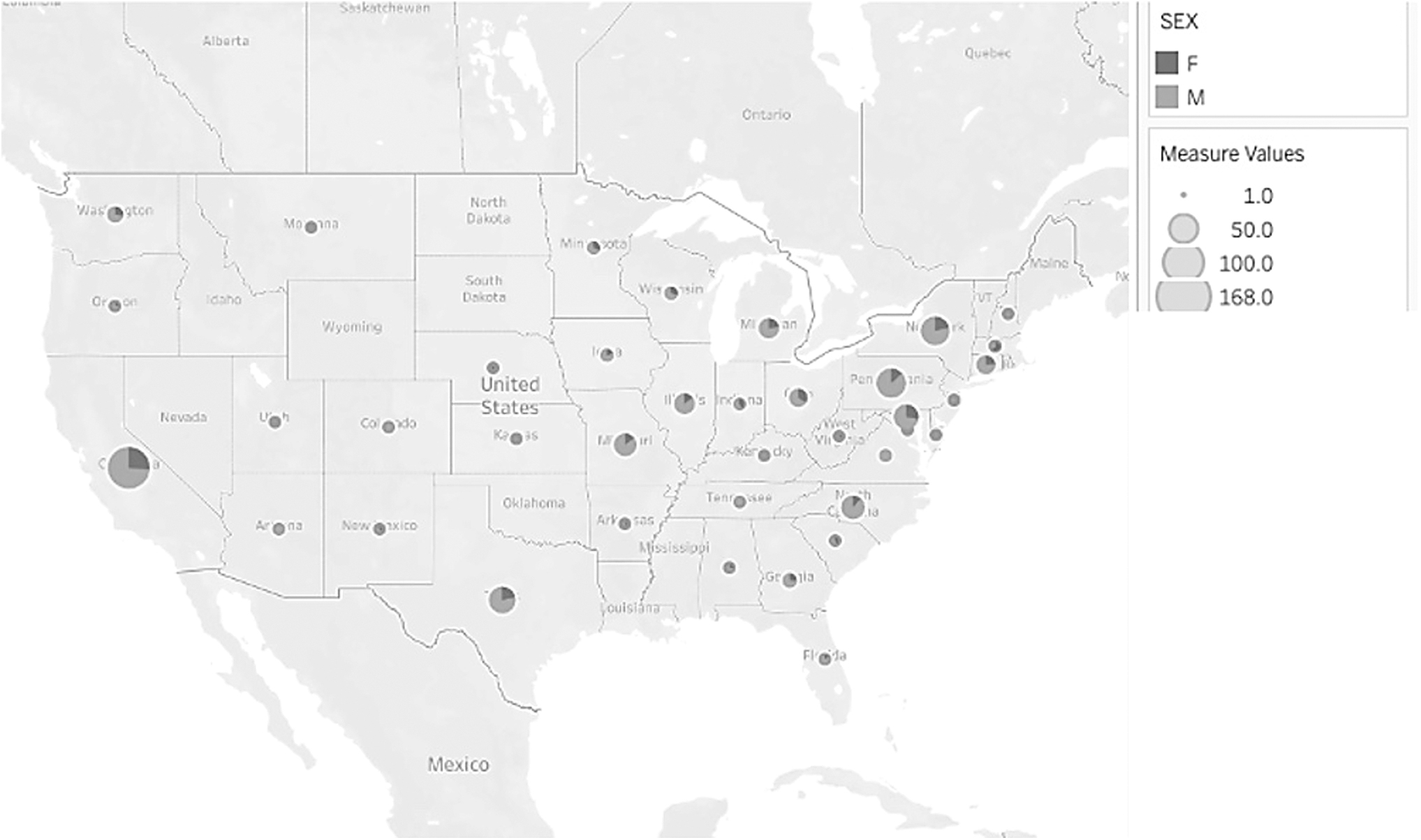
Distribution of female and male radiology PIs across the United States. The markers are placed according to the state of each university, and the size represents the total number of PIs within each state. The proportion of males and females are displayed in grey and black, respectively.
The majority held PhDs (n = 605, 75.2%). One hundred seventy-two (21.4%) held an MD degree and 18 (2.2%) held a double doctorate (i.e., MD with PhD). Ten PIs held other degrees (i.e., MA, MSc, etc.). As per Figure 3, over half of the PIs held the academic rank of Professor (n = 441, 54.9%). More than a quarter of PIs were Associate Professor (n = 220, 27.4%). One hundred twenty-nine PIs (16%) were Assistant Professors. The 14 PIs who did not fit the above categories were categorized as “other” academic positions (i.e., instructor, research scientist, fellow, etc.). One in 10 PIs (n = 84) had received teaching awards.

Distribution of male and female radiology PIs across academic ranks. Females are shown in black and males are in grey.
Gender disparity in academic profiles
There was a significant association of gender with the attainment of the highest academic rank (p = 0.026), as shown in Table 1. Females occupied more of the assistant professor rank (M:F = 1:1.5) and “other” academic rank (M:F = 1:2.1) while occupying less of the professor rank (F:M = 1:1.2). There were no significant differences in academic degrees attained among genders (p = 0.12), as per bivariate analysis.
Gender Differences in Academic Profiles
Gender differences in leadership positions and postgraduate honors and awards
The mean number of PI-held first and second tier leadership positions was 0.3 ± 0.7 and 0.7 ± 1.1, respectively (Table 2). The range of positions within first tier was 0–6, while the second tier leadership positions varied from 0 to 9. No significant differences among male and female PIs in the number of first and second tier leadership positions were found (p = 0.497, p = 0.116).
Gender Differences in Leadership Positions
Each PI received a mean of 2.6 ± 4.9 postgraduate awards and honors with greatest in research (2.1 ± 3.9). The average number of clinical, teaching, lifetime achievement, and “other” awards were 0.2 ± 1.8, 0.2 ± 0.6, 0.1 ± 0.4, and 0.1 ± 0.6, respectively. Table 3 demonstrates no significant difference among genders in the number of postgraduate awards and honors received (p = 0.149). However, the maximum number of postgraduate awards received by a male PI was 42, compared to 23 by a female PI. Males received a statistically significant greater maximum number of research awards than females (p = 0.034). Although not statistically significant, males received a greater maximum number of teaching (p = 0.091), clinical (p = 0.378), and “other” awards and honors (p = 0.155). Lifetime achievement awards and honors were similarly distributed between genders.
Gender Differences in Postgraduate Honors and Awards
IQR, interquartile range.
Gender disparity in grants
Figure 4 reveals gender disparity in the number of grants granted to faculty members. We hypothesized that the number of grants provided to males and females would be different. The highest number of grants was received when there was a sole male PI (n = 1124, 55%), followed by both the contact PI and other project leader (other lead) being male (n = 388, 19%). Together, male-only studies contributed 74.2% of the total grants received.

Gender distribution of grants. The bars represent the number of grants received while the line signifies the cumulative percentage of grants. The x-axis shows the gender composition of the grant receivers with M representing a sole male PI, MM representing both contact PI and other project leader being male, F representing a sole female PI, MF representing male contact PI and female other project leader, FM representing female contact PI with male other project leader, and FF representing both contact PI and other project leader being female.
Grants with a sole female PI (n = 295) made up 14% of the total grants. For a male contact PI and female other lead combination (n = 137), the proportion of grants received was 7%. The proportion of grants decreased to 4% when the combination was composed of a female contact PI with a male other lead (n = 76). This proportion further dropped to 1% when both the contact PI and other lead were female (n = 15). The chi-square test of equal proportion divulged a significant difference in the provision of grants to male and female PIs, or with their combination (p < 0.001).
Discussion
This study contributes to the knowledge gap of the role of gender, geographic location, academic rank, leadership, and postgraduate awards and honors among NIH funding recipients within Diagnostic Radiology. It builds on prior research with data from 2016 to 2019, in which Jutras et al. reported that for this cohort, there was no overall significant gender difference among mean NIH funding received. 35 Overall, there were no significant differences in the average number of leadership positions and postgraduate awards and honors.
Previous studies have reported females being underrecognized as award receivers within the disciplines of neurology, physiatry, and medical schools. 24,27 –29 The focus of these previous studies was mostly limited to medical societies, with gender disparity in recognition awards being described in 11 societies of 7 medical specialties. 25 Notably, within four major radiological societies, females were underrepresented in prestigious leadership awards (categorized as leadership in research or overall contributions) and were overrepresented in teaching awards. 43 This could reflect more females doing educational tasks in the department or gender stereotypes of traditional female traits such as compassion, kindness, and approachability being associated with educators. In contrast, females within U.S. surgical societies were appropriately recognized overall as award recipients, yet were underrepresented as achievement award receivers. 26
Similarly, in this study, we found no significant difference among genders in the number of postgraduate awards and honors received. However, we found a lack of difference in lifetime achievement awards. This may be reflective of the current trend of increasing numbers of females in academic radiology. Furthermore, we did not limit awards and honors to medical societies, and also included awards granted by research societies, universities, research institutions, and community organizations.
Previous thematic analyses conducted on female leaders in health care, academia, and business have identified that the top prevailing barriers to obtaining leadership positions are gender gap, lack of career opportunities, stereotypes, work/life balance, lack of mentoring, and lack of flexible working environment. 44 Across subspecialties and societies in radiology, females are underrepresented in leadership positions. 36,45,46 For female academic radiologists in the United States, h-index and years of practice were the strongest predictors for full professorship and executive leadership. 45 We report no significant gender differences in the average number of first and second tier leadership positions among NIH recipients, similar to Qamar et al. who investigated Canadian radiologists. 17
The majority of the grant recipients had a PhD, with similar proportions of males (75.6%) and females (73.6%) in this cohort. Despite these similar proportions, there was a significant difference in grant distribution based on the gender of the contact PI and other lead. Across the majority of the states in the United States, except Nebraska, West Virginia, and Massachusetts, more grants were given to males. Sole male contact PI resulted in the most grants, followed by the combination of male contact PI and male other lead. Yet, the lowest grant distribution was when both contact PI and other lead were females. Since there were no significant gender differences in the number of leadership positions and postgraduate awards and honors of the PIs, the findings suggest that female PIs receiving radiology funding may be subjected to higher standards in funding decisions.
Previous research on grant funding has demonstrated gender bias in application evaluation, likely related to implicit biases and the use of masculine-gendered language in instructions and evaluation sheets. 47 Future work should systematically investigate the reasons for gender differences in grant award success rates, including gender makeup and academic credentials of the awarding NIH Radiology study sections. 48
This study has a few notable limitations. A binary description of gender was used, in concordance with the data that were collected; however, this may not be fully representative as gender identification exists on a continuum. In this study, gender was classified by the name and personal pronoun on the websites used to collect information about each PI. In addition, the academic rank for the PIs was determined to be the rank at the time of data collection. Thus, it is possible that PIs that received a grant may have had a promotion in academic rank between grant submission and data collection. Finally, data collection was dependent on publicly available information.
Some institutions may require their faculty members to keep their curriculum vitae (CV) data up-to-date on their institutional faculty website while other institutions may not uniformly display CV data on faculty profiles. These could potentially lead to issues in consistency and compliance. For instance, in an internal LinkedIn report, it was found that male LinkedIn members would include more information in their profiles and skew their profiles to highlight more senior-level experiences. 49 In the occasional instances when institutional websites contained incomplete information, other websites such as Doximity and LinkedIn were used to trace the PI to their current institution. However, since most information was collected directly from official faculty webpages, it is likely that these discrepancies exist at an institutional level and may impact males and females from these institutions similarly.
Conclusion
For the cohort of NIH radiology funding recipients from 2016 to 2019, there were no significant differences in the number of leadership positions and postgraduate awards and honors. However, the lowest proportion of grants was awarded when both the contact PI and other project leader were female, suggesting that female PIs receiving radiology funding may be subjected to higher standards in funding decisions and ultimately may result in less of them obtaining full professorship.
Footnotes
Acknowledgments
The authors thank Jina Jisu, Avery Ratcliffe, and Keegan Landrigan for their assistance in data collection and/or organization.
Authors' Contributions
J.Y.: conceptualization; data curation; methodology; validation; visualization; and writing. R.K.: conceptualization; validation; and writing. M.H.: software; formal analysis; visualization; and writing. G.M.: data curation; visualization; and validation. M.J.: conceptualization; writing; and supervision. M.P.: writing and supervision. J.B.R.: writing and supervision. F.K.: conceptualization; project administration; supervision; and writing.
Statement of Data Access and Integrity
The authors declare that they had full access to all of the data in this study and the authors take complete responsibility for the integrity of the data and the accuracy of the data analysis.
Author Disclosure Statement
Dr. F.K. is the recipient of the Michael Smith Health Research BC Award (2023–2028); Don Rix Physician Leadership Lifetime Achievement Award (2022); BC Achievement Foundation—Mitchell Award of Distinction (2022); University of British Columbia—Distinguished Achievement Award for Equity, Diversity and Inclusion (2022) and Vancouver Medical Dental and Allied Staff Association—Equity, Diversity and Inclusion Award (2022). None of the authors has any conflict of interest to disclose.
Funding Information
No funding was received for this article.