




Abstract
Purpose:
The psychosocial impacts of the coronavirus disease-2019 (COVID-19) pandemic on women Veterans' mental health compared to men are understudied, with few studies examining the differential impact of COVID-19 stressors on depression and post-traumatic stress disorder (PTSD). Furthermore, little is known about whether social support may buffer against adverse pandemic-related outcomes for this population. In the present study, we examined (1) gender differences in the impact of the COVID-19 pandemic on numerous life domains, including economic, work, home, social, and health; (2) how pandemic impacts in these domains were associated with depression and PTSD symptoms; and (3) whether social support buffered against worse mental health outcomes.
Materials and Methods:
Data from 1530 Veterans enrolled in the Longitudinal Investigation of Gender, Health, and Trauma (LIGHT) study were analyzed using descriptive statistics and multiple groups' path analyses.
Results:
Women reported higher pandemic impact scores across life domains. For both men and women, higher health impacts were associated with increased PTSD symptoms; differential findings emerged for depressive symptoms. Home and economic impacts were associated with increased depression for both men and women, social and health impacts were associated with depression for women, and work impacts were associated with depression for men. Higher social support was associated with decreased depressive symptoms for both men and women; however, social support moderated the relationship between pandemic impacts and both PTSD and depressive symptoms for women only.
Conclusions:
Findings highlight the value of social support in mitigating effects of pandemic-related stress, particularly for women Veterans.
Introduction
The coronavirus disease-2019 (COVID-19) pandemic has profoundly impacted people's lives across the globe. In addition to the well-documented short-term and long-term physical effects of COVID-19 infections, 1 restrictions and limitations posed by the pandemic contributed to increased psychological distress in the general population. The psychiatric and psychological toll of the global pandemic ranges from elevated rates of anxiety, depression, and post-traumatic stress to increased experiences of loneliness, boredom, and frustration. 2,3
The extent to which the pandemic impacted major domains of functioning, including financial, occupational, social, and family functioning, 4,5 is clearly related to psychological distress levels. Lockdowns, transitions to remote work, and school closures altered individuals' and families' routines, contributing to heightened stress levels. Elevated stress, in turn, impacted functioning in areas such as caregiving and parental functioning. 6 –8 Financial stress created by pandemic-related business closures and layoffs also contributed to worse mental health and well-being, 4,9 and COVID-related anxiety and suboptimal home working environments contributed to worse occupational functioning. 10,11 For those with children, school and day care closures led to home-schooling challenges and reduced working hours that impaired work functioning. 12,13 Finally, pandemic-related restrictions significantly limited access to common stress relievers, including connecting with social networks (e.g., friends, extended family), engaging in coping strategies (e.g., retail therapy, going to the gym), and/or accessing needed medical care.
The impact of COVID-19 on women
A substantial body of literature has documented widespread disparities in the impact of the COVID-19 pandemic, 14,15 and women may be particularly at risk for negative outcomes. The social, economic, and occupational impact of the pandemic has had more severe consequences for women's mental health. 16 Early research during the pandemic suggested that women reported more overall distress, anxiety, depression, and post-traumatic stress compared to men. 17,18 Among hospitalized patients with COVID-19 infection, women were at higher risk of poorer mental health outcomes. 19 In addition, a meta-analytic study investigating increases in suicide behaviors during the pandemic found increased rates for suicidal ideation, suicide attempts, and self-harm, with women being especially vulnerable to pandemic-related increases in ideation. 20
Women's elevated risk for poor outcomes may be explained in several ways. Women spend a disproportionate amount of time on housework and childcare activities compared to men 21 and, subsequently, may have shouldered the majority of the burden to educate and care for their children in the wake of school and childcare closures, 22 resulting in heightened parental stress 23 and disruption to work functioning. 12 Gender differences in the impact of the pandemic on social and occupational functioning also emerged, with more women than men reporting cancellation of planned celebrations, vacations, or entertainment, and more women than men reporting loss of current job security or income. 24 Among a sample of women, financial difficulties contributed to COVID-related stress, whereas social support was protective against COVID-related stress. 25
Women Veterans and the COVID-19 pandemic
Women Veterans are at a unique intersection of vulnerability in which their gender and Veteran status may confer a greater risk for negative mental health outcomes when faced with the challenges of the COVID-19 pandemic. For example, women Veterans experience a high trauma burden and report higher rates of childhood trauma 26 and intimate partner violence 27 compared with civilian women and higher rates of military sexual trauma compared to Veteran men. 28 Women Veterans are at elevated risk for a number of psychiatric conditions, including eating disorders, post-traumatic stress, substance use, anxiety, depression, and suicide attempts, compared to civilian women. 29 The added stressors associated with the pandemic may exacerbate preexisting mental health conditions and amplify prepandemic social and economic challenges for women Veterans who are more likely to be single mothers or divorced compared to civilian women and Veteran men and are more likely to experience greater family disruptions resulting from military service compared to Veteran men. 30
Social support may have a buffering impact on negative mental health outcomes in the Veteran population, 31 –33 and perhaps particularly for women Veterans. 34 A previous study of women Veterans returning from deployment showed that greater social support was associated with significantly lower depression scores. 35 In addition, in a sample of female survivors of military sexual trauma employed in civilian jobs, coworker social support buffered against negative mental health outcomes. 36 Given the demonstrated importance of social support during stressful situations, the isolating impact of the pandemic may have had a particularly negative effect on women Veterans' mental health.
Current study
The purpose of the current study was to examine the unique psychosocial impacts of the COVID-19 pandemic on women Veterans' mental health compared to Veteran men. Few studies have examined the differential impact of COVID-19 stressors on mental health outcomes for both men and women, and even fewer have compared impacts on depression and post-traumatic stress disorder (PTSD).
Leveraging data from a longitudinal survey study, we first examined gender differences in the impact of COVID-19 on a range of life domains, including economic, work, home, social, and health. We hypothesized that women Veterans would endorse more negative impacts of the pandemic on these life domains compared to men. We then examined how each of these domains was associated with the mental health of men and women Veterans, specifically depression and PTSD symptoms, as these are two of the most common mental health disorders in the Veteran population. 37 Finally, we examined whether social support moderated the relationships among COVID-19 impacts on life domains and mental health symptoms. We hypothesized that social support would buffer the negative effects of the pandemic on depression and PTSD for both men and women.
Materials and Methods
Data for this study came from the baseline (Time 1; T1) and Time 5 (T5) survey of the Longitudinal Investigation of Gender, Health, and Trauma (LIGHT) study. 38 LIGHT is a multiwave prospective, national survey study of Veterans' mental, physical, and reproductive health. Potential participants were identified via the Veterans' Affairs (VA)/Department of Defense (DoD) Identity Repository (VADIR) and invited to participate in a mailed survey study. Veterans living in high crime neighborhoods and female Veterans were oversampled, and the sample was restricted to Veterans between the ages of 18 and 50. For more information regarding the LIGHT sample and study design, please see Galovski et al. 38 The T1 interval took place between September 2018 and July 2019. The T5 interval took place ∼1 year into the COVID-19 pandemic (January–April 2021). A total of 1530 Veterans enrolled in the LIGHT study identified their gender identity as male or female and completed the T5 survey that included measures of COVID-19-related impacts across life domains.
Procedures
A modified Dillman mail survey approach was used for data collection. 39 Veterans first received an invitation letter, the survey, an opt-out postcard, and a $5 cash preincentive. 40 A reminder postcard was mailed approximately one and a half weeks later, followed by a reminder letter after another one and a half weeks. Veterans who completed and returned the survey were paid $20. The study was approved by the VA Boston Institutional Review Board.
Measures
Demographic characteristics
At T1, Veterans were asked to report their biological sex, gender identity (male, female, transgender, other), age, race/ethnicity, education, household income, parental status, and relationship status. For the present study, race was dichotomized as either non-Hispanic White or racial/ethnic minority.
COVID-19 impacts
COVID-19 impacts were assessed during the T5 interval using a modified version of the Epidemic–Pandemic Impacts Inventory (EPII). 41 The original EPII is a 92-item inventory which assesses pandemic-related impacts across multiple life domains. For the LIGHT study, only the Infection History, Work and Employment (e.g., “Laid off from job or had to close own business”), Home Life (e.g., “Had to take over teaching or instructing a child”), Social Activities (e.g., “Family celebrations cancelled or restricted”), Economic (e.g., “Unable to pay important bills like rent or utilities”), and three items from the Physical Health Problems [e.g., “Important medical procedure cancelled (e.g., surgery)”] domains were included. Participants were only asked about experiences as they pertained to themselves. Items were scored dichotomously (applied/did not apply to me) and then summed within each domain.
Depression symptoms
The 9-item Patient Health Questionnaire (PHQ-9) 42 was used at T1 and T5 to measure depressive symptoms experienced over the past 2 weeks using a 4-point scale (0 = not at all to 3 = nearly every day). Items were summed with higher scores reflective of more severe depression. Internal consistency reliability in the current sample was excellent (α = 0.92 at T1 and at T5).
PTSD symptoms
The PTSD Checklist-5 (PCL-5) 43 was used at T1 and T5 to measure PTSD symptoms. The PCL contains 20 items that assess the extent to which symptoms have been bothersome in the past month ranging from 0 (not at all) to 4 (extremely). Items were summed with higher scores reflective of worse PTSD symptoms. Internal consistency reliability in the current sample was excellent (α = 0.97 at T1 and T5).
Social support
Social support was measured at T5 with the 12-item Multidimensional Scale of Perceived Social Support. 44 Participants rated their agreement with statements related to level of support received from 1 (very strongly disagree) to 7 (very strongly agree), and items were averaged, with higher scores representing greater social support. Internal consistency reliability in the current sample was excellent (α = 0.95).
Data analysis
Analyses were conducted using R (Version 4.0.5), 45 MPlus (Version 8.7), 46 and the MPlusAutomation package. 47 Self-reported gender identity was used to classify individuals as men or women. Because there were too few individuals who identified as transgender or another gender identity to analyze, these individuals, along with those who did not report a gender identity, were dropped from the analytic sample, resulting in a final sample size of 1530. The compareGroups package 48 was used to compare men and women on demographic, mental health, and COVID-19 impact variables. Welch t-tests were used for continuous variables and chi-square (χ 2 ) for categorical variables.
Multiple groups' path analysis in MPlus was used to examine the relationship between COVID-19 impacts and two mental health outcomes: depression (PHQ) and PTSD (PCL), for men and women. Models were tested separately for depression and PTSD, and T1 income, age, race, marital status, and the corresponding T1 mental health variable were included as covariates (i.e., T1 PHQ score was included in the PHQ model). Models were fully saturated, so no fit statistics were examined. Finally, multiple groups' path analysis was used to examine social support as moderator of the relationship between COVID-19 impacts and mental health outcomes. The effect of social support, as well as the interactions between social support and each COVID-19 impact, were included in the model. Significant interactions were plotted using the interactions package 49 using the “pick-a-point” method (mean and ±1 SD).
Results
Table 1 contains a summary of the demographics of the sample, as well as statistical comparisons between men and women on each variable. Men were more likely to be non-Hispanic White, married, and older than women. Women endorsed more depressive and PTSD symptoms than men at baseline, and women endorsed more depressive symptoms at T5. Women reported higher COVID-19 impact scores across all five domains: work, economic, home, social, and health.
Descriptive Statistics for the Study Sample
Due to missing data, ns for each variable may not sum to 1567. Demographics reported are from the baseline assessment (T1). COVID-19 impacts were measured at T5.
MSPSS, Multidimensional Scale of Perceived Social Support scale; PCL, PTSD Checklist; PHQ, Patient Health Questionnaire; PTSD, post-traumatic stress disorder; SD, standard deviation.
Table 2 contains the results of the multiple group analysis. For the PTSD model, health impacts were significantly related to PTSD symptoms for both men and women; no other significant relationships emerged. For the depression model, economic and home impacts were significantly associated with depressive symptoms for both men and women. Gender differences emerged such that work impacts were significantly associated with depressive symptoms for men only, whereas social and health impacts were significantly associated with depressive symptoms for women only.
Multiple Group Path Analysis of the Relationship Between COVID-19 Impacts and Mental Health
Unstandardized coefficients are presented.
Finally, we examined social support as a moderator of the relationships among COVID-19 impacts, depression, and PTSD symptoms. Table 3 contains the results of the multiple groups moderation models. For men, none of the predictors was statistically significantly associated with PTSD symptoms. For depression, only home impacts and social support were both associated with depressive symptoms; none of the interactions was statistically significant.
Multiple Group Models Examining Social Support as a Moderator of the Relationship Between COVID-19 Impacts, Depression, and Anxiety
SS, social support.
For women, work and home impacts, and their interactions with social support, were significantly associated with PTSD (Fig. 1a, b). In addition, work and health impacts, and their corresponding interactions with social support, were all significantly associated with depressive symptoms (Fig. 1c, d). The pattern of the interactions was the same for both work impact interactions: for individuals low in social support, the relationship between work impacts and mental health symptoms was positive, such that higher work impacts were associated with higher levels of symptoms. In contrast, for individuals high in social support, the relationship was negative: as work impact increased, symptoms decreased.
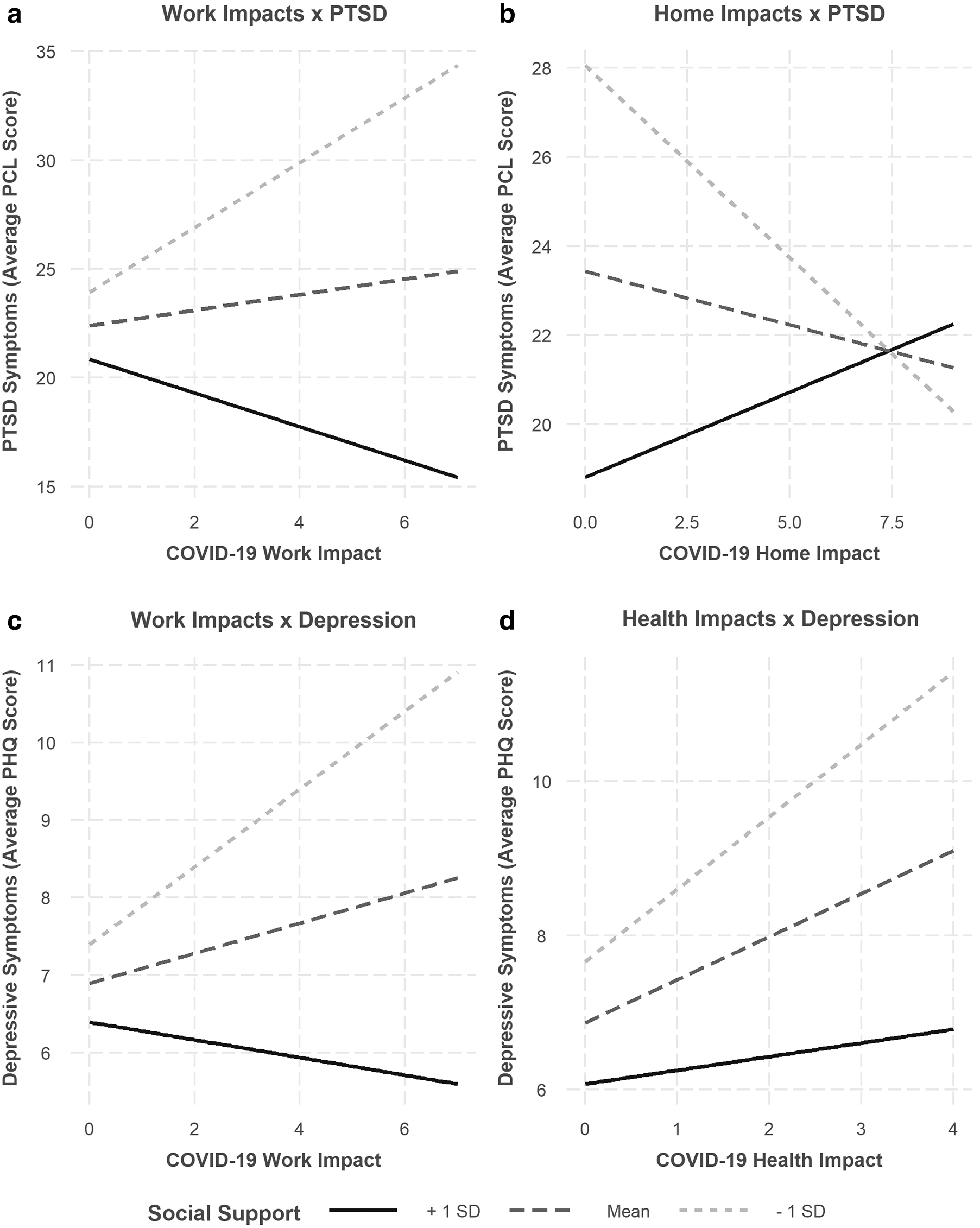
The interaction between health impacts and depressive symptoms followed a similar pattern: as social support increased, the positive relationship between COVID-19 health impacts and depression weakened, suggesting that social support served as a buffer against the negative health impacts of the pandemic. Interestingly, the pattern of the interaction was in the opposite direction for home impacts, social support, and PTSD. When social support was high, there was a positive relationship between home impacts and PTSD; when social support was low, the relationship was negative.
Discussion
As hypothesized, gender differences emerged on each of the COVID-19 impact domains. Women Veterans reported more economic, work, home, social, and health effects compared to men. This finding is consistent with national and international studies of the general population suggesting that COVID-19 restrictions and closures disproportionately affected women. 22,50
Previous studies using the EPII have shown that the impact of the pandemic on a variety of major life domains is associated with increased depression, anxiety, and PTSD. 51,52 In the present study, we found additional support for the relationships between COVID-19 impacts and mental health in the Veteran population, with both gender similarities and differences emerging. For example, health impacts were associated with higher levels of PTSD for both men and women, but also associated with higher levels of depression for women. Health impact items focused on how the pandemic impacted one's ability to obtain needed health care, medication, and procedures; thus, not being able to access the health care system could be perceived as potentially life-threatening and particularly frightening because of the potential danger associated with not being able to receive critical medical care when needed. As such, the impact of COVID restrictions in the health domain differs from the other domains in its potential for threatened death or serious, life-threatening medical conditions (consistent with the DSM-5 definition of a Criterion A event necessary for a diagnosis of PTSD). 53
Health impacts during the pandemic might be particularly salient in the Veteran population given their preexisting high rates of serious medical conditions and related concerns about health status. A population-based study of Veterans' health and well-being found that more than half of Veterans reported a physical health condition and were less satisfied with their health compared to their work or social relationships. 54 These concerns may be understandably amplified during a global health crisis where health care may have been compromised during the pandemic. For women in particular, the combination of a higher childcare burden, managing the health care concerns of their family, and difficulty in obtaining safety items like cleaning supplies and masks may have been experienced as especially stressful and contributed to increased depressive symptoms.
Two other gender similarities emerged in the present study: Economic and home impacts were both associated with increased depression for men and women. Economic items included significant economic challenges such as losing one's home or having to move, having trouble getting food, or paying bills. Clearly economic strain is worrisome in the best of circumstances and can contribute to disruptions in mood for both men and women.
Although women reported higher levels of home impacts, the relationship between home impacts and depression was similar for men and women. Items on this scale reflected increased care-giving responsibilities (for children, family, and friends), changes in home living situations, and increased verbal and physical conflict among those living in the home. Our findings for Veterans are consistent with the larger civilian literature examining similar relationships and finding that relevant pandemic-related conditions such as work, school, recreational closures, and the fast pivot to remote work likely increased the opportunity for stress and even conflict in the home. 55 For those respondents who are parents, a number of prior studies have found that navigating school closures and remote work led to particularly stressful home environments. 56 –58 Due to the unique challenges and stress around deployments, reintegration, and parental mental health, Veteran families are at increased risk for conflict in the home before the pandemic. 59,60 Given the high number of parents in this cohort of Veterans aged 18–50, parenting stress may have been a particularly profound stressor on home life for both men and women, leading to increased depressive symptoms.
A number of gender differences also emerged. For men, work impacts were associated with worse depressive symptoms, but social impacts were not related. For women, social impacts were associated with worse depression, while work impacts were not related. These results might be explained, in part, by previous research suggesting that occupational disruption (e.g., unemployment) is more strongly associated with low self-esteem for men than for women 61 and thus men may have been more prone to experience poorer mental health in the wake of pandemic economic or work disruptions.
Our finding that social impacts were associated with depression for women but not for men is also consistent with prior research 24 and may be explained by the idea that women may tend to develop social support networks and rely on these networks in times of stress, more so than men. 34 Our data suggest that women were impacted across all domains more so than men, suggesting that women carried a higher overall burden of impact. When pandemic restrictions limited people's ability to access typical coping resources, it follows that the combination of a heavy burden of overall pandemic impact coupled with the removal of a particularly salient coping resource (social networks) led to increased depression for women specifically.
We followed up our examination of COVID impacts on mental health by examining whether social support buffered the relationships between COVID impacts and mental health for both men and women. Our findings suggest that social support serves as a buffer of the negative effects of pandemic impacts on both PTSD (work impacts) and depression (work and health impacts) for women but did not serve as a buffer for men. For women, leveraging existing support networks and accessing available social resources helped to mitigate the effect of covid-related stress on mental health. This is consistent with a well-established literature which suggests that having supportive loved ones in one's life protects against negative mental health outcomes, 62 particularly for women. 35,36,63 These protective factors may be even more profound in times of a global crisis, and social networks seem to remain important even when the logistics of these networks are drastically altered such as in the case of pandemic restrictions. 64
For men, although social support did not buffer the negative effects of pandemic stress on mental health, it was protective for depressive symptoms (i.e., increased social support was associated with lower reports of depressive symptoms). It may be the case that when men have social support, they do not leverage that support as a resource for coping with pandemic-related stressors, perhaps due to gendered norms around socialization. 65,66 Alternatively, other coping strategies that increase resilience through enhanced feelings of self-control may be more protective against mental health problems for male Veterans. 67
Surprisingly, social support seemed to have the opposite effect on the relationship between home impacts and PTSD for women. It is likely that as home-related stress and conflict increased and exacerbated PTSD symptoms, support from others sharing the same stressful situation may have become less effective and even deleterious. Stress and conflict in the home is often viewed as a private matter, and women may not have leaned on their support systems for assistance in this domain. Future research is needed to better understand what coping strategies are most and least effective for women in coping with increased stress in the home and for men in coping with the impacts across important domains of functioning in the context of the COVID-19 pandemic.
Limitations and future directions
Several limitations to the present study should be noted. The data used for analysis were part of a larger national study that oversampled for Veterans living in high crime areas, which may affect overall generalizability. 68 Another limitation is the measurement of gender identity, which was limited to four mutually exclusive categories (man/woman/transgender/other). Because relatively few individuals identified as transgender or another gender identity, we were not able to include them in the analyses. In addition, although we used data from a longitudinal study, our primary hypotheses and corresponding analyses focused only on the interval which occurred during the pandemic. However, this limitation is tempered by the fact that data collection occurred 9–12 months after the start of the pandemic, providing an ideal window for understanding how COVID-19 restrictions and impacts affect mental health outcomes. Furthermore, we were able to leverage the longitudinal nature of the LIGHT study by controlling for prepandemic income, PTSD, and depression symptoms.
An important direction for future research will be to examine other forms of social support and how they impact mental health for Veterans in the context of the COVID-19 pandemic. Future studies might examine additional sources and aspects of social support that may directly affect both mental health and the relationship between COVID-19 impacts and mental health. For example, individuals may seek and receive emotional, instrumental, informational, and appraisal social support to varying degrees, and these types of social support may differentially predict mental health outcomes or moderate relationships among gender, stressors, and mental health outcomes. 69
Conclusions
Nearly 3 years into the pandemic, people are still coping with the physical and emotional toll and the lasting impact it has had on health, family, social, financial, and economic functioning. Findings revealed the ways in which COVID-19 impacts differentially affected men and women Veterans, including their mental health. Specifically, women Veterans reported greater overall burden of pandemic-related impacts across a range of life domains. The home and health impacts of the pandemic were associated with poorer mental health for both men and women, whereas gender differences emerged related to the other pandemic impacts.
Notably, greater social impacts were uniquely associated with worse depression for women, and social support emerged as a salient buffer for women, but not for men. It is important to note that although this study focused on pandemic-related stressors experienced up to a specific point during the pandemic, our findings may have broader implications for understanding differential relationships between psychosocial and economic stressors and mental health outcomes beyond the pandemic. Men and women will continue to experience psychosocial and economic stressors, particularly now that most pandemic related restrictions have been lifted.
Findings highlight the unique ways in which psychosocial and economic stressors may impact the mental health of Veterans and have important implications for prevention and intervention strategies. Consistent with the Veteran Health Administration's Whole Health Initiative designed to promote health across multiple dimensions of well-being, 70 screening for potential psychosocial and economic impacts is warranted and may aid in identifying Veterans in need of services such as structural supports (e.g., housing, employment support) or mental health care (e.g., psychotherapy). In addition, findings also point to the importance of social support as an important coping mechanism for mitigating the negative effects of COVID-19 impacts on depression and PTSD, particularly for women Veterans. National peer-support programs such as the Women Veterans Network 34 may be meaningful sources of connection and offer opportunity to bolster an important coping resource for women.
Given the emergence of social support as a protective factor (although not a buffer) for men, engagement in peer-support programs may also be a valuable strategy to improving male Veteran health. 71 Furthermore, consistent with research showing that involving loved ones in the treatment process itself leads to better mental health outcomes, 72,73 increasing social support may also be an important therapeutic target for Veterans engaged in mental health services. In conclusion, findings highlight the ways in which men and women Veterans were differentially affected by the COVID-19 pandemic and point to the value of social support in mitigating effects of pandemic-related stress, particularly for women.
Footnotes
Authors' Contributions
A.B.F.: Conceptualization (equal); methodology (equal); formal analysis (lead); writing—original draft (lead), reviewing and editing (equal). A.L.B.: writing—original draft (supporting); writing—review and editing (equal). E.A.: writing—original draft (supporting); writing—review and editing (equal). Y.I.N.: Funding acquisition (co-lead); Conceptualization (equal); Methodology (equal); writing—review and editing (equal). T.E.G.: Funding acquisition (co-lead); Conceptualization (equal); Methodology (equal); writing—review and editing (equal).
Author Disclosure Statement
No competing financial interests exist.
Funding Information
No funding source to report.