




Abstract
Prior to the Dobbs v. Jackson Women’s Health Organization decision that overturned federal protections for abortion access, public perceptions about abortion legality and accessibility fluctuated, while attitudes toward abortion remained consistently supportive. Our study objective was to assess if and how perceptions and attitudes on the legality, accessibility, safety, acceptability, and availability of abortion changed from prior to post-Dobbs in more restrictive abortion policy states (Arizona and Wisconsin) compared with a less restrictive abortion policy state (New Jersey). We used both longitudinal and cross-sectional data from the population-based Surveys of Women (SoW) conducted from 2019 to 2023 in these three states to examine the impact of Dobbs on abortion perceptions and attitudes using quasi-experimental difference-in-difference models. We found a significant negative impact of the Dobbs decision on perceptions of abortion legality and of ease in getting an abortion for those living in more restrictive states, compared with those living in New Jersey. We also found decreases in negative attitudes regarding abortion acceptability and increases in supporting abortion availability from prior to post-Dobbs across both more and less restrictive state policy settings. Our findings highlight that people living in more restrictive states accurately perceived the Dobbs decision affected abortion legality and accessibility; simultaneously, more supportive attitudes toward abortion across both more and less restrictive state settings highlight the mismatch between ongoing state-level efforts aimed at restricting abortion and attitudes among state reproductive-aged populations. This study adds to the growing evidence base highlighting the myriad ways the Dobbs decision has impacted people’s lives and reproductive outlooks.
Introduction
In June 2022, the U.S. Supreme Court issued its decision on the Dobbs v. Jackson Women’s Health Organization case (hereafter referred to as Dobbs), which removed federal protections for abortion access established under Roe v. Wade (1973) and allowed individual states to ban abortion completely or at any point during pregnancy. In the immediate aftermath of the decision, it was unclear whether it was legally permissible to provide abortion in many states. Within one month, six states had implemented trigger laws banning or severely restricting abortion, and within six months, abortion was banned or practically unavailable in 14 states. 1,2
Public knowledge about the legality of abortion in the United States was inconsistent even pre-Dobbs. Studies from several years prior to and immediately before Dobbs highlighted that a majority of people correctly knew that abortion was legal in their state, 3,4 but constantly shifting state-level policy contexts affected people’s perceptions of that legality. For example, in Ohio, the state government passed numerous abortion restrictions over 2018–2019, and the percentage of women of reproductive age who believed that abortion was illegal increased from 4.5% to 15.9%, even though the restrictions were vetoed or blocked by courts and never implemented. 5 In more recent research from 2024, only 45% of women of reproductive age were able to correctly describe the legal status of abortion in their state. 6
Policy and information environments are also associated with people’s perceptions of abortion access and knowledge of abortion safety. It follows that people’s knowledge of the legal status of abortion in their states (including restrictions) would be closely tied to their perceptions of access. For example, residence in a state with hostile abortion policies has been associated with higher levels of reporting that accessing abortion was difficult or neither easy nor difficult (compared with those who did not reside in a hostile state). 7 When considering how individuals form their perceptions around the safety of abortion, their levels of educational attainment and knowledge on the topic are key factors. 8 Research has shown that further educating people can make a difference, as with Texas voters who were less likely to report that abortion restrictions improve safety after reading informational statements about abortion. 9 For people living in states where there is a large amount of ambient discourse hostile to abortion (through the media, religious and civil society institutions, and social networks), they may be more likely to form incorrect perceptions about the safety of abortion. 10 Media representations have also been found to overwhelmingly present narratives of unsafe abortion. 11 These perceptions are likely reinforced by the reality of living in states that have imposed numerous restrictions on access.
People’s social networks and interpersonal relationships are also often formed in the places in which they live and are likely to influence their beliefs about the morality and acceptability of abortion. Stigma toward abortion operates at individual and structural levels and can be mutually reinforcing. 12,13 Inaccurate information about abortion is disseminated and perpetuated in media and social networks, influencing negative social attitudes about abortion acceptability and serving as justification for legal restrictions on abortion. 14,15 In turn, evidence indicates that state policies that restrict abortion or make it illegal can exacerbate and perpetuate abortion stigma. 16 These contexts shape people’s attitudes toward abortion and factor into their determinations about whether abortion should be available to themselves or others. However, it is possible that increased media attention on negative consequences of abortion bans post-Dobbs may resonate with the public in a way that results in more supportive attitudes around abortion. 17
Even in the face of increased state restrictions on abortion access over the past decade, public opinions regarding abortion, at least as measured by national opinion polls, have been relatively stable in the decades between when Roe was decided in 1973 and Dobbs. While there were slight and inconsistent increases in the early and mid-2000s of people believing that abortion should be illegal in all circumstances (20–22% of respondents), since 2022, the proportion of people who endorse that view has dropped back to similar levels as the 1990s (∼15%). 18 Additionally, opinion polls between 2016 and 2024 consistently showed that approximately 60% of American adults reported that they thought abortion should be legal in all or most cases. 19 Other analyses have found that people are more likely to support abortion legality than oppose it, even if they live in states with restrictive policies. 20,21
However, people also display conflicting and contradictory opinions about abortion, which vary by how the questions are framed and people’s identity characteristics. 21,22 Even people who reported being strongly opposed to abortion and finding it unacceptable did not always endorse making abortion illegal (by overturning Roe), and about half of adults who thought abortion should be illegal in all or most cases also thought it should be legal if the pregnancy threatens a woman’s life or health. 19,22 Alternately, there is some evidence that those who support abortion legality also support certain abortion restrictions, illustrating the nuance of abortion beliefs and perceptions in the general population. 23 Research has also found that people who are younger (versus older), are Black and Asian (versus White or Hispanic), are religiously unaffiliated (versus Catholic or Protestant), have low religiosity (versus high religiosity), are unmarried (versus married), have college or higher educational attainment (versus high school or less), have higher income (versus lower income), and are Democrats (versus Republicans) are more likely to believe that abortion should be legal in all or most cases or have supportive attitudes toward abortion. 20,21,23,24 Yet even within those groups there is nuance; for example, 47% of Republicans think abortion should be illegal, but with some exceptions. 23
Given the recency of the Dobbs decision, few studies have assessed perceptions and attitudes around abortion post-Dobbs or compared stances pre- and post-Dobbs. These studies are limited in their ability to comment on general trends in that they have collected data just among young people, 25 post-Dobbs only (without a pre-time point for comparison), 25,26 or within a few days of the Dobbs decision being released. 3 Public opinion polls that examined changes between 2019 and 2023 specifically in states that have banned abortions found that the proportion of people who believed it would be difficult to get an abortion where they lived increased from 50% to 71% and the proportion who believed it should be easier to access an abortion in the area that they lived increased from 31% to 43% over the same period. 27 However, more than two years after Dobbs, there is still limited research on how attitudes and perceptions may have changed across time and different state policy environments. Additionally, public opinion polls are generally descriptive and do not always adjust for shifts in demographic characteristics in the population over time. 27
The objective of this analysis was to assess if and how perceptions and attitudes on the legality, accessibility, safety, acceptability, and availability of abortion changed from prior to post-Dobbs in more restrictive abortion policy states (Arizona and Wisconsin) compared with a less restrictive abortion policy state (New Jersey). Prior to the Dobbs decision, both more restrictive states in our analysis had either implemented “targeted regulation of abortion provider” restrictions or made legislative efforts to restrict or ban abortion. 28,29 For example, Arizona attempted to pass an early gestational ban, which was blocked by courts. 30 Post-Dobbs, the abortion legality and accessibility landscape reflected a patchwork of state laws still on the books from the 1800s, which led to abortion providers in Arizona and Wisconsin pausing services (Fig. 1). 30,31 In contrast, New Jersey moved to further protect abortion access in the state constitution in early 2022. 32,33 While New Jersey has revised some of its restrictions on which types of health care providers can provide abortions and what operational requirements are necessary for abortion facilities, state legislators are still in the process of codifying these expansions in state law. 34
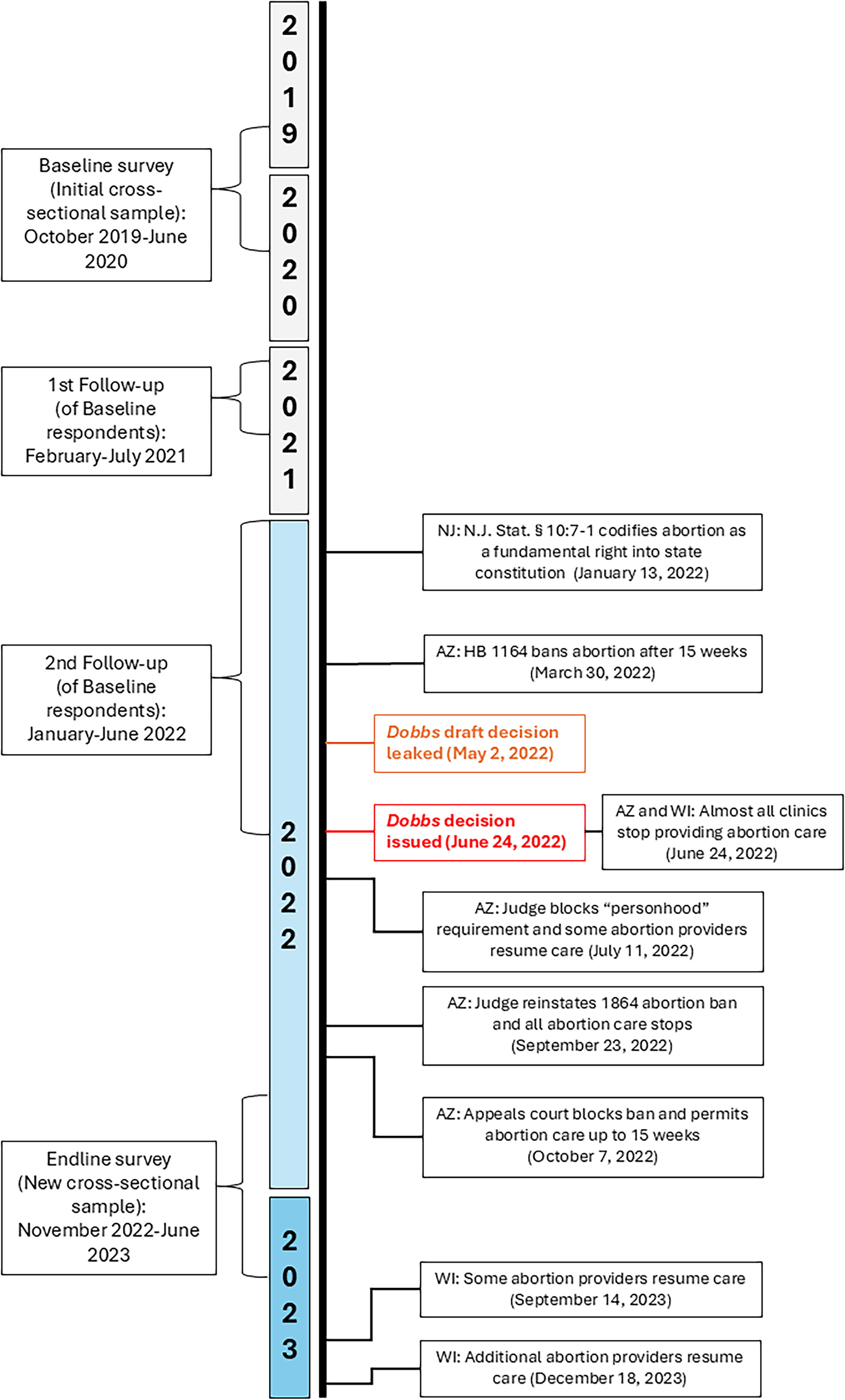
Timeline of Survey of Women data collection and key abortion-related events in Arizona, New Jersey and Wisconsin, 2019–2023.
Methods
Data source
For this study, we used both longitudinal and cross-sectional data from the Surveys of Women (SoWs) in Arizona, New Jersey, and Wisconsin, population-based surveys conducted from 2019 to 2023 by NORC, a research organization at the University of Chicago. The SoWs were originally developed to evaluate statewide contraceptive access programs in other states not examined in the present study. They were expanded into the three states examined in this study to align with a concurrent research initiative, the Reproductive Health Impact Study, 35 which examined how changes in state and federal policies impacted publicly funded sexual and reproductive health (SRH) care delivery and the patients who relied on this care in these specific states. A previously published methodology paper described the processes and decisions around survey development, sampling, and data collection for the panel data in these and other SoW states. 36 The SoWs asked a baseline weighted representative sample of women a aged 18–44 recruited via household-based sampling in each state in 2019–2020 about their attitudes around and experiences of SRH topics and care. 36 NORC’s Institutional Review Board approved the data collection protocols.
The SoWs in these three states subsequently collected panel data from those who completed baseline surveys and indicated willingness to be recontacted with two follow-up surveys at yearly intervals. Final baseline sample sizes and response rates (RRs) of eligible participants contacted varied across states (Arizona: N = 2,031, RR: 31.5%; Wisconsin: N = 2,041, RR: 37.5%; New Jersey: N = 2,172, RR: 23.7%). Due to loss to follow-up, endline data were collected from a new representative sample of reproductive-aged women in each of the three states in 2022–2023 (Arizona: N = 2,068, RR: 25.0%; Wisconsin: N = 1,985, RR: 29.2%; New Jersey: N = 2,025, RR: 19.3%.). Since the data were collected from the three states on the same schedule, we grouped the data into three time points for this analysis: (1) baseline survey data (collected in early 2019–mid 2020); (2) first follow-up survey data (collected in early 2021) b ; and (3) endline data (collected late 2022 to early 2023), where the first two time points occurred pre-Dobbs and the third occurred post-Dobbs. We excluded the second follow-up panel survey data that were collected in early–mid 2022 (around the leak of the Dobbs decision in May 2022) to avoid assessing perceptions or attitudes that may have been impacted by the leak. The timing of the various surveys and state-specific actions related to abortion access in the immediate pre- and post-Dobbs periods are detailed in Figure 1.
Key variables
To understand how abortion perceptions and attitudes varied by different state policy contexts, we categorized the states as “more” or “less” restrictive, based on each state’s post-Dobbs abortion policy landscape. We drew from the Guttmacher Institute’s seven-level categorization of state abortion access policies 28 but, for this analysis, focused on a binary “more” versus “less” restrictive categorization. Over the time period that corresponded to the SoW time points, Arizona and Wisconsin were consistently categorized as “restrictive” or “very restrictive” and New Jersey as “protective” or “very protective.” 28 We placed Arizona and Wisconsin into the more restrictive group based on restrictions put in place post-Dobbs (in addition to those that had existed pre-Dobbs) and New Jersey into the less restrictive group.
Our key outcomes of interest were abortion perceptions and attitudes among respondents, and we used responses to five abortion-related questions asked at each survey time point (Table 1). These included what respondents thought about the legality, accessibility, and safety of abortion in their state at the time of the questionnaire; their personal perception of acceptability of abortion; and a situation-based question about their opinion about whether abortion should be available in their community. These questions covered the breadth of how respondents understand abortion without providing specific details, leaving it to the respondents to interpret. For example, the question asking respondents about their perception of abortion safety (“Based on what you know or have heard, how safe or dangerous do you think abortion is in your state?”) did not distinguish between health/physical versus legal safety and therefore could be interpreted as either or both.
Outcome Variables, Response Categories, and Their Binary Groupings
We also included respondent sociodemographic characteristics shown in the literature to have an association with both state of residence and perceptions and attitudes toward abortion. 5,20,21 These included age, race and ethnicity, nativity, sexual and gender minority status, educational attainment, political affiliation, relationship status, changes in financial situation, income as a percentage of the federal poverty level, employment status, religious affiliation, importance of religion in daily life, frequency of religious service attendance, and whether or not the respondent ever had a child. NORC performed hot deck imputation on missing information for baseline measures of nativity, race and ethnicity and we used these imputed versions of these measures for this analysis. 36 Because race and ethnicity, nativity, religious affiliation, and importance of religion in daily life were not included in the follow-up surveys used for the pre-Dobbs time point, we used baseline data for these measures.
Analysis
For the purposes of this analysis, we collapsed response categories for all outcome variables into binary variables. We grouped the outcome responses into categories such that the outcome for which we report on was clearly defined given the response options (“1” in Table 1). Any ambiguous or neutral responses (such as “don’t know,” “not sure,” “neither agree nor disagree,” and “it depends on the situation”) were grouped into the other outcome category (“0”), which we do not report.
We calculated descriptive statistics and weighted proportions of responses to the five outcomes for respondents in the more restrictive states (Arizona and Wisconsin) and the less restrictive state (New Jersey) at the pre (2021) and post (2022–2023) time points. We used simple logistic regression to test for changes in the composition of the two state groupings across time points, as well as to test for changes in the proportions of each outcome.
We then utilized a quasi-experimental difference-in-differences (DID) approach to assess whether changes in attitudes and perceptions related to abortion changed differentially between the more and less restrictive states from prior to after the Dobbs decision. While Dobbs was a national decision, it allowed individual states to determine their abortion laws going forward. Those in the more restrictive states were therefore exposed to abortion bans and additional restrictions as a result of Dobbs, while New Jersey maintained its status quo and its residents were considered to not be exposed to the policy consequences of Dobbs. We constructed DID models for each of our five outcomes, using linear probability models that included binary variables for time (comparing the post-Dobbs time point of late 2022–early 2023 to the pre-Dobbs time point of 2021), exposure (living in a more restrictive [Arizona or Wisconsin] versus less restrictive state [New Jersey]), and an interaction term between time and exposure, where the coefficient was interpreted as the effect of living in a more restrictive state on the outcomes in the post-Dobbs period. By their nature, DID models assume that any unobserved individual or community-level heterogeneity that might be correlated with the exposure status is time-invariant. However, to account for composition differences in our pre- and post-Dobbs samples, we included all covariates noted above selected a priori to be associated with abortion attitudes and state fixed effects for all models. Baseline and endline survey data were weighted to be representative of the reproductive-age population of women in each state at each respective time point. Post-stratification weights were applied to the panel data to further account for respondent attrition in the follow-up surveys. We also conducted two additional sensitivity analyses: (1) separate DID models for each more restrictive state compared with New Jersey and (2) a DID model using early–mid 2022 as the pre-Dobbs time point.
To examine the standard parallel trends assumption of DID analyses, we used two pre-Dobbs time points of the SoW panel data (2019–2020 and 2021) to graph and examine the trends in outcome responses prior to the decision. We tested for linear differences in the pre-Dobbs outcome trends between the more and less restrictive states using linear fixed-effects regression models. All analyses accounted for the complex sampling design and were conducted using Stata 18.1.
Results
Sample characteristics
The analytic sample included a total of 9,784 respondents, and of these respondents, 6,573 were living in more restrictive abortion policy states (Arizona and Wisconsin) and 3,211 were living in the less restrictive abortion policy state (New Jersey). Table 2 shows the sociodemographic characteristics of respondents for each policy context at the pre (2021) and post (2022–2023)-Dobbs time points. Distributions in sociodemographic characteristics were similar between the two time points in the less restrictive state; however, there were several changes to the sample composition in the more restrictive state contexts. When comparing characteristics by state policy context pre-Dobbs, states with more restrictive policy contexts had higher proportions of respondents who were non-Hispanic White (60.4% versus 47.5%), born in the United States (87.7% versus 70.5%), not college graduates (65.7% versus 50.5%), living below 200% of the federal poverty line (34.4% versus 25.9%), and identified as Republican or Conservative (18.9% versus 11.4%) and Protestant (36.3% versus 29.1%).
Sociodemographic Characteristics of Sample Population in Less and More Restrictive State Policy Environments Pre- and Post-Dobbs Decision, 2021–2023
Percentages are weighted. Bolded p-values indicate significant differences in percentages in the two timepoints. Total ns for nativity, sexual orientation and gender, financial situation, income, religious affiliation, religion importance, religious service attendance, and ever had a child vary due to exclusion of missing cases and in some variables “prefer not to answer.” Values for race/ethnicity, nativity, religious affiliation, and religiosity at the pre-Dobbs time point were taken from baseline surveys because they were not available in follow-up surveys. The nativity variable uses imputed baseline values at the pre-Dobbs time point and unimputed values at the post-Dobbs time point.
a“Not a gender/sexual minority” includes respondents who reported to be female, cis and straight; “gender/sexual minority” includes respondents who reported to be lesbian, gay, bisexual, pansexual, queer, gender expansive and/or transgender or “don’t know.”
bPolitical affiliation included write-in responses initially in the “Other” category. A small proportion of write-in responses that reflected political ideologies that best matched political affiliations were then reclassified into the main political affiliation categories.
c“Out of the labor market” includes respondents who were retired or unemployed students or homemakers.
dRespondents were asked to write in their religious affiliation, and their responses were coded into large religion categories. Small proportions of respondents who identified as Orthodox were included in the Catholic category and small proportions those identifying as Hindu and Buddhist were included in “Other.”
FPL, federal poverty level.
Changes in abortion perceptions and attitudes post-Dobbs
In the unadjusted analyses, the proportion of respondents living in more restrictive states who reported that it was legal to get an abortion in their state decreased 35.3 percentage points (from 62.6% pre-Dobbs to 27.4% post-Dobbs, p < 0.001), while the proportion increased 5.1 percentage points (from 72.6% to 77.7%, p = 0.025) among respondents in the less restrictive state during the same period (Table 3). Similarly, there was a 17.0 percentage point decrease from pre- to post-Dobbs (from 23.8% to 6.8%, p < 0.001) among respondents in more restrictive states reporting that it was easy to access abortion. Fewer respondents in more restrictive states believed it was safe to get an abortion in their state post-Dobbs (from 42.6% pre-Dobbs to 26.5% post-Dobbs, p < 0.001). This was compared with a small increase of 3.7 percentage points (from 53.4% to 57.1%) in the less restrictive state.
Differences in Responses to Key Abortion-Related Questions Pre- and Post-Dobbs Decision by State Policy Environment, 2021–2023
Percentages are weighted. Total n varies due to exclusion of missing and “prefer not to answer” responses. Bolded p-values indicate significant differences in outcome variable percentages in the two timepoints.
aIncludes “Don’t know” responses (<1%).
bIncludes “very” and “somewhat” categories for “easy”, “safe” and “dangerous.”
For the outcomes regarding acceptability and whether abortion should be available, the direction and magnitude of the changes in attitudes or beliefs pre- and post-Dobbs were comparable in the more and less restrictive policy settings. There was a decrease in respondents who believed that abortion was never acceptable from pre- to post-Dobbs in both groups of states: 4.3 percentage points (from 9.8% to 5.5%, p = 0.002) in the less restrictive state and 2.3 percentage points (from 12.4% to 10.2%, p = 0.036) in the more restrictive states. The proportion who agreed with the statement “Safe, effective, and affordable methods of abortion care should be available to people in their community” increased 3.3 percentage points from 80.3% pre- to 83.6% (p = 0.107) post-Dobbs in the less restrictive state and 5.4 percentage points from 72.3% to 77.7% (p < 0.001) in more restrictive states. Differences by individual state are provided in Supplementary Appendix Table A1.
Difference in differences analysis
In the fully adjusted models (Model 3, Table 4), compared with the pre-Dobbs period, living in the more restrictive states was associated with a 41.9 percentage point decrease (95% confidence interval [CI]: −47.6, −36.2) in respondents believing abortion was legal in their state post-Dobbs. Living in the more restrictive states was also associated with a 21.4 percentage point decrease (95% CI: −27.8, −15.0) in believing it was easy to get an abortion in their state and a 20.9 percentage point decrease (95% CI: −27.2, −14.6) in believing it was safe to get an abortion in their state post- versus pre-Dobbs. The other two outcomes (abortion is never acceptable and belief that abortion should be available in one’s community) did not change significantly after the Dobbs decision in the more restrictive states relative to the less restrictive state. We confirmed significant differences post-Dobbs for the first three outcomes in sensitivity analyses, separating out the two more restrictive states, as well as when using the 2022 time point that overlapped with the Dobbs decision leak (the results when using the 2022 time point were slightly attenuated from the 2021 time point) (not shown). We found support for the overall assumption that there were parallel trends for each outcome in the less restrictive versus more restrictive states during the pre-Dobbs time points (Supplementary Appendix Table A2).
Changes in Abortion Attitudes Post-Dobbs from Pre-Dobbs in More Restrictive States (Compared with the Less Restrictive State), 2021–2023
Bolded p-values indicate significance at <0.05.
More restrictive states include Arizona and Wisconsin, and the less restrictive state is New Jersey. Model 1 is the unadjusted model; Model 2 is adjusted for covariates including age, race/ethnicity, nativity, sexual orientation/gender identity, education, political affiliation, relationship status, financial situation, income, employment, religious affiliation, religiosity, religious service attendance, and ever had child; and Model 3 is adjusted for covariates and state fixed effects.
aCombines “very” and “somewhat” easy or safe.
CI, confidence interval; Coeff, coefficient.
Discussion
Post-Dobbs, perceptions and attitudes of abortion have shifted, particularly in the two states in this study that restricted or banned abortion access during the study period. Perceptions of abortion legality, accessibility, and safety can be conceptualized as closely related to people’s idea that they could seek out and access safe, legal abortion care in the event that they needed it, which was ostensibly guaranteed for almost 50 years after Roe v. Wade. 8 This analysis reflects that people in more restrictive states correctly perceived the potential legal limits on accessing abortion in their states post-Dobbs and the challenges to physically accessing care. Evidence from #WeCount, a national abortion reporting effort, underscored how severely access was curtailed in these states in the months immediately post-Dobbs (July 2022–June 2023, closely corresponding to the endline data collection): abortions dropped to between one-fifth and two-thirds of their pre-Dobbs levels in Arizona (as providers were unsure whether to provide care giving changing interpretations of state laws) and were completely unavailable in Wisconsin. 37 While previous research has shown that people might not have been completely clear about the legality of abortion under Roe or the specific laws regulating abortion in their own states, 3,5 people in the two more restrictive states that we examined appear to have registered that the Dobbs decision was a major factor in limiting legal abortion access. Increased media attention around Dobbs and abortion bans, as well as the 2022 midterm elections, could have contributed to heightening people’s awareness of the impacts of their states’ new abortion policies. 38
Post-Dobbs, there was a significant decrease in the proportion of respondents in the more restrictive states who thought it was safe to get an abortion in their state. This trend is clearly in contrast with the pattern in the less restrictive state in this study (New Jersey), as well as a previous study using SoW data from two other less restrictive abortion policy states (Delaware and Maryland), which showed a trend toward more respondents viewing abortion as safe (versus dangerous) over time between 2016 and 2020. 39 Respondents in more restrictive states could be interpreting the level of danger as it relates to physical or bodily harm and/or the danger of legal risks for attempting to access a now banned health care service. Abortion continues to be incredibly safe, which has not changed post-Dobbs. However, some respondents might have been concerned that post-Dobbs, total or early gestational bans on abortion mean a return to dangerous or unregulated medical procedures that occurred decades ago pre-Roe. In terms of legal repercussions, the landscape is still evolving. States are likely to continue to weigh how to pursue and prosecute people seeking or providing abortion, and more research is needed on how people perceive their legal risks in a post-Dobbs landscape. Interestingly, even before Dobbs, our analysis showed that around half of respondents in both groups of states perceived abortion to be dangerous or they were not sure, which is aligned with previous research that people do not correctly understand the medical safety of abortion, regardless of the political context of their state of residence. 4
Stigmatizing abortion via both the use of inaccurate information to influence social attitudes about abortion acceptability and legal restrictions have historically been tools used by anti-abortion groups and policy makers to undermine public support for abortion. 14,15 Interestingly, we did not find a differential impact of the Dobbs decision in more versus less restrictive state contexts on people’s attitudes around acceptability of abortion, as the proportion of people reporting that abortion is never acceptable decreased in both groups of states. While the absolute levels were not equivalent to New Jersey, changes in levels of acceptability and belief in availability of abortion post-Dobbs were significantly different from their pre-Dobbs levels in the more restrictive states. This might imply that some of the previous pathways through which abortion stigma was enacted (through restrictive legislation) may no longer hold in the post-Dobbs context. While this study asked about the acceptability of abortion in different state policy environments (rather than whether people think abortion should be legal or illegal), we found some similar and some diverging patterns with previous research. We did find that the absolute levels of people who think abortion is never acceptable are higher in the more restrictive states than the less restrictive state, which aligns with findings that states with the most restrictive abortion laws have the largest proportion of people who think abortion should be illegal and less accessible. 40 However, contrary to some expectations that the Dobbs decision would not have a measurable impact on people’s abortion attitudes, we saw that even in restrictive states, there was a reduction in the proportion of people who think that abortion is never acceptable and an increased desire to have abortion available in their communities. Greater media attention to the harmful outcomes people have faced post-Dobbs may have contributed to a more open discussion of abortion that reduces stigma, as well as buoying public attitudes that people facing severe health consequences due to abortion restrictions is unacceptable. 17
There is no doubt that the Dobbs decision was a policy shock that threw abortion access into question in many states. However, based on our findings, state policies banning abortion or making it less accessible do not appear to be in line with the attitudes of women of reproductive age in those states. This is aligned with other research findings that underscore the complexity of public attitudes about abortion that often do not align with their state’s policies. 20,40 This mismatch between state policies restricting or banning abortion and people’s increasingly supportive attitudes that abortion should be available in their communities could be a reason for the success of multiple state ballot measures supporting abortion in 2023 and 2024, even in states that have historically had more restrictive policies. 41,42 While the measurement of perceptions and attitudes in this study does not necessarily equate with actual behaviors, there is a large body of evidence that demonstrates that they are linked. 8 The development of perceptions about who has abortions informs subsequent attitudes about it. 43 Dobbs curtailed abortion access even for those with resources and privilege, so shifting perceptions of who is being denied access to the full spectrum of pregnancy care as a result of abortion bans may be influencing attitudes on the acceptability of abortion. It may also reflect a more widespread understanding of the ways the Dobbs decision has and will impact reproductive and maternal health treatment-seeking options more broadly.
This study has strengths and limitations. Our use of longitudinal panel data allowed us to confirm parallel trends in perceptions and attitudes between the more and less restrictive states in the pre-Dobbs period, and the timing of the endline data collection after the Dobbs decision permitted a pre-post comparison. Since our post time point was immediately post-Dobbs, future research should examine whether these early shifts, particularly in attitudes, persist as the time after Dobbs increases. The design of the SoW meant that the pre-time point for our analysis cannot be considered “representative” of women of reproductive age in the state at the 2021 time point (compared with the baseline data); however, we utilized post-stratification weights to account for respondent loss to follow-up and controlled for sociodemographic characteristics to account for any associated composition changes.
Some other important factors to consider related to the SoW are that the use of “women” and “female” in the survey and screener may not capture abortion perceptions and attitudes of nonbinary, trans, and other people who did not identify with this gendered language but have capacity for pregnancy, which limits generalizability of these findings to the full population of interest. In addition, the baseline SoW and follow-up surveys were collected during the ongoing COVID-19 pandemic, and people’s perceptions of abortion access during that time period might also have been influenced by restrictions on abortion put in place. 44,45 The relatively low survey RRs may mask differential abortion perceptions and attitudes held by nonresponders.
We also grouped responses to the outcome variables as binary to best describe outcome categories that were more clearly definable and less ambiguous. Attitudes about abortion are complex and contradictory, and research continues to explore innovative ways to measure the multidimensional ways in which people define what abortion is and their attitudes related to its legality, acceptability, and acceptability. 21,40,43,46 Relatedly, some of the questions might be interpreted differently by respondents. For example, the question about whether abortion is safe or dangerous in their state could be interpreted as physically safe/dangerous, but especially post-Dobbs, more people could be interpreting it as legally safe/dangerous. We also did not assess whether people’s perceptions of legality aligned with correct knowledge of the actual legal status in their state at the time of the survey; rather, we focused on their perceptions of legality as a pre-condition for their self-assessment of whether they would even be able to access abortion in their state. Finally, previous research has demonstrated important differences by sociodemographic subgroups in their perceptions regarding legality of abortion in shifting state environments. 5,7,21 While that exploration was outside of the scope of this analysis, it will be important for future research to determine among which groups’ perceptions and attitudes may have shifted more or less than others.
Conclusions
In addition to profoundly affecting physical accessibility and availability to abortion across many states, the Dobbs decision has ensured that abortion continues to be part of the national media and political conversation. In this analysis, we also demonstrated the ways in which Dobbs heightened perceptions of the barriers to accessing abortion, while simultaneously increased acceptability and the reported need for local abortion access, even in restrictive state settings. There is a rich body of research exploring how Americans form their perceptions and attitudes around abortion, which should continue to delve into factors contributing to these shifts, especially for those perceptions and attitudes that have been relatively stable for a long period of time and that may reflect deeper underlying changes in what U.S. women of reproductive age think about abortion access.
Footnotes
Acknowledgments
The authors thank Joerg Dreweke, Amy Friedrich-Karnik, and Rachel Jones of the Guttmacher Institute for their feedback on an earlier version of this article; Ayana Douglas-Hall of the Guttmacher Institute for assistance with survey data cleaning and preparation; and several colleagues from NORC at the University of Chicago for data and analytic guidance.
Authors’ Contributions
A.F.C.: Conceptualization (lead); methodology (lead); formal analysis (equal); writing—original draft (lead); and writing—review and editing (equal). R.H.: Project administration (equal); methodology (supporting); formal analysis (equal); visualization (lead); writing—original draft (supporting); and writing—review and editing (equal). A.C.L.: Software (equal); formal analysis (equal); visualization (support); and writing—original draft (supporting). M.Z.: Project administration (equal); methodology (supporting); software (equal); and writing—review and editing (equal). M.L.K.: Conceptualization (supporting); methodology (support); supervision (lead); writing—original draft (supporting); and writing—review and editing (equal).
Author Disclosure Statement
The authors have no conflicts of interest to disclose.
Funding Information
This study was supported by a grant to the Guttmacher Institute from an anonymous donor and the William and Flora Hewlett Foundation (M.K., Award #2017-6247). The findings and conclusions in this article are those of the authors and do not necessarily reflect the positions and policies of the donors. The funders had no role in study design, data collection and analysis, decision to publish, or preparation of the article.
Supplementary Material
Supplementary Appendix Table A1
Supplementary Appendix Table A2
Supplementary_Table_S1_edit
Supplementary_Table_S2_edit
a
We note the use of “women” in this analysis and in the survey name; the screener item in the questionnaires asked people to self-identify their own eligibility based on the question wording: those ages 18–44 who identified as “Female,” “Transgender,” “Gender expansive,” or “Something else” advanced to the survey questions.
b
Loss to follow-up resulted in the following sample sizes by state at these time points: Arizona: N = 1,248; Iowa: N = 1,427; Wisconsin: N = 1,282; New Jersey: N = 1,187.