




Abstract
Background:
There is growing awareness that the experiences of neurodivergent people during menopause are not well understood. Menopause may be particularly challenging for autistic people due to common co-occurring conditions such as depression and differences in sensory processing. The few (mostly qualitative) studies to explore autism and menopause suggest that autistic traits may be exacerbated.
Methods:
In an online cross-sectional survey, we examined self-reported menopause symptoms of 342 people (autistic, n = 242 and non-autistic, n = 100) at different stages of their reproductive life (premenopausal [∼20% of sample], menopausal [∼30%], postmenopausal [∼50%]).
Results:
Autistic people reported significantly higher rates of bothersome psychological and somatic menopause symptoms than non-autistic people, but no differences were observed for vasomotor symptoms. Results indicated different patterns of psychological, somatic, and vasomotor symptoms between the autistic and non-autistic groups. People in the menopause and postmenopause groups reported negative changes in symptoms, but non-autistic women reported these as more negative than autistic women. Whether this finding is related to the observation that autistic people report more bothersome psychological and somatic symptoms before the menopause requires further investigation.
Conclusion:
This cross-sectional analysis suggests that autistic people may experience more bothersome symptoms during menopause compared with non-autistic people. Longitudinal studies examining change are required to fully understand the variables that impact individual experiences for autistic people.
Autism is a lifelong condition diagnosed based on differences in social communication, repetitive behaviors, and sensory sensitivity. 1 Most research to date has focused on the male presentation of autism and on childhood and adolescence. 1 –3 In recent years, the male-to-female ratio in autism has been questioned, 4 and there has been increasing interest in female experiences of autism. 5 –7 Although research including autistic girls and women is increasing, research focused on female-specific issues for autistic people remains relatively rare; see Table 1 for an overview of studies to date. There is likewise increasing interest in the experiences of autistic people across the lifespan, reflecting a growing awareness of potentially different experiences and age trajectories. 8 –10 Due to the limited research including autistic people assigned female at birth (AFAB) and in middle age and older, few studies have examined autistic experiences of menopause.
Summary of Literature Exploring Experiences of Menstruation and Menopause in Autistic People
ADHD, Attention Deficit and Hyperactivity Disorder; ASC, autism spectrum conditions; COM, comparison group; M, mean; PD, primary dysmenorrhea; PMDD, premenstrual dysphoric disorder; SD, standard deviation.
Menopause typically occurs in middle age, when ovary function begins to change, leading to variability and then lowering of hormone levels. 14,15 During menopause, the body produces less estrogen, progesterone, and testosterone, and more follicle-stimulating hormone and luteinizing hormone. 15 As hormone levels begin to fluctuate, symptoms occur that can include psychological (e.g., anxiety, fatigue, low mood), somatic (e.g., headaches, muscle or joint pain), and vasomotor (e.g., hot flushes, night sweats) components. 16 There are large individual differences in experiences of menopause. 17 –19 Approximately 80% of people experience vasomotor symptoms, with 62% of people experiencing symptoms that have a significant impact on well-being. 20,21 Although about 20% of people experience very few menopause symptoms, approximately 25% of people experience debilitating symptoms. 20,21 Some studies suggest that hormone fluctuation during menstruation has a significant impact on autistic people AFAB. Research suggests that autistic people AFAB experience high rates of premenstrual syndrome and menstrual pain, and that autism-related difficulties increase during menstruation. 22,23 Therefore, there is growing interest in understanding whether autistic people’s sensitivities to hormonal changes through the menstrual cycle may indicate that menopause might be a particularly difficult experience for autistic people AFAB.
To date, most studies of menopause for autistic people have used interviews and qualitative analysis to explore individual experiences. Studies suggest that menopause exacerbates autistic traits, making it particularly challenging for autistic people. 24 –27 As well as experiencing common menopause symptoms such as vasomotor symptoms, low mood, anxiety, and reduced cognitive abilities, autistic people also report an increase in sensory sensitivities, which impacts daily functioning. 25 –27 For some autistic people, however, menopause can be a time for self-reflection, growing self-awareness, and lead to changes in behavior to improve self-care. 25,27 To our knowledge, only one study has quantitatively compared menopause symptoms for autistic (n = 30) and non-autistic (n = 35) people. 28 In this study, people aged over 40 years old with irregular or absent menstruation patterns were included in the analysis of menopause complaints. Autistic people reported more menopause symptoms compared with non-autistic people, including more psychological and somatic symptoms (but not more urogenital symptoms). 28 While there is no guarantee that people in this study were in perimenopause or menopause (people may have irregular periods for other reasons), there are benefits to including people who may be early in menopause and not yet have identified the reason for irregular periods. Although studies are sparse, results suggest that autistic people are significantly impacted by menopause symptoms and that they may experience symptoms at a higher rate than non-autistic people.
The aim of the current study was to examine self-reported menopause symptoms in a large sample of autistic and non-autistic people AFAB. We will also explore symptoms at different stages of menopause, which to our knowledge have not yet been examined. We hypothesize that autistic people will report higher rates of menopause symptoms than non-autistic people, and we will explore differences in symptom level at menopausal stages for autistic and non-autistic people.
Methods
Study design and participants
This study uses cross-sectional data from the second wave of the “AgeWellAutism” study, an online survey exploring aging on the autism spectrum, conducted in September 2023. Prior to the first wave of the AgeWellAutism study (May 2019), patient and public involvement (PPI) interviews were conducted about the key factors that influence the quality of life of autistic people as they aged. The AgeWellAutism study survey addressed the topics that arose, and further PPI confirmed survey accessibility. Measures were adjusted after wave 1 feedback, and menopause experience questions were added.
Participants were recruited into the AgeWellAutism 2023 study through adverts circulated by Autistica’s Research Network, the Cambridge Autism Research Database, the Matthews Hub, and the author’s research participation database. These adverts described the study as exploring factors that influence the quality of life of autistic and non-autistic people, that is, not specifically referencing menopause. Participants who completed the first wave of the study were invited to participate via email. Individuals were eligible to take part if they were (1) 40 years of age or older, (2) had access to an internet-enabled device, and (3) could read English. There were no specific exclusion criteria for this study. Participants accessed the survey via Qualtrics. Before beginning the survey, a full information sheet including study aims was presented. Participants gave informed consent and were reminded of their right to withdraw at any time. Participants were presented with demographic and other standardized questionnaires (not included here) and menopause experiences (for people AFAB). Upon completion, participants were presented with a debrief, including links to a range of support services. Participants were entered into a raffle to win one of twenty £20 Amazon gift vouchers. Full ethical approval was received for this study through the University College London Research Ethics Committee (25855/001).
The final sample included in the analysis was 242 autistic and 100 non-autistic people AFAB (aged 40–86 years old). For full disclosure, the sample was formed as follows: 738 responses were recorded. Eighty-six responses (12%) were excluded due to either (1) withdrawing via closing the survey before completion, (2) having a very short completion time (i.e., <10 minutes), and/or (3) irregular open-text response answers that suggested bot activity. 29 Of the 652 participants, 342 were AFAB, and 1 person self-described as intersex. These 342 AFAB participants were asked about their experience of menstruation and menopause, whereas the one intersex participant opted not to answer the questions. The final sample was 342 participants. The autistic group (n = 242) included 198 people who disclosed an autism diagnosis and 44 who self-identified as autistic. For reference, both diagnosed and self-identified groups scored above the cutoff of 14 on the Ritvo Autism and Asperger Diagnostic Scale (RAADS; diagnosed group, mean = 33.9, standard deviation [SD] = 6.2; self-identified group, mean = 30.9, SD = 8.2). 30 (For comparison, RAADS-14 scores for autistic people in other studies have been reported as mean = 27.9, SD = 11.15 and mean = 30.8, SD = 8.6.) 31 The autistic group had received their autism diagnosis/began to identify as autistic from the current year to early childhood (mean years since diagnosis = 10.05 years). The remaining participants formed a non-autistic comparison group (total non-autistic n = 100).
The autistic and non-autistic participants did not differ significantly in age (autistic group, mean age = 56.85; non-autistic group, mean age = 60.53); see Table 2 for statistical comparisons. The autistic group identified as being gender diverse (e.g., nonbinary, agender, genderfluid) at significantly higher rates than the non-autistic group and was significantly more likely to endorse nonheterosexual sexuality. The autistic group was single at significantly higher rates than the comparison group. No differences were observed in ethnicity or education. Autistic people were less often employed or unable to work due to health at significantly higher rates compared with non-autistic people. Homeownership was explored as a proxy for socioeconomic status (SES); the autistic group was significantly less likely to own their own home compared with the non-autistic group. See Table 2 for demographic characteristics of the autistic and non-autistic groups.
Demographic Characteristics of the Autistic and non-autistic Groups
Participants could select from a list of genders or self-describe. Own home includes living in a family home or those with shared ownership agreements.
*p < 0.05, **p < 0.01, ***p < 0.001.
CI, confidence interval; SD, standard deviation.
Materials
Demographic characteristics
Participants provided detailed demographic information including age, sex assigned at birth, gender identity, sexuality, education history, employment status, living situation, ethnicity, and home ownership (as a proxy for SES).
Menopause stage
Menopause stage was used as a grouping variable. Participants were asked a multiple-choice question about which stage of the menopause they were currently experiencing, “Are you currently going through the menopause?” Responses were classified as Yes = menopause; No, I have not experienced the menopause = premenopause; and No, I have finished the menopause = postmenopause. Relying on self-report classification of menopause stage means that people early in menopause may categorize themselves as premenopause, meaning that the premenopause group includes both genuinely premenopause and early-menopause people. However, self-report is less likely to misclassify people in menopause and postmenopause groups.
Menstrual history
For descriptive purposes, a series of multiple-choice and open-text questions were used to explore their menstrual history. Participants were asked, “Do you regularly menstruate/have your period? [responses: Yes, in a regular cycle; Yes, in an irregular cycle; No, I no longer menstruate; No, I have never menstruated].” If participants reported an irregular cycle or never having a cycle, they would be presented with an open-text question asking if they wished to contextualize this response (e.g., “You previously answered that you have an irregular cycle. If you wish to add any brief comments on this, please use the space below.”). Specific information about the final menstrual period was not recorded.
Use of Hormone Replacement Therapies
Participants were asked open-text questions about their use of hormone replacement therapies (HRTs). These open-text questions were “Are you currently prescribed/taking over-the-counter supplements for the menopause? For example, hormone replacement therapies (HRT). If no, you can leave the box empty.” and “Are you currently prescribed any birth control/oral contraception? If no, you can leave the box empty.”
Current symptoms of menopause
Participants reported their experience of symptoms that are associated with menopause using the Greene Climacteric Scale (GCS). 32 The GCS is a 21-item questionnaire that asks participants to rate how bothered they are by a range of different symptoms on a 4-point scale (0 = not at all, 1 = a little, 2 = quite a bit, and 3 = extremely). The GCS has three subscales, which examine psychological (11 items; max score = 33), somatic (7 items; max score = 21), and vasomotor (2 items; max score = 6) experiences associated with menopause. The final GCS item (interest in sex) is not included in any subscale. To the authors’ knowledge, the psychometric properties of the GCS have yet to be examined in autistic populations. In the current sample, the internal consistency of the GCS was excellent in the autistic group (Cronbach’s α = 0.90) and very good in the non-autistic group (Cronbach’s α = 0.83).
Change in symptoms of menopause
An additional “change” scale was added to the GCS questionnaire. This scale explored whether symptoms were typical to them and something they had experienced prior to menopause or whether the symptom was something newly emerging during or since menopause. After each item in the GCS questionnaire, participants were asked a question dependent on their menopause stage. Menopausal participants were asked, “Has this [symptom/experience] changed during the menopause, or is this typical for you?”, and postmenopausal participants were asked, “Has this [symptom/experience] changed since the menopause, or is this typical for you?” The questions were worded in this way to allow participants to identify changes that they interpreted as being associated with menopause transition. Premenopausal participants were asked about change with the question “Has this [symptom/experience] changed when menstruating (having your period), or is this typical for you?” but reported change in symptoms for the premenopause group is not included in the analysis. Participants could respond to each symptom as either “no change/typical for me” (coded as 0), “changed for the worse” (coded as −1), “changed for the better” (coded as 1), or “changed but not better or worse” (not included in coding). Mean change scores for psychological, somatic, and vasomotor symptoms were then calculated for each participant in the menopause and postmenopause groups.
Data analysis
All statistical analyses were performed using SPSS (version 29). 33 Differences between the autistic and non-autistic groups in demographic variables, menstrual history, menopause stage, and menopause symptom scores were analyzed using analysis of variance (ANOVA) and chi-square (χ 2) tests. A series of 2 × 3 ANOVA examined differences in menopause symptoms by autism group (autistic versus non-autistic) and menopause stage (pre, menopause, and post-) for each symptom type (psychological, somatic, and vasomotor). Post hoc analyses repeated the 2 × 3 ANOVA controlling for self-rated anxiety and depression scores. A series of 2 × 2 (group × menopause stage, menopause, and postmenopause only) ANCOVA examined whether current symptoms represented a change from previous experiences for each symptom type (with the symptom subscale total score included as a covariate). Multiple comparisons were controlled for using the false discovery rate (FDR) method, 34 with an α value of 0.034 being used. FDR was applied to all p values, with adjusted α values being assigned based on the p value rank. The data analysis plan was preregistered (https://doi.org/10.17605/OSF.IO/62CZD).
Results
Menstrual history and menopause stage
Menstrual history
Chi-square analysis identified a significant group difference in menstrual history, with fewer participants reporting having a regular cycle in the autistic than the non-autistic group. Rates of those no longer menstruating were comparable (∼70%). See Table 3 for details on menstrual history and statistical analysis.
Descriptive Statistics and Group Differences of Menstrual History, Menopause Stage, and Menopause Symptom Scores of the Autistic and non-autistic Groups
Mean (SD) [95% CI].
*p < 0.05, **p < 0.01, ***p < 0.001.
CI, confidence interval; SD, standard deviation.
Participants could provide context for their irregular cycle; 41/47 (88%) of the autistic group and 5/7 (71%) of the non-autistic group responded. Participants in both groups suspected they may be perimenopausal (autistic n = 17, non-autistic n = 1), noted that they had always had an irregular cycle (autistic n = 14, non-autistic n = 1), or that HRT was causing cycle disruptions (autistic n = 2, non-autistic n = 3). Other participants in the autistic group noted that health conditions caused irregularities (n = 6), stress disrupted their cycle (n = 1), or they were breastfeeding and not menstruating (n = 1).
Menopause stage
Chi-square analysis observed no significant difference between the groups in menopause stage. Approximately 20% of both groups were premenopausal, 30% were menopausal, and 50% were postmenopausal (see Table 3).
Use of HRTs
Participants were asked if they currently or have previously used HRT; 72/242 (30%) of the autistic group and 33/100 (33%) of the non-autistic group responded. Most respondents (82%) currently used HRT (autistic n = 59, non-autistic n = 27); some no longer used HRT (autistic n = 3, non-autistic n = 5) or were considering HRT (autistic n = 1, non-autistic n = 1). Participants in the autistic group also reported being unable to take HRT due to health conditions (n = 4), reluctance to take HRT (n = 3), or that they selectively used prescribed HRT (n = 1). One autistic participant noted that their doctor would not prescribe them HRT.
Current menopause symptoms
Psychological symptoms
Main effects of the autism group and menopause stage were observed for reported psychological symptoms (see Fig. 1 and Table 4). Autistic people reported more bothersome psychological symptoms compared with non-autistic people. Psychological symptom scores were lower in the postmenopause group compared with the menopause group (mean difference = −1.93, p = 0.037). A significant group by menopause stage interaction was observed. Autistic people reported no differences in psychological symptom scores at the different stages of menopause. In contrast, non-autistic people reported equivalent symptoms between premenopause and menopause stages but lower symptom scores in the postmenopause period (mean difference = 6.78, p < 0.001).

Rating of menopause symptoms by group and menopause stage.
Descriptive Statistics, Group Differences, and Interactions of Menopause Symptom and Change Scores by Autistic/Non-autistic Group and Menopause Stage
Mean (SD) [95% CI]. Psychological symptom score ranges from 0 to 33; somatic 0 to 21; vasomotor 0 to 6. Change scores range −1 to 1. For symptom score, a similar pattern of group differences and interactions is found when accounting for current symptoms of depression and anxiety.
RESULT does not reach significance after FDR correction.
*p < 0.05, **p < 0.01, ***p < 0.001.
CI, confidence interval; FDR, false discovery rate; SD, standard deviation.
Somatic symptoms
A main effect of the autism group was observed for somatic symptoms, with autistic people reporting more bothersome symptoms than non-autistic people. No significant effect of menopause stage was observed. A significant interaction effect was noted. Autistic people reported lower somatic symptom scores during premenopause compared with menopause (mean difference = −1.76, p = 0.044) but no difference in symptom scores between menopause and postmenopause. For non-autistic people, significantly lower symptom scores were reported postmenopause, compared with the premenopause (mean difference = 2.88, p < 0.001) and menopause (mean difference = 2.64, p < 0.001) stages.
Vasomotor symptoms
No significant differences between the autistic and non-autistic groups were observed for vasomotor symptom scores. A significant effect of menopause stage was observed. Vasomotor symptom scores were lower in premenopause compared with menopause (mean difference = −1.53, p < 0.001) and postmenopause (mean difference = −1.02, p < 0.001), whereas reported vasomotor symptom scores were not significantly different in menopause and postmenopause. A significant interaction effect between group and stage was observed for vasomotor symptom scores. Among autistic people, symptom scores were lower in premenopause compared with menopause (mean difference = −1.53, p < 0.001), and there was no difference between menopause and postmenopause symptom scores. A different pattern was seen in the non-autistic group, where vasomotor symptom scores were lower in premenopause compared with menopause (mean difference = −1.69, p = 0.001), and postmenopause symptom scores were lower compared with menopause symptom scores (mean difference = 1.60, p < 0.001).
Post hoc analyses
ANOVAs were repeated, controlling for self-rated anxiety and depression scores; the pattern of results remained unchanged (see Supplementary Table S1).
Change in menopause symptoms
Change in psychological symptoms
After controlling for overall psychological symptom scores, significant differences in the change in psychological symptoms were observed by group and menopause stage. The interaction term did not reach significance. The non-autistic group, on average, reported more change for the worse in psychological symptoms than the autistic group (see Fig. 2 and Table 3). For both groups, change scores were worse for those currently in menopause compared with those postmenopause.
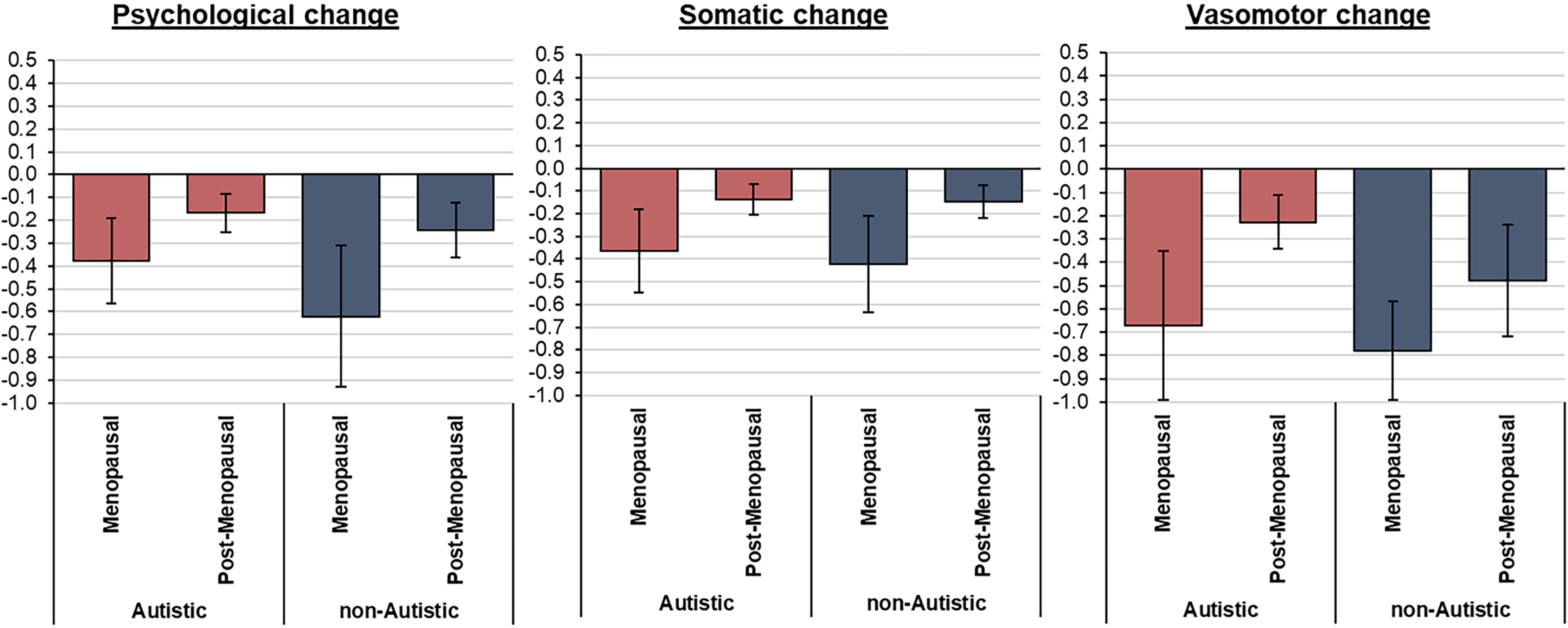
Self-reported change in symptoms by menopause stage for autistic and non-autistic people.
Change in somatic symptoms
After controlling for overall somatic symptom scores, there was a significant effect of menopause stage on change in somatic symptoms. No significant effect of group or interaction of group by menopause stage was observed. For both groups, change scores were significantly worse for those in the menopause stage versus the postmenopause stage. Autistic and non-autistic groups reported similar patterns of change overall.
Change in vasomotor symptoms
After controlling for overall vasomotor symptom scores, significant effects of group were observed, although this result did not survive FDR correction. Non-autistic people reported more negative change in symptoms overall compared with autistic people. A significant effect of menopause stage was observed. Change in vasomotor symptoms was reported as significantly more negative during menopause, with change being reported as less negative at postmenopause. No statistically significant interaction of group by menopause stage was observed.
Discussion
This study examined autistic and non-autistic people’s experiences of menopausal symptoms. When considering all autistic participants compared with non-autistic participants independent of menopause stage, the autistic participants reported more bothersome psychological and somatic (but not vasomotor) menopause symptoms. Furthermore, the two groups (autistic versus non-autistic) reported different scores depending on menopause stage. For autistic people, either no differences (in psychological symptom scores) or very small differences (somatic symptom scores) were observed between menopause stages. In contrast, non-autistic people reported lower scores for symptom severity on psychological and somatic subscales for postmenopause compared with premenopause and menopause stages, suggesting that symptom severity may differ through menopause for autistic and non-autistic people. Our finding of high self-report scores for somatic and psychological menopause symptoms is in keeping with the only previous study that quantitatively examined menopause symptoms 28 (although note that this study used a different measure, the Menopause Rating Scale 35 ). We are not aware of any previous studies that have examined the amount of bothersome symptoms by menopause stage including autistic people.
For autistic people, psychological symptom scores were high before menopause and remained high within other menopause stages. This is in keeping with other studies, which have reported high rates of depression and anxiety symptoms among autistic people. 36 In contrast, for non-autistic people, psychological symptom scores were reported as high during premenopause and menopause but lower in people who were postmenopausal, a pattern that has been observed elsewhere. 37 For both groups, there was no difference between psychological symptom scores in the premenopause and menopause groups. It is possible that people in middle age who self-identify as premenopausal may be beginning to experience psychological symptoms of the menopause but do not (yet) associate these symptoms as related to menopause. A significant difference in the pattern of results between autistic and non-autistic people was that postmenopausal non-autistic people reported lower psychological symptom scores compared with other menopause stages, whereas autistic people’s postmenopausal psychological symptom scores remained high. Whether this reflects the often observed higher levels of psychological distress across the lifespan among autistic people, or a difference in the experiences, trajectory, and “return to normal” of autistic people postmenopause requires further investigation. 36,37 It is worth noting that both autistic and non-autistic groups report fewer negative (but not more positive) changes at postmenopause compared with menopause for all symptom types (see analysis of self-reported change in symptoms). It is interesting to note that although non-autistic people report lower psychological symptom scores overall, they report a worse negative change in psychological symptoms at the transition to menopause compared with autistic people. This may reflect psychological distress as being a less common experience for non-autistic compared with autistic people, and therefore the onset of psychological symptoms is perceived as more distressing. 36,37 Exploring individual change through longitudinal studies may help to clarify the reasons for this pattern of results.
Autistic people in the premenopause group reported lower somatic symptom scores than autistic people in the menopause and postmenopause groups. This is in contrast to the non-autistic group, where the lowest somatic symptom scores were reported by the postmenopause group. In previous studies of menopause in general (with no information about menopause stage), menopause is associated with high rates of somatic symptoms among autistic compared with non-autistic people. 28 Despite these differences in the symptom scores reported by menopause stage, there are no significant differences between autistic and non-autistic people in their ratings of the change in somatic symptoms. Ratings of the change in somatic symptoms suggest that both groups report the change in somatic symptoms to be generally negative and more negative during menopause compared with postmenopause, and these experiences are similar for autistic and non-autistic people.
Reports of vasomotor symptoms show a different pattern from other symptom types. No group differences in vasomotor symptom scores for autistic and non-autistic people were observed. Although no direct comparison of vasomotor symptoms is available in other studies, vasomotor symptoms contribute to the somatic scale of the Menopause Rating Scale, 35 which has been found to be higher for a group of autistic compared with non-autistic people. 28 Interaction effects demonstrate that there are significant differences between the vasomotor symptom scores reported at each menopause stage by autistic compared with non-autistic people. For autistic people, menopause is associated with higher vasomotor symptom scores (compared with premenopause), and these scores remain high in the postmenopause group. For the non-autistic group, menopause is associated with higher vasomotor symptom scores compared with the premenopause group, but also significantly lower vasomotor symptom scores in the postmenopause group. Among non-autistic people, vasomotor symptoms are reported as more bothersome during menopause compared with both before and after menopause, but autistic people continue to report high vasomotor symptom scores after menopause when symptoms “should” reduce. 15 These results suggest that some autistic people may continue to be bothered by vasomotor symptoms through postmenopause. Although both groups report that the change in vasomotor symptoms is most negative during menopause, overall experiences of vasomotor symptoms are rated as worse by non-autistic compared with autistic people. Previous studies examining autistic people’s menopause experiences reported the presence of vasomotor symptoms and that these were particularly bothersome due to sensory sensitivities, but no information from non-autistic people was available for comparison. 25,27 Longitudinal studies, which explore changes in individual symptom experiences over time, are required to fully understand how menopause may impact autistic people and other neurodivergent groups.
To our knowledge, no other study has included both a measure of menopause symptoms and information about menopause stage for autistic and non-autistic people, limiting our ability to compare our results with previous findings. The only other study including a measure of self-reported menopause symptoms included people aged over 40 years with irregular or absent menstruation but did not include further information about menopause stage. 28 Due to the limited research in this field, it is important to apply caution when interpreting the current results. Data were collected as part of an online survey, which may introduce bias in who participates. Participants in online, self-report surveys may be more likely to be better educated or have a higher SES, as taking part requires access to a computer, the internet, and a certain amount of confidence using computers. Therefore, participants may not be representative. Being interested in the topic of a study may also introduce participant bias. However, study advertisements did not mention menopause (data collection was part of a larger study of aging), so this sample may be relatively representative rather than including people who have particularly problematic experiences of menopause. The sample size included here is large compared with previous studies, which allows some confidence in the results. A final consideration is that this study included cross-sectional data, and individuals were retrospectively reporting on perceived change in symptoms; therefore, caution must be exercised when drawing conclusions about change. Longitudinal studies, which collect detailed information about menstrual history and final menstrual period, are required to investigate prospectively the individual differences in change in menopause symptoms over time.
Results from this online survey suggest that autistic people may experience more bothersome psychological and somatic (but not vasomotor) menopause symptoms compared with non-autistic people. Importantly, there appear to be significant differences in symptoms by menopause stage for autistic and non-autistic people that warrant further investigation. Although this study did not measure longitudinal change in symptoms, both autistic and non-autistic people reported that psychological, somatic, and vasomotor symptoms worsened during menopause. Future longitudinal studies should investigate individual differences in experiences at different stages of menopause to better understand the factors that may reduce the impact of negative symptoms.
Footnotes
Acknowledgments
The authors are grateful to the 12 autistic people who offered suggestions on content and provided feedback on the language use and accessibility of the first wave of the AgeWellAutism study in 2019. We would like to thank the Autistica Network, the Cambridge Autism Research Database (CARD), and the Matthews Hub for advertising this study to their members.
Authors’ Contributions
R.A.C.: Conceptualization, methodology, investigation, and writing—original draft. F.G.H.: Conceptualization, methodology, writing—review and editing, supervision, and funding acquisition. A.J.S.: Visualization and writing—review and editing. W.M.: Conceptualization, writing—review and editing, and supervision. G.R.S.: Conceptualization, formal analysis, investigation, visualization, project administration, and writing—review and editing.
Author Disclosure Statement
The authors report no conflicts of interest.
Disclaimer
This article represents independent research conducted by the authors, and the views expressed are those of the author(s) and not necessarily those of the ESRC, BA, NIHR, NHS, UCL, KCL, or Goldsmiths UoL.
Funding Information
R.A.C. receives funding from an NIHR Research for Social Care grant. G.R.S. has received funding from the ESRC (via UBEL-DTP) and the British Academy during the collection of these data to the write-up of this present study. F.G.H. is part-funded by the NIHR Maudsley Biomedical Research Centre at South London and Maudsley NHS Foundation Trust and King’s College London. During this project, W.M. received funding from the NIHR, ESRC, Dunhill Medical Trust, MRC, and ERC. The funders have had no role in the data collection, analysis, interpretation, or any other aspect pertinent to the study. The authors have not been paid to write this article by any agency.
Supplementary Material
Supplementary Table S1
References
Supplementary Material
Please find the following supplemental material available below.
For Open Access articles published under a Creative Commons License, all supplemental material carries the same license as the article it is associated with.
For non-Open Access articles published, all supplemental material carries a non-exclusive license, and permission requests for re-use of supplemental material or any part of supplemental material shall be sent directly to the copyright owner as specified in the copyright notice associated with the article.
