




Abstract
Purpose:
The National Institutes of Health (NIH) policy on sex as a biological variable (SABV) was implemented in 2016 to encourage researchers to consider both sexes within their study design. However, there continues to be ongoing debate regarding the utility of this initiative. This study aimed to evaluate opinions of the SABV policy among study section members and how these varied by self-reported sex.
Method:
An 18-question survey was sent via email in 2023 to 20,803 study section members who participated in a review session from May 15 to July 15 in 2020, 2021, 2022, or 2023. Survey questions were based on a previously published study surveying study section members from 2016 to 2017 to allow for comparison of results.
Results:
A total of 3,699 individuals responded to the survey (17.7%). Among respondents, 52.1% self-identified as male, and 69.8% conduct basic/translational research. Fewer respondents received resources to learn about the policy in 2020–2023 compared to 2016–2017 (n = 2,147, 58.0% versus n = 848, 73.0%, p < 0.001). More respondents in 2020–2023 felt that considering SABV would improve the rigor and reproducibility of NIH-funded research compared to 2016–2017 (n = 2,630, 71.1% versus n = 654, 56.3%, p < 0.001). However, only 2,358 (63.7%) respondents felt it was important for all NIH-funded research to consider SABV within experimental design, similar to 2016–2017 (n = 766, 66.0%, p = 0.2). Fewer male respondents compared to female respondents felt considering SABV would improve rigor and reproducibility (n = 1,325, 68.8% versus n = 1,285, 74.6%, p < 0.001), and fewer male compared to female respondents felt it was important for all NIH-funded research to consider SABV within their experimental design (n = 1171, 60.9% versus n = 1170, 67.9%, p < 0.001).
Conclusions:
Since the implementation of the SABV policy, diverse perspectives continue to exist among study section members. Continued efforts are required in order to understand how sex can be incorporated into research for the benefit of all people.
Introduction
In 1989, the New England Journal of Medicine (NEJM) published the effects of aspirin in preventing myocardial infarction based on a large randomized controlled trial of ∼22,000 men and no women. 1 The inclusion of women and minorities in clinical trials was controversial until the National Institutes of Health (NIH) Revitalization Act was passed in 1993, making it federal law. 2 Since then, many more studies have been published regarding cardiovascular disease in women, including a comparably large randomized controlled trial that found aspirin actually lowered the risk of stroke in women in a study published by the NEJM in 2005. 3 Similar calls to action have been made for the equal and appropriate representation of both sexes in basic/translational research, as studies show a disproportionate inclusion of males in animal studies. For example, one study in neuroscience showed a greater than 5:1 ratio of male-only to female-only animal studies. 4,5 Furthermore, despite the importance of cellular work within basic/translational science, only a minority of studies in top cardiovascular journals reported the sex of the cell studies, and when reported, it was usually male. 6 In 2016, the NIH implemented the sex as a biological variable (SABV) policy, which required consideration of incorporating both sexes into experimental design to improve the rigor of human subjects and vertebrate animals research, attempting to correct the historically androcentric approach to biomedical investigation and research seen above. 7,8 However, sex bias remains prevalent in clinical research 30 years after the passing of the NIH Revitalization Act, and the impact of the SABV policy has yet to be determined. 9 –11
Several barriers exist to incorporating SABV within biomedical research. Interviews with animal researchers found that increased costs and lack of knowledge regarding the biological variability from female estrous cycles are perceived obstacles to including both sexes in preclinical studies—an assumption later not shown to be supported by evidence. 12 Furthermore, while inclusion of both sexes has reportedly increased in biomedical literature since 2009, many of these studies lack appropriate sex-based analyses and possibly overreport sex differences. 13,14 As the gatekeepers of U.S. research dollars and the enforcers of NIH policies, study section members play a pivotal role in addressing these key issues. Yet, one study that surveyed NIH study section members in 2016–2017 demonstrated that study section members have mixed perspectives on and knowledge of the NIH SABV policy. 15 For example, 32% of respondents disagreed that it is important for research to consider SABV within their experimental design, and 42% disagreed that considerations of SABV will improve the rigor and reproducibility of research. 14
Now, 9 years since the implementation of the SABV policy, study section members and researchers have had the opportunity to become more familiar with the SABV policy. As such, our study aims to identify how perceptions regarding the SABV policy have changed over time among NIH study section members, with a particular focus on how these perceptions vary by self-reported sex. We hypothesized that there would be increased awareness of the SABV policy and its importance over time. Given the historically androcentric nature of biomedical research and science overall, we also hypothesized that the perceptions of female respondents in our sample would be more agreeable to the policy in comparison to male respondents.
Method
Survey design
We designed this survey study in accordance with the American Association for Public Opinion Research (AAPOR) Transparency Initiative, and it follows the AAPOR Standards for Disclosure Checklist (Supplementary Data S1). 16,17 The 18-question survey containing multiple-choice, demographic, dichotomous, and open-ended questions is based on the original work done by Woitowich and Woodruff in 2019 to collect basic demographic information and opinions on the SABV policy (see Supplementary Data S2 for the survey questions). 14 The questions in our survey aligned with the Woitowich and Woodruff survey questions in order to compare trends over time. Additional information collected included information regarding respondents’ personal research programs, as well as possible barriers to the implementation of the SABV policy. Survey respondents were asked to self-identify as “male,” “female,” or among other categories. Hence, when referencing data obtained through our survey, we refer to participants as “male respondents” and “female respondents.” However, the broader discussion of the SABV policy and implementation has profound impacts on men and women, which is reflected in our gendered language in our discussion. We sent the survey to 20,803 email addresses with a 1-week follow-up email reminder, and it was available to access for 6 weeks. We collected all information anonymously using Qualtrics (Qualtrics, Provo, UT, USA). Not all survey questions were required; thus, the number of responses varies across questions. Additionally, one question on the barriers to SABV policy implementation was multiple choice, allowing users to select several options and therefore not totaling 100%.
Study participants
To capture a wide and diverse audience, we identified 295 unique study sections and 725 additional special emphasis panels spread across 25 NIH Centers and Institutes from 2020 to 2023, including Chartered Study Sections, HIV/AIDS Research Study Sections, and other special emphasis panels. Aggregate special emphasis panels and integrated review groups were excluded to maintain consistency with previously published work. 15 NIH study section rosters are publicly available through the NIH Scientific Review Group Roster Index website (https://public.era.nih.gov/pubroster). We then abstracted names and institutions from each study section roster that took place May 15–July 15 during 2020, 2021, 2022, and 2023. For each study section member, we obtained institutional emails through public online faculty profiles and/or article authorships. Additional data comparisons to the 2016 and 2017 study section participants from the original work done by Woitowich and Woodruff were taken directly from the article published in 2019. 15 We aimed to reach a representative sample by emailing all publicly listed study section members; however, representation by sex was dependent on response rates and was not controlled for.
Statistical analysis
We used OriginPro, Version 2018b for Windows (OriginLab Corporation, Northampton, MA, USA) for statistical analysis. Categorical values of proportions of survey respondents were compared using chi-squared and Fisher’s exact tests, with a p-value <0.05 considered significant. Specific comparisons made included gender, time periods (2016–2017 versus 2020–2023), age groups, years of participation in study sections, employment sector, type of research conducted, confidence in understanding SABV policy, perception of SABV policy’s impact on rigor and reproducibility, importance of considering SABV in NIH-funded research, discussion of SABV policy during study section meetings, and barriers to including SABV in research. No corrections for multiple comparisons were made. Analyses were run independently between the two studies.
Results
Study participants
A total of 3,699 individuals responded to and completed the survey, resulting in a response rate of 17.7% among members who participated in NIH study sections during 2020–2023 (Table 1). Among the 2020–2023 survey respondents, 1,929 (52.1%) self-identified as male, 1,725 (46.6%) self-identified as female, and 45 (1.2%) selected other responses. The distribution of male and female respondents was similar to the 2016–2017 survey (p = 0.54) (Supplementary Table S1). Most respondents reported working in an academic setting (n = 3,533, 95.5%) and conducting basic/translational research (n = 2,583, 69.8%). The majority of respondents identified as temporary study section members (n = 2,205, 60.9%), and most reported 10 or more years of participation on a study section (n = 1,159, 31.8%).
Opinions on Sex as a Biological Variable Between 2016 and 2017 Versus 2020 and 2023
2016–2017 resources provided by NIH.
NIH, National Institutes of Health; SABV, sex as a biological variable.
Opinions on the SABV policy from 2020 to 2023
Only 58% of respondents report being provided resources to learn about the SABV policy between 2020 and 2023. However, the majority of respondents (89.4%) felt confident about their understanding of the SABV policy, and most (78.0%) discussed the policy at the study section meeting. Additionally, the majority of respondents (71.1%) believe that considering SABV will improve the rigor and reproducibility of NIH-funded research, and the majority (63.7%) believe it is important for all NIH-funded research to consider SABV.
Among the barriers that exist for including SABV in research, respondents most often selected increased cost and increased use of animals (Supplementary Fig. S1). Comments regarding practical challenges also included the perceived ease of using one sex due to behavioral differences or assumptions that certain diseases or pathologies are predominantly sex-specific, despite having been refuted in the literature. 12 Conversely, some comments mentioned that other factors may be more important to consider, such as age, and that ultimately the policy could be implemented as a checklist item in the grant review process.
Opinions on the SABV policy over time
Fewer respondents report receiving resources to learn about the policy in 2020–2023 compared to 2016–2017 (n = 2,147, 58.0% versus n = 848, 73.0%, p < 0.001) (Table 1). However, slightly more survey respondents in 2020–2023 felt confident in their understanding of SABV compared to 2016–2017 (n = 3,307, 89.4% versus n = 1,004, 86.5%, p = 0.01), although fewer respondents in 2020–2023 indicated that SABV was discussed during the study section meeting as compared to 2016–2017 (n = 2,878, 78.0% versus n = 1,071, 92.2%, p < 0.001). Considerably more respondents in 2020–2023 felt that consideration of SABV would improve the rigor and reproducibility of NIH-funded research compared to 2016–2017 (n = 2,630, 71.1% versus n = 654, 56.3%, p < 0.001). However, in 2020–2023, only 2,358 (63.7%) respondents felt it was important for all NIH-funded research to consider SABV within experimental design, which was similar to 2016–2017 (n = 766, 66.0%, p = 0.2).
Opinions on the SABV policy by gender and research program
Within their personal research programs, most respondents reported studying both male and female animals (n = 3,141, 84.9%) (Table 1). Of those who do not routinely study both sexes, frequently cited reasons included indeterminate or asexual organisms (e.g., yeast), basic science research not requiring cells or animals (e.g., biochemistry or molecular), or sex-specific disease research (e.g., menopause). Notably, of the 554 respondents who do not study both males and females in their personal research programs, only 233 (17.5%) do not believe it is important to consider SABV in all NIH-funded research.
Examining the demographics in the 2020–2023 cohort revealed that there were more male respondents above the age of 55 and more male respondents who have participated in study sections for at least 10 years compared to female respondents (Table 2). There were similar rates of employment in academia between male and female respondents. However, more male respondents reported conducting basic/translational research compared to female respondents (n = 1,460, 75.7% versus n = 1,089, 63.2%, p < 0.001).
2020–2023 Survey Demographics by Sex (Male Versus Female)
NGO, Non-Governmental Organization.
Overall, slightly more male respondents reported routinely studying both males and females within their personal research programs compared to female respondents (n = 1,664, 86.4% versus n = 1,439, 83.5%, p = 0.03) (Table 3). Furthermore, slightly more male respondents felt confident about their understanding of the SABV policy compared to female respondents (n = 1,753, 90.9% versus n = 1,515, 87.8%, p = 0.003). However, fewer male respondents felt considering SABV would improve rigor and reproducibility in NIH-funded research compared to female respondents (n = 1,325, 68.8% versus n = 1,285, 74.6%, p < 0.001), and fewer male respondents felt it was important for all NIH-funded research to consider SABV within their experimental design compared to female respondents (n = 1,171, 60.9% versus n = 1,170, 67.9%, p < 0.001), which is consistent with results from prior studies (Fig. 1). Moreover, a subgroup analysis of male and female respondents disaggregated by race demonstrated the main observed gender-based differences are attributable to White, non-Hispanic respondents (Supplementary Table S3). Specifically, female White, non-Hispanic respondents were less likely to report discussion of SABV in study section meetings (n = 949, 69.3% versus n = 1,084, 74.7%, p < 0.01), receiving resources regarding SABV (n = 716, 52.3% versus n = 839, 57.8%, p < 0.01), and were less confident in their self-reported understanding of the SABV policy (n = 1,108, 80.9% versus n = 1,239, 85.4%, p < 0.01) than their male White, non-Hispanic counterparts. Conversely, female White, non-Hispanic respondents were more likely than male White, non-Hispanic respondents to endorse the potential of SABV policy to improve rigor and reproducibility in biomedical research (n = 941, 68.7% versus n = 936, 64.5%, p < 0.01) and the importance of NIH-funded research to consider SABV (n = 841, 61.4% versus n = 800, 55.1%, p < 0.01). Among respondents who self-identified as Black/African American, Hispanic/Latino(a), or Native American/American Indian, a similar pattern was appreciated between male and female respondents regarding their perceptions of the SABV policy. Given the low number of respondents in these categories, it only reached significance among Black/African American respondents, for whom more male respondents were confident in their understanding of the policy than female respondents (Supplementary Table S3).
2020–2023 Opinions on Sex as a Biological Variable by Sex (Male Versus Female)
NIH, National Institutes of Health; SABV, sex as a biological variable.
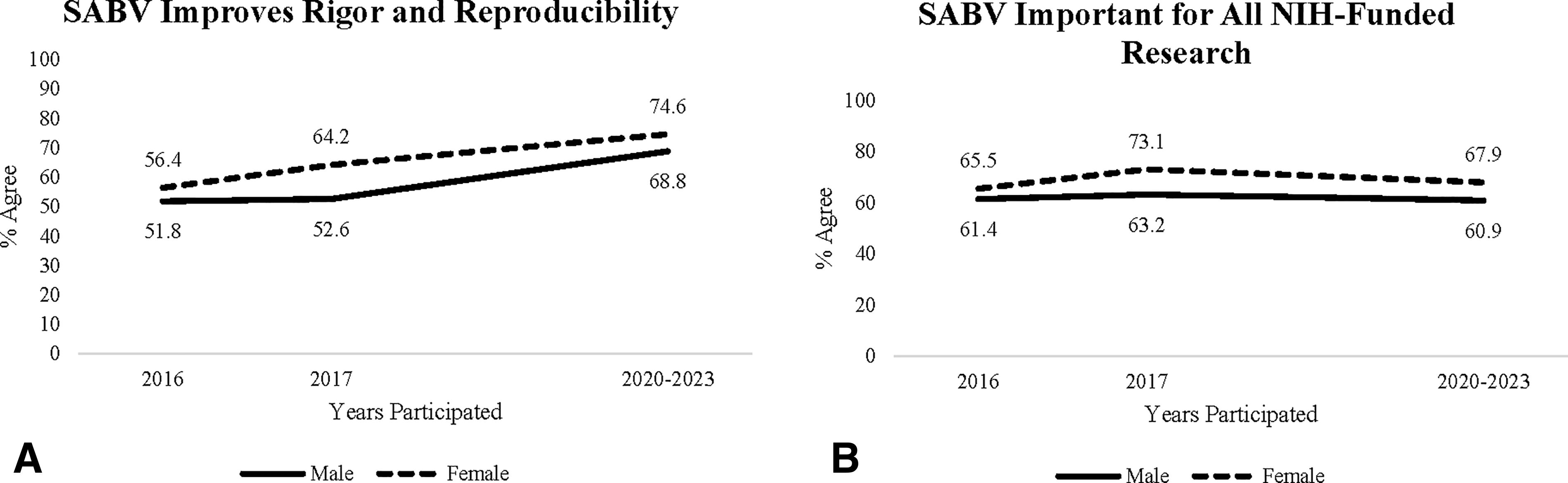
Survey responses from NIH study section members in 2016 (N = 448), 2017 (N = 713), and 2020–2023 (N = 3,654) show:
In a subgroup analysis of respondents whose personal research programs are basic/translational science, fewer male respondents reported that considering SABV improves rigor or reproducibility compared to female respondents (n = 1,007, 69.1% versus n = 857, 78.9%, p < 0.001) (Table 4). Of the female respondents who study basic/translational science, significantly more females <55 years old are likely to believe that SABV improves rigor or reproducibility (p = 0.04) (Supplementary Table S2). Additionally, fewer male respondents reported that it is important for all NIH-funded research to consider SABV compared to female respondents (n = 892, 61.3% versus n = 767, 70.6%, p < 0.001). For respondents who primarily study clinical outcomes or health services research, there was no significant difference between male and female respondents for either question.
2020–2023 Opinions on Sex as a Biological Variable by Sex (Male Versus Female) and Personal Research Program (Basic/Translational Versus Clinical/Health Services)
NIH, National Institutes of Health; SABV, sex as a biological variable.
Discussion
The goal of the SABV policy is to improve the scientific rigor of NIH-funded research to inform interventions in both sexes, but current opinions vary about whether the policy actually serves that purpose. 18 The results of our current survey of NIH study section members show that a significantly greater percentage of respondents acknowledge the SABV policy will improve the rigor and reproducibility of research compared to the 2016–2017 survey respondents. However, the proportion reporting that consideration of the policy is important for all NIH-funded research has remained unchanged compared to the 2016–2017 survey. A more interesting finding was that more female than male study section members continue to report that consideration of the SABV policy would improve the rigor and reproducibility of research and that it was important for all NIH-funded research to consider SABV. When examining the trends over time by sex of the respondents, it is notable that a consistently higher percentage of female respondents than male respondents agree that SABV improves the rigor and reproducibility of NIH-funded research and that SABV should be considered in all experimental design. This trend is evident in both the 2016–2017 and 2020–2023 survey periods. While our study is limited by the time points of data collection, the overall trend between male and female respondents is similar over time. Together, these results suggest that there may be a disconnect between the perceived value of the SABV policy and the desire for broader implementation between male and female respondents.
Since its implementation in 2016, the SABV policy has led to a significant increase in the discussion of sex differences in published articles. 19 However, other studies have demonstrated that the SABV policy may contribute to less precise methods of research: A proportion of sex differences findings reported in the literature are observational or not hypothesis-driven in their discovery. 14,20 This phenomenon has the potential to derail research findings that are not reproducible or lack clinical relevance, contradicting the goal of the SABV policy. As such, several authors have called for increased clarity when reporting sex differences, such as including sex steroid hormone levels and other sex-related factors as opposed to simply referring to a binary female versus male. 13,19,21 How the SABV policy can contribute to rigorous science is an important topic of discussion for study sections, given ongoing debates about its operationalization and implementation. 22,23
Our study demonstrates, however, that discussion of the SABV policy during the study section has decreased. Lack of engagement with a problem—despite knowledge and awareness of it—is described in political science and ecology as a “creeping crisis” and portends incomplete resolution of the problem. 21,24,25 We suggest that one way to improve engagement of SABV is through a structured discussion, such as utilizing the previously reported guidelines on sex and gender equity in research (SAGER) for the study section members. 26 Of note, discussions surrounding the limitations and potential harms to scientific rigor and reproducibility stemming from the SABV policy will ultimately strengthen sex-related variables. More specifically, we acknowledge that researchers may try to include both sexes without sufficient rigor, for example, improper use of controls or underpowered studies, simply to fulfill the requirement of considering SABV. Additionally, the NIH has developed and published resource materials for peer reviewers to better understand the SABV policy that should be used in conjunction with the SAGER guidelines when reviewing grant applications. Furthermore, this study found that fewer respondents received educational materials regarding the policy. We believe that peer reviewers should be provided the SABV policy, despite the fact that this study finds that the majority of survey respondents feel confident in their understanding of the SABV policy. We propose that scientific review officers (SROs) should also spend time at the beginning of the study section panel review, highlighting the importance and answering any questions regarding the policy. Furthermore, SROs could collect information to confirm that all peer reviewers have read the SABV policy prior to submitting proposal scores. By providing guidelines for structured discussions regarding the consideration of SABV in research design, as well as providing educational materials about the actual SABV policy, study section members will be better equipped to evaluate grant proposals and have more fruitful insights.
Lack of discussion may also conceal the different perspectives that exist regarding sex differences and gender inequalities. Literature regarding academic leadership and workplace equality provides evidence that men might not identify systemic barriers that exist against women and that men are less likely to recognize biases against women. 27 –29 Thus, when comparing male and female respondents, it is unsurprising that fewer female respondents reported that the SABV policy was discussed compared to male respondents. Additionally, more females feel the SABV policy improves rigor and reproducibility and endorse the importance of all NIH-funded research considering SABV in its design, which is particularly pronounced among respondents who conduct basic/translational science, where the use of single-sex can be less noticeable (e.g., male cell lines). These discrepancies in opinions could be attributed in part to an underlying discrimination many women have experienced in their careers, and the SABV policy becomes a vehicle through which cultural change may become more accessible and instituted. Interestingly, female scientists age ≥55 years are less likely to believe the SABV policy will improve rigor and reproducibility compared to younger female scientists, further suggesting that experience with the SABV policy may be influenced by differences in personal or life experiences as society continues to change through the years. However, this study demonstrates that the gap between male and female respondents who believe SABV improves rigor and reproducibility is narrowing, which may suggest implementation of this policy, as well as other initiatives, is creating a shared understanding over time.
Besides the complex social implications of the SABV policy, there are also many perceived practical limitations. A majority of respondents identified increased cost as a barrier to implementation of the SABV policy, and one comment noted that there should be proportionally increased funding to enable researchers to perform these studies. However, Tannenbaum et al. note that the SABV policy does not necessarily imply equal numbers of males and females, but that sex should be “thoughtfully consider[ed].” 30 Likewise, a strict doubling of the sample size requirement has been refuted as an appropriate statistical approach to sex-stratified experimental design. 31 Other respondents noted that sex-specific pathologies that might be more prevalent in one sex allow for the use of single-sex studies. However, previous work has shown equal variability exists between both sexes that is not limited to only pathologies that affect sex organs and sex steroid hormones. 5,32,33 Such respondents may feel the SABV policy is better suited to specific use cases (e.g., women’s health) and, therefore, that its indiscriminate application could hinder research progress. However, we reject the notion that SABV consideration should be limited to specific use cases such as these, as sex differences in various disease states have been well described. 34 –38 Particularly, in an era of increasingly personalized medicine, ensuring that both sexes are appropriately represented in research is a fundamental scientific issue.
Interestingly, several comments mentioned the SABV policy as a screening tool, suggesting that regulatory bodies beyond the NIH, such as institutional review boards, need to participate in its enforcement and follow through with regular check-ins. 39 The White House Initiative on Women’s Health Research, signed by President Biden in March 2024, provides an example of how interdisciplinary leadership can determine accountability within its agency, such as its 30-, 90-, and 180-day checkpoints. 40 Engagement with different groups, regulatory or not, may help continue the conversation of sex bias and the SABV policy. The discussion of the policy on institutional-level committees, such as the institutional review board and Institutional Animal Care and Use Committees, may also improve perceptions around the importance of SABV. Scientific journals can also implement instructions for authors to include the sex being studied and a justification statement for single-sex studies. Without constant recognition that there are still gaps in the application of the SABV policy in research on multiple levels, movement toward a true understanding of sex differences will cease.
Limitations
Given that our data collection method utilized publicly available information, there were some errors in survey distribution, such as failure of emails to deliver or incorrect email addresses. Furthermore, this survey was sent to study section members who participated in a study section meeting between 2020 and 2023, making it subject to recall bias. Our survey achieved a relatively low response rate of 17.7%; however, this is still higher than the response rates of the 2016 and 2017 surveys (10% and 15%, respectively). 15 We attribute this increase to the SABV policy being a new initiative at the time, resulting in lower awareness. Notably, no incentives were given to participate in the survey. While we are encouraged by the response rate increase over time, we recognize that our results may be subject to nonresponse bias, requiring future investigation. Additionally, demographic information was only collected on respondents and not on all the people who received the survey, which limits our ability to comment on how representative our sample is relative to the entire group. The scope of the survey also does not discuss or reflect gender-based studies or single-sex research studies (e.g., uterine cancer). While this study mainly addresses perceptions of study section members, it does not evaluate opinions of the SABV policy of researchers not involved in study section meetings. Future studies would benefit from the evaluation of a wider audience to obtain other perspectives on how the SABV policy has affected the quality and scope of research conducted.
Conclusions
This study demonstrates ongoing progress toward increasing awareness of the SABV policy, which is critical to advancing human health by encouraging SABV in research practices. However, it also shows that there are differing perspectives between male and female study section members. While a greater proportion of study section members believe that the SABV policy contributes to research rigor, varying views among male and female study section members prove the importance of continued effort in advocacy and education. Without acknowledgment of the obstacles that exist, the SABV policy will simply become another checkbox to complete as opposed to a policy that will inspire meaningful discussion.
Footnotes
Acknowledgment
The authors would like to thank Deb Hepp for providing editorial assistance in proofing this article.
Ethical Approval
This study was reviewed by the institutional review board at the University of Virginia and was deemed exempt from full review.
Authors’ Contributions
Conceptualization: S.M.M., D.Z.A., C.C.B., and M.R.K. Data curation: S.M.M., D.Z.A., N.P., S.L.M., and M.E.F. Formal analysis: S.M.M., D.Z.A., and M.R.K. Investigation: S.M.M., D.Z.A., C.C.B., N.P., S.L.M., M.E.F., and M.R.K. Methodology: A.V., T.K.W., M.R.K., and M.K. Project administration: M.R.K. Supervision: M.R.K. Writing: S.M.M., D.Z.A., C.C.B., and M.R.K.
Author Disclosure Statement
No competing financial interests exist.
Funding Information
No funding was received for this article.
Supplementary Material
Supplementary Data S1
Supplementary Data S2
Supplementary Data S3
References
Supplementary Material
Please find the following supplemental material available below.
For Open Access articles published under a Creative Commons License, all supplemental material carries the same license as the article it is associated with.
For non-Open Access articles published, all supplemental material carries a non-exclusive license, and permission requests for re-use of supplemental material or any part of supplemental material shall be sent directly to the copyright owner as specified in the copyright notice associated with the article.
