




Abstract
Abstract
Introduction:
The use of a gastrostomy button for intermittent emptying of the bladder has been already proposed. The aim of this study was to describe a percutaneous button placement under endoscopic control as a safe, minimally invasive technique.
Materials and Methods:
The percutaneous gastrostomy kit, according to the Russell gastrostomy tray (Cook®; Cook, Bloomington, IN), was used under cystoscopic control. The U-stitche technique, according to Georgeson, allowed us to secure the bladder to the abdominal anterior wall. A guide was introduced into the bladder through a needle. Three dilatators, respectively 12, 14, and 16 FR, allowed the path for a probe or, immediately, the gastrostomy button (Mic-Key®; Ballard Medical Products, Draper, UT).
Results:
Over 2 years, 10 percutaneous continent vesicostomies were performed for patients with a neurogenic bladder. Patients were from 5 months to 19 years old. The procedure was safe. No major complication was observed except for only minor ones.
Discussion:
When intermittent urethral catheterization cannot be established, Mitrofanoff continent urinary diversion seems to be a major surgery for patients and their parents. In addition, for some patients, intermittent bladder emptying may be required for a transitory period. For all these reasons, there is a place for a reversible vesicostomy with a minimally invasive procedure. Button vesicostomy seems to be a good alternative. In this article, we propose a percutaneous technique with an endoscopic control. If this kind of treatment is effective, it may avoid further major surgery.
Conclusions:
Percutaneous button vesicostomy placement under endoscopic control is safe and feasible and must be evaluated with large series.
Introduction
Materials and Methods
Since January 2007, some patients requiring bladder drainage were considered for the placement of a vesicostomy button once they did not need baldder augmentation, surgery on the baldder neck, and ureteral reimplantation. The percutaneous gastrostomy kit, according to the Russell gastrostomy tray (Cook®; Cook, Bloomington, IN), was used under cystoscopic control. First, the bladder was explored, described, and fulfilled endoscopically. The U-Stitche technique, according to Georgeson, 10 allowed us to secure the bladder to the abdominal anterior wall (Fig. 1). A guide was introduced into the bladder through a needle under direct vision. Three dilatators, respectively, 12, 14, and 16 FR, allowed the path for a probe or, immediately, the button after evaluation of the length of the required button, owing to the probe, including in the Russell kit, which is graduated. The procedure was covered by perioperative antibiotics, while a urinary test was systematically realized a few days before the procedure. U-Stitches were removed 1 week later. A Mic-Key® button (Ballard Medical Products, Draper, UT) was placed either immediately or 4 weeks after surgery as an easy office procedure (Fig. 2). The button was generally changed every 3 months. The button can be used immadiately after the procedure either to drain the bladder intermittently or for a permanent drainage with a connecting set. We followed the button-care protocol described by Hitchkok and Sadig. 7 Material was presented to the patients and their parents before surgery. Button management was explain during the hospital stay, and good handing was supervised by a nurse. Patients and parents were followed up evenly.

Percutaneous placement of the button.
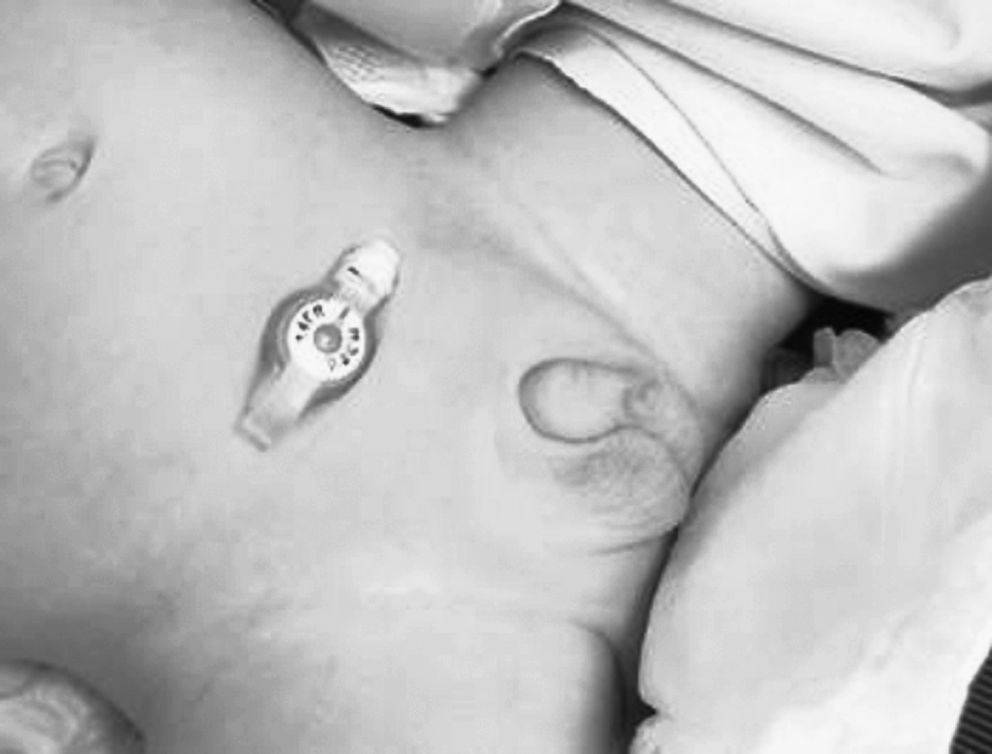
Vesicostomy.
Results
Over 2 years, 10 percutaneous continent vesicostomies were performed. Patients were from 5 months to 19 years (mean, 5). The mean follow-up was about 1 year. Indications for this technique included: incapacity to empty bladder because of bilateral obstructive ureteroceles (1), neurogenic bladder associated with anorectal malformation (1), myelomeningocele with secondary failure of a Mitrofanoff derivation in relation with obesity (2) or refusing major surgery with failure of self-catheterization (1), sacrococcygeal agenesia (1), iatrogenic neurogenic bladder secondary to a voluminous pelvic tumor surgery (2), posterior urethral valves (1), and neurogenic bladder associated with neurofibromatosis (1). This technique was associated with a bladder-neck injection of dextranomer/hyaluronic acid in 1 case and detrusor injection of botulinic toxin in another case. Each patient and their family were in agreement with this percutaneous technique. Procedure was safe in all cases, with a mean operative time about 20 minutes. We had no complication, infection, leakage, or stone formation during our follow-up. Actually, no added measures have been needed. Patients and parents were satisfied.
Discussion
Clean intermittent catheterization, instituted by Lapides et al., 1 has revolutionized the management of patients with conditions precluding normal voiding and continence. Intermittent self-catheterization for patients who do not have a sensate urethra and with a good bladder capacity and a relatively continent bladder neck is a good alternative, but complications may occur. 8 Urethral catheterization is not always possible, and continent urinary derivations involve a very heavy procedure, for some children, who already have a hard surgical past. The Mitrofanoff urinary diversion seems to be a major surgery for patients and their parents. Stomal stenosis is a problem with a Mitrofanoff channel. 4 That is why several procedures were proposed to modify this technique.3,4
Bladder-drainage techniques to protect the upper tract are numerous. It may be done with a suprapubic catheter for temporary drainage. A surgical cystostomy for a permanent drainage is efficient but uncomfortable. For these patients, wearing a urinary sac for a long time is not conceivable. 6
The gastrostomy button, to occlude vesicostomy, provide access for intermittent catheterization, and evaluate urodynamic conditions of the patients, was first proposed in 1996. 5 Since 2003, several researchers have reported the use of a continent urinary stoma from using a gastrostomy button.6–8 Sometimes, intermittent bladder emptying may be required for a transitory period; consequently, there is a place, in these cases, for a reversible vesicostomy. When used as a catheterizable stoma, a gastrostomy button is a safe, effective option. 6 The rate of symptomatic infections is low and the risk of bladder stone formation is minimal, 6 but the button-care protocol is important so as to avoid any infection. 7
Until now, vesicostomy was classically performed with an open procedure, either through a previous cystostomy 5 or through a mini-Pfannenstiel incision.6–8 Haider and Subramaniam have recently report the endoscopic insertion of a gastrostomy button in the bladder with good results. 9 We propose our percutaneous technique with an endoscopic control. Complementary treatments can be envisioned during the same time as botulinic injections into the detrusor or partial closure of the bladder neck with Macroplastic® (Uroplasty BV®, Geleen, The Netherlands) or Deflux® (Q-Med®, Uppsala, Sweden). These are minimally invasive techniques and easily acceptable, which can be proposed. If this kind of treatment is effective, it may avoid further major surgery. Physical handicaps may be treated with simple techniques. It is easier to convince patients to begin a treatment with minimally invasive procedures for improving their status.
Conclusions
Percutaneous button vesicostomy placement under endoscopic control is safe and feasible and must be evaluated with large series. It is easier to convince patients to begin a treatment with minimally invasive procedures for improving their status.
Footnotes
Disclosure Statement
No competing financial interests exist.