




Abstract
Abstract
Necrotizing fasciitis (NF) is a rapidly progressing bacterial infection of soft skin tissue layers, combined with high mortality rates. Association with laparoscopic surgery is rare. In this article, we report a case of a 61-year-old patient suffering from severe NF after laparoscopic left hemicolectomy with low anterior resection due to diverticulitis of sigmoid colon. Skin discolorations, combined with critical illness of the patient, led to the diagnosis of NF. Early recognition, intensive care treatment with stabilization of vital parameters, broad-band antibiotics, and aggressive debridement are the cornerstones for successful treatment of NF.
Introduction
Case Report
A 61-year-old female with a body-mass index (BMI) of 24 kg/m2 who presented with abdominal pain and obstipation arrived in our emergency department. She had a history of sigmoid diverticulitis, diabetes mellitus type IIa, and a hysterectomy performed in 1996. The patient smoked 15 cigarettes per day. A barium enema showed a sigmoid stenosis caused by acute diverticulitis. She was initially treated conservatively with parenteral feeding, intravenous antibiotics (mezlocillin and metrodinazol), and received bowel preparation.
After initial recoverance, at 2.5 weeks of admission, the patient underwent a laparoscopic left hemicolectomy with low anterior resection, followed by end-to-end anastomosis. A small lesion in close proximity to the indurated region of the diverticulitis mass occurred intraoperatively with a small portion of feces leaking into the abdominal cavity. The leakage was closed safely by suture and the abdomen was rinsed carefully, using NaCl 0.9%. The patient was treated with intravenous (i.v.) antibiotics (mezlocillin and metrodinazol) and recovered well. Postoperative laboratory showed a white blood cell count of 1.8 × 10⁹/L without any clinical findings.
In the morning on postoperative day 1, the patient complained of lower abdominal pain with local tenderness. Laboratory findings were a white blood cell count of 1.6 × 10⁹/L, hemoglobin of 10.5 g/dL, and a CRP of 95.3 mg/L. We decided to perform a diagnostic laparoscopy to exclude an anastomotic leak, but no bleeding or anastomotic leak was found during the operation. The following partial colonoscopy showed a vital anastomosis in the endoluminar and dorsal portion, excluding an anastomosal leakage as the cause for the clinical condition of the patient. The diagnosis of postoperative septic shock was made, and the patient was moved to the Intensive Care Unit where mechanical ventilation was continued after the operation (blood pressure: 100/50 mm Hg; pulse: 120 beats/min; pH: 7.168; pO2: 79.6 mm Hg; pCO2: 42.3 mm Hg; base excess −13.8 mmol/L HCO3: 15.4 mmol/L). Vasopressory therapie (noradrenaline) was needed to control the blood pressure of the patient. Antibiotic treatment was changed to imipenem and clindamycin.
Despite intensive therapy, the patient's condition worsened over time. In the right-lower abdomen, where the CO2 inflating trocar was placed, a rapidly progressing dark reddish-purple discoloration appeared (Fig. 1). This led to the diagnosis of fast progressive NF. The patient was transferred to the operation theater again. To reassure a sufficient and vital anastomosis, a laparotomy was performed. Again, no leakage could be found, but because of septic condition and the remaining high risk of anastomosal leakage, a Hartmann's situation was created. Then, aggressive debridement of the affected tissue was performed. All perforating vessels in this area were thombosed. The skin, subcutaneous, and fascia layers were found in a “cooked-like” easy-to-dissect condition. Muscle and peritoneum could be spared. Multiple swabs of the wound as well as blood cultures showed the presence of Enterococcus faecalis and Escherichia coli, sensible to imipenem and metronidazole.

Preoperative findings of typical skin discolorations.
Despite aggressive debridement, infection spread further and made reoperations necessary throughout the following 2 days. The patient's condition worsened, with septic shock leading to multiple organ failure, and finally, the patient deceased on the fourth day after the initial operation. The postmortal obduction verified the diagnosis of necrotizing fasciitis in combination with septic shock and multiple organ failure (Fig. 2). Again, no enteral leakage could be detected.
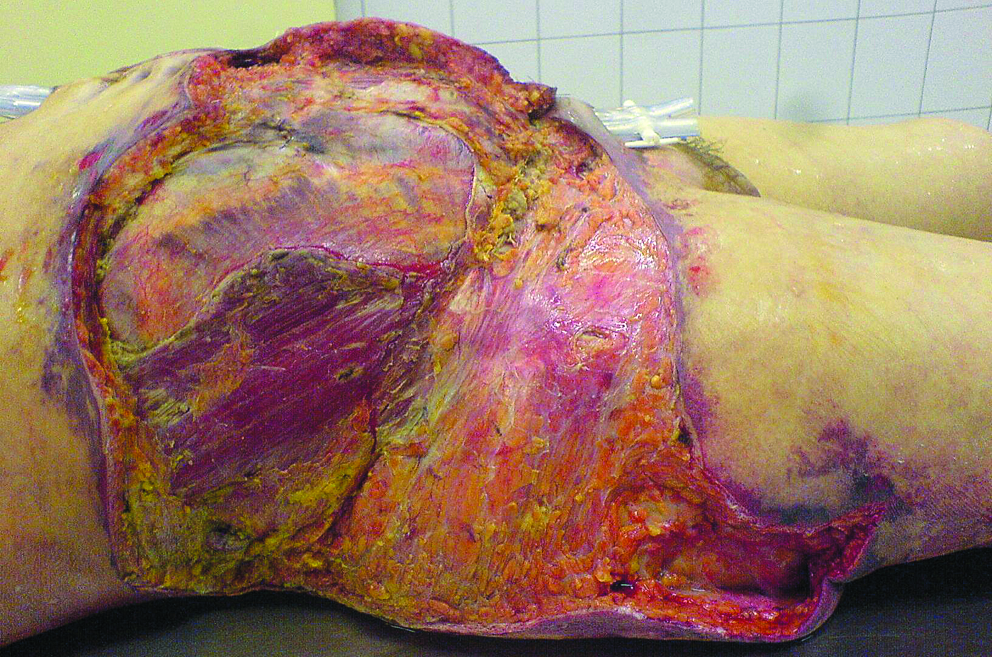
Postmortal view after aggressive skin debridement.
Discussion
In 1764, Baurienne 1 first described a fulminant gangrenous infection of the scrotum, usually associated with diabetes. Fournier 2 redescribed it in 1883 and established the term Fournier's gangrene. Meleney (1924) found the close relationship to group A beta-hemolytic streptococci and called his findings Hemolytic streptococcus gangrene. In 1952, Wilson 3 coined the term necroting fasciitis.
Previously, a monomicrobial infection was thought to be cause of the fulminant fascial necrosis, most closely linked to group A beta-hemolytic streptococcus. In fact, 55–75% cases of NF are the result of type 1 (polymicrobial) infections. Staphylococcus aureus, streptococcus, or klebsiella serotypes are most commonly found. These bacteria provoke only a few of the cases. Most are caused by other bacteria, such as enterococcus, klebsiella, or different streptococcal serotypes. Polymicrobial infections can also occur.4–6
Mortality rate and comorbidity
Although the incidence of NF is very low (1:200,000),7,8 it is associated with an extremely high mortality between 6 to as high as 76%. Patients with diabetes mellitus, as well as obese (BMI >25) and immune-suppressed patients, are at higher risk for infection.9–13
Pathomechanism in laparoscopic NF
Necrotizing fasciitis is characterized by rapidly spreading infection in the subcutaneous (s.c.) tissues. Accidental extraperitoneal insufflation of CO2 creates spaces between epifascial and s.c. layers. It seems possible that contaminated abdominal fluids could transfer bacteria into these spaces as infectious aerosol. 14 Bacteria produce endo- and exotoxins that cause microvascular thrombosis, tissue ischemia, and necrosis. This, then, leads to inadequate intracellular antibiotic absorption, which has a negative influence on antibiotic efficiency.15,16 Septic shock follows, inducing multiple organ failure, and, finally, death.
Typical clinical findings
Common signs and symptoms of NF vary. The most common early signs are erythema, local warmth, and skin indurations. Reddish-purple spots, edema, and crepitating skin, combined with signs of sepsis, such as hyperthermia, tachycardia, and hypotension, deserve alert recognition. Immediate therapy is essential; delay quickly leads to a severe gain of mortality.
Diagnostics
Exact examination and close observation of typical dermal discolorated spots lead to an early diagnosis. Other diagnostic adjuncts, such as ultrasound, computed tomography scan, and magnetic resonance imaging, 17 can be helpful in unclear findings. Biopsy of affected tissue could be useful for correct diagnosis in early stages as well for identification of bacteria. 18 A typical raise of white blood cell count >15 × 109/L is described, contrary to our case, where leucocytopenia (1.3 × 10⁹/L) occurred after the initial operation.
Therapy
Early diagnosis and prompt treatment, including surgical debridement and use of broad-spectrum i.v. antibiotics, are the keys to successful treatment in necrotizing fasciitis. The usefulness of additional hyperbaric oxygen therapy has been controversially discussed by multiple researchers.19–21 No significant improvement of survival rates was achieved, in comparison with standard operative and supportive therapy only.
Laparoscopy and outcome in literature
Multiple studies clearly confirm lower infection rates of surgical wounds for laparoscopic colon versus open operations. NF seems to be a very rare complication associated with laparoscopic procedures. Nine case reports22–30 were found, only 1 describing a case involving a partial colon resection. Other case reports describe NF after appendectomy, cholecystectomy, fundoplication, and adhesiolysis. Insufflation of contaminated aerosol in extraperitoneal layers is discussed as a pathomechanism for NF in laparoscopic surgery.
Conclusions
The key points for successful treatment of NF are early recognition, immediate intensive care treatment with broad-spectrum antibiotics, and stabilization of vital parameters, followed by aggressive debridement of the infected tissue. NF is, nevertheless, a rare complication, and therefore, initial examination of the abdominal cavity for organic complications, such as enteric leakage or peritonitis, remains obligate.
Footnotes
Disclosure Statement
No competing financial interests exist.