




Abstract
Abstract
Objective:
The use of laparoscopic scissors or blades in laparoscopic nondismembered pyeloplasty is quite common; however, the incision made using these tools may cause difficulties for the surgeon. We developed an efficient, safe, reusable, and inexpensive instrument to incise the pelvis and ureter during laparoscopic pyeloplasty. The aim of the present study was to evaluate the new laparoscopic instrument designed for pelvic and ureteric incisions.
Materials and Methods:
The cold knife consists of an internal urethrotome that is transformed into an endoscopic instrument that can be inserted easily through a 5-mm-diameter trocar. It has a manual retraction system that enables a stand-by position for added protection when no incisions are being made. The new tool was trialed in laparoscopic Y-V pyeloplasty. Data regarding perioperative parameters and outcomes were collected and analyzed.
Results:
Eight patients participated in the present study. All patients underwent Y-V pyeloplasty using a three-port retroperitoneal access. Mean operative time was 166.2 minutes (range: 100–300). There were no complications during the procedures.
Conclusions:
Laparoscopic cold knife for laparoscopic pyeloplasty is a simple, safe, reusable, and inexpensive instrument with a low maintenance cost.
Introduction
During laparoscopic nondismembered pyeloplasty, laparoscopic scissors or blades are used at the ureteropelvic anastomosis step to incise the ureteropelvic junction (UPJ) obstruction. However, the incisions made using these tools may cause difficulties for the surgeon and prolong the operation time. On several occasions, our team experienced that the scissors employed were inadequate in cutting and shaping the tissue and that they could “chew” the tissue. To simplify the incision of the pelvis and ureter during laparoscopic nondismembered pyeloplasty, we designed a simple and inexpensive instrument.
In this report, we introduce a new laparoscopic instrument that might be used effectively in the near future, and we report the results obtained in patients who underwent Y-V pyeloplasty using this instrument.
Materials and Methods
The laparoscopic cold knife
The cold knife consists of an internal urethrotome, which is transformed into an endoscopic instrument that can be inserted easily through a 5-mm-diameter trocar. The internal urethrotome's handle is welded to an endoscopic instrument's shaft, which is adjustable for manual retraction system. Usually, laparoscopic needles with sheaths are appropriate for this consistency. Manual retraction system is provided by means of an outer sheath. The generated cold knife has a manual retraction system that enables a stand-by position for added protection when no incisions are being made (Fig. 1).

Scheme of the laparoscopic cold knife: the laparoscopic cold knife consists of an internal urethrotome inserted into a 5-mm-diameter outer tube (
Evaluation of the instrument
During laparoscopic pyeloplasty for UPJ incision, either laparoscopic scissors or blades were used until the introduction of the cold knife. A total of 8 patients who were indicated for nondismembered pyeloplasty were included in this study. Radiologic images, including ultrasonography, diuretic renography, or intravenous pyelogram, indicative of the diagnosis of UPJ obstruction were obtained in all patients. Laparoscopic pyeloplasties were performed in the patients with UPJ obstruction with impaired split renal function (<40%), a decrease in split renal function of >10% in subsequent studies, increased anteroposterior diameter on ultrasonography, recurrent flank pain, and urinary tract infection. To evaluate the new instrument, a laparoscopic scissor was used for UPJ incision in 8 patients (Fig. 2). The pyeloplasty procedures were video recorded. The stents were removed at 4 weeks after the intervention.
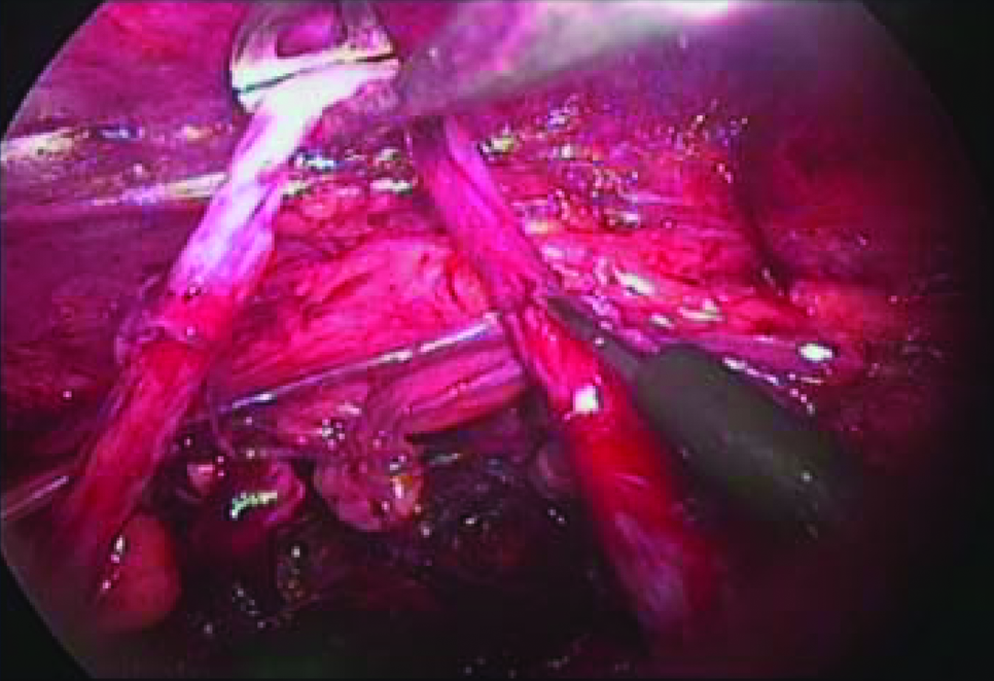
Cutting the ureteropelvic junction with laparoscopic cold knife during laparoscopic pyeloplasty.
Technique
A Double-J stent was placed in the lithotomy under general anesthesia prior to retroperitoneal access. The patient was then replaced in the flank position. Initially, a 12-mm trocar port for the 30° scope was placed on the midaxillary line by an open laparoscopic procedure. After expanding the retroperitoneal cavity with a balloon dissector, a 10-mm trocar for the surgeon's right hand and a 5-mm trocar for the left hand were placed on the two sides of the scope port. Dissection and hemostasis were performed by use of bipolar coagulation to avoid any damage to the ureter. A precise dissection of the upper ureter and pelvis was performed to evaluate the cause of UPJ obstruction. The Y-V plasty with a V-shaped incision of the renal pelvis and a 2-cm incision of the stenosis, including spatulation of the ureter, was performed.
Results
Eight patients were included in the present study. Preoperative patient characteristics are shown in Table 1. Retroperitoneal Y-V pyeloplasty was carried out in all patients. Three-port retroperitoneal access was used in all patients except 1 who needed a fourth trocar. Mean operative time was 166.2 minutes (range: 100–300) (Table 2). There were no major complications during these procedures.
There were no problems in cutting the pelvic and ureteric tissues with the laparoscopic cold knife. A sharp blade on the tip of the tool was conducted easily by the manual retraction system, converting the blade from safe mode to active mode. The tool did not chew the tissues during usage.
In 1 patient, the procedure was converted to open surgery because of prolonged operation time. In 1 patient, fever occurred on the second postoperative day. The patient recovered with administration of antibiotics. The mean follow-up time was 3 (2–7) months. Pyelography carried out after removal of a ureteral stent revealed that hydronephrosis had disappeared in 6 patients and had improved in the other patients.
Discussion
Although laparoscopic pyeloplasty application has grown dramatically and gained widespread use, laparoscopic surgery continues to advance with arguably less evolution with respect to some simple laparoscopic tools.5,6 The design of custom-made tools to be used at different steps of difficult reconstructive operations such as laparoscopic pyeloplasty is of utmost importance. Disposable and reusable scissors are apt to become dull and ineffective, especially during Y-V “shaping” at the pelvis and ureter during laparoscopic nondismembered pyeloplasty.
The scissors employed in these procedures are frequently inadequate in cutting the tissue and may chew the tissue during use. Further, their reuse for multiple procedures can present difficulties. There are commercially available laparoscopic handles (Aesculap AG & Co., Tuttlingen, Germany) for scalpels, but we have no experience with these tools. As well to our knowledge, there has been no report evaluating these tools during the incision of the pelvis and ureter in UPJ obstruction.
In the present study, we evaluated the safety and feasibility of laparoscopic cold knife use for nondismembered pyeloplasty. The results obtained in these patients are presented herein. Under direct visual control, the laparoscopic cold knife is a safe, simple, and efficient instrument for pelvic and ureteric incisions. With the laparoscopic cold knife, it is easy to incise the UPJ. The general surgical outcomes in both groups were similar.
Previous studies that have compared the costs of laparoscopic instruments noted that it was >10 times less expensive to use instrumentation with reusable components.5,6 The laparoscopic cold knife introduced in this report is reusable. It can also be easily assembled and disassembled. Because of its reusable and practical design, it may be less expensive compared with laparoscopic scissors.
This tool was used during retroperitoneoscopic pyeloplasty in this report, but it can also be used in other approaches and interventions such as ureteral or pelvic stones and strictures necessitating ureter and pelvis incision. It can be also used to facilitate scissor effectiveness.
The present study also reports the clinical results of 8 patients who underwent laparoscopic Y-V pyeloplasty. The analysis of the patients' data revealed that the mean operative time (166.2 minutes) was reasonable, and the intra- and postoperative complications were comparable with other published series.7–10
There is a need for custom-designed tools that facilitate the steps of laparoscopic interventions, which have become quite popular. These custom-designed tools will undoubtedly simplify laparoscopic pyeloplasty and similar interventions and thus have a positive impact on the results of these interventions in patients.
Conclusions
The laparoscopic cold knife introduced in the present study is a readily available and simple tool with low maintenance cost that can be used for incision of the pelvis and ureter.
Footnotes
Disclosure Statement
No competing financial interests exist.