




Abstract
Abstract
Background:
Laparoscopic cholecystectomy via the three-trocar technique is widely used for symptomatic gallbladder stones. Single-incision laparoscopic surgery (SILS) for cholecystectomy is a well-established procedure and represents the next step in developing the concept of mini-invasive surgery. We here described our 24-month experience SILS cholecystectomy.
Methods:
Between February 2009 and 2011, patients referred for cholecystectomy to the General and Endocrine Unit of our institution who agreed to undergo SILS were included in a prospective study. All operations were performed by the same surgical team specially trained in this type of surgery. The umbilicus was the sole point of entry for all patients. The same operative technique was used in all patients. Data of patients undergoing SILS cholecystectomy were compared with those from an uncontrolled group of patients undergoing standard laparoscopic cholecystectomy during the same study period.
Results:
The SILS and standard cholecystectomy groups included 120 patients each. SILS was performed in all patients and none of them required conversion to an open procedure. The median operating time of 45 minutes in the SILS group was not significantly different from that in the standard laparoscopic cholecystectomy group. We suture fascial edge with simple stitches under direct vision, thus reducing the risk of incisional hernia in SILS group (P=.046).
Conclusions:
SILS cholecystectomy was technically feasible and safe and represents a reproducible alternative to standard laparoscopic cholecystectomy in selected patients. The definitive clinical, esthetic, and functional advantages of this technique require further analysis.
Introduction
Single-incision laparoscopic surgery (SILS) in which only one incision is made through the umbilicus has received increasing attention in recent years and is an area targeted for intensive investigation in abdominal surgery.1–5 SILS laparoscopic single-site surgery, one-port umbilical surgery, or single-port access surgery are expansions of SILS. Other approaches such as natural orifice transluminal endoscopic surgery (NOTES) may represent the final frontier for the minimally invasive revolution surgery without incisions.6,7 A number of advantages have been proposed for SILS, including cosmesis (scarless abdominal surgery performed through an umbilical incision), less incisional pain, and the ability to convert to standard multiport laparoscopic surgery if needed. Different techniques for SILS cholecystectomy,8,9 appendectomy,10–12 nephrectomy, 13 adrenalectomy, 14 and obesity surgery 15 have been recently reported.
Different methods for port access to perform SILS include multiple fascial punctures through one skin incision, the introduction of membrane-based umbilical devices, and the use of additional transabdominal sutures to stabilize the target organ.16,17 To further overcome the technical challenges for SILS, different instruments that provide angulations and small profile trocars are being developed.
We here described our 24-month experience with SILS cholecystectomy. The objective of this study was to assess the feasibility of SILS cholecystectomy using a novel method of establishing single access using existing instrumentation with the addition of the SILS™ Procedure Kit Plus Components (Covidien, Norwalk, CT), as compared with standard multiport cholecystectomy.
Patients and Methods
Between February 2009 and February 2011, patients referred for cholecystectomy to the General and Endocrine Unit of Hospital Clínic i Provincial in Barcelona (Spain) who agreed to undergo SILS were included in a prospective study. The study was approved by the Ethics Committee of our institution. All patients were fully informed of the characteristics of the SILS procedure and other surgical options, including open cholecystectomy and standard laparoscopic cholecystectomy as well as the possibility of requiring conversion to an open procedure or standard laparoscopic cholecystectomy at the time of operation.
Surgical procedure
All patients followed the same preoperative protocol with antibiotic prophylaxis before operation. The operation was performed as we were previously reported. 9 The umbilicus was the sole point of entry for all patients (Fig. 1).
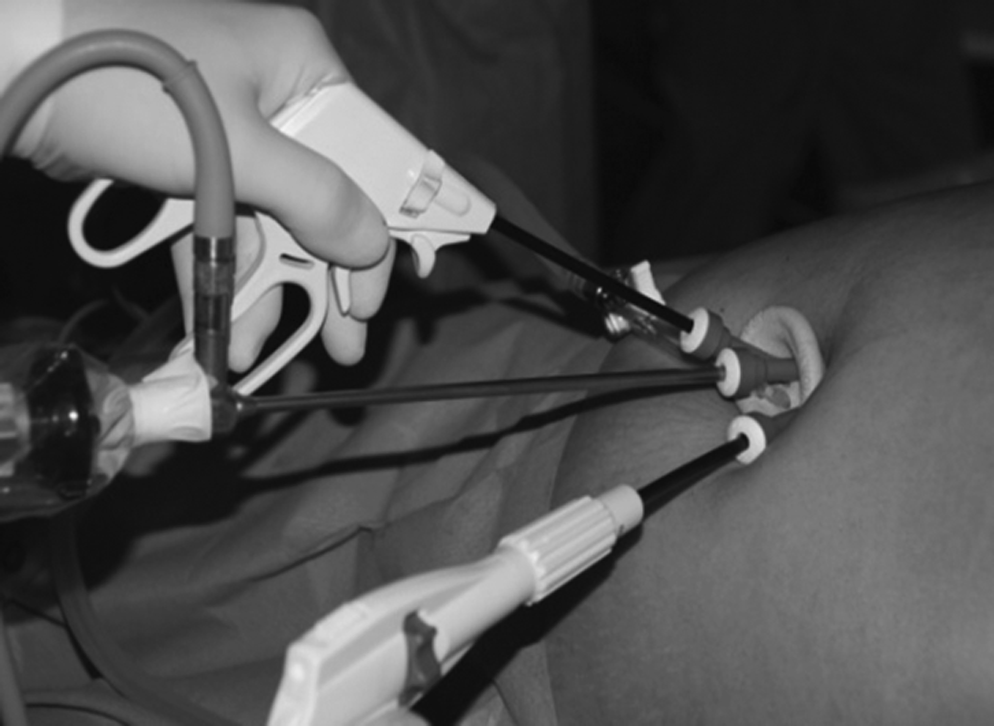
Single-incision laparoscopic surgery cholecystectomy. Position of the trocar.
A standard anesthetic, analgesia, and antiemetic protocol was used with the aim of minimizing postoperative nausea, vomiting, and pain. Before induction of anesthesia, patients were given an antiemetic intravenously, either Ondansetron 4 mg or metroclopramida 10 mg. The surgery was performed by 2 experienced laparoscopic surgeons (O.V. and J.J. E.). At the end of the procedure the umbilicus was infiltrated with 0.5% bupivacaine.
Assessment
In all patients the following variables were recorded: demographics (age, sex); date of admission to the hospital; clinical features; duration of operation (minutes); intraoperative complications; postoperative complications; postoperative pain on day 1 using a 10-cm visual analog scale (VAS), where 0 was defined as no pain and 10 was defined as the worst pain imaginable; time of starting oral diet; and length of hospital stay. For comparison purposes, the same number of patients with gallbladder stones undergoing standard multiport cholecystectomy was also selected. These patients were also consecutively recruited during the month of study period.
Statistical analysis
Data of patient undergoing SILS and patients undergoing standard laparoscopic cholecystectomy were compared. The chi-square (χ2) test was used for the analysis of categorical variables and the Mann–Whitney U-test for continuous variables. Statistical significance was set at P<.05.
Results
A total of 240 patients with gallbladder pathology were included in the study; 120 of them underwent SILS cholecystectomy and SILS standard multiport cholecystectomy. There were 82 men and 158 women, with a mean (range) age of 55 (29–76) years. Anesthetically, all patients were classified as belonging to ASA class I and II. The mean duration of operation was 45 (25–95) minutes in the SILS group and 40 (30–70) minutes in the standard laparoscopic cholecystectomy group (P=.623). Operation was completed in all patients and no conversion to open surgery was required. SILS group had three intraoperative complications due to an incomplete clipage of the cystic duct and five postoperative complications (two wound infection and three umbilical haemathoma).
The median (range) VAS for postoperative pain intensity was 3 (1–5) in the SILS cholecystectomy group and 4 (1–8) in the standard laparoscopic group (P=.311). The median (range) VAS for postoperative nausea was 1 (1–2) in the SILS cholecystectomy group and 1 (1–2) in the standard laparoscopic group (P=.923). All patients resumed oral intake within the first 24 hours after operation. The length of hospital stay was also similar in both study groups, with a mean of 1 (1–4) days.
As shown in Table 1, statistically significant differences between both groups of SILS cholecystectomy and standard multiport laparoscopic cholecystectomy for the most of the study variables were not observed. After a follow-up of 24 months none of SILS patients had incisional hernia due to two patients in the standard group (P=.046).
SILS, single-incision laparoscopic surgery; VAS, visual analog scale; NS, non-statistically significant differences.
Umbilical wound had good appearance 7 days after surgery.
Discussion
The advantages of laparoscopically performed operations in comparison with the same procedures performed through an open approach have lead to an increasing interest for developing lesser invasive procedures,1–3 as well as in reducing the size of laparoscopic instruments for an evolving field in which suitable instruments were lacking. Unlike NOTES, which faces obvious hurdles in safety6,7 and reproducibility, single-incision transumbilical laparoscopy is ready for widespread implementation. SILS cholecystectomy is implemented now. 9 SILS approaches “no scar” surgery and may not be associated with any significant learning curve beyond standard laparoscopic surgery 18
It is mandatory to have a good experience in laparoscopic surgery to introduce this new technique without adding complications. Our group has developed an SILS technique for acute appendicitis and cholelytiasis through a single skin umbilical incision, with an experience of more than 100 cases.9–12 For this reason, there was no learning curve to this approach in our study and operative times were consistently similar from the time of the first 50 SILS cholecystectomy to the 120th SILS cholecystectomy.
We restricted the incision to the umbilicus.9–12 This incision permits three operative pipes to be used simultaneously. Positioning the incision at the umbilicus offers better cosmetic results. When reducing the amount of skin incisions from three to a single one, it is possible to reduce postoperative pain by eliminating muscular penetration by the ports and this can also avoid injuring muscular or epigastric vessels. 19 Another advantage from this approach comes from the closing of fascial holes. We sutured fascial edge with simple stitches under direct vision, thus reducing the risk of incisional hernia in SILS group (P=.046).
Operation was completed in all patients, and neither conversion to open surgery nor the use of additional trocar was required in 4 cases (3.3%), but in our hospital the placement of other ports, if it is necessary, is not considered a failure of the technique.
The present results in our series SILS cholecystectomy are comparable to standard multiport laparoscopic cholecystectomy. The duration of surgery for the SILS procedure, 45 (25–95) minutes, was less than 62 minutes that we previously reported, 9 and 70 and 79 minutes reported by others.16,18 The group of the University of Amsterdam and others described the transumbilical laparoscopic operation with a mean operative time between 50 and 70 minutes (our mean time was 45 minutes) with no conversions; hospital stay was less than 2 days with no complications. 16
Cuesta et al. 16 and Tacchino et al. 17 performed the cholecystecomy with the help of one 1-mm Kirschner wire or two sutures to suspend the gallbladder and to ensure optimal exposure of the Triangle of Calot.
The most recently published study in 2009 by Hodgett et al. at the University of South Florida 20 describes transumbilical laparoendoscopic single-site cholecystectomy using two intra-extraabdominal sutures, with a mean operative time of 79 minutes and a mean postoperative hospital stay of 1.6 days. We used the SILS-PORT™ and standard instruments through the same umbilical incision without using any sutures to suspend the gallbladder; this probably reduces our operating time (Fig. 1).
Postoperative evolution of our patients was fast and favorable. In our series, oral intake was initiated within the first 24 hours in all patients, which is consistent with the experience of other authors, 21 showing a level of pain on the VAS scale of 3 out of 10, and a nausea score on the VAS scale of 1 out of 10, consistent with the current literature. 20 Moreover, both in the current series and in other studies, pain and nausea are the main postoperative problems. 22
On the other hand, the mean length of hospital stay of 1 day is also in agreement with the expected duration of hospitalization for this group of surgical patients.
In summary, SILS cholecystectomy was technically feasible and safe and represents a reproducible alternative to standard laparoscopic cholecystectomy. The definitive clinical, esthetic, and functional advantages of this technique require further analysis.
Footnotes
Acknowledgments
The authors are grateful to COVIDIEN Spain, S.L., for logistic support.
Disclosure Statement
No competing financial interests exist.