




Abstract
Abstract
A single surgeon's 5-year experience of preserving the gubernaculum in laparoscopic-assisted Fowler-Stephens orchidopexy is reported. Thirty-six cases of impalpable testes are considered. Sixteen patients were confirmed as having intra-abdominal testes, with 20 testes considered to be absent/vanished. At follow-up, all testes had a similar volume to the contralateral testis except for one that had been considered hypoplastic at the initial operation. Mean follow-up was 612 days. The method and potential importance of gubernacular preservation in this situation are discussed.
Introduction
Testicular survival rates for laparoscopic Fowler-Stephens–type orchidopexy is reported to be between 85% and 93%.1,2 Preservation of the gubernaculum has been previously reported in small case series with both open and entirely laparoscopic techniques.3,4 We aim to demonstrate a technique of testicular salvage in a series of patients undergoing gubernacular-sparing laparoscopic-assisted Fowler-Stephens procedure for intra-abdominal testes.
Materials and Methods
A prospective analysis was undertaken over a 5-year period between November 2005 and January 2011 of a single surgeon's experience within a tertiary pediatric surgical unit. All cases of impalpable testes subjected to laparoscopy were recorded in a standard Microsoft Excel spreadsheet. Patient demographic details, operative findings, details of intervention, and outcome were documented.
Testes that were impalpable under general anesthesia and found to be lying within the abdominal cavity at laparoscopy were recorded as intra-abdominal and subjected to a staged Fowler Steven's procedure using a three-port approach (5-mm umbilical camera and two similar working ports in the right or left iliac fossa and in the midline suprapubically). Intra-abdominal testes were managed in the first instance by clipping and division of the spermatic vessels.
The second stage is undertaken 6 months later by a laparoscopic-assisted technique wherein the testis is mobilized on the pedicle of the vas deferens extending inferiorly to close to the termination of the vas at the prostate. The vas is mobilized with a 10 mm margin of peritoneum, either side of the vas, using principally sharp dissection. Peritoneal division is continued superiorly to include the margins of the internal ring, effectively freeing up the testes. Thereafter, a standard groin incision and laying open of the inguinal canal is performed. The testis is then retrieved through the internal ring by traction on the gubernaculum. Remaining attachments of the testes to the margins of the internal ring are freed by blunt dissection. A rich network of vessels passing between the gubernaculum and the vas is apparent on distracting these structures (Fig. 1a–c). The testis thus mobilized is placed in the Dartos pouch in conventional fashion, with care taken to preserve the alignment of the gubernacular vessels. The length of the gubernacular and deferential pedicle is usually sufficient to permit fixation in the scrotum (Fig. 2). No attempt is made to achieve peritoneal closure at the internal ring, although standard closure of the anterior wall of the inguinal canal is undertaken.

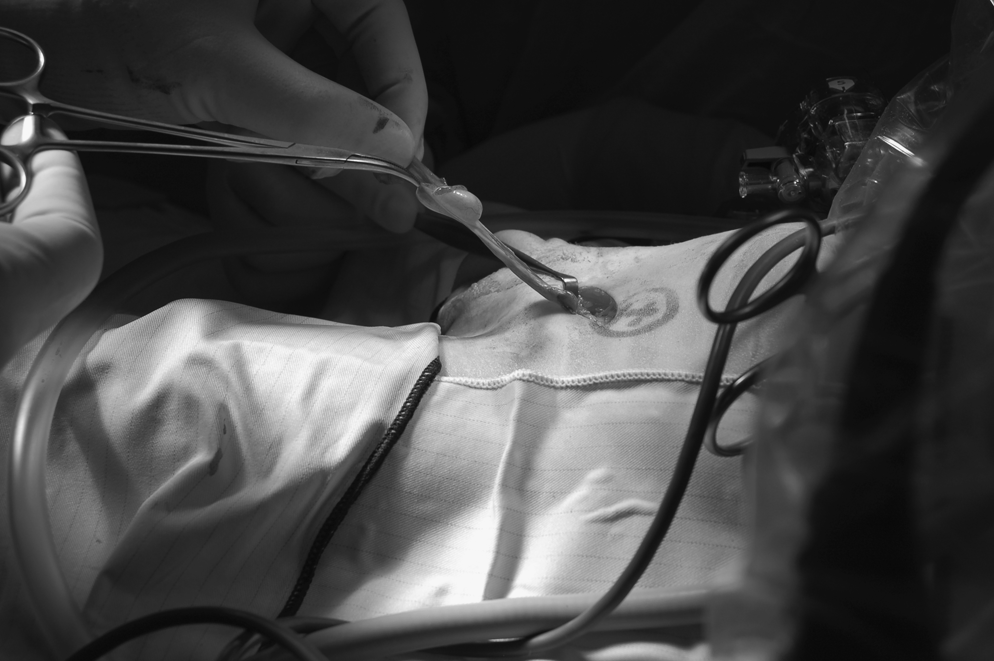
An externalized and viable left-sided testes. Demonstrated is the adequate length of the pedicle, which enables tension-free placement in the scrotum.
Patients with bilateral intra-abdominal testes were managed in three stages conducted at 6-month intervals. These include an initial clipping of spermatic vessels on the ipsilateral side and an assisted second stage on the same side with clipping of the contralateral spermatic vessels, followed by a final procedure on that side.
Results
Thirty-six cases of impalpable testes of median age (at initial intervention) of 1.51 years (range: 0.85–9 years) were managed over the period of study. Twenty testes were absent/vanished (7 left, 10 right, 3 unstated) and the rest were intra-abdominal. Of the latter group of 16 cases, 2 were bilateral, resulting in a total of 18 orchidopexies. Of these cases, one had a diagnosis of Rubinstein Taybi syndrome who had been previously subjected to gastrostomy placement and a laparoscopic fundoplication and both testes were located above the pelvic brim. The rest of the testes were well proximal to the internal ring and subjected to staged Fowler-Stephens ochidopexy. Apart from a single patient who suffered small bowel injury, which was repaired at the time of operation, and who was kept overnight, all other patients were managed as day cases for all of the admissions and were uncomplicated.
All patients subjected to a staged Fowler-Stephens procedure (16) had successful surgery with all testes (18) palpable within the scrotum at postoperative assessment at 3 and 6 months. Mean follow-up was 612 days (standard deviation: 478). All testes were equivalent in volume to the contralateral gonad except in one where a hypoplastic intra-abdominal testis' volume remained unchanged.
A single case of an intra-abdominal left testis with absent ipsilateral vas and kidney (Fig. 3a, b) underwent a successful staged procedure notwithstanding division of the spermatic vessels.

At follow-up, no patients were observed to have suffered indirect inguinal hernia.
Discussion
A two-stage laparoscopic or laparoscopic-assisted Fowler-Stephens orchidopexy for the intra-abdominal testis can be performed utilizing a variety of modifications in technique. This description focuses on maintaining the gubernacular and vas deferential collateral vasculature following previous division and clipping of the gonadal vessels. The author has elected to perform the second-stage procedure at 6 months after the first stage. This was felt, in the absence of alternative evidence, to provide sufficient time for good collateral vascular growth.
The choice to perform a staged procedure remains subject to debate; however, a recent meta-analysis demonstrated a higher rate of success in two-stage compared with single-stage Fowler-Stephens orchidopexy (85% success in staged operations compared with 80% in single stage). 5
A previously described method of totally laparoscopic gubernacular-sparing two-stage orchidopexy, 3 which utilizes the patent processus vaginalis to pass the testis to the scrotum, raises the concern to the authors that there may be an increased risk of subsequent indirect hernia. It is also possible that, because of the retrograde retrieval of the testes (via the scrotum), an anatomical course for the testes and an unkinked lie of the gubernacular vessels cannot be guaranteed. Other descriptions of totally laparoscopic Fowler-Stephens orchidopexy describe passing the testis medial to the inferior epigastric vessels, thus obtaining the shortest route to the scrotum. 2 This nonanatomical path, however, risks occlusion of gubernacular collaterals, which we are concerned may be acutely angulated and stretched. Additional concerns are a tight squeeze at the opening in the dartos layer of the scrotum and direct and excessive testicular handling by grasping forceps.
The laparoscopic approach to the Fowler-Stephen's orchidopexy had initially demonstrated much greater success rates when compared with the open approach, 6 although more recent studies suggest a convergence of outcomes. 7 There is some evidence to suggest that less dissection results in a much greater chance of testicular survival 8 and thus we propose that preserving the gubernacular collaterals in situ as well as deferential vessels may offer the best chance for testicular survival in an otherwise tension-free laparoscopic-assisted two-stage orchidopexy.
Interestingly, despite no attempt being made to achieve peritoneal closure at the internal ring, indirect inguinal hernia was not observed.
The single case referred with a unilateral absent vas deferens was also noted to have an ipsilateral agenic kidney. The link here is well published with up to 80% of kidneys missing on the ipsilateral side of an absent vas. 9 The importance of the gubernacular supply to testicular survival cannot be under estimated and is underscored by this case, which retained testicular viability notwithstanding division of the spermatic vessels.
Although a small series, the initial results from a staged Fowler-Stephens procedure with a laparoscopic-assisted second stage is encouraging. Despite being more invasive than a totally laparoscopic approach, preservation of the gubernacular supply without acute angulation may improve the chance of success.
Footnotes
Disclosure Statement
No competing financial interests exist.