




Abstract
Abstract
Objective:
We performed retroperitoneal laparoendoscopic single-site (LESS) adrenalectomy using a homemade multi-access platform to evaluate the feasibility and safety of this technique and to share our initial experiences.
Patients and Methods:
Since March 2011, 40 patients underwent retroperitoneal LESS adrenalectomy. A single incision of 2.5–3 cm was made under the 12th rib on the midaxillary line on the affected side. Next, a homemade multi-access platform was inserted through that incision, and a combination of lengthened curved and conventional rigid instruments was used for handling. The procedure was performed mainly according to the procedure for conventional laparoscopic retroperitoneal adrenalectomy.
Results:
For 1 patient with pheochromocytoma, one additional trocar was used because the peritoneum was damaged. Surgery was successfully completed in all other patients without conversion to conventional laparoscopic or open surgery.
Conclusions:
Retroperitoneal LESS adrenalectomy is feasible; although initial technical adjustments are inevitable, some useful techniques are effective in simplifying the procedure.
Introduction
Patients and Methods
General patient data
Forty patients consented to take part in the study; of these, 29 were men, and 11 were women. The mean age was 38 years (range, 20–62 years), and the mean body mass index was 23.4 kg/m2 (range, 16.8–29.2 kg/m2). All the patients were diagnosed with a unilateral adrenal mass by computerized tomography: 18 on the left side and 22 on the right. The mean diameter of the mass was 3.4 cm (range, 2–6 cm), with two 6-cm masses among them.
Procedures
We chose the retroperitoneal approach. After general anesthesia, the patients were placed in the lateral decubitus position with appropriate flexion, a skin incision of 2.5–3 cm was made along the inferior margin of the 12th rib in the midaxillary line, the fascia and muscle were bluntly dissected using vessel forceps, and the retroperitoneal space was accessed by blunt finger dissection. A homemade multi-access platform (Fig. 1) was then placed in the incision. This rubber platform was shaped like a trumpet at both ends and could be easily deformed to fit through the incision and ensure gas tightness. After a pneumoperitoneum was created by carbon dioxide at a pressure of 14 mm Hg, a rigid, 10-mm, 30° laparoscope was inserted for monitoring. In terms of handling instruments, we chose two curved instruments (Fig. 2) for the first 2 cases and then changed the one in the dominant hand to a conventional rigid instrument for all subsequent cases. The curved instruments were 5 cm longer than the conventional rigid instruments. The operation procedure was similar to conventional retroperitoneal laparoscopic adrenalectomy. To ensure that sufficient space was available, we routinely removed some retroperitoneal fat, then exposed the upper renal pole, and dissociated the surrounding fat to expose the adrenal mass. The adrenal vessel was ligated using endoclips and dissected using an ultrasonic scalpel.
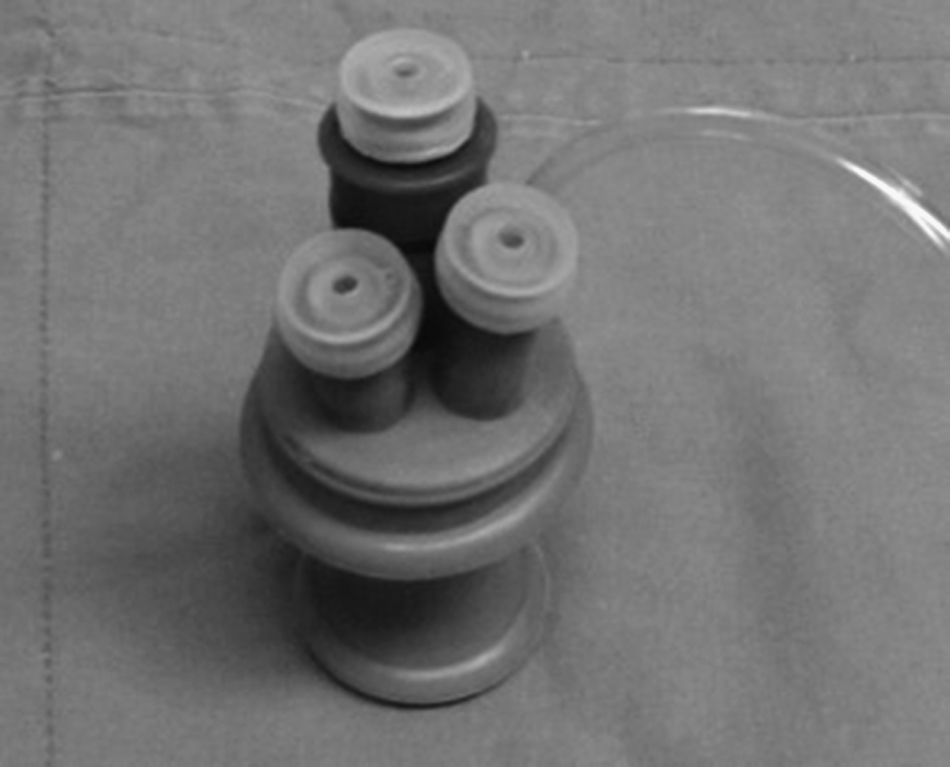
The homemade multi-access platform we used, which is made of rubber.

The lengthened curve instruments we used to fasten the tissues.
Results
In all the cases, the procedure was completed successfully without converting to open or conventional laparoscopic surgery, except the second case in which the diameter of the mass was 6 cm, which required an additional trocar owing to rupture of the peritoneum. The mean operation time was 68 minutes (range, 30–140 minutes), and the mean blood loss was slight (<50 mL). The mean hospital stay was 3 days (range, 2–5 days). During the short-term follow-up visit after 2–7 months, 1 patient with primary aldosteronism needed antihypertensive drugs to control blood pressure; this patient's serum potassium levels had recovered to normal levels after the operation. All the clinical symptoms and biochemical indicators of the remaining 39 patients had recovered to normal, and no tumor recurrence was observed. Long-term effects are still being monitored for all the patients.
Discussion
One of the eternal pursuits of surgery is to reduce incision size as far as possible. Regarding adrenalectomy, in the last two decades, the long incisions of open surgery have been replaced by three to six small incisions by using conventional laparoscopic surgery. Laparoscopic adrenalectomy not only had a surgical effect equivalent to that of open surgery but also showed a remarkable advantage in terms of the cosmetic outcome. 3 As conventional laparoscopic surgery became well established, surgeons began to seek further improvements, and new approaches have included LESS, robot surgery, and natural orifice transluminal endoscopic surgery (NOTES).8–12 At present, LESS has been the most successful of these new approaches. In 2008, Castellucci et al. 4 reported the first single-port adrenalectomy, in which a single 2-cm incision was used for complete adrenalectomy. After this, other surgeons also successfully used this procedure and provided additional evidence for the feasibility of LESS. LESS adrenalectomy also had a cosmetic advantage and was associated with a faster return to work and a reduced risk for port-site hernia. 13 However, this technique is still not extensively practiced owing to many problems, especially regarding handling difficulties. Therefore, some useful technical advice is needed for beginners.
To perform the LESS adrenalectomy technique, selection of appropriate cases is important because an obese somatotype could increase handling difficulties, especially affecting retroperitoneal access. Stolzenburg et al. 14 regarded a body mass index of less than 30 kg/m2 to be suitable for LESS. On the other hand, a smaller mass size is more suitable for beginners. Our cohort included 2 cases in which the mass diameter was 6 cm; the respective operation times were 125 minutes and 140 minutes. This was much longer than the mean operation time (65 minutes) in the other cases in which mean diameter was 3 cm (range, 2–4.5 cm).
Selection of patients with a body mass index of <30 kg/m2 and small-size mass not only can facilitate surgery but also can decrease the incidence of intraoperative and postoperative complications. We broke the peritoneum intraoperatively in our second LESS adrenalectomy, in which the mass diameter was 6 cm; we found that the interference of the instruments was severe when dissociating the border of the mass, finally causing a rupture of peritoneum, and an additional trocar was used to finish the procedure. No other intraoperative and postoperative complications were observed in the other cases during a follow-up of 2–7 months. Greco et al. 15 also regard patient selection to be the key factor for reducing potential complications of LESS surgery. On the other hand, they found that a 23% nonstatistically significant reduction in the risk of complications occurred each year, which indicating that increased surgical experience in LESS skills plays an important role in avoiding complications. In addition to the effect of technical experience on the success of LESS surgery, we summarize some surgical skills that improved our LESS surgery procedures.
During the procedure, a 30° laparoscope is necessary for successful completion of the procedure, rather than a 0° laparoscope, because it can afford a better view with little shift in the location, thereby reducing the interference between the camera and the surgical instruments. Compared with conventional laparoscopic surgery, the instruments and the camera are in a paralleled line and close to each other during the LESS procedure, resulting in significant interference between the camera and the instruments and between different instruments. In an attempt to minimize this interference, we used two curved instruments in the initial procedures; however, it was hard to adapt to the internal curve. We therefore replaced these instruments with a conventional rigid instrument in the dominant hand and a curved one in the other hand, whereby the curved instrument was used to fix the tissue and the rigid instrument was used for the major handling during surgery, and found that this set-up decreased handling difficulties. Botden et al. 16 reported that conventional rigid instruments can also be used to successfully perform the LESS procedure, but we consider that a curved instrument can increase the angle of the instruments and thus provide a better handling view. Moreover, the curved instruments we used were 5 cm longer than the rigid instruments, which meant that the two hands were not at the same level, and this therefore reduced interference between the hands (Fig. 3). We found that these techniques eased handling difficulties during the LESS procedure, and we believe that they can provide significant guidance to a beginner in LESS.

The curved instruments are 5 cm longer than conventional instruments. This change can diminish the interference when cross-handling is needed.
Conclusions
Retroperitoneal LESS adrenalectomy is feasible. However, there is an inevitable learning curve, and some useful techniques can facilitate the procedure.
Footnotes
Disclosure Statement
No competing financial interests exist.