




Abstract
Abstract
Background:
Intussusception is a common cause of bowel obstruction in children, which sometimes necessitates operative reduction and or resection. We report our series of patients with intussusception who were treated laparoscopically (LAP group) compared with exploratory laparotomy (OPEN group).
Subjects and Methods:
After institutional review board approval, a retrospective review was performed evaluating outcomes for patients requiring surgical reduction of intussusception over a 10-year period. Analysis was based on intent to treat, and technique of exploration was surgeon's choice. Data were analyzed with the Wilcoxon rank sum test and chi-squared test where appropriate. P≤.05 was considered significant.
Results:
During the time period studied, there were 92 patients treated surgically for intussusception: 65 LAP and 27 OPEN. Conversion to the open procedure was required for 21 patients in the LAP group, and of those, 6 required bowel resection. Seven of the patients who were started in the OPEN group ultimately required bowel resection. Operative time, length of hospital stay, time to full feeds, and total days of narcotics were all significantly shorter for the LAP group compared with the OPEN group (P=.003, P=.001, P=.001, and P=.004, respectively). A pathologic lead point was found in 14% of LAP and 15% of OPEN cases. In a subset analysis, 33% of patients who were converted from the LAP group to the open procedure had a pathologic lead point. Complication rates between the LAP and OPEN groups were comparable.
Conclusions:
Laparoscopy appears to be a safe and effective technique for reducing intussusception in children. The laparoscopic cases had shorter operative time, shorter time to full feeds, lower requirement for intravenous narcotics, and earlier discharges.
Introduction
Minimally invasive pediatric surgery has expanded dramatically over the last decade and has been applied to the surgical management of intussusception. Laparoscopy was initially utilized as a diagnostic modality after failed hydrostatic reduction of intussusception.4–6 In 1996, Cuckow et al. 7 reported the first case of laparoscopic reduction of intussusception in a 10-month-old patient. Against surgical dogma, they suggested that constant, gentle traction on the small bowel with countertraction on the large bowel can reduce the intussusception without damage to the bowel.
Subsequently, small retrospective case series have been reported using laparoscopic reduction with mixed results. Success rates for laparoscopic reduction have been quoted between 30% and 91%. One study suggested that children older than 3 years would not benefit from the laparoscopic approach, although another has stated that laparoscopy should be the standard of care for pediatric intussusception of the ileocecal valve after failure of radiological reduction.6,8–12
We report our series of patients with intussusception who were treated laparoscopically (LAP group) versus exploratory laparotomy (OPEN group) over the last decade. We hypothesize that laparoscopic reduction of intussusception is safe and effective and may offer advantages over the open technique.
Subjects and Methods
During the time period between January 1999 and June 2010, a retrospective chart review was performed on all patients who underwent operative exploration for intussusception at our tertiary-care facility. In total, seven pediatric surgeons were a part of the group during the study period. Two surgeons joined the group in the latter half of the study time period, and one departed midway through the study. Operative technique was chosen based upon surgeon's preference.
Data are expressed as mean±SD values or median (range) as appropriate. The outcome variables between the LAP group and the OPEN group were statistically analyzed with the Wilcoxon rank sum test and chi-squared test when appropriate. Data were analyzed based upon intention to treat. A subset analysis was performed between LAP group patients converted to the open procedure and OPEN group patients.
The Children's Healthcare of Atlanta Institutional Review Board approved this study.
Results
During the time period studied, there were 92 patients treated for intussusception: 65 in the LAP group and 27 in the OPEN group. The LAP group consisted of 43 boys and 22 girls whose average age and weight were 11±142 months and 9.5±38.8 kg, respectively. The OPEN group consisted of 16 boys and 11 girls whose average age and weight were 8.2±165 months and 9.1±48.9 kg, respectively (P=.214 and P=.137, respectively). The duration of symptoms prior to going to the operating room was 2±20 and 2±6 days for the LAP and OPEN groups, respectively (P=.697) (Table 1).
Data are mean±standard deviation values.
LAP group, patients with intussusception who were treated laparoscopically; OPEN group, patients with intussusception who were treated with exploratory laparotomy.
Of all patients who required surgery for intussusception, laparoscopic reduction was attempted in 70% (n=65) and was successful 68% of the time (n=44). Fifteen percent of the LAP patients were over the age of 3 years (n=10). Within that subgroup there was a 60% success rate at laparoscopic reduction. This compares with a 69% success rate for children under the age of 3 years (n=55) (P=.57). The LAP group patients who were converted to open laparotomy received a transverse right lower quadrant incision. Decision to convert was based on failed laparoscopic reduction, poor visibility due to distended bowel, or concern for serosal injuries. A total of 42% of the LAP group patients converted to open surgery required either a bowel resection or repair of a serosal injury. Once converted from the LAP group to the open procedure, 15 had their intussusception reduced (71%), and 6 required ileocecal resection. These results were similar in the OPEN group, in which 20 of 27 patients (74%) were successfully reduced, and 7 required bowel resection (26%). A pathologic lead point was identified in 13.8% of LAP group patients and 14.8% of OPEN group patients (n=9 and n=4, respectively). However, in the subset analysis, a pathologic lead point was found in 33% of patients who were converted from the LAP group to open surgery (n=7). This compares with a 4.5% incidence in patients who had their surgery completed laparoscopically (n=2) (P=.02). Figure 1 identified pathologic lead points that included Meckel's diverticuli, lymphoma, and an ileal polyp.
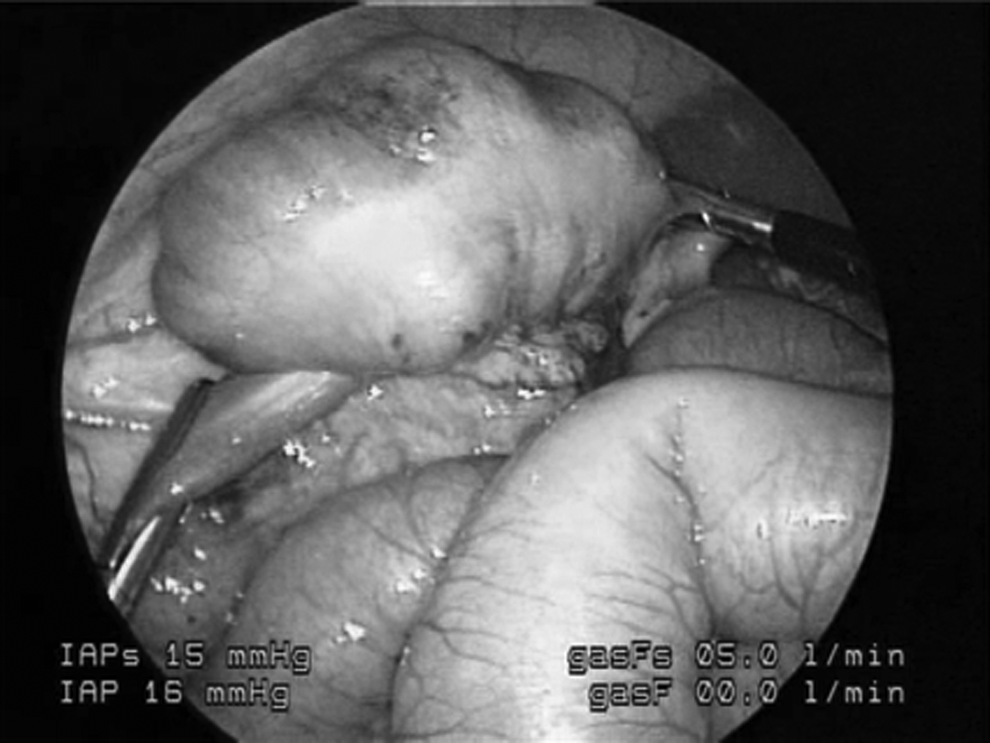
Intussusception, prior to laparoscopic reduction.
Mean operative time for the LAP group, including patients converted to the open procedure, was 50.3±35 minutes. Operating time was 65.8±29 minutes for the OPEN group (P=.003). Most patients in the LAP and OPEN groups received scheduled perioperative ketorolac (0.5 mg/kg intravenously every 6 hours for 48 hours) to facilitate pain control. Intravenous morphine was also provided to patients on as needed basis. The median duration of intravenous narcotic usage for the LAP group was 0.75 days, with a range of 0–3 days, and for the OPEN group was 1.52 days, with a range of 1–4 days (P=.004). The median time to full feeding was 1 day, with a range of 0–14 days, and 2 days, with a range of 1–4 days, for the LAP and OPEN groups, respectively (P=.001). Median length of postoperative hospital stay was 1 day, with a range of 1–15 days, for the LAP group and 3 days, with a range of 1–6 days, for the OPEN group (P=.001) (Table 2).
Data are mean±standard deviation values or median (range) as indicated.
LAP group, patients with intussusception who were treated laparoscopically; OPEN group, patients with intussusception who were treated with exploratory laparotomy.
A subset analysis was performed comparing patients based on the final operative procedure performed (LAP reduction, OPEN reduction, LAP converted to open reduction, LAP converted to open procedure with bowel resection, and OPEN with bowel resection). Data from these subsets can be found in Table 3.
Data are mean±standard deviation values or median (range) as indicated.
LAP group, patients with intussusception who were treated laparoscopically; OPEN group, patients with intussusception who were treated with exploratory laparotomy.
Complication rates were similar between the two main groups. Over the 10-year period, 5 of the LAP group patients had readmissions related to their intussusception. This includes 3 LAP group patients who were readmitted for concern of recurrent intussusception. Additionally, 2 OPEN group patients were readmitted with fever within 1 month of discharge: 1 was found to have viral meningitis, and the other was diagnosed with a viral upper respiratory infection (Table 4).
LAP group, patients with intussusception who were treated laparoscopically; OPEN group, patients with intussusception who were treated with exploratory laparotomy.
Discussion
In this series, we document our experience with 92 patients with intussusception who required surgical intervention. We found that the majority of these patients can be managed laparoscopically, regardless of age, weight, or duration of symptoms. Our experience suggests that laparoscopic technique has several advantages over an open technique, making it the more desirable approach in most situations. For all patients, operative times were shorter for the LAP group compared with the OPEN group. Postoperative pain control was better in the LAP group as demonstrated by fewer days of narcotic pain medicine required. LAP group patients also appeared to tolerate a regular diet faster as documented by significantly shorter number of days to tolerating full feeds. However, this difference may also reflect the decreased morphine use in the LAP group. The LAP group patients were discharged quicker than the OPEN group patients, and postoperative complications were comparable between the two populations.
With this study, we found a conversion rate of 32% for patients initially treated laparoscopically. Risk for conversion was directly related to identification of a pathologic lead point. Whether conversion took place secondary to the identification of a lead point or if the presence of a lead point prevented laparoscopic reduction is unclear. In contrast to the findings of Van der Lan et al., 10 patient age did not appear to predict successful laparoscopic reduction of the intussusception.
The subset analysis based on the final procedure performed demonstrated several concepts that are key to both the understanding of the disease process and the utility of laparoscopy compared with traditional open surgery. Regardless of the approach (OPEN group or LAP group converted to the open procedure), the operative times, postoperative length of stay, time to full feeds, and intravenous narcotic usage were significantly longer in patients requiring bowel resection. This is not unexpected as these patients likely had more complex disease, which required more time to address in the operating room and took longer to resolve in the postoperative period. Comparing these groups to each other, there was no significant difference in measured outcomes. Similarly, postoperative length of stay, time to full feeds, and intravenous narcotic usage were the same between patients who underwent primary open reduction of their intussusception regardless of whether they were initially in the LAP group and converted to the open procedure or were started in the OPEN group. Patients converted from the LAP group to the open procedure essentially behave like traditional OPEN group patients in the postoperative period. Of note, however, is that the operative time was significantly longer in the patients in the LAP group converted to the open procedure who underwent a primary reduction compared with both the LAP group patients and the OPEN group patients (P=.001). This is likely a reflection of the increased time spent attempting laparoscopic reduction prior to converting to an open procedure.
The data represented in this study are for a cumulative series over 10 years. During that time, there have been only minor changes in the members of the practice. Certainly, over the 10 years evaluated, skills and level of comfort with laparoscopy have evolved. During the first 5 years of the study, 60% of all patients were treated laparoscopically; however, 46% of these cases were performed by a single surgeon. Over the 10-year period, as practice standards and skill sets evolved, laparoscopic intervention became a mainstay within our group, and by the second half of the study period, 78% of all cases were treated laparoscopically.
As with any retrospective study, these results are subject to numerous biases that should be highlighted. One criticism of this study is that there could be some selection bias by surgeons who are not comfortable with the laparoscopic technique. This may have been the situation early in the series; however, all surgeons at our institution have adopted laparoscopy as the first-line procedure for hemodynamically stable patients with intussusception who failed radiologic reduction. Another potential bias in this study is the selection bias for operative approach. Because technique used was based on the surgeon's choice, those that were more likely to be challenging may have been performed by the open procedure, rather than attempting a laparoscopic approach. We have presented all our data as intent to treat in order to minimize this effect. Certainly, another limitation of any retrospective study of this nature is that some of the outcome measures are susceptible to surgeon and nursing biases such as morphine use and postoperative feeding. Similarly, postoperative ileus and time to tolerating feeds can be directly related to amount of narcotics used.
Although this study is limited by being a retrospective chart review, we feel even with that understanding, the data support the laparoscopic approach. Although it is recognized that operative time is longer in cases where the intussusception cannot be safely reduced laparoscopically, the majority of cases can be safely approached with a minimally invasive technique. Likewise, remaining outcome measures for patients converted from the LAP group to the open procedure are the same as those who are started in the OPEN group, further supporting an initial laparoscopic attempt. Our study suggests that laparoscopic reduction of intussusception in children is a safe and effective technique that offers the advantage of being quicker while having a shorter hospital stay. It is our opinion that laparoscopy should be used as the initial approach in all hemodynamically stable patients with intussusception who require operative intervention.
Footnotes
Disclosure Statement
No competing financial interests exist.