




Abstract
Abstract
Introduction:
When a large gauze is needed during a single-incision surgery or reduced port surgery using slim (5-mm) trocars, the operation needs to be interrupted to introduce the gauze via an incision or to change to a large trocar. We describe here a novel procedure for introducing a large gauze into the corporeal cavity by using a slim trocar, called the “Tornado gauze procedure” (TGP).
Materials and Methods:
Commercially packed Trox® (Osaki Medical, Nagoya, Japan) gauze (30×150 mm, 4-ply) and a specially ordered precision stainless steel tube (Smart introducer; Kinugawa Factory, Kyoto, Japan) are used for the TGP. The gauze is screwed into the Smart introducer. When the surgeon needs a gauze, a Smart introducer with a gauze is set into the 5-mm trocar; then, the 5-mm grasper is used to push the gauze into the corporeal cavity with small screwing-in movements. The gauze is also gently removed from the corporeal cavity through a 5-mm trocar.
Results:
This procedure efficiently and safely introduced the gauze for hemostasis, blunt dissection, suction filtering, and organ retraction without interrupting the pneumoperitoneum to introduce the gauze in single-incision laparoscopic cholecystectomy, transabdominal preperitoneal hernia repairs, and appendectomy, with good visualization and adequate working space. The rhythm of surgery remains undisturbed with the use of the TGP, even in a high-risk and high-stress situation. The port's valves were not disabled during surgery, and no procedure-related complications were reported.
Conclusions:
TGP is expected to be helpful to surgeons and enhance the safety of laparoscopic surgeries involving the use of slim trocars.
Introduction
Materials and Methods
The commercially packed Trox® gauze (Fig. 1A) (30×150 mm, 4-ply with a radiopaque strip; Osaki Medical, Nagoya, Japan) and a specially ordered precision stainless steel tube (Fig. 1C) (Smart introducer; catalog number SUS304, 6.0-mm O.D., 5.5-mm I.D., 110-mm length; Kinugawa Factory, Kyoto, Japan) were used for the TGP. Trox gauze has adequate absorbing power and is popular in Japan for laparoscopic surgery since 2004. However, it cannot be introduced into the corporeal cavity by using a slim trocar in the traditional method. In TGP, the Trox gauze is screwed into the Smart introducer during or before surgery as follows (Fig. 1B): a surgeon or nurse grasps the corner of the Trox gauze with the 5-mm grasper that passes through one end of the Smart introducer and moves it into the Smart introducer with screwing movements. When the surgeon needs gauze, a Smart introducer with gauze is set into a 5-mm trocar; then, the 5-mm grasper is used to push the gauze into the corporeal cavity with tiny screwing movements (Fig. 2). Thus, the gauze can be smoothly and quickly introduced into the corporeal cavity through a 5-mm trocar (Fig. 3). When the gauze needs to be replaced, the grasper is used to hold the corner of the Trox gauze, and it is gently removed through the 5-mm trocar itself.


When the surgeon needs gauze, the Smart introducer with gauze is set into the 5-mm trocar.
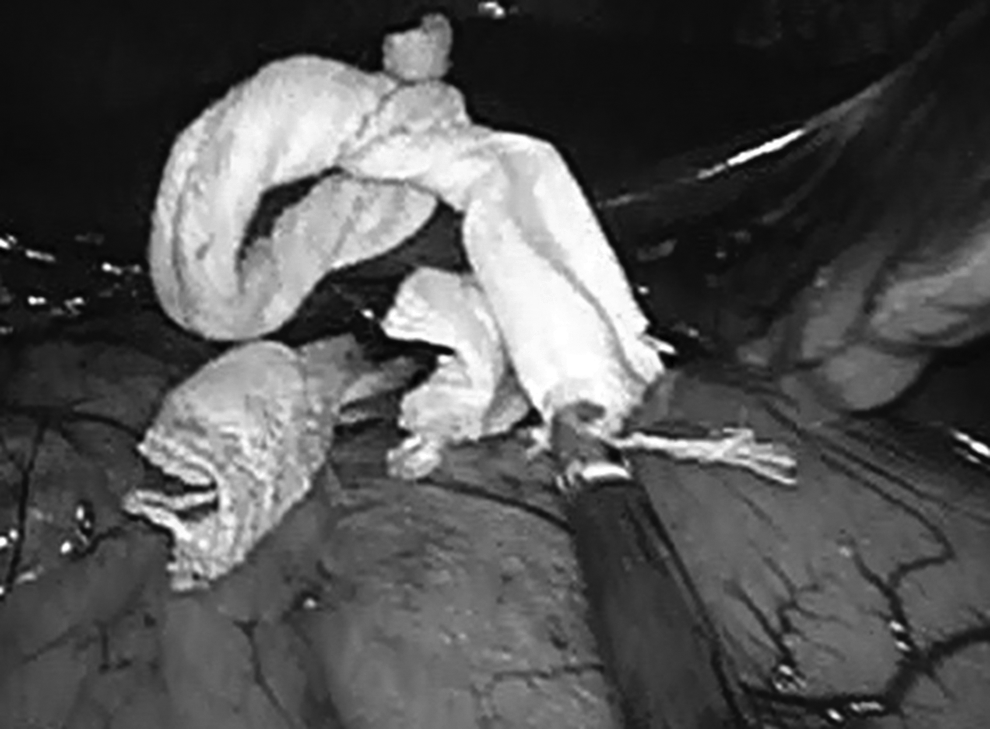
The 5-mm grasper is used to push the gauze into the corporeal cavity with tiny screwing movements.
Results
We used the TGP during single-incision laparoscopic cholecystectomy (SI-LC) (n=15), single-incision transabdominal preperitoneal hernia repairs (SI-TAPP) (n=15), and single-incision laparoscopic appendectomy (SI-LA) (n=10). Compressed gauze was quickly re-expanded in the corporeal cavity and used for hemostasis, blunt dissection, suction filtering, and organ retraction, with good visualization and sufficient working space. In acute cholecystitis and severe appendicitis, large gauze pieces are useful for the management of bleeding or for blunt dissection. Using the TGP, a surgeon could exchange the gauze as many times as desired without interrupting the pneumoperitoneum.
All surgical cases of SI-LC and SI-LA were completed without converting to traditional laparoscopic procedure or open surgery. Furthermore, in SI-TAPP, because this procedure eliminated the need for interrupting the surgery to introduce the gauze and avoided interrupting the pneumoperitoneum and disturbing the surgical field during surgery, the operation times tended to decrease compared with the institutional averages. The gauze pieces were most frequently changed in SI-LC (six times), with the overall average being two or three times in SI-LC, SI-TAPP, and SI-LA. The port's valves were not disabled during the surgery, and no procedure-related complications were reported in the 45 patients.
Discussion
Using the TGP, we could introduce large gauze pieces, which can conventionally be introduced only by using 10–12-mm trocars, into the corporeal cavity. Using the conventional procedure, only small gauze pieces can be introduced using 5-mm trocars. In this novel procedure, the gauze is compressed and made smaller by forming a tornado shape and placed thus into the Smart introducer. This setup requires no practice, and the staff could perform it smoothly in our hospital. The gauze is packed tightly into the tube, and the gauze cannot be introduced into the corporeal cavity just by simply pushing using the grasper because the static frictional force between the gauze and the Smart introducer is too much. Generally, the kinetic frictional force is lower than static frictional force. 8 The frictional force between the gauze and the Smart introducer was reduced by the screwing movements. Hence, large gauze pieces could be smoothly and quickly introduced into the corporeal cavity with screwing and pushing movements through a slim 5-mm trocar.
Initially, we used a polypropylene tube as an introducer. However, the structural strength of a polypropylene tube is not adequate, and the shape of these tubes was often deformed during the pushing and screwing of the gauze with the grasper. To resolve these problems, we ordered specially constructed precision tubes made of stainless steel (the Smart introducer) from a precision equipment manufacturer. In addition, the inner surface of the Smart introducer was polished to a mirror finish, in order to reduce the frictional force between the gauze and the Smart introducer, which was subsequently lower than that in the polypropylene tube. Thus, the screwing movements were smoother and easier than those required for the introduction of the gauze into the polypropylene tube.
When the surgeon needs gauze, especially to manage unexpected bleeding, it is important to introduce the gauze quickly while maintaining the surgical field in status quo. Interrupting the pneumoperitoneum to introduce the gauze and disturbing the surgical field rendered hemostasis more difficult. The rhythm of surgery remains undisturbed with the use of the TGP, even in a high-risk and high-stress situation. Furthermore, this procedure may also be applicable for introducing large, nonwoven, absorbable hemostat materials or fabric for achieving more secure hemostasis.
Some novel instruments such as a cylinder-type gauze and cigarette or sheet-type sponges have been developed for blunt dissection, suction filtering, and organ retraction.9–12 These are very useful; however, these have been developed for large trocars measuring 10–12 mm. In addition, the cost of surgical gauze is much less than that of such surgical sponges. Thus, the TGP is also cost-effective in terms of material costs in the long term.
Conclusions
The TGP is expected to be helpful to surgeons and to enhance the safety of laparoscopic surgeries involving the use of slim trocars.
Footnotes
Disclosure Statement
No competing financial interests exist. Y.N. prepared the manuscript and photographs. T.T. and K.F. assisted in the operations and performed literature review. T.M. revised the manuscript and performed the literature review.