




Abstract
Abstract
Background:
Gastric transposition is an established method of esophageal replacement in children, and the use of minimally invasive techniques avoids the trauma of open access. The objective of this study was to compare outcomes of minimally invasive versus open gastric transposition in children.
Materials and Methods:
All cases of attempted laparoscopic-assisted gastric transposition at Great Ormond Street Hospital (GOSH), London, United Kingdom, between 2003 and 2012 were retrospectively reviewed. A comprehensive literature search was completed on MEDLINE for minimally invasive gastric transposition in children, and postoperative outcomes were collated. The outcomes from the retrospective review (single-center, GOSH) and the literature search (multicenter) were compared with those of the largest study on open gastric transposition consisting of 192 cases performed at GOSH.
Results:
In this retrospective review of 19 patients (mean age, 3.5 years; range, 0.4–15 years), the indications were long-gap esophageal atresia, postoperative, caustic, and idiopathic esophageal stricture, and esophageal dysmotility. Three cases were converted to laparotomy and excluded from subsequent analysis. There were one anastomotic leak, two strictures, and no deaths in this series. The literature search yielded a further 50 cases for comparison. Single-center (n=16) and multicenter (n=66) comparison of minimally invasive versus open technique (n=192) showed no difference in leak (6.3% and 16.7%, respectively, versus 12.0%; P=.701 and P=.398), stricture (12.5% and 15.2% versus 20.8%; P=.535 and P=.370), and mortality rates (0% and 1.5% versus 4.7%; P=1.000 and P=.461).
Conclusion:
Minimally invasive gastric transposition is a safe and acceptable alternative to open surgery in children.
Introduction
E
Meta-analyses of adult esophagectomy for the treatment of esophageal cancer support the use of minimally invasive surgery 7 ; however, equivalent comparative studies in the pediatric population are lacking. As such, it is unclear whether minimally invasive gastric transposition is as safe as the open procedure in children. The present study aims to address this question by comparing the postoperative outcomes of children who underwent minimally invasive versus open gastric transposition at single-center and multicenter levels.
Materials and Methods
Patients
All patients who underwent a laparoscopic-assisted gastric transposition procedure at Great Ormond Street Hospital for Children (GOSH), London, United Kingdom, between January 2003 and December 2012 were retrospectively reviewed. Demographic characteristics, clinical background, indication for operation, intraoperative findings, and postoperative outcomes were collected from hospital records and stored on a computerized database. An open procedure was defined as access via laparotomy; this did not include thoracotomy, which along with thoracoscopy was considered to be additional thoracic access. Patients who were converted to an open procedure were included to define characteristics of patients for whom minimally invasive surgery was attempted; however, they were subsequently excluded from the analysis of postoperative outcomes.
Surgical technique
All procedures were performed individually or jointly by six consultant pediatric surgeons. The patient is placed in the supine position. A 6.5-mm Hasson umbilical port is used to induce pneumoperitoneum of 10 mm Hg. A Nathanson liver retractor is inserted to gain access to the esophageal hiatus, and two 5-mm instrument ports are inserted laterally on the left and right side (Fig. 1).
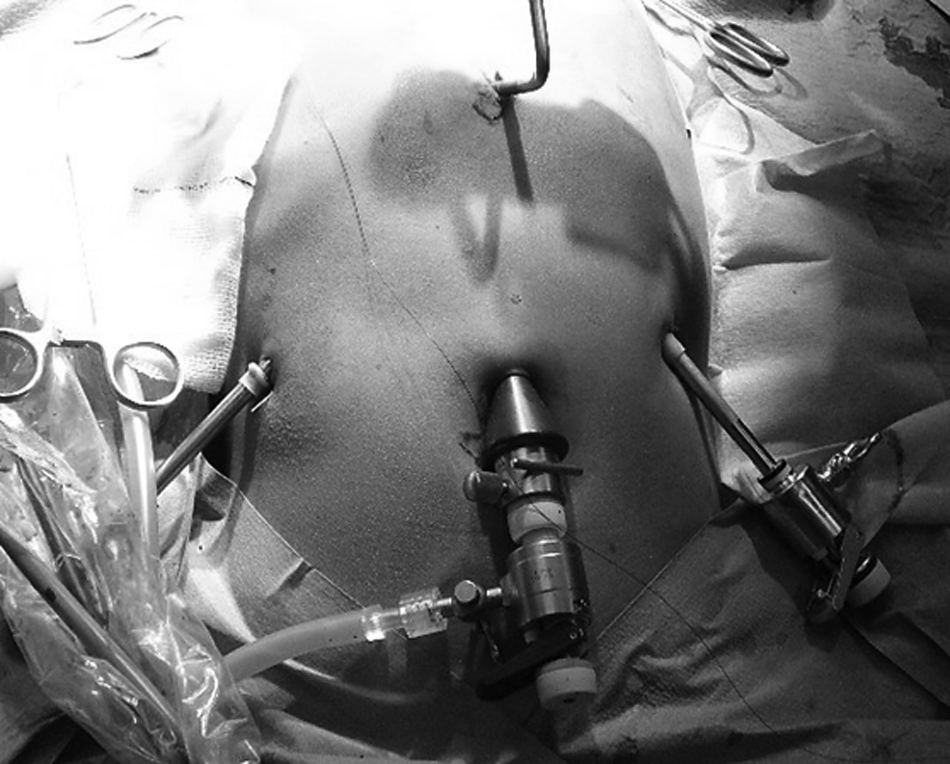
Positioning of laparoscopic ports: a 6.5-mm Hasson umbilical port to induce pneumoperitoneum, a Nathanson liver retractor in the epigastrium, and two 5-mm instrument ports laterally on the left and right side.
The gastrostomy is taken down and closed with absorbable suture. A procedure to facilitate gastric emptying is performed; more recently this has become primarily pyloroplasty. Harmonic® shears (Ethicon, a Johnson & Johnson Company, Wokingham, United Kingdom) or a LigaSure™ (Covidien, Whiteley, United Kingdom) device is used to divide the short gastric vessels, while preserving the right gastroepiploic and right gastric arcade. The left gastric artery is similarly divided to mobilize the lesser curve. The distal esophageal stump is mobilized from the posterior mediastinum, resected at the esophagogastric junction, and securely oversewn.
If present, the cervical esophagostomy is disconnected, and the esophagus is mobilized; otherwise, a cervical incision is made to access the cervical esophagus. The posterior mediastinal tunnel is created from above with digital dissection and from below using blunt dissection and monopolar cautery. The posterior mediastinal track is dilated using long blunt-ended forceps and serial Hegar dilators until it sufficiently accommodates the transposed stomach. The camera can be introduced from the caudal end of the posterior mediastinal tunnel to allow further development of the space under direct view. If difficulty is encountered in developing the posterior mediastinal tunnel, then dissection may be required using thoracoscopy or thoracotomy.
The tip of an appropriately sized chest tube is secured to the most proximal part of the fundus, and the stomach is pulled through the mediastinal tunnel to reach the cervical incision (Fig. 2). The anastomosis between the cervical esophagus and stomach is created using interrupted absorbable sutures. The cervical incision is closed in layers using absorbable sutures; the umbilical port site and remaining port sites are closed using absorbable suture and skin glue. A nasogastric tube is inserted with the tip in the middle of the posterior mediastinum. In cases requiring thoracotomy, a chest drain is inserted. A feeding jejunostomy is considered for children who have not been established on oral feeding or regularly sham-fed.
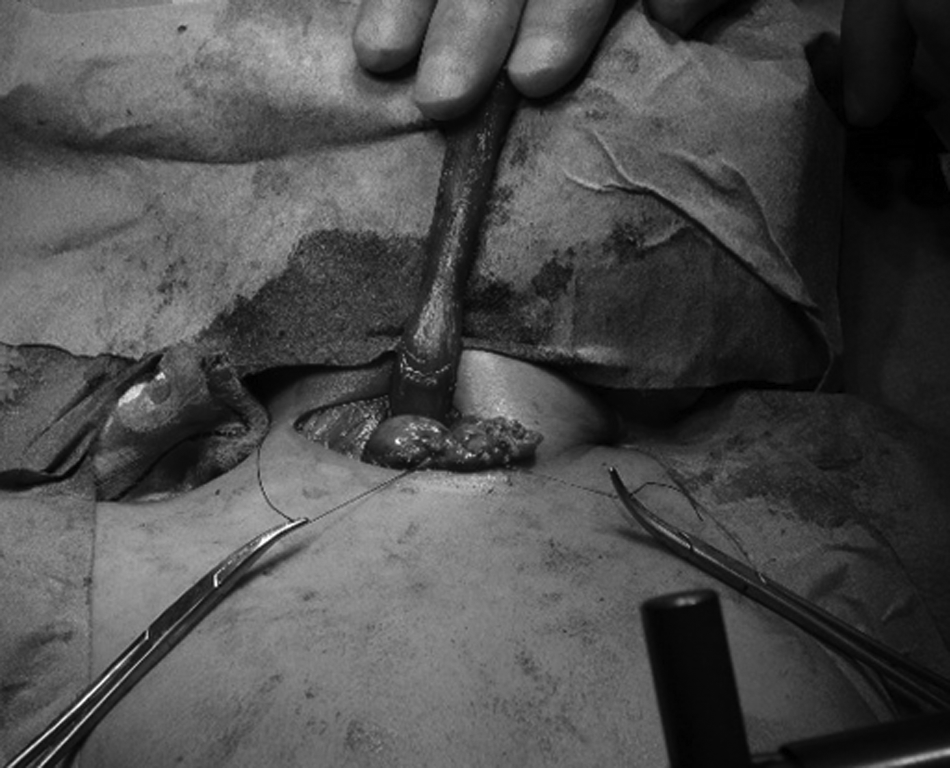
Esophagus and proximal stomach brought out at the cervical incision for anastomosis.
Postoperatively, patients remain paralyzed and ventilated in the intensive care unit for 2–5 days prior to transfer to the surgical ward. Paralysis is used to prevent movement at the esophagogastric anastomosis and to prevent swallowing. Opiate analgesia is provided via a nurse-controlled pump system. Enteral feeding is started within 48 hours if a jejunostomy is used, or oral feeding is commenced when gastric function returns (i.e., absence of nausea, low gastric aspirates <10 mL/kg/day, and when flatus or bowel motions restart).
Patients are followed up at regular intervals at the GOSH outpatient clinic or a tertiary pediatric surgical center abroad.
Literature search (multicenter outcomes)
A systematic literature search was performed using MEDLINE. The medical subject heading terms used were “gastric transposition,” “gastric pull-up,” and “gastric interposition” with Boolean AND/OR operators. Titles, abstracts, and full-text articles of the identified citations were reviewed to determine eligibility. The reference lists of included studies were also searched to identify further relevant citations.
The inclusion criteria were studies on children (age <18 years) who had undergone minimally invasive gastric transposition with sufficient report on anastomotic leak, stricture, and mortality rates. Exclusion criteria included patient age ≥18 years and articles that had insufficient breakdown of datasets. When more than one publication was suspected to arise from a single dataset or if there was overlap in the dataset, only the most recent study was used. Data from eligible studies were collated on a computerized database. The baseline data collected included authors, year of publication, study center, number of cases, anastomotic leak, stricture, and mortality rate.
Statistical analysis
The outcome measures were anastomotic leak, stricture, and mortality rates. The outcomes of the current retrospective review of minimally invasive gastric transposition were compared with those of the open procedure from the largest published study to date by Spitz 3 (consisting of 192 cases performed at GOSH between 1981 and 2005) to provide a single-center review. The outcomes from studies arising from the literature search were combined with the outcomes from this study to form a multicenter group using minimally invasive techniques. The outcomes of the multicenter group were compared with those of the open procedure from the report of Spitz. 3
Contingency tables were designed for each categorical outcome measure and analyzed using Fisher's exact test. Values of P<.05 were considered statistically significant. Statistical analysis was performed using GraphPad Prism® software (GraphPad Software Inc., San Diego, CA).
Results
Patient characteristics
Laparoscopic-assisted gastric transposition was attempted in 19 children. There were 12 male and 7 female patients with a mean age of 3.5 years (range, 0.4–15 years). Indications for surgery were long-gap esophageal atresia (n=11), esophageal stricture following repair of atresia (n=3), caustic esophageal stricture (n=3), idiopathic esophageal stricture (n=1), and esophageal dysmotility (n=1). Patient characteristics are shown in Table 1.
Conversion to open procedure.
EA, esophageal atresia; F, female; GERD, gastroesophageal reflux disease; M, male; PDA, patent ductus arteriosus; PFO, patent foramen ovale; TEF, tracheoesophageal fistula; VSD, ventricular septal defect.
Of the 19 patients, 3 cases (patients 2, 14, and 17) were converted to laparotomy. All 3 of these patients had previously had open abdominal surgery (either fundoplication and/or gastrostomy insertion), and conversion was necessary because of the presence of significant adhesions between the stomach and abdominal wall. The converted cases were excluded from subsequent analysis. Perioperative and postoperative outcome data for the 16 patients who underwent a laparoscopic-assisted procedure are summarized in Table 2.
EA, esophageal atresia.
The mean anesthetic time was 354 minutes (range, 240–565 minutes). There were 6 pyloromyotomies and 10 pyloroplasties performed. Additional thoracic access was required in 6 patients (2 underwent thoracoscopy, and 4 required thoracotomy). The mean duration of postoperative ventilation was 5 days (range, 3–9 days), and the mean hospital stay was 19 days (range, 10–53 days).
Complications
In total, 9 patients experienced at least one postoperative complication. There was one anastomotic leak, which resolved spontaneously. Two patients developed dysphagia and endoscopy-confirmed anastomotic stricture; 1 patient responded to a single balloon dilatation, and the other case required multiple dilatations. Three patients developed hiatus hernia, and all required surgical repair. Gastric-outlet obstruction was reported in 3 patients; 2 of these had pyloromyotomy, and 1 had pyloroplasty during their gastric transposition operation. One of the patients who initially had a pyloromyotomy had this converted to a pyloroplasty to treat the obstruction. The remaining 2 patients each required a single pyloric dilatation attempt to resolve their symptoms. Other early complications were pleural effusion and pneumothorax, which were treated conservatively, pneumonia, and Horner's syndrome. In the patient with Horner's syndrome the original cervical esophagostomy was formed lateral to the carotid sheath. There were no deaths in this series.
Follow-up and feeding status
Eleven patients are followed up at GOSH (mean follow-up period, 28 months; range, 2–80 months). The remaining 5 patients are followed up in other pediatric surgical centers abroad. The feeding statuses of the patients on last follow-up (or on discharge in the case of those who were followed up abroad) are as follows: 9 patients are thriving on oral feeds only, 4 patients are feeding orally with supplemental tube feeding, and 3 patients are solely tube-fed.
Single-center (GOSH) comparison of outcomes
The single-center comparison of outcomes is shown in Table 3. The complication rates of anastomotic leak and stricture from this series (6.3% and 12.5%, respectively) are nearly half of the open procedure from the report of Spitz 3 (12.0% and 20.8%, respectively). There were no deaths compared with a mortality rate of 4.7% in the open procedure. However, the single-center comparison showed no statistical difference in rates of anastomotic leak (P=.701), stricture (P=.535), and mortality (P=1.000) between the two techniques.
By Fisher's exact test.
Multicenter comparison of outcomes
The literature search yielded 10 further studies describing experiences with minimally invasive gastric transposition; when combined with the current study there were, in total, 66 cases (Table 4). In this multicenter group there were 11 leaks, 10 strictures, and 1 death.
The 11 cases of anastomotic leak were detected either on clinical suspicion with subsequent contrast study or by protocol contrast study. All but 1 case resolved spontaneously. The remaining case needed surgical repair along with removal of a retained piece of Penrose drain. 10
There was no universal definition for anastomotic stricture described; each center reported stricture as either a patient with dysphagia and/or requiring balloon dilatation. With regards to the frequency of balloon dilatation to manage stricture, all but 1 case (patient 11 from this current series) required more than one attempt. One patient, reported by Shalaby et al., 5 went on to have revision of the anastomosis.
Outcomes of the multicenter group using minimally invasive techniques were compared with those of the open procedure from the report of Spitz 3 (Table 5). There were no significant differences in leak (P=.398), stricture (P=.370), and mortality rates (P=.461).
By Fisher's exact test.
Discussion
Gastric transposition was first described by Sweet 16 in 1948 as a method of esophageal replacement. Alternative techniques for esophageal replacement include gastric tube reconstruction, jejunal interposition, and colonic interposition. Satisfactory results have been reported for all forms of esophageal replacement3,17–19; however, there is still no consensus on the best conduit for esophageal replacement.1,20,21 The most common techniques used in children today are gastric transposition and colonic interposition.3,19 Spitz and co-workers, discouraged by poor long-term results of colonic grafts, 22 established gastric transposition as one of the favorable techniques for esophageal replacement in pediatric surgery.3,23 This study's single-center and multicenter comparisons of minimally invasive gastric transposition with the largest study by Spitz 3 using the open approach show no significant difference in anastomotic leak, stricture, and mortality rates.
Relevant larger studies in adults include those evaluating minimally invasive esophagectomy with transposition of the stomach for esophageal cancers. Meta-analyses of mainly case-control studies have suggested that minimally invasive esophagectomy is a safe technique with the benefits of reduced hospital stay, respiratory complications, and total morbidity while maintaining oncological outcomes.7,24–26
The use of minimally invasive techniques is growing; however, the barriers to minimally invasive techniques are illustrated by the 3 patients who were converted to open abdominal surgery and the 4 cases that required thoracotomy. Patients who have had a previous abdominal procedure can develop significant abdominal adhesions that make mobilization of the stomach difficult and create a significant obstacle to performing the procedure laparoscopically. It is not uncommon for patients who have had previous thoracotomy or caustic esophageal injury to require thoracotomy to facilitate reconstruction.
Interesting findings from our single-center comparison are the anastomotic leak and stricture rates. These rates following the laparoscopic-assisted procedure, where the anastomosis is performed extracorporally, are nearly half of that reported in the open technique (although not statistically significant). This may be due to less tissue handling in the laparoscopic approach compared with the open procedure, such that tissue and vessel injury is reduced to maintain a sufficient blood supply for tissue healing.
To minimize the risk of gastric outlet obstruction, at our center we perform a pyloric drainage procedure (pyloroplasty or pyloromyotomy) at the time of gastric transposition. Alternative pylorus management includes balloon dilatation, botox injection, finger fracture, and no intervention. The literature on the best choice of pyloric drainage in cases of gastric transposition in children is scarce. Current opinion on the management of the pylorus in eosphagectomies in adults is divided between routine drainage procedure and no intervention. A recent systematic review on the clinical outcomes of pyloric drainage following esophageal reconstruction in adults demonstrated that pyloric drainage was associated with a nonsignificant trend toward lower rates of earlier gastric emptying, pulmonary complications, and anastomotic leak. 27 The optimal technique remains unproven. Numbers from our study are too small to determine the best pyloric drainage option in children. However, following our center's overall experience from the open and laparoscopic procedures, pyloroplasty is preferred over pyloromyotomy to aid gastric emptying.
Our center's series included 3 (18.7%) patients complicated by hiatus hernia following laparoscopic-assisted gastric transposition. Reported incidences in adult cases range from 0.4% to 6% 28 after open esophagectomy and from 2.8% to 4.5% after minimally invasive esophagectomy.28–30 A possible explanation for a higher incidence of hiatus hernia following minimally invasive technique is the decreased amount of postoperative adhesions. To prevent the complication of hiatus hernia and need for re-operation, it is worthy to consider narrowing the esophageal hiatus after the stomach has been pulled into the chest.
The comparison of the current series with the study of Spitz 3 provides a single-center review and reduces heterogeneity in surgical technique and perioperative management. A complete meta-analysis was not performed in view of the lack of other large series to provide additional power to such study. The limitations of this single-center and multicenter comparative study, which consists of retrospective case series and reports only, are recognized. Furthermore, the period of follow-up is at a relatively early stage for the majority of patients from this series and from other published reports. This limits our analysis of long-term functional and nutritional outcomes. However, these early results are encouraging in terms of anastomotic leak, stricture, and mortality rates.
In conclusion, our 10-year experience and single-center and multicenter comparisons support minimally invasive gastric transposition as a safe and acceptable alternative to the open procedure in children.
Footnotes
Disclosure Statement
No competing financial interests exist.