




Abstract
Abstract
Purpose:
To evaluate different technologies that can facilitate telementoring in a variety of pediatric surgical procedures.
Materials and Methods:
Two different telementoring technologies were used to provide two-way audio and visual communication between experienced pediatric surgeon mentors located in another city and less experienced trainees performing a surgical procedure. The first technology consisted of store-bought equipment that connected the operating room laparoscope to a Skype™ (Microsoft, Redmond, WA) connection (used in 1 case), whereas the second was a proprietary telementoring robot, Karl Storz Endoscopy-America, Inc. VisitOR1® (Karl Storz GmbH & Co. KG, Tuttlingen, Germany) (used in 5 cases). The procedures included a video-assisted thoracic surgery lower lobectomy, a temporary and two permanent gastric stimulator placements, and two laparoscopic inguinal hernia repairs and were performed by pediatric surgeons (3 cases), a pediatric gastroenterologist (1 case), and a general surgeon (2 cases) under the guidance of pediatric surgeon mentors.
Results:
All procedures were completed successfully in a time-efficient manner, without loss of transmission and without complications. Although the Skype technology was less costly, it lacked telestrator capacity and was not adequately secure. The VisitOR1 telementoring robot enabled high-resolution video communication, had telestrator capacity, and allowed pointing during the procedure. The mentors assisted with trocar placement, modifying the surgical technique, identifying planes of dissection, and indicating locations of device and suture placement.
Conclusions:
Telementoring is a useful adjunct in the field of pediatric surgery that can aid in the transfer of surgical skills remotely and shorten the time to implementation of new surgical techniques into practice. Optimal telementoring technology should have a secure wireless connection, high video resolution, and minimal bandwidth latency.
Introduction
R
The current model for learning postgraduate techniques consists of hands-on courses or simulators. However, these short courses or simulated experiences are not usually sufficient to learn a new operation or surgical technique. In addition, the new work hour restrictions have limited the experience that trainees undergo during residency, and additional mentoring after residency may limit errors for the young surgeons. An alternative approach, which resembles the known standard model of apprenticeship in surgical training, is telementoring, in which a surgeon can learn under the guidance of an expert while in practice. In telementoring, an expert surgeon, or telementor, assists another less experienced person in performing a procedure from a remote location through real-time, live interactions. 1 Telementoring has the potential to overcome distance, cost, and time constraints that limit access to expert mentors in the field and aids in the distribution of advanced surgical techniques. Previous studies have shown that there is no difference in knowledge and skill acquisition among telementored and locally mentored surgeons.2,3
Although telementoring has been shown to flatten the laparoscopic learning curve in many fields, 4 it has been slower to gain widespread use in the field of pediatric surgery, with only one previously published study to date. 5 One of the biggest obstacles to the implementation of telementoring programs is the coordination of proper telecommunication systems. Here, we discuss our evaluation of two different technologies used by pediatric surgeons in 6 cases of transcontinental telementoring.
Materials and Methods
Two different telepresence technologies were used.
In the first case, special store-bought equipment was used to link the endoscopic tower and operating room audio system to a Skype™ (Microsoft, Redmond, WA) connection. In addition, an external Webcam enabled video and audio streaming between the mentor and the trainee of external operating room activities and external patient views. We used the hospital's Wi-Fi network, which speed tests at approximately 30 megabits per second with some variation during peak traffic. Skype does not establish a secure peer-to-peer connection with encryption, however.
Because of concern for Health Insurance Portability and Accountability Act (HIPAA) compliance and lack of telestrator capability with the Skype connection, our subsequent cases used a proprietary telementoring robot, the Karl Storz Endoscopy-America, Inc. VisitOR1® (Karl Storz GmbH & Co. KG, Tuttlingen, Germany) 6 (Fig. 1). The VisitOR1 remote presence device is a Food and Drug Administration–cleared Class II medical device, is HIPAA-compliant, and has a 256-bit, military-grade encryption. The mentor's laptop (Fig. 2) connects directly to the telementoring robot in the operating room, which provides the mentor with internal and external views of the operation and allows him or her to telestrate on the screen and mark directly on the surgical field with a laser pointer. The system also allows for the mentor surgeon to view the endoscopic image via a direct connection—either S video or composite video—between the operating surgeon's endoscopic camera and the robot. The VisitOR1 requires a minimum bandwidth of 300 kilobits per second, with an optimal speed of 700 kilobits per second. The average latency of the system is less than 300 milliseconds, and the video capture rate is 30 frames/second. The screen resolution is 1024×768.

The Karl Storz VisitOR1 telementoring robot cart. (Image provided by Karl Storz Endoscopy-America, Inc.)
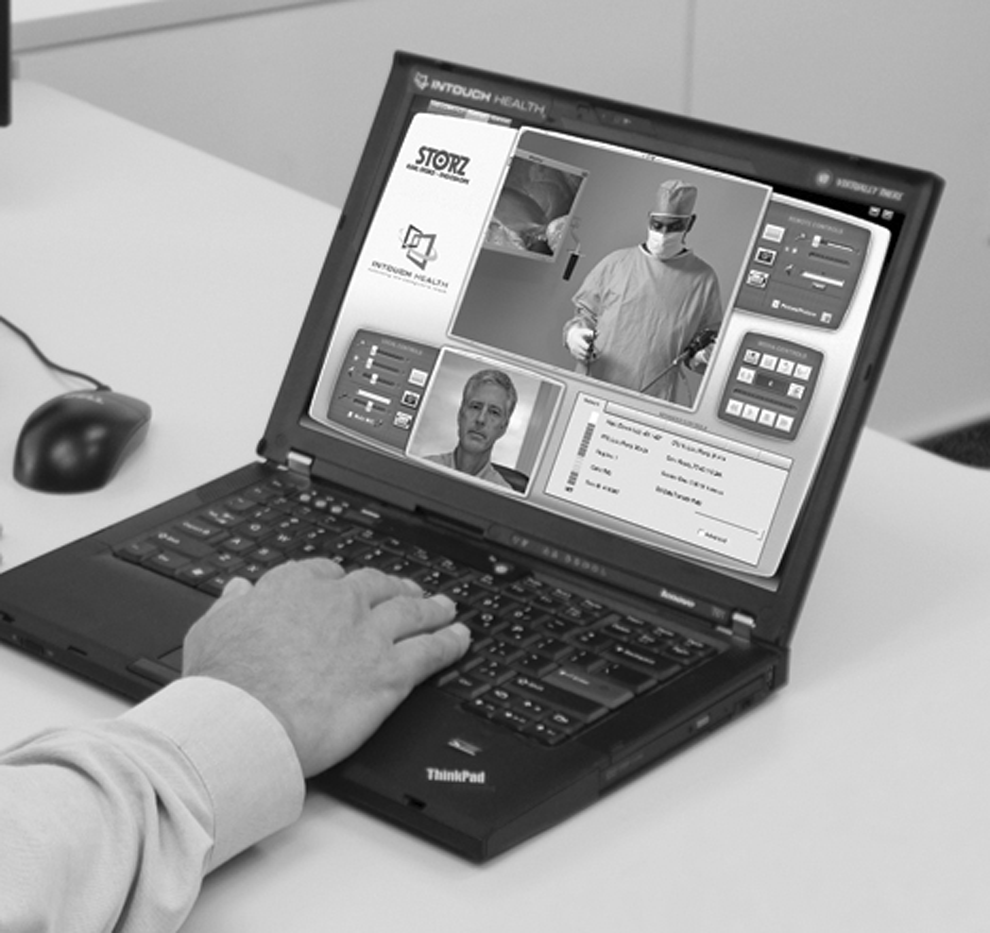
Laptop used by the remote mentor while telementoring a surgical case. (Image provided by Karl Storz Endoscopy-America, Inc.)
A discussion was held with the patients' guardians about the use of telementoring during the procedure, and a separate consent was signed. In total, 6 cases were performed by four mentees: two pediatric surgeons, a pediatric gastroenterologist, and a general surgeon (Table 1). The first case was a video-assisted thoracic surgery left lower lobe resection. The second case was a temporary gastric stimulator placement by a pediatric gastroenterologist. The third and fourth cases were permanent gastric stimulator placements, and the last 2 cases were laparoscopic inguinal hernia repairs performed by a general surgeon (Table 1). The telementoring robot enabled the mentors to be virtually present for the entire procedure, assist in patient setup and trocar placement, and instruct the mentee on the surgical technique.
GI, gastroenterologist; Lap, laparoscopic; VATS, video-assisted thoracic surgery.
Results
All six procedures were completed successfully laparoscopically, without loss of transmission, in a time-efficient manner (Table 1). There were no intraoperative or postoperative complications. In the first case, a video-assisted thoracic surgery left lower lobectomy, telementoring occurred via Skype communication. The mentor was able to guide the surgical team by verbally identifying dissection planes and instructing locations for vessel ligation. The subsequent 5 cases of telementoring occurred via the proprietary Karl Storz VisitOR1 telementoring robot. In the second case, a pediatric gastroenterologist with no previous experience was guided by a pediatric surgeon through the successful endoscopic placement of a temporary gastric stimulator. In the third and fourth case, a pediatric surgeon with no previous experience was guided through the laparoscopic placement of permanent gastric stimulators in two children (Fig. 3). The mentor assisted with identifying trocar placement locations, modifying the surgical technique, and indicating an optimal location for the gastric stimulator (Fig. 4). The last 2 cases were cross-specialty laparoscopic inguinal hernia high ligations performed by a general surgeon directed by a pediatric surgeon on trocar sites and locations of suture placement (Fig. 5). In all cases, both the surgeon and mentor felt the telementoring greatly assisted in the case and were very satisfied with the visualization and assistance in the case.
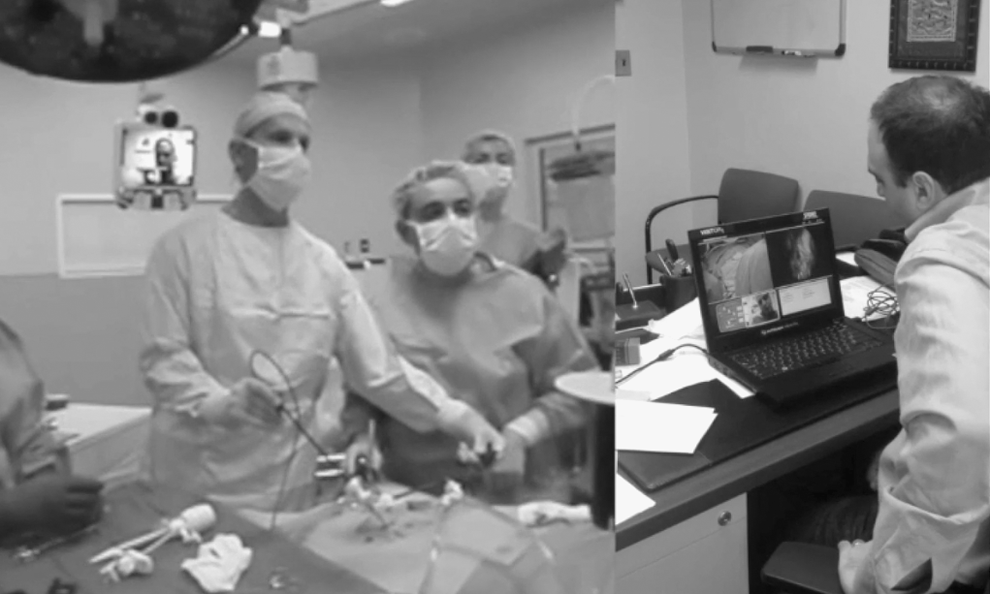
T.A.P. in Akron is mentoring a laparosopic gastric stimulator placement procedure in Denver using the Karl Storz VisitOR1 system.
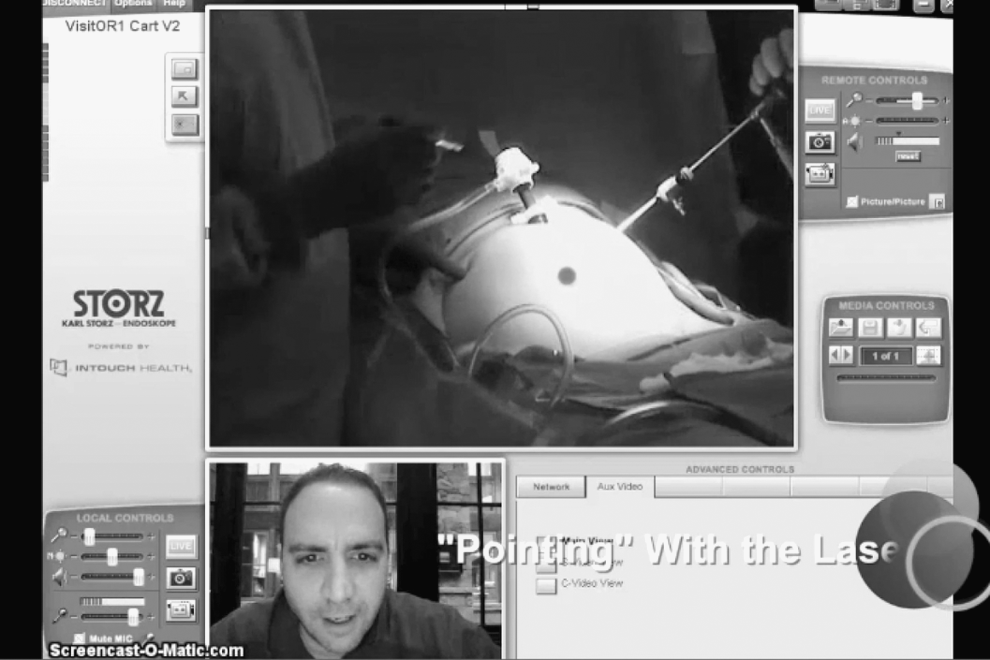
T.A.P. in Colorado uses the laser pointer of the VisitOR1 system to suggest trocar placement on a patient in Cleveland.

T.A.P. in Colorado uses the arrow to recommend suture placement locations in an inguinal hernia high ligation performed in Cleveland.
Discussion
With the exponential increase of emerging surgical technologies, surgeons must be committed to lifelong learning and new skill acquisition throughout their career. Besides conventional methods of postgraduate training such as skills courses, simulators, video, and other teaching aids, telementoring has been successful in helping disseminate new techniques and improve surgical skills in many fields, particularly for advanced laparoscopic techniques. 4 Experts in the field who have performed a significant number of operations are not always locally available. Previous studies have shown no difference in knowledge and skill acquisition among telementored and locally mentored surgeons performing laparoscopic nephrectomies, 2 laparoscopic colectomies, or Nissen fundoplications. 3 A comprehensive review of surgical telementoring studies published in the last two decades found a 5% complication rate and a 5% conversion rate in 433 mentored cases across multiple specialties, similar to on-site mentoring. 4 Furthermore, it has been shown that trainees can obtain clinical results similar to those of an expert surgeon if supervised by an experienced trainer. 7 Pediatric surgery is a highly specialized field with few experienced mentors, particularly in the surgical management of many rare cases that could highly benefit from this telepresence technology.
Although telemedicine in pediatric surgery has been more widely used to increase access of remote ambulatory care patients to pediatric surgeons,8,9 telementoring has been slower to gain widespread use, possibly because of the challenges of implementing telecommunication systems. Multiple telementoring technology options have been explored by us and other groups.5,10,11 In this study, we present six pediatric surgical procedures successfully performed by various trainees under the guidance of expert pediatric surgeons with two different telepresence devices. In the first case of a video-assisted thoracic surgery lower lobectomy, we used a lower-cost solution via store-bought equipment and a Skype connection, which allowed direct connection from the laparoscopic camera and the Webcam in the operating room to the remote mentor located in his office in another city. Although the cost of this option was low, there were several shortcomings of this setup. Because of the lack of interactivity, without telestrator capacity or laser-pointing capabilities, the mentor had a limited ability to instruct the surgical team and had to mostly rely on “verbal pointing” to anatomic landmarks. In addition, this technology lacked HIPAA-compliant video encryption, which compelled us to explore other telementoring technologies. For the subsequent 5 cases, we used the proprietary Karl Storz VisitOR1 telementoring robot, which provided excellent visualization, the ability to telestrate on the screen, and to point with a laser pointer on the surgical field. 6
We have recently made several attempts at more robust, lower-cost solutions. One of those solutions was used at Akron Children's Hospital to enable an iPad® (Apple, Cupertino, CA)-based solution using several “off-the-shelf” software solutions and a direct connection to the operating room camera feed. The feed was then sent to the iPad over a secure connection where the mentor could use the telestrator and view a high-definition feed of the operating room camera directly on the iPad.
The most helpful parts of the mentoring interactions were patient setup and trocar placement, modification of surgical technique, and identification of dissection planes and locations for suture and device placement. Although no formal survey was used, all mentees and mentors felt that telementoring greatly facilitated the efficient and successful completion of the cases and acquisition of skills and confidence by the less experienced mentees.
The telecommunication system affects the mentoring process itself and thereby potentially influences the operative outcome. 12 Various modern telementoring systems are now commercially available, as reviewed by Antoniou et al. 11 The essential components of the system are as follows: high-quality video with a resolution of 768×492 or higher; a time delay of less than 250 milliseconds one way, which is usually achieved with a bandwidth greater than 1.2 megabytes per second; and the ability to telestrate on the screen and point with a laser pointer on the surgical field.4,11 Although cost is often an institutional concern and barrier to adopting telementoring technology, if properly planned, there could be a cost savings effect if the technology is used by various departments and areas of education within one institution. The time and cost of travel for bringing an expert to the institution also add to the cost savings with this technology.
The relationship between the mentor and the patient in telementoring, and thus the liability of the mentor, is an issue of debate. Some argue that the mentor is involved in the care of the patient because he or she affects intraoperative decision-making, which may alter patient outcomes, and thus the mentor is liable if anything goes wrong. Others argue that the mentor is not directly taking care of that patient but simply advising the primary surgeon and therefore not liable for the outcome. We are of the latter opinion and believe that the mentor acts as an informal consultant and does not have a physician–patient relationship because the patient is not under his or her care. It is paramount that the surgeon can complete the case without the mentor's help and is only gaining the mentor's advice or opinion on the optimal technique, especially in case there is a technical malfunction in the transmission. A mutual understanding must exist that the responsibility for the outcome of the case resides with the mentee doing the procedure, not the mentor. 10
In summary, telementoring technology is a useful adjunct in the field of pediatric surgery that can aid in the transfer of surgical skills remotely, avoiding travel and shortening the time to implementation of new surgical techniques into practice. Further studies should evaluate clinical and educational outcomes of telementoring in a larger cohort of pediatric patients treated by a telementored, locally mentored, or non-mentored surgeon to further validate the utility and optimal use of telepresence technology in the operating room.
Footnotes
Disclosure Statement
T.A.P. is part owner of GlobalcastMD. M.S. is an employee of GlobalcastMD. I.D.B., T.H.S., M.R., R.P., M.N., and S.S.R. declare no competing financial interests exist.