




Abstract
Abstract
Purpose:
Visceral and shoulder tip pain following laparoscopic cholecystectomy is mainly due to carbon dioxide (CO2) insufflation. Various methods have been adopted to eliminate residual CO2. We compared the postoperative analgesic efficacy of intraperitoneal normal saline (30 mL/kg) irrigation with preoperative oral acetazolamide administration in patients undergoing laparoscopic cholecystectomy.
Materials and Methods:
Sixty patients between 20 and 60 years of age were included in this prospective, randomized, double-blind study. Patients in Group I received placebo, Group II patients received preoperative oral acetazolamide (5 mg/kg), and Group III patients received intraperitoneal irrigation with 30 mL/kg of normal saline. Intravenous paracetamol (1 g) was administered every 6 hours for postoperative analgesia. Parietal and visceral pain scores at rest, on movement, and on coughing and shoulder tip pain were recorded using a visual analog scale after arrival in the postanesthesia care unit, at 1, 2, 4, 6, 12, and 24 hours after surgery. Rescue analgesia was provided with an intravenous fentanyl (1 μg/kg) bolus whenever the visual analog scale score was ≥4.
Results:
Compared with Group I, Group III patients had significantly lower visceral pain scores at all time intervals except at 12 hours. Group III patients also recorded significantly lower visceral pain scores than Group II from 2 to 24 hours. There was no significant difference in shoulder tip pain. The total dose of fentanyl used was significantly less in Group III.
Conclusions:
Intraperitoneal normal saline irrigation is more effective than acetazolamide in reducing postoperative visceral pain after laparoscopic cholecystectomy and has significant opioid-sparing effect. However, its effect on shoulder pain is comparable to that of acetazolamide.
Introduction
P
Among the various methods adopted to eliminate residual CO2, active aspiration of CO2 at the end of the procedure or leaving a subhepatic drain to expel the residual CO2 has been tried, but with varying degrees of success. 2 Subdiaphragmatic instillation of a large volume of normal saline (25–30 mL/kg) at the end of laparoscopic cholecystectomy and its subsequent aspiration have been shown to decrease visceral and shoulder tip pain in the postoperative period. This beneficial effect of saline irrigation may be due to dilution of carbonic acid and displacement of residual CO2. 3 As is known, carbonic acid formation from CO2 and H2O is accelerated by the enzyme carbonic anhydrase. Thus, acetazolamide, a potent carbonic anhydrase inhibitor, has also been used to reduce referred pain after laparoscopic cholecystectomy. 4
As pain relief provided by normal saline irrigation and oral acetazolamide has never been compared, we decided to conduct this study with the aim of comparing the postoperative analgesic efficacy of intraperitoneal irrigation with 30 mL/kg of normal saline at the end of the procedure versu preoperative oral acetazolamide administration in patients undergoing laparoscopic cholecystectomy.
Materials and Methods
After approval by the institute ethics committee and written informed consent was obtained, 60 American Society of Anesthesiologists class I and II patients of either sex, between 20 and 60 years of age, scheduled for elective laparoscopic cholecystectomy were included in this prospective, randomized, double-blind study. Patients were excluded if they had preoperative hepatic or renal disease, electrolyte imbalance, allergy to sulfonamides, metabolic acidosis, chronic obstructive pulmonary disease, and conversion of laparoscopic cholecystectomy to open cholecystectomy.
Randomization and blinding were achieved as discussed below. Envelopes containing a slip with acetazolamide or placebo written over it and another envelope with instructions for intraoperative interventions were prepacked by the statistician and randomly allocated to each patient with the help of a computer-generated random number sequence. The envelopes had one of the combinations: Group I (control group), placebo+no intraoperative intervention; Group II, oral acetazolamide (5 mg/kg)+no intraoperative intervention; and Group III, placebo+intraperitoneal irrigation with 30 mL/kg of normal saline
Sachets containing 5, 10, 50, 100, and 200 mg of powdered tablet acetazolamide and placebo were prepared with the use of a microbalance. By combining different sachets, sugar-coated identical capsules were filled with either placebo or acetazolamide (5 mg/kg), the day before surgery, by the pharmacist after recording the patient's weight; these capsules were placed in the envelope along with another envelope containing a slip for intraoperative intervention according to the random number allocated to the patient. The capsule was given to the patient with a few sips of water 90 minutes before induction of anesthesia. The envelope having the slip for intraoperative intervention was handed over to the anesthesiologist present in the operating room. The anesthesiologist who opened the envelope and the one managing the patient intraoperatively were not involved in postoperative data collection.
All patients were kept fasting for 8 hours prior to surgery. After the patient arrived in the operating room, standard monitoring consisting of heart rate, noninvasive blood pressure, electrocardiogram, oxygen saturation, and end-tidal CO2 was established. Anesthesia was induced with injection of propofol (2–3 mg/kg intravenously), and vecuronium (0.1 mg/kg intravenously) was administered to facilitate endotracheal intubation. Anesthesia was maintained with 66% nitrous oxide in oxygen and isoflurane. Fentanyl (2 μg/kg intravenously) was administered for intraoperative analgesia. Intraoperatively, all patients received intravenous Ringer's lactate at the rate of 8–10 mL/kg/hour.
During laparoscopic cholecystectomy, pneumoperitoneum was established with CO2, and the intraabdominal pressure was maintained between 12 and 14 mm Hg. After completion of surgery, Group III patients underwent intraperitoneal irrigation with 30 mL/kg of normal saline at 37°C infused under the right hemidiaphragm, with the patient in the 30° Trendelenburg position. This fluid was suctioned out after the pneumoperitoneum was deflated. Port sites were infiltrated with 12–15 mL of 0.25% bupivacaine before wound closure in all three groups. Total CO2 flow, duration of pneumoperitoneum, and surgical duration were noted for each patient. All the patients were injected with diclofenac (0.15 mg/kg) and ondansetron (0.1 mg/kg) intravenously 30 minutes before completion of surgery. At the end of surgery, residual neuromuscular blockade was reversed with intravenous neostigmine (50 μg/kg) and glycopyrrolate (10 μg/kg).
All the patients were observed for 24 hours after surgery by an anesthesiologist who was not aware of the patient's group allocation. Intravenous paracetamol (1 g) was administered every 6 hours for postoperative analgesia. Parietal and visceral pain scores at rest (supine), on movement (sitting up from supine position), and on coughing and shoulder tip pain were recorded using a visual analog scale (VAS) with a scale of 0–10, where 0=no pain and 10=the worst possible pain, 5 after arrival in the postanesthesia care unit, at 1, 2, 4, 6, 12, and 24 hours after surgery. Rescue analgesia was provided with intravenous fentanyl (1 μg/kg) bolus whenever the VAS score was ≥4. The time to first dose of rescue analgesia and the total fentanyl consumption during the first 24 hours after surgery were recorded. The incidence and severity of postoperative nausea were assessed (0=none, 1=mild, 2=moderate, and 3=severe), and metoclopramide (10 mg intravenously) was injected for severe nausea or if the patient vomited. Serum electrolytes were evaluated in all the patients in the postoperative period to rule out any electrolyte disturbance due to acetazolamide administration. Any other side effects related to interventions were also recorded.
Statistical analysis
Demographic data and hemodynamic parameters were compared using analysis of variance followed by post hoc analysis when required. The chi-squared test was used to compare the descriptive variables. Pain scores for different pain components were compared by the Kruskal–Wallis test followed by the Mann–Whitney U test when required. Statistical significance was defined as P<.05.
Sample size was calculated with the assumption that carbonic anhydrase inhibitor will reduce postoperative fentanyl consumption by 30%. With a 0.05 α level and 80% power, 17 patients were required in each group. In an adjustment for subjects who may not complete the study, 20 patients were enrolled in each group.
Results
All the 60 patients who were enrolled completed the study (Fig. 1). All the groups were comparable with respect to demographic characteristics, duration of pneumoperitoneum, total volume of CO2 used, and intraabdominal pressure during the established pneumoperitoneum (Table 1).
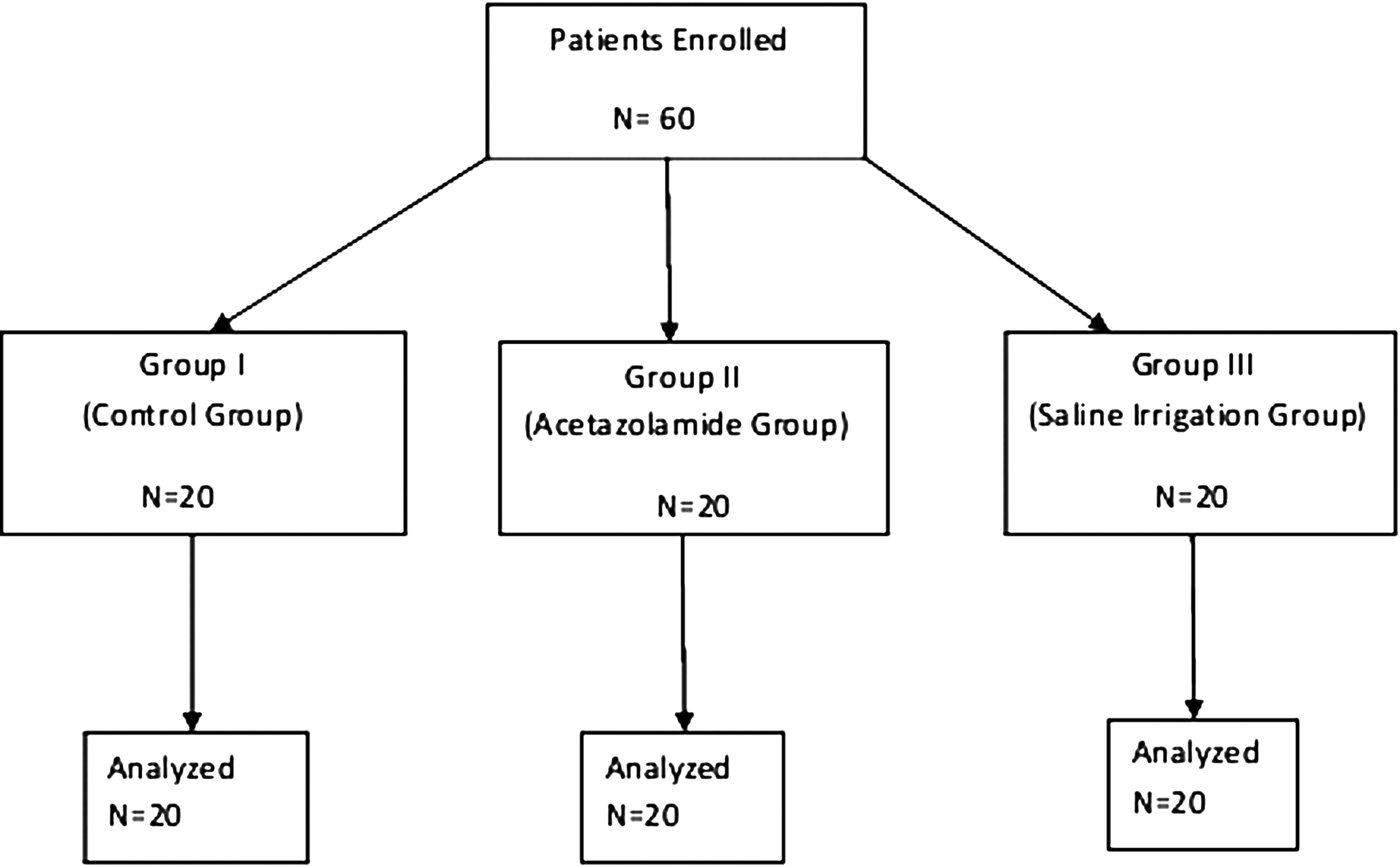
CONSORT diagram.
P>.05, no significant difference among the groups.
F, female; M, male.
Postoperative parietal pain scores at rest, on movement, and on coughing were comparable among the three groups (Table 2). Compared with Group I, visceral pain scores at rest were significantly lower in Group II up to 2 hours postoperatively, whereas Group III patients had significantly lower pain scores than Group I at all time intervals except at 12 hours. Group III patients recorded significantly lower pain scores than Group II from 2 to 24 hours (Table 3). On movement, patients in Group III had significantly lower visceral pain scores than Groups I and II at all time intervals, whereas Group II patients had lower pain scores than those in Group I only at 2 and 4 hours postoperatively (Table 3). Group III patients also recorded significantly lower pain scores on coughing compared with Groups I and II patients from 2 to 12 and from 2 to 24 hours postoperatively, respectively. The difference between Groups I and II was only significant at 4 hours postoperatively (Table 3).
Data are mean (standard deviation) pain scores. P>.05, no significant difference among the groups.
Data are mean (standard deviation) pain scores.
P<.05, Group II versus Group I; bP<.05, Group III versus Group I; cP<.05, Group III versus Group II.
Shoulder tip pain was reported by 35%, 15%, and 10% of patients at 24 hours in Groups I, II, and III, respectively, with no significant difference among the three groups. However, between 8 to 24 hours postoperatively, the intensity of pain was significantly lower in Group III patients compared with those in Group I, whereas the difference between Groups II and III was not significant (Table 4).
Data are mean (standard deviation) pain scores.
P<.05, Group III versus Group I.
Total dose of fentanyl used as rescue analgesia was significantly less in Group III than in Groups I and II. However, there was no difference in the time to requirement of first dose of rescue analgesic among the groups (Table 5).
P<.05, Group III versus Groups I and II.
Four patients in Groups I and II each and 2 patients in Group III had either severe nausea or vomiting that required intravenous metoclopramide. No side effects attributable to the interventions were observed in any of the groups.
Discussion
Postoperative pain following laparoscopic cholecystectomy is multifactorial with complex mechanisms and has been the subject of numerous studies. Various modalities like parenteral opioids, nonsteroidal anti-inflammatory agents, and intraperitoneal local anesthetic agents have been tried with varying degrees of success.6,7 Other interventions have focused on removal of residual CO2, preventing the formation of carbonic acid, and washing out of carbonic acid formed from CO2 and H2O. 8
In the present study, intraperitoneal irrigation with 30 mL/kg of normal saline and its subsequent aspiration were more effective than preoperative oral acetazolamide in reducing postoperative visceral pain at rest, during mobilization, and on coughing after laparoscopic cholecystectomy during the first 24 hours postoperatively. However, the intensity of shoulder tip pain was similar in patients who received either intraperitoneal normal saline irrigation or oral acetazolamide.
Insufflation of CO2 during laparoscopic procedures leads to acidification of the peritoneum by formation of carbonic acid, and space is created between the liver and the diaphragm, which might be the cause of visceral and shoulder tip pain. 2 The rate of formation of H+ and HCO3− ions from CO2 and H2O is markedly accelerated by carbonic anhydrase. Acetazolamide potentially inhibits both membrane-bound and cytoplasmic forms of carbonic anhydrase and decreases the rate at which H+ ions are formed due to enzymatic catalysis. It can be used both intravenously and orally, with the bioavailability after oral administration being 100%.4,8 Harvey et al. 9 hypothesized that inhibition of carbonic anhydrase by acetazolamide might reduce the postoperative pain by inhibiting carbonic acid formation. In this study, conducted on patients undergoing various laparoscopic procedures under general anesthesia, acetazolamide (5 mg/kg intravenously) at induction was associated with significant reduction in referred pain during the initial 4–6 hours postoperatively. The definition of referred pain in this study was diffuse pain remote from the site of surgery that is poorly localized by the patients. Because of the nonavailability of an intravenous preparation of acetazolamide, we administered oral acetazolamide 90 minutes before anesthesia induction, which corresponded to the time of onset of action of the drug. Compared with the control group, we found visceral pain scores at rest to be significantly lower at 2 hours, on movement at 2 and 4 hours, and on coughing at 4 hours in the postoperative period. The effect of a single dose of acetazolamide is known to last for 4–6 hours. The duration of pain relief in our study as well as in the study by Harvey et al. 9 was limited to this period only.
We observed that subdiaphragmatic instillation of 30 mL/kg of normal saline at the end of the procedure and its subsequent aspiration decreased the visceral pain scores at rest, on movement, and on coughing during most of the observation period compared with the control group. Shoulder tip pain was also of lower intensity in this group. This is in accordance with the result of two previous studies by Tsimoyiannis et al.,3,10 who have also used 25–30 mL/kg of normal saline for irrigation. A larger volume of saline is required to displace all of the residual CO2 in the abdominal cavity and also effectively dilute the carbonic acid formed on the peritoneal surface. A lower volume of normal saline (500 mL) has been found to be ineffective by the same authors.
There is no previous study comparing the effects of oral acetazolamide with intraperitoneal normal saline irrigation. We found intraperitoneal saline irrigation more effective in reducing visceral pain scores in comparison with oral acetazolamide. This difference could probably be due to a difference in the mechanism of action of the two interventions. Acetazolamide prevents acidification of the peritoneum by decreasing the rate of formation of carbonic acid, whereas intraperitoneal normal saline irrigation and its subsequent removal not only eliminate all the residual CO2 but also dilute the carbonic acid formed on the peritoneal surface. Furthermore, intraperitoneal irrigation with normal saline might also contribute in reducing visceral pain probably by removing the local irritants like particulate debris from dissection, blood, bile, and other materials present as a result of the surgical intervention. The benefit of acetazolamide in the postoperative period was limited to its duration of action (4 hours), whereas normal saline irrigation was effective throughout the first 24 hours.
The reported incidence of shoulder tip pain after laparoscopic chelecystectomy is 30%–45% when patients are evaluated for 24–48 hours.11,12 Usually the patients do not complain of shoulder tip pain during the initial postoperative hours, but it becomes the main complaint a few hours after surgery. In our study the patients complained of shoulder tip pain 8 hours after surgery, with the incidence at 24 hours being 35%, 15%, and 10% in Groups I–III, respectively. Although the number of patients complaining of shoulder tip pain in the control group was higher than in the acetazolamide and normal saline irrigation group, the difference did not reach statistical significance. No difference was observed between the acetazolamide and normal saline irrigation groups also. However, compared with the other two groups, the intensity of shoulder tip pain was significantly lower in the normal saline irrigation group at 8, 12, and 24 hours. Because we observed our patients for the first 24 postoperative hours only, we cannot comment on the incidence and intensity of shoulder tip pain after 24 hours.
In the present study, patients in all three groups received port-site infiltration with 12–15 mL of 0.25% bupivacaine at the end of procedure. However, parietal pain scores were high and not significantly different among the three groups at rest, on movement, and on coughing. Previous studies show conflicting results regarding the effect of port-site infiltration. Although there are a few positive trials,13,14 however, many studies have failed to show any significant benefit of local anesthetic infiltration on parietal pain scores.15,16 A systematic review by Moiniche et al. 17 also failed to find any evidence of measurable effect of port-site infiltration.
In the present study, Group III patients required a significantly lower dose of rescue analgesic compared with the other two groups. However, the time to requirement of the first dose of rescue analgesia was similar among the three groups. We did not observe electrolyte disturbances, in any of our patients, in the postoperative period. Acetazolamide, like any other diuretic, can cause electrolyte disturbances. However, we did not expect a single dose of acetazolamide to cause any electrolyte disturbance.
One of the main limitations of our study was that we could not follow up our patients after 24 hours because all of them were discharged the next day.
In conclusion, intraperitoneal normal saline irrigation is more effective than acetazolamide in reducing postoperative visceral pain after laparoscopic cholecystectomy and has significant opioid-sparing effect. However, its effect on shoulder pain is comparable to that of acetazolamide.
Footnotes
Disclosure Statement
No competing financial interests exist.