




Abstract
Abstract
Introduction:
Enteric duplication (ED) cysts are rare. The commonness of ultrasonographic investigation contributes to an earlier diagnosis of such a pathology before the onset of the first clinical symptoms. A planned mini-invasive surgical treatment during the infancy is proposed. This study presents the possibility and safety of elective laparoscopic or laparoscopy-assisted mini-invasive resection of ileal (IL) and ileocecal (IC) duplications, thus avoiding bowel resection.
Materials and Methods:
A retrospective review was conducted of medical records of 6 patients at the age from 3 to 22 months with the diagnosis of ED, treated in the Department of Pediatric Surgery, Jagiellonian University Medical College, Krakow, Poland, within the period from January 2012 to September 2014.
Results:
Excision of cysts without bowel resection was performed in five children with IC and IL duplications. Laparoscopic excision was performed in two children with IC duplication; in the other three children (1 IC and 2 IL duplication), laparoscopy confirmed the diagnosis with consecutive cyst excision without bowel resection after external evacuation of the cyst. The external resection of the cecum and Bauhin's valve was necessary in 1 patient with large IC duplication and malrotation. The postoperative course was satisfactory in all the cases.
Conclusions:
The laparoscopic approach allows for confirming the diagnosis and accurately defining the exact site of duplication, as well as for effective and safe mini-invasive treatment. Laparoscopic or laparoscopy-assisted excision of ED without bowel resection is a safe option in a significant number of IL and IC duplications.
Introduction
E
The aim of our study was to present the possibility and safety of elective laparoscopic or laparoscopy-assisted mini-invasive resection of ED, thus avoiding bowel resection in children, including duplication cyst at the IC region with preservation of the Bauchin's valve.
Materials and Methods
A retrospective review of the medical records of all patients who underwent surgical treatment for intraabdominal ED cyst in the Department of Pediatric Surgery, Jagiellonian University Medical College, Krakow, Poland, between January 2012 and September 2014 was carried out. All the 6 patients with IL and IC duplication in whom surgical intervention was initialized with laparoscopy were included in our study.
Results
All the children (Table 1) had preoperatively diagnosed ED cysts and were subjected to elective surgery with intention to treat by laparoscopy. There were four boys and two girls. Two boys had the prenatal diagnosis of abdominal cystic mass and were referred although asymptomatic in the first week of life for further evaluation. Two children presented with palpable mass at 10 and 12 months of age, respectively. Two children had abdominal pain and vomiting: one in the first week of life with resolution of symptoms after conservative treatment and one at 9 months of age with intussusception reduced by hydrostatic saline enema. The mean age at initial presentation was 4.5 months.
F, female; M, male.
In the subsequent period of observation and diagnosis between 2 and 10 (mean, 7.5) months, all patients had ultrasound, and 5 had computed tomography imaging, with diagnostic criteria for ED such as a thick well-defined wall seen on ultrasound and contrast-enhanced capsule on computed tomography. At the time of surgery the children were between 5 and 22 (mean, 10) months of age.
Excision of ED without bowel resection was performed in five children (with IC and IL duplications). Laparoscopic excision was performed in two of them with IC duplication (Fig. 1; Case 2). In the other three children (one IC and two IL duplications), the surgery consisted of resection of the duplication without bowel resection after the evacuation of the cyst through an incision within the lower umbilical margin in two children and enlargement of the epigastric port entry in one child (Fig. 2; Case 4). Resection of the cecum and Bauhin's valve was necessary in 1 patient with large IC duplication and malrotation; the procedure was performed after the evacuation of the intestine through a widened omega-shaped incision within the lower umbilical margin.
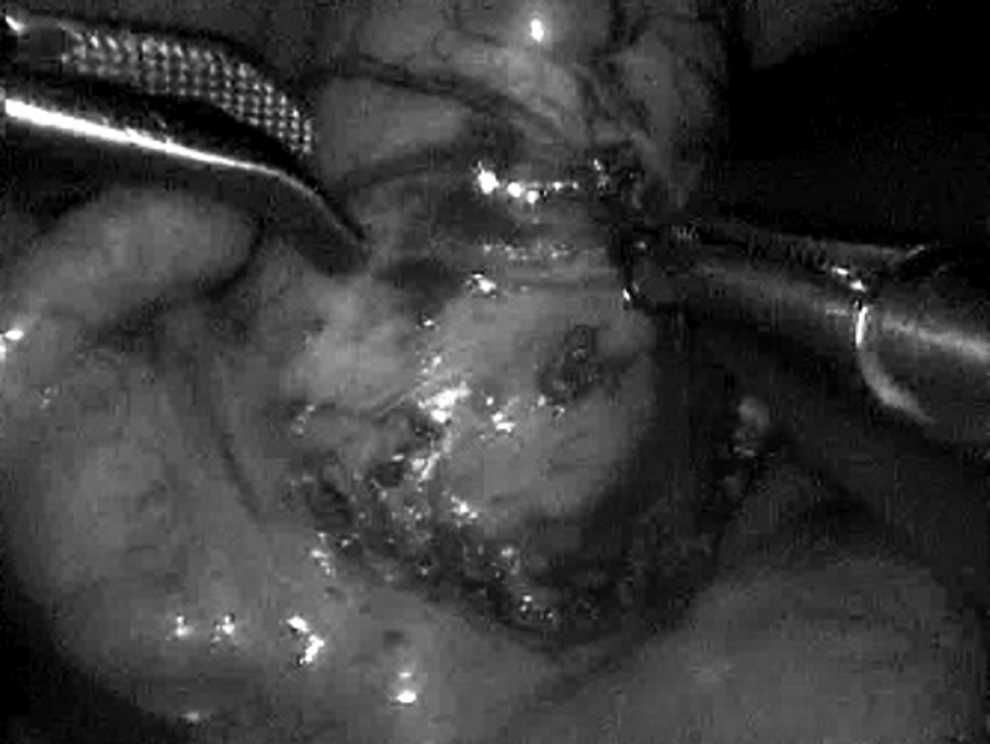
Intraabdominal excision of an ileocolic duplication cyst.
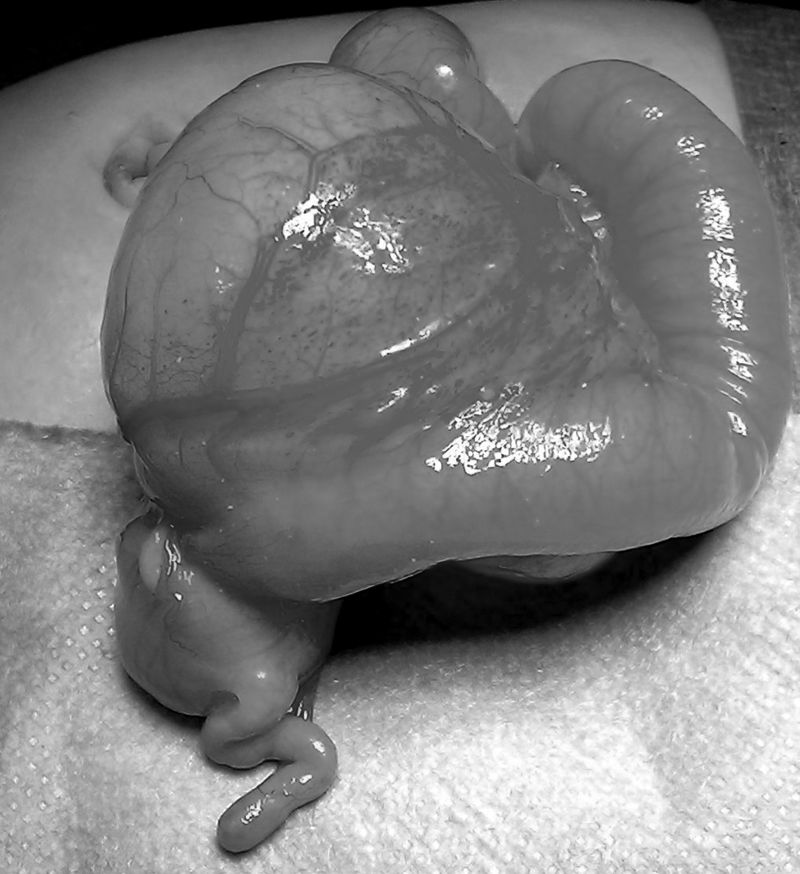
An exteriorized ileocolic duplication cyst ready for external excision.
The final diagnosis of duplication cyst was made by histopathological examination, which showed intestinal mucosal lining in 5 cases and ectopic pyloric tissue in Case 6.
The children were discharged between postoperative day 2 and 14 (median, 7 days) with prolonged stay for two of them due to urinary tract and bloodstream infections. In all others, the early postoperative course was uneventful. In long-term follow-up of 5–36 (median, 14) months, one child (Case 2) had laparotomy for small bowel obstruction in which the adhesions were released without bowel resection. Two children (Cases 3 and 5) with lack of appetite have had slower growth within 10 and 25 percentile of the population, without evident abdominal problems. Parents of all children, including children with periumbilical incision enlargement, reported superb cosmetic results.
Discussion
There are few publications describing the role of laparoscopy in ED in children. 1 The chance for excision of IC duplications preserving Bauchin's valve even in the open approach has not been described until recently. 2 Our experience with the laparoscopic approach in six children within a 2.5-year period, of whom three out of the four with an IC duplication cyst had their Bauchin's valve preserved, constitutes a significant caseload addition to the published literature. Male to female prevalence as in our series (4:2) was also reported previously. 1
Laparoscopy will increasingly take the field in the management of intestinal duplications, along with increasing the “learning curve.”1,5 IC duplication cysts have heterogeneous morphology, from a tough intraluminal “unresectable” location to an external cyst adjacent to but without a common wall, easily removable lesion. Even the former morphology justifies an attempt for Bauchin's valve preservation. In Case 6 of our report we would now probably have avoided bowel resection at the cost of enterorrhaphy and suture of the cecal enterotomy, as was recently described. 2 We believe such an attempt is justified, as the negative consequences of IC valve resection have been well known for a long time.2,8
Not all duplications will give rise to symptoms, so the advent of antenatal ultrasound scanning has given rise to new dilemmas regarding observation versus surgery and the timing of the latter.3,5
The potential complications of ED can be fatal; thus early neonatal resection of these duplications has been advocated, even for those that are asymptomatic. 6 Although ED cysts can give rise to symptoms at any point in life, 65% of intraabdominal duplications that present with symptoms do so within the first year of life and 87% by 2 years of age. 5
One patient in our series had Meckel's diverticulum, 1 had intestinal malrotation, and 1 had both of these anomalies detected. Other congenital anomalies are encountered in 48% of patients with alimentary tract duplications. Moreover, heterotopic gastric mucosa, present in up to one-third of duplications (as in one of our series), may have occult or obvious blood loss or frank perforation secondary to peptic ulceration within the duplication. 9 All of the above may contribute to the symptomatology of ED.
Pain is one of the most frequent forms of presentation and is usually attributed to high pressure inside the duplication because of the accumulation of secretions. Intussusception is another complication in which the duplication serves as a lead point. Intestinal obstruction because of the extrinsic compression of the adjacent bowel has been reported as well. 3 When it is possible after successful conservative management of symptomatic cases, our practice over the study period, similarly to that of others, 5 has been to manage our patients with serial ultrasound scans and one computed tomography imaging, allowing us to plan elective, technically easier surgery with the accurate preoperative diagnosis.
Conclusions
The laparoscopic approach allows for confirming the diagnosis and accurately defining the exact site of ED, as well as for effective and safe mini-invasive treatment. Laparoscopic or laparoscopy-assisted elective excision of ED without bowel resection is a safe option in a significant number of IL and IC duplications.
Footnotes
Disclosure Statement
No competing financial interests exist.