




Abstract
Abstract
Purpose:
Laparoscopic appendectomy is one of the most common operations. Single-site appendectomy has been gaining popularity; however, it has certain disadvantages. The purpose of this study was to review the results of an essentially scarless laparoscopic appendectomy technique.
Methods:
A retrospective review of all patients who underwent two-site appendectomy for appendicitis between January 2015 and February 2016 was performed. For all cases, a 4 mm trocar and a 5 mm trocar were placed through an infraumbilical incision and a 3 mm trocar was placed in the suprapubic region.
Results:
Fifty patients underwent appendectomy using this technique. The average age was 9.7 years (5–16 years) and average weight was 40 kg (15.7–73.3 kg). The classifications of appendicitis consisted of 32 simple, 5 suppurative, 4 gangrenous, and 8 perforated. The average operative time was 29 minutes (6–53 minutes) and average length of stay was 1.9 days (1–6 days). There were three minor complications, and all cases were completed with this technique, including in obese patients and for perforated appendicitis. All patients reported satisfaction with their postoperative cosmetic outcome.
Conclusions:
This technique allows for the main incision to be hidden at the umbilicus, creating an essentially scarless cosmetic result. The addition of a 3 mm suprapubic port leads to increased maneuverability of the instruments and better retraction of the appendix. It is also feasible in obese children and cases of perforated appendicitis.
Introduction
L
However, single-site surgery has certain disadvantages, including a large umbilical incision potentially leading to increased pain,4,5 increased risk of incisional hernias and infections,6,7 and an inability to triangulate instruments. 8 The parallel orientation of the ports, and consequently instruments and camera, at the umbilicus leads to a restricted range of motion and narrow field of view. The purpose of this study was to review the results of an essentially scarless laparoscopic appendectomy technique using two port sites.
Materials and Methods
After IRB approval, a retrospective review of all patients who underwent two-site appendectomy for appendicitis at a single institution between January 2015 and February 2016 was performed. Details examined included patient demographics, classification of appendicitis, operative time, complications, and length of hospital stay. For all cases, an infraumbilical incision was made at the skin crease and a veress needle used to insufflate the abdomen. A 4 mm trocar (nondisposable low profile; Karl Storz, CA) was placed to the right of the umbilicus for a 4 mm camera and a 5 mm port (Kii low profile system; Applied Medical, CA) was placed to the left of umbilicus through a separate fascial opening but same incision for 5 mm right hand instruments. A 3 mm trocar was placed in the suprapubic region under vision for 3 mm left hand instruments (Fig. 1). The appendix was mobilized in the standard manner as required and the mesoappendix was divided with hook electocautery until the base of the appendix was identified. The appendix was then divided at its base with a 5-mm stapler (JustRight Surgical, Boulder, CO) and was removed in a 5 mm specimen retrieval bag (Applied Medical) through the 5 mm port. Endoloops™ could also be used for closure of the appendiceal base if a stapler is not available.

Intraoperative picture demonstrating 4 and 5 mm infraumbilical port and 3 mm suprapubic port placement.
Results
Fifty consecutive patients underwent appendectomy using this technique during the study period. The average age was 9.7 years (range from 5 to 16 years) and the average weight was 40 kg (range from 15.7 to 73.3 kg). Twenty-four were female and 26 were male. The classifications of appendicitis consisted of 32 simple, 5 suppurative, 4 gangrenous, and 8 perforated. The average operative time was 29 minutes (range from 6 to 53 minutes), and the average length of stay was 1.9 days (range from 1 to 6 days). All cases were able to be completed with this technique, including in obese patients and for perforated appendicitis. Additional trocars were not required in any of the cases. Average follow-up was 2 weeks (range 5 days to 1 month). There were three minor complications including one umbilical wound infection and two superficial wound separations. All patients reported satisfaction with their postoperative cosmetic outcome to date (Fig. 2).
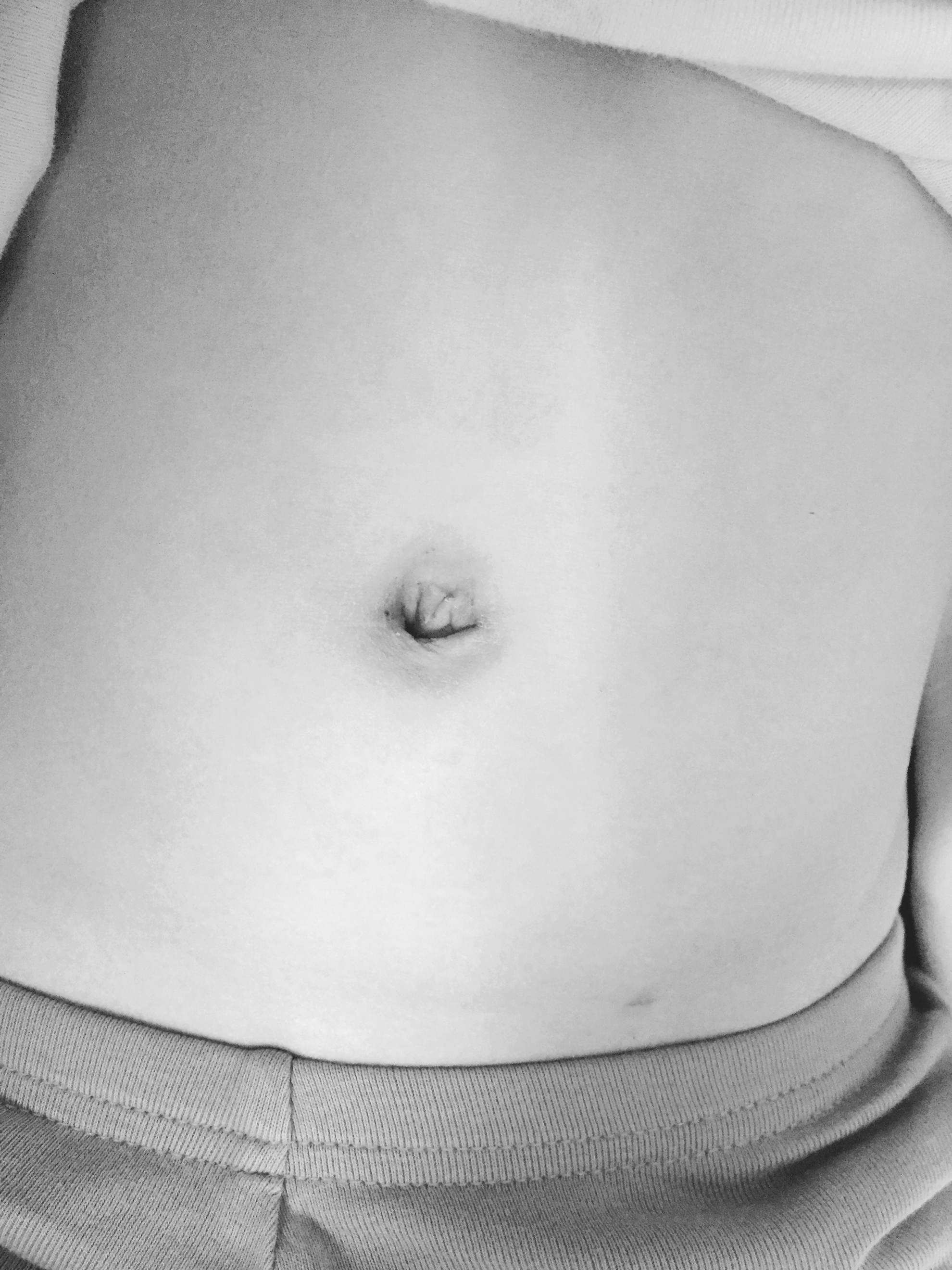
Postoperative picture at 2 weeks follow-up.
Discussion
Appendectomy for appendicitis remains one of the most commonly performed operations in children. With the advent and popularization of minimally invasive surgery, laparoscopic appendectomy has become widely accepted as the standard technique in the United States. Meta-analyses have demonstrated the advantages of laparoscopic over open appendectomy. 9 Although the three-port laparoscopic appendectomy is the most frequently employed, a number of alternative techniques have been developed to decrease the number and size of the trocars.
Disadvantages of single-site surgery include need for a large umbilical incision with increased pain and potential for incisional hernias as well as an inability to triangulate instruments making retraction and dissection difficult. 8 The port and instrument placement at the umbilicus leads to a parallel orientation, causing a restricted and narrow range of motion. Many series also use special ports and instruments for single-site appendectomies, increasing the cost and learning curve for the procedure. An adult meta-analysis of single-incision laparoscopic appendectomy versus conventional three-port laparoscopic appendectomy found significantly longer operative times and higher doses of analgesia required with single incision than with the three-port technique. 4 A randomized control trial in children also showed increased operative time with the single incision group. 10
There have also been studies in children of appendectomies using laparoscopic-assisted techniques with extracorporeal removal of the appendix through the umbilicus.1,3 However, there are concerns for increased incisional infections given that the appendix is brought through the umbilicus without a retrieval bag. 11 In addition, there are difficulties using this method in patients who are obese or have a retrocecal or very adherent appendix because of the inability to mobilize the appendix with one instrument. 12
This technique using an additional 3 mm suprapubic port allows for a smaller umbilical incision similar to that of a traditional three-port appendectomy using a 10 or 12 mm trocar at the umbilicus. The additional 3 mm suprapubic port allows for easier retraction while maintaining an essentially nonexistent scar. In addition, it is feasible in children with a higher body mass index as well as in cases in which the appendix is adhered to the abdominal wall, such as retrocecal or perforated appendixes. This technique allows the main scar to be hidden at the umbilicus, creating an essentially scarless cosmetic result while still allowing increased maneuverability of the instruments. Thus, a two-site appendectomy is a feasible method with a good cosmetic result and overcomes some of the limitations of parallel alignment of instruments often seen in traditional single-site surgery.
There are several limitations of this study. This is a retrospective study primarily determining the feasibility of the technique and reviewing the outcomes. As such, no postoperative cosmetic survey was obtained from patients to more objectively assess cosmetic outcomes. In addition, there was no comparison with a three-port appendectomy group in regard to patient and family perceptions of the scar's appearance.
Footnotes
Disclosure Statement
One of the coauthors is a founding member and consultant for JustRight Surgical, the company that makes the 5 mm stapler used in this study. The technique may be performed without the use of that stapler.