




Abstract
Abstract
Background:
Esophageal repair after caustic injury is a surgical challenge in children. The aim of this study was to report the first results of a total laparoscopic approach in transhiatal esophagectomy and esophageal replacement by an anisoperistaltic gastric tube.
Patients and Methods:
A retrospective review of data from children operated on with a laparoscopic approach for transhiatal esophagectomy and Gavriliu's esophagoplasty between 2011 and 2015 was performed. Surgical techniques were related with variations for 2 cases, 1 case with robotic assistance and 1 with thoracoscopic assistance.
Results:
Seven patients were operated on. The median weight was 16 kg. Median duration of mechanical ventilation was 2 days. Total esophagectomy was achieved in all cases. Two patients could eat after a barium swallow 7 days after surgery. The most frequent immediate complication (57%) was anastomotic or gastric tube leakage treated successfully in 100% of the cases with self-expanding metallic stent placement. Seventy-one percent of children presented with stenosis, which responded to pneumatic dilatation in 67% of the cases. Redo surgery was required in 43%, either for anastomosis revision or nonfunctioning gastric tube. With an average follow-up of 51 months, 85.7% of children achieved oral feeding.
Conclusions:
Total laparoscopic approach for esophagectomy and esophageal replacement by Gavriliu's anisoperistaltic gastric tube is a feasible technique allowing to shorten the postoperative mechanical ventilation duration and save parietal damage often present in these patients requiring multiple surgery. It appears to have a good long-term tolerance, although the immediate postoperative complication rate remains as high as the open technique.
Introduction
A
Esophageal replacement is a surgical challenge to reduce morbidity associated with caustic injuries. Many procedures of esophageal replacement exist, but no study has ever shown superiority of a technique over others. The choice of conduit and technical procedure depends on the surgeon's experience and preferences. The most frequently used conduit is the colon, but stomach and small bowel can also be used. 6 Gavriliu described in 1975 a procedure during which he created an anisoperistaltic gastric tube. 7 The advantages of a gastric tube compared with a colonic conduit are resistance to ulceration from gastric acid reflux, a reliable blood supply, and a lower risk of developing tortuosity. 6
However, thoracotomy, which used to be required for such surgery, is associated with high postoperative morbidity.
In 1978, Orringer described blind esophagectomy without thoracotomy in adults. This blind digital dissection can lead to potentially serious life-threatening injuries due to adhesions of the esophagus to major vascular structures and bronchi. 8
A laparoscopic approach for transhiatal esophagectomy has been developed in children since 2007, 9 facilitating dissection and reducing the risk of vascular injuries. However, in that series, a colonic conduit was used in 85% of the cases.
The aim of this study was to evaluate the feasibility and report our first results of a total laparoscopic approach for transhiatal esophagectomy and Gavriliu's esophagoplasty in children with caustic esophageal injuries.
Patients and Methods
Patients and preoperative workup
A retrospective monocentric study was conducted from June 2011 to February 2015 in Robert Debré Childrens University Hospital, Paris, France, on children with severe esophageal caustic injuries managed surgically by a total laparoscopic approach for transhiatal esophagectomy and Gavriliu's esophagoplasty. Indication for surgery was long esophageal strictures (Fig. 1), which failed to respond to a dilatation program.

Upper gastrointestinal tract study before surgery (left: front view; right: profile view).
Patients' characteristics were reviewed, including sex, age at the time of the caustic injury, age and weight at the surgery, time between the caustic ingestion and surgery, the number of dilatations before surgery, and the presence of a gastrostomy at the time of the surgery.
Preoperative workup included a barium swallow (Fig. 1), gastric contrast study through gastrostomy, esophageal endoscopy, and gastric endoscopy. This allowed us to assess the length and upper level of the stenosis, gastric volume, and placement of gastrostomy. The childrens' respiratory condition was evaluated clinically and by a chest X-ray.
Surgical technique
Position of the patient
The children were operated on under general anesthesia in a French position, with the surgeon standing between the child's legs (Fig. 2). The video monitor was placed on the patient's left side.
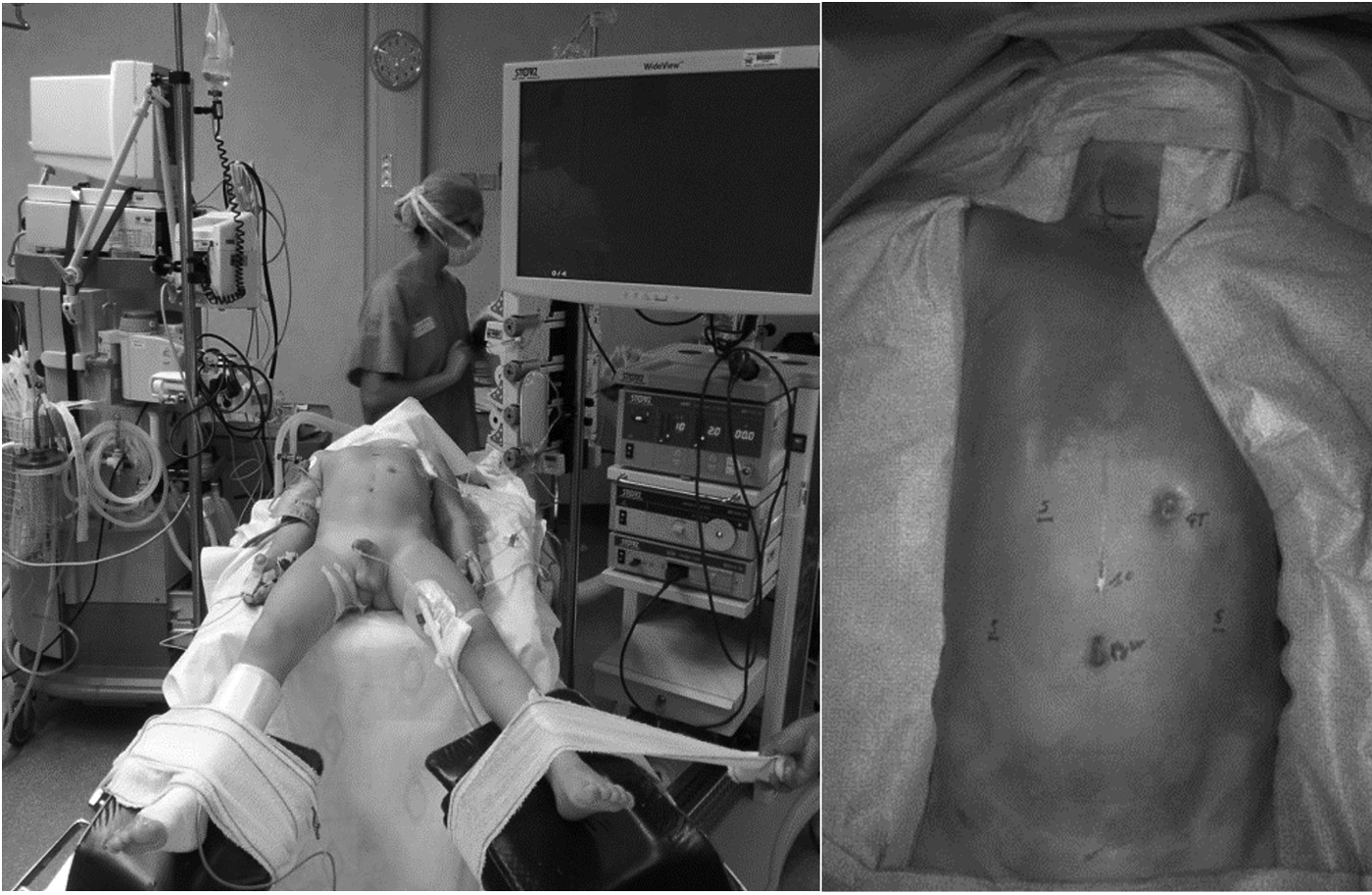
Patient's installation and trocar placement during the laparoscopic procedure.
Port location
Five ports were used (Fig. 2):
– one transumbilical 12-mm port for the Endo GIA Ultra Universal stapler (Tri-staple 3.0, Covidien/Medtronic, Minneapolis), – one 10-mm port placed on the midline a few centimeters above the umbilicus for the 10-mm 30° laparoscope, – one 5-mm port in the right upper quadrant to retract the liver, and – two 5-mm operative ports on the right and left flanks for instruments.
Pneumoperitoneum was created with a maximal pressure of 12 cm H2O.
Gastrostomy takedown
All gastrostomies were taken down and closed by interrupted intracorporeal knots.
Hiatal exposure
The liver was retracted upward. After exposing the right crus, the pars condensa was opened, followed by dissection of the peritoneum in front of the esophagus. The HARMONIC® ultrasonic device (Ethicon Endo-Surgery, Cincinnati) was used for dissection. The esophageal hiatus was then enlarged anteriorly to ensure perfect vision for esophageal dissection.
Gastric tube creation
The lesser sac was entered after opening the gastrosplenic omentum. Blood supply from the gastroepiploic vessels was preserved carefully.
The length of the gastric tube was estimated extracorporeally using a tissue strip, which was then reported as the greater curve of the stomach. Short gastric vessels were divided to free the greater curve. The stomach was entered and a rectal tube was inserted (24–26F; Bard Medical, New Jersey). The gastric tube was fashioned around it with repeated Endo GIA stapler application in a distal to proximal direction.
Transhiatal esophagectomy
Transhiatal dissection was performed as far as possible in the mediastinum under vision control using a harmonic scalpel device, monopolar coagulation, and Endo Peanut™ 5-mm device (Covidien/Medtronic). The 30° laparoscope allows vision of all sides of the esophagus. Endo GIA stapler (Ethicon, Cincinnati) was then used to disconnect the dissected esophagus from the stomach.
Right cervical approach
A right cervical incision was performed, allowing access to the proximal native esophagus. Dissection of the esophagus was completed digitally if necessary to the most upper point of the transhiatal dissection. The native esophagus was then sutured distally to the gastric tube and pulled out by cervicotomy incision, under laparoscopic control, to guide the gastric tube through the mediastinum at the same time and avoid twist or traction of the tube. Cervical gastroesophageal anastomosis was done with interrupted absorbable sutures.
Nota Bene: For 1 patient for whom esophagus replacement was done for half of the caustic esophagus, anastomosis was done by thoracoscopy.
Hiatus closure
Diaphragmatic hiatus was closed and the tube sutured to the hiatus to avoid hiatal hernia of the remaining stomach. A drain was inserted near the cervical anastomosis for a few days to control possible anastomotic complications.
Port placement for the case with da Vinci robotic assistance
– The optical port was transumbilical
– 2 other robotic ports were placed on both sides of the umbilicus
– a 5-mm port was used in the right upper quadrant for liver retraction
– a 12-mm port was placed on the midline just below the umbilicus to introduce the Endo GIA stapler.
Results
Population
Seven patients were operated on, whose characteristics are reported in Table 1. There were 6 boys and 1 girl. Median age at the time of surgery was 36 months [30; 81], and the median weight was 16 kg [13; 23.3]. Seventy-one percent of the children had a gastrostomy in place before surgery. Thus, all of them presented a satisfying nutritional state. Moreover, the pulmonary function was not impaired.
DRESS, Drug Reaction with Eosinophilia and Systemic Symptoms.
Surgery
The procedure was attempted in all cases at least 7 months after caustic ingestion. Six patients were operated on by the same surgeon, with a total laparoscopic approach for transhiatal dissection and Gavriliu's esophagoplasty. One patient was operated on with da Vinci robotic assistance. The gastroesophageal anastomosis was performed in 6 cases by cervicotomy and in 1 case by thoracoscopy. None of the procedures needed to be converted to an open approach, and there were neither intraoperative complications nor increased blood loss. Median duration of mechanical ventilation after surgery was 2 days [1; 5]. Average operative time for complete surgery was 350 minutes [248–407].
Postoperative course
A barium swallow was performed for all patients at postoperative day 7.
There were no complications due to transhiatal dissection under laparoscopic control.
Postoperative course was uneventful for 2 patients. After an upper gastrointestinal study, enteral feeding was resumed 7 days after surgery. These patients were discharged home 15 days after surgery.
Four patients presented leakages (57%), 2 anastomotic and 2 on the stapler line. They all required an endoscopic endoprosthesis (Self-Expanding Metallic Stent, Cook Medical, Bloomington) placement. Stent placement was controlled every day by a chest X-ray to diagnose any dislodgment. Endoscopy was performed in all cases 15 days after placement to make sure that the healing process was on the good way and that the prosthesis was not incarcerated. Duration of the stent was based on the adult experience, and the length of stay was based principally on the larger of the defects to cover. Complete healing was obtained after 14 to 50 days. Stenosis then developed in all cases, which responded well to pneumatic dilatations, apart from the 2 patients with initial anastomotic leakage, who underwent anastomotic revision after three dilatations (28.5% of redo surgery).
One other child (14%) presented anastomotic stenosis without leakage, which also responded well to dilatation.
The overall rate of stenosis is 71% (5/7), which responded well to dilatations in 3 of the cases.
There were 2 cases of mediastinum abscess, which required external drainage by a percutaneous approach.
One child presented bilateral recurrent laryngeal nerve palsy. This patient recovered without requiring tracheotomy.
Three patients (43%) underwent a redo surgery either for anastomotic revision (2 patients) or for hiatal orifice revision associated with redundant hiatal hernia and finally a gastric tube disconnection without cervical esophagostomy for severe pulmonary disease related to a nonfunctioning tube and repeat aspirations (1 patient).
Median follow-up is 51 months [35; 68]. Five children (71%) have achieved full oral feeding, without any reflux symptom. One is receiving enteral feeding on a gastrostomy associated with oral feed. One developed oral aversion and is still on full enteral feeding.
Discussion
We report the first case series of total laparoscopic approach for transhiatal esophagectomy and esophagoplasty by anisoperistaltic gastric tube.
Overall complication rate is high, in part, related to the learning curve of the laparoscopic approach in this procedure and, in part, related to the technically demanding procedure of gastric tube confection. After an average follow-up of 51 months, 6 patients (86%) have good results on oral feeding, 5 are weaned of enteral nutrition.
Esophageal replacement is a surgical challenge. Caustic injury is the most frequent cause of esophageal replacement, but the indication remains rare, so larger series are difficult to obtain. Many case reports have been published, but it is difficult to compare the studies. Indeed, there is no consensus, and the chosen surgical technique depends on local experience for esophageal replacement. Therefore, the procedure varies from one department to another and even from one surgeon to another.
For 20 years, the laparoscopic approach for esophageal surgery has been used routinely in adult's surgery. Recently, this application in children has been developed in departments of pediatric surgery and can be used for a safer transhiatal esophagectomy.9,10 The published results are very encouraging, but need long-term evaluation and larger groups of patients to estimate the benefits in this population.
The experience with gastric grafts is much smaller than with colonic interposition. Two techniques using the greater curve of the stomach have been described: an isoperistaltic tube11,12 and an anisoperistaltic tube built with a stapler. Using a gastric tube has some advantages compared with colonic grafts, such as resistance to ulceration from acid gastric reflux, a reliable blood supply, and a lower risk of developing tortuosity. 6 In Anderson's series published in 1992, no differences were noted between the gastric tube technique and the colonic interposition for esophageal replacement in children presenting long-gap atresia. 13 The two techniques have not been compared for children with severe caustic injuries.
The laparoscopic approach for these patients is an important challenge. Mini-invasive surgery could decrease immediate postoperative morbidity and shorten the hospitalization stay in the future with development of those techniques. The median time on mechanical ventilation was quiet short (2 days), which can be prolonged with an open approach. This is a real benefit for these patients who can have a pulmonary status impaired related to multiple aspirations due to caustic esophageal stenosis. Many studies report techniques that associate laparoscopy and thoracoscopy with control of different stages of the surgical procedure.14,15 Our experience shows that vision control allows a safer and higher transhiatal esophageal dissection. The gastric tube could then be easily fashioned with the Endo GIA stapler and then guided through the mediastinum under laparoscopic control to prevent a twist.
Robotic assistance during one procedure allowed us to benefit from instruments with 7 degrees of motion and vision, which seems very attractive. The downside is in the lack of strength feedback, which could be dangerous on delicate steps where vascularization or delicate tissues must be carefully manipulated. Instruments are also too large for operating on small children as our study has an average weight of 16 kg.
Esophageal surgery should be done by a well-trained anesthesiology and surgical team. In literature, esophagoplasty with reversed gastric tubes by laparotomy were followed by 82% anastomotic leakage and 72% stricture. 16 These results are in accordance with our results, showing that the mini-invasive approach is not inducing an over-rate of complication.
In this series, leakage occurred in half of the cases on the stapler line (both children had a gastrostomy in place before the surgery), which may be explained by insufficient blood supply, especially if the gastrostomy had been placed too close to the great curvature. On the other hand, anastomotic leaks could be explained by insufficient venous drainage. 17
In literature, long-term follow-up shows 88% of asymptomatic children, the rest having slight swallowing problems with lumpy food. 18 In our series, 86% of the children have achieved correct oral feeding with pieces with a median follow-up of 24 months.
Blind dissection of the damaged esophagus can result in vascular wounds or failure of total esophagectomy. 9 In our series, there were no vascular wounds and total esophagectomy was achieved in 100% of the cases (excluding the case where only half of the esophagus was injured and replaced).
Endoprosthesis was systematically used when there was anastomotic or tube leakage, with good tolerance and satisfying healing results. 19 In our series, 4 patients required an endoprosthesis; for one of them, the endoprosthesis was kept in place for several weeks with regular endoscopic monitoring.
Management of those patients must include a multidisciplinary approach with a trained surgeon, intensive care unit, and gastroenterologists to achieve satisfying oral feeding as quickly as possible. The total laparoscopic approach for esophageal replacement in children is feasible and safe, but requires a learning curve to achieve high performance in routine. Long-term results and comparative studies are necessary to evaluate techniques and their advantages for surgeons and patients.
Conclusions
The total laparoscopic approach for transhiatal esophagectomy and Gavriliu's gastric tube esophageal replacement in children with caustic injuries is feasible and allows safe vision-controlled total esophagectomy. Gastric graft seems a good option as a means of function of the neoesophagus. Anastomotic and tube leakage remain the most frequent complications, but can be treated effectively with an endoprosthesis. A multidisciplinary approach of these patients is required. The mini-invasive approach on these patients at risk for multiple surgeries is, to our point of view, the best approach allowing to reduce parietal damage, which can impair the pulmonary status during the immediate postoperative course.
Footnotes
Disclosure Statement
No competing financial interests exist.