




Abstract
Abstract
Aim:
Over-the-scope-clip (OTSC) System is a relatively new endoluminal intervention for gastrointestinal (GI) leaks, fistulas, and bleeding. Here, we present a single center experience with the device over the course of 4 years.
Methods:
Retrospective chart review was conducted for patients who received endoscopic OTSC treatment. Primary outcome is the resolution of the original indication for clip placement. Secondary outcomes are complications and time to resolution.
Results:
Forty-one patients underwent treatment with the OTSC system from 2011 to 2015 with average follow-up of 152 days. The average age is 53.7. The most common site of clip placement was in the stomach (44%). Clips were placed after surgical complication for 28 patients (68%), endoscopic complications for 8 patients (19%), and spontaneous presentation in 5 patients (12%). Technical success was achieved in all patients. Overall, 34 patients (83%) were successfully treated. Nine patients required multiple clips and three patients required additional treatment modalities after OTSC. Four patients used the OTSC as a bridging therapy to surgery. Using OTSC for palliation versus nonpalliative indications was associated with lower rates of treatment success (50% versus 86%, P = .028). Using OTSC for symptoms <6 months had higher rates of treatment success than those experiencing longer symptoms (88% versus 65%, P = .045). There were no major morbidities or mortalities directly associated with the OTSC system. Complications from clip use were pain in two patients (5%) and hematemesis in one patient (3%).
Conclusions:
The OTSC System can be a very successful treatment for iatrogenic or spontaneous GI leaks and bleeds. Treatment success is more likely in patients treated within 6 months of diagnosis and less likely to when used for palliation. It was also successfully used as bridging therapy in several patients.
Introduction
P
Endoscopic intervention is still a relatively new treatment category that is growing in popularity due to its ability to directly intervene in a noninvasive manner. Traditionally, endoscopic clips are applied through the working channel of the endoscope. Due to the small caliber of the working channel, the clips used in this capacity are quite limited. In recent times, there has been a movement toward attaching devices over the endoscope to expand the capacity of endoscopic treatments.
Since it was first described in humans in 2007 for the treatment of lesions and bleeding in the GI tract, over-the-scope-clipping (OTSC) system (Fig. 1) has gained popularity as another interventional tool for endoscopists. 3 OTSC is a relatively new device from a company in Tübingen, Germany from within the last decade. The clips used in this system allow for approximation of tissue defects as large as 2 cm in diameter and greater compression of force when compared with traditional endoscopic clips.4–6 The utilities of this device have been applied to GI bleeding, spontaneous GI perforation, perforation prophylaxis, anastomotic or staple line leaks, and chronic fistulas.
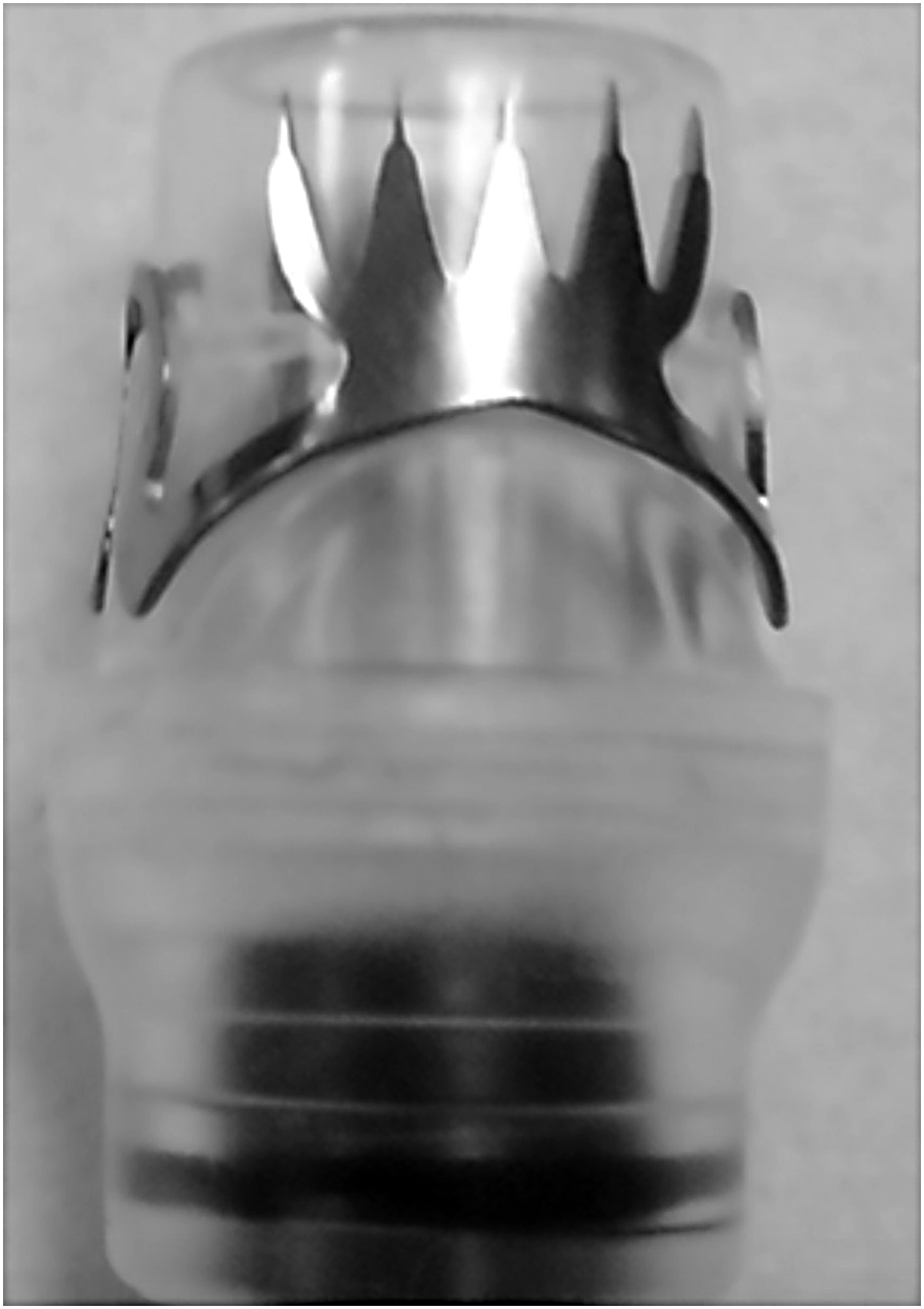
The plastic applicator placed over the tip of the endoscope with over-the-scope-clip in ready position. The applicator thread is located in the tip itself going through the working channel to the handle of the endoscope where the clinician can release the clips when ready.
In our institution, we have incorporated the OTSC system into our clinical practice over the last 5 years as a tool for gastroenterologists and surgeons alike. Here we describe our experience in clip application and outcome data for patients treated with the OTSC system for GI leaks, fistulas, perforations, and bleeding.
Methods
After approval from the Institutional Review Board, a retrospective analysis of prospectively collected data was performed with patients who were treated using the OTSC system from 2011 to 2015. All leaks, perforations, fistulas, and bleeding were identified by contrast studies, computed tomography (CT) scans, or direct visualization by endoscopy. All OTSC treatments were performed by minimally invasive surgeons or advanced endoscopic gastroenterologists.
Informed consent was obtained before each procedure and patients were treated under general anesthesia. A standard endoscopy was performed to confirm each case before application of the OTSC system. The OTSC system consists of an applicator cap that is applied over the standard endoscope (Fig. 1). This cap houses the clip in a preloaded position and an endoscopic grasper is used to bring the release thread through the working channel back to the endoscope handle. Suction and endoscopic graspers are used to bring the tissue into the applicator cap and the release thread is used to deploy the clip in a method analogous to over the scope rubber band ligation.
The measured primary outcomes were resolution of the leak, perforation, fistula, or bleeding as determined by swallow study, CT scan, or follow-up clinical exam without recurrence at the site of OTSC placement. In the event that the patient's follow-up was at another institution, the patient was contacted via telephone. If patients became deceased from medical reasons before resolution of symptoms, they were considered a treatment failure.
Secondary outcomes measured were time to resolution and any reported complications. Additional evaluated factors included the location of OTSC placement in the GI tract, the preceding event leading to the treatment with OTSC system, and the timeline of symptom presentation.
All statistical analyses were carried out using SPSS Statistics™ (IBM; build version 23.0). Binary logistic regression, chi squared, and Fisher's exact test (when N per cell is <5) were used.
Results
Patient cohort
A total of 41 patients underwent treatment with the OTSC system from 2011 to 2015. The study population was predominantly male (61%) with an average age of 53.7 years (Table 1). Average follow-up was 152 days. At the time of OTSC intervention, the average albumin was 3.3 (±0.85). Seventeen patients (41%) presented with <6 months of symptoms warranting clip placement and 20 patients (49%) presented with more than 6 months of symptoms. Four patients (10%) presented with acute uncontrolled bleeding.
BMI, body mass index; GI, gastrointestinal.
Summary of each of the patient cases can be seen in Table 2. Overall, there were 7 cases of leak after laparoscopic sleeve gastrectomy (LSG), 2 cases of leak after partial gastrectomy, 3 cases of leak after laparoscopic gastric bypass (LGB), 5 cases of esophageal perforation either spontaneous or iatrogenic, 11 cases of leak after either low anterior resection or other colonic resection, 4 cases of GI bleeding, and 9 cases of iatrogenic gastric perforation after procedure.
CABG, coronary artery bypass graft; GI, gastrointestinal; IR, interventional radiology; LAR, low anterior resection; LGB, laparoscopic gastric bypass; LSG, laparoscopic sleeve gastrectomy; NG, naso gastric; OTSC, over-the-scope-clip; PEGR, percutaneous endoscopic gastrostomy tube removal; TPN, total parental nutrition.
Fifteen patients received OTSC as their first-line treatment within 1 week of onset of symptoms. Twenty-six patients had failed at least one other treatment modality before attempting OTSC. These modalities included eight failed interventional radiology (IR) drainage, five failed endoscopic stenting, two failed hemoclip placements, and four failed exploratory re-operation.
Treatment outcomes
In all patients, technical success was achieved immediately following the endoscopic intervention. Treatment success was measured by ultimate resolution of symptoms and was seen in 34 patients (83%) (Table 3). Twenty-five (61%) patients were successfully treated after a single treatment with OTSC system. Three patients required an additional form of endoscopic treatment modality after in the form of endoscopic stitching (one patient) and endoscopic stenting (two patients). The OTSC device was used as a bridge to definitive surgery in four patients (10%).
Treatment success directly attributed to OTSC placement is broken down by pretreatment diagnosis in Table 4. OTSC was most successful (100% success) in treating leaks after iatrogenic gastric perforation, leaks after gastrectomy, and uncontrolled GI bleeding. OTSC was moderately successful (<50% success) in treating leaks after LSG, leaks after LGB, and traumatic/iatrogenic esophageal perforations. OTSC was least successful (<50% success) in treating leaks after colonic resections or surgeries. OTSC demonstrated higher rates of success when used as a first-line treatment in nearly all diagnosis except for leaks after LSG (Table 4), however, these results were not statistically significant.
GI, gastrointestinal; LGB, laparoscopic gastric bypass; LSG, laparoscopic sleeve gastrectomy; NA, not applicable.
The success of OTSC divided by anatomic position and precipitating event is seen in Table 5. The OTSC was most commonly placed in the stomach and was most commonly placed for complications of GI surgery. Univariate analysis is seen in Table 6. Clip location was not a significant predictor of treatment success (P = .193). Using OTSC in cases of palliation were associated with poorer chances of treatment success (2 of 4 versus 32 of 37, P = .028). OTSC was more successful in treating patients with <6 months of symptoms compared with those who were treated after 6 months (15 of 17 versus 13 of 20, P = .045).
Four patients in whom clip was placed for palliation due to metastatic malignancy in this group.
Statistically significant (P < .05).
BMI, body mass index; NA, not applicable.
There were no major morbidities or mortalities to report that can be directly associated with the OTSC system. Complications from clip use included pain in two patients (5%) requiring escalation of their pain medications and hematemesis in one patient (3%). All four patients who had OTSC placement for palliation related to metastatic disease expired and their deaths were not attributed to the OTSC placement as death was the expected outcome.
Discussion
In our experience, the OTSC system is a safe and effective method for treating GI leaks and bleeds. We have experienced overall treatment success of 83% for patients who used OTSC either as primary or adjunct therapy with an average follow-up time of 6 months. In 61% of patients, the OTSC system achieved treatment success without any additional procedures. These results are similar to those achieved in other small series publications with overall short-term success rates of 53%–92% reported in the literature.7–9 To our knowledge, this is one of the largest single institution series using OTSC with an average median follow-up greater than 6 months and our results suggest high rates of treatment success with OTSC with extended follow-up.
OTSC had the highest success when treating leaks in the esophagus and stomach, and the lowest success rate when treating leaks in the colon. However, univariate analysis did not demonstrate location as a predictor of success likely due to size of the cohort. There were no statistically significant differences between whether OTSC was used as first-line or second-line therapy.
Despite this, OTSC offers a safe alternative treatment in patients who have failed other treatment modalities. Sixty-three percent of our patients failed either a trial of medical therapy or another procedure (endoscopic stenting, IR drainage, or surgery) before being treated by OTSC. The reason why our cohort mainly received OTSC as the second-line therapy is two-fold. First, our medical center is a tertiary referral center and is often referred tough cases from other institutions without the capability of performing OTSC. Second, OTSC is not yet considered a standard-of-care first-line treatment at our institution, thus leading to variable referral timelines to our service. For example, patients have often been placed on total parental nutrition and Nil Per Os as an initial conservative management effort before being referred to our practice. For these patients, OTSC becomes a safe alternative procedure when their current therapy is unsuccessful.
OTSC may also play an important role in bridging therapy. In the case that OTSC is unable to obtain primary treatment success, it allows temporization of symptoms until factors, such as nutritional status, is more favorable for definitive surgery. All four of our patients who used OTSC as bridging therapy to definitive surgery were successfully treated without any reported negative impact. Partial closure rates up to 42.9% with OTSC have been reported in the literature, it is possible that the utility of OTSC as bridging therapy is related to its ability to temporarily close a fistula or obtain partial closure after its application. 8 However, it should be recognized that there were no strict criteria for when OTSC should be used as a bridging therapy at our institution. As a result, each patient was evaluated on a case-by-case basis.
Due to the retrospective nature of this study, a previously agreed protocol for when OTSC was to be used was not provided. This limitation introduces selection bias and variations in clinical practice, as we were unable to accurately standardize the reasoning of the clinician who decided to use OTSC at the time of patient presentation. The utilization of OTSC in the treatment algorithm for GI leaks and bleeds is an area of active debate and should be investigated further in future studies.
Despite these shortcomings, the OTSC is a versatile tool with a diverse range of indications. All patients who had upper GI bleeding and failed medical management were successfully treated. Other investigators experienced high success rates in noncirrhotic hemodynamically stable patients as well.10–12 Similarly, 80% of our patients with staple line leak after sleeve gastrectomy were successfully treated, on par with the suggested high success rate in literature.6,13 In our anecdotal experience, we had success treating both acute and chronic perforation of the esophagus and stomach with OTSC. Clips in the colon were only placed for postoperative leaks or malignant fistulas above the level of the anus. Prior studies were also unable to demonstrate OTSC as a favorable treatment for fistulas at the level of the anus.14,15 However, when malignant fistulas were excluded from the analysis, all postoperative leaks of the large bowel above the level of the anus were successfully managed in our study.
Treatment failure was higher when the OTSC was used for palliation in patients with malignant fistulae. However, primary treatment success may be unrealistic in these patients and the goal of palliation may still be an indication for the OTSC system. Conversely, we experienced higher success rates when OTSC was used to treat patients with <6 months of symptoms. Similar trends have been suggested by previous studies suggesting highest rates of treatment success in those with acute perforation, followed by post-op leaks, and well-developed fistulas respectively.4,16 Lower rates of treatment success with well-developed fistulas may be due to underlying pathophysiology that is beyond treatment with tissue approximation in patients with chronic fistula.
There are several considerations for the side effects of the OTSC system. In our experience, complications included low rates of pain and stricture. These complications may be due to a larger amount of tissue grasped with OTSC for approximation when compared with traditional endoscopic clips. These complications were managed with endoscopic dilation in our study. Other methods such as endoscopic removal of OTSC through cooling or bipolar division have also been described successfully in the literature.7,17,18
In conclusion, our study suggests the utility and success of the OTSC for the treatment of GI leaks and bleeds. Successful treatment is significantly higher in patients with acute to subacute presentation (<6 months of symptoms) and should be considered in this time frame if appropriately trained endoscopists are available. It should be also considered as a bridging therapy to temporarily control GI leaks until patients can be optimized for definitive surgery. Finally, though it can be used for palliative cases, the chances of resolution of symptoms are unlikely. Although it appears there may be a higher success rate when treating perforations of the esophagus and stomach, we were unable to find statistically significant differences. Future studies with greater power to risk stratify patients would be important.
Footnotes
Disclosure Statement
No competing financial interests exist.