




Abstract
Abstract
Background:
Minimally invasive and remote access thyroid surgery has been evolving with the transoral endoscopic thyroidectomy vestibular approach (TOETVA) emerging as a true “scarless” thyroidectomy. In this study, we describe a hybrid transoral and submental thyroidectomy (TOaST) technique for thyroid lobectomy.
Materials and Methods:
A TOaST right thyroid lobectomy was performed for a 4 cm cytologically benign right thyroid nodule. Initial incision was made in the submental region with two additional 5 mm lateral ports inserted transorally. Right thyroid lobectomy proceeded via standard TOETVA with intact specimen extraction via the submental incision.
Results:
The patient was discharged home on postoperative day 1. Final pathology showed a 4.2 cm follicular adenoma. Cosmetic results and patient satisfaction were excellent.
Discussion:
This is the first reported case of a hybrid TOaST technique. It aims to maintain the principles and advantages of TOETVA while addressing its limitations related to large tumor extraction, mental nerve injury, and chin sensory changes. The shorter distance of dissection required may reduce postoperative pain. This approach may expand the indications for transoral thyroidectomy while maintaining excellent cosmetic outcomes.
Introduction
M
In this study, we describe a novel hybrid procedure, the transoral and submental thyroidectomy (TOaST) technique, to perform an endoscopic right thyroid lobectomy. The patient is a healthy 33-year-old woman who presented with an enlarging, cytologically benign 4 cm right thyroid nodule. She was interested in a scarless technique but had concerns regarding possible capsular disruption of the thyroid nodule, with associated pathological uncertainty, as well as the possibility of extended chin numbness and pain from a larger midline oral incision. This hybrid technique was developed to address both concerns.
Materials and Methods
Surgical technique
The patient was placed in the supine position with neck extended under general anesthesia (Fig. 1). A size 6.0 endotracheal tube was utilized with Nerve Integrity Monitor (NIM, Medtronic, Minneapolis, MN) electrodes. Cefazolin 2000 mg and metronidazole 500 mg were administered 30 minutes before incision. A 1 cm incision was made under the chin, 5 mm posterior to the natural submental crease, and carried down to the underlying platysma muscle. The platysma was divided using electrocautery under direct vision to gain access to the subplatysmal plane. A Veress needle was introduced into this plane and hydrodissection was performed using ∼30 mL of 1% epinephrine in normal saline. The subplatysmal plane was then developed further utilizing a curved Mayo clamp and a blunt Anuwong dilating dissector.
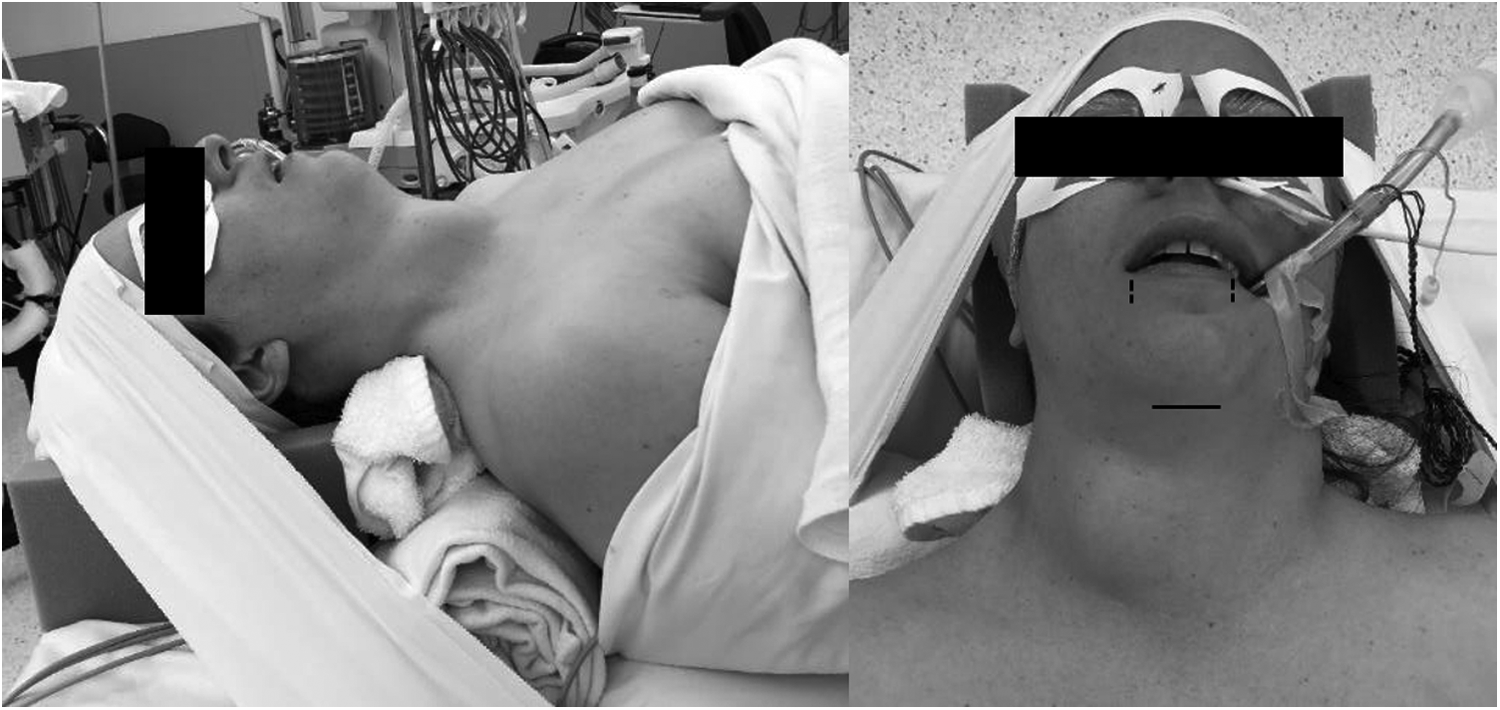
Patient positioning. Note large visible right thyroid nodule. Dashed lines indicate approximate location of intraoral incision. Solid line marks submental incision.
An 11 mm Versaport trocar was inserted in our submental incision and insufflation with CO2 was established at 6 mmHg. Two 5 mm lateral incisions were then made intraorally just inferior to the lower lip, taking care to avoid the mental nerves bilaterally. A plane was developed with hydrodissection to meet the predeveloped subplatysmal space below. Two 5 mm lateral trocars were then inserted. A standard 10 mm 30° laparoscope was utilized, and the working space was finalized to reach the sternal notch inferiorly and the sternocleidomastoid muscle laterally (Fig. 2a).

Intraoperative endoscopic view
The remainder of the case proceeded similar to the standard TOETVA, as described by Anuwong et al. 2 The strap muscles were separated in the midline and retracted laterally on the right with a transcutaneous 2-0 silk suture. The thyroid isthmus was identified and divided using ultrasonic shears (Harmonic Scalpel). The enlarged right lobe of the thyroid was steadily rotated medially. The enlarged upper pole vessels were identified and divided with the Harmonic Scalpel, staying close to the surface of the thyroid so as to avoid injury to the external branch of the superior laryngeal nerve and the upper parathyroid gland. The recurrent laryngeal nerve was identified behind the tubercle of Zuckerkandl both visually and with the nerve stimulating probe to confirm function (Fig. 2b). The thyroid tissue was then divided at the ligament of Berry, making sure to sweep the recurrent laryngeal nerve posteriorly and preserving the lower parathyroid gland.
The thyroid lobe was then separated from the trachea and inserted into a 10 mm Endocatch bag that was introduced through the 11 mm trocar. The specimen was then removed intact through the submental site without any incision extension. The operative bed was then reexamined for hemostasis and the strap muscles were reapproximated. The submental incision was closed with interrupted 3-0 Vicryl stitches for the platysma and a running 4-0 Monocryl subcuticular stitch. The oral incisions were closed with a single figure of eight 4-0 chromic stitch. A pressure dressing was then placed around the chin and the patient was extubated and transported to the recovery unit. Total operative time was 240 minutes, and blood loss was 10 mL.
Results
The patient was commenced on a liquid diet on the day of surgery and progressed to a soft diet for the following 3 days. Three days of amoxicillin–clavulanate 875–125 mg was prescribed and the patient was discharged home on postoperative day 1. The patient was seen in postoperative follow-up at 2 weeks and 1 month without any evidence of hypoparathyroidism or recurrently laryngeal nerve injury. Final pathology showed a 4.2 cm follicular adenoma with chronic lymphocytic thyroiditis with no evidence of malignancy. Cosmetic results were excellent (Fig. 3).
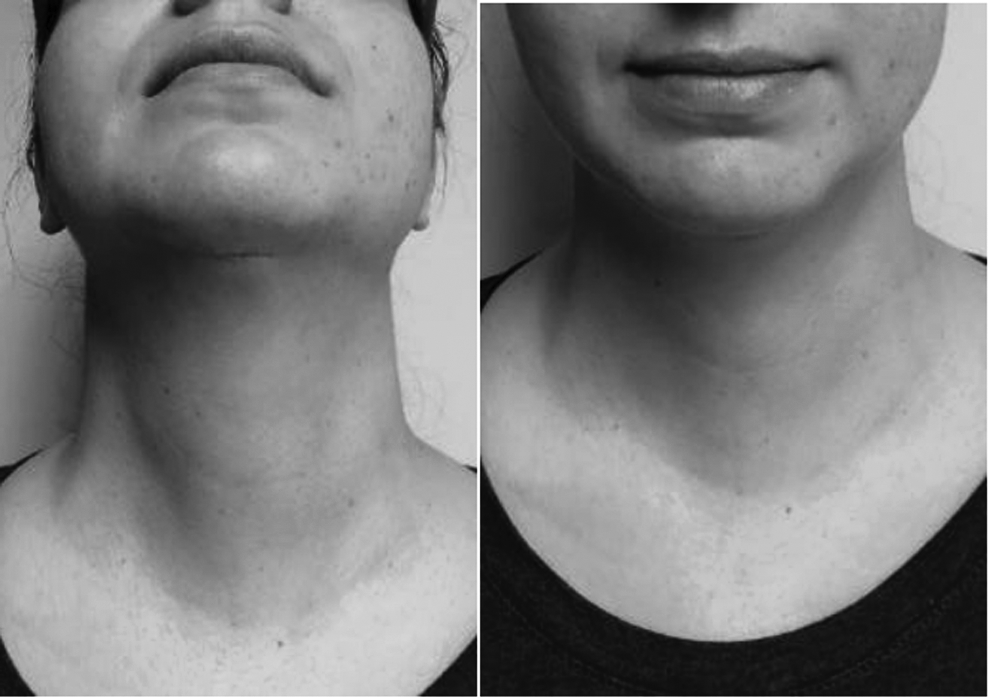
Postoperative follow-up after 1 month.
Discussion
Despite the promise of TOETVA, the technique has several limitations. Large tumors >4 cm often require disruption of the capsule to aid its extraction through the 10 mm central intraoral incision, and in patients with thyroid cancer, the proposed upper limit of nodule size is 2 cm2. The need for capsular disruption can be a particular issue for follicular lesions, in which a complete tumor capsule is required to be assessed for evidence of invasion to diagnose malignancy. A submental route for tumor extraction should theoretically allow larger nodules to be extracted intact due to a shorter tissue flap and avoidance of the fixed and inflexible chin. The submental incision is also easier to extend laterally without concern for mental nerve injury.
Transoral thyroidectomy has also been reported to have reduced postoperative pain, especially when compared to more remote-access techniques that require additional tissue dissection and retraction. 3 In our experience, given the size and extent of dissection required for the midline camera port, as well as the leverage of instruments on the mandibular prominence, many patients report residual numbness, tightness, and/or pain specifically at the midline of the lower lip and chin. Although these bothersome symptoms tend to improve over an extended period of time, this difference is notable when compared with the well-tolerated standard open thyroidectomy. This may be more pronounced in western patients who have more prominent chin projection. 4 By shortening the flap dissection required, postoperative pain may potentially be further reduced.
One of the newer complications resulting from transoral thyroidectomy is the incidence of mental nerve injury. Early experiences with transoral thyroidectomy resulted in high rates of mental nerve injury with prolonged sensory loss to the chin area. 5 TOETVA aims to minimize injury to the main mental nerve by reducing the size of the midline intraoral incision, utilizing cautious dissection of the premandibular subcutaneous tunnel and placing the 5 mm lateral incisions closer to the free edge of the lower lip and as lateral as possible, close to the canines. 2 By keeping only the lateral 5 mm incisions and having the main access port in the submental area in our TOaST technique, this virtually eliminates the need for premandibular dissection and subsequent injury to midline branches of the mental nerve and any postoperative sensory loss to the anterior chin.
A pure submental endoscopic thyroid procedure has been previously described. 6 The authors utilized two adjacent “mini-incisions” in the submental region to insert a 10 mm trocar and a 5 mm trocar for a working port. Percutaneous thin retractors were then used through separate cutaneous stab incisions over the operative bed. The outcome of this port placement functionally is that of a single-port approach that does not allow adequate triangulation of the laparoscopic equipment, preventing optimal laparoscopic vision and ergonomics. The small working space also limits the utility of articulating instruments or robotics. The hybrid TOaST technique we describe maintains the triangulation critical to endoscopic surgery and allows for a smaller submental incision.
Other remote-access thyroid operations that have been performed utilize an incision in a cosmetically hidden region, including retroauricular, breast, and axillary approaches. However, these approaches do not allow access to the contralateral thyroid lobe or nodal basin, unlike the transoral approach that affords this without making a separate incision and subcutaneous dissection. The submental incision has been well described in the plastic surgery literature and is commonly used for neck lift procedures such as the corset platysmaplasty with excellent cosmetic results. 7
This is the first published hybrid approach of TOaST. We believe that it will expand the indications for endoscopic thyroid surgery by allowing for larger specimen extraction while avoiding central chin pain and sensory loss. This novel technique maintains the advantages of TOETVA by allowing visualization of bilateral thyroid lobes, triangulation of laparoscopic equipment and minimizing flap dissection, while leaving a hidden and cosmetically favorable incision.
Footnotes
Disclosure Statement
No competing financial interests exist.