




Abstract
Abstract
Purpose:
Adnexal torsion constitutes 2.7% of gynecological emergencies, it is more frequently seen in reproductive age. Delay in diagnosis and treatment may lead to loss of the ovary. In this study, we aimed to assess patients who had adnexal torsion and compare laparoscopy with laparotomy in the treatment of these patients and point the most appropriate surgery according to age groups of the patients and comparison of patient characteristics and management between adnexal torsion in postmenopausal and premenopausal patients.
Materials and Methods:
This study was carried out in Necmettin Erbakan University, Meram Medicine Faculty, Department of Obstetrics and Gynecology. The study retrospectively analyzed 380 patients presented to our clinic with abdominal pain between January 2005 and December 2017 and had surgery for adnexal torsion.
Results:
The study included 380 patients who had surgery for adnexal torsion. A total of 220 patients had laparoscopy and 160 patients had laparotomy. Laparoscopy group consisted of young patients with low parity, whereas laparotomy group consisted of 160 patients of which 92 (57.5%) were in menopause. Teratomas were the most common pathological finding followed by follicular cysts. Fourteen ovarian malignancies and 11 borderline tumors had been reported. Eleven ovarian malignancies had been reported in postmenopausal patients and three in premenopausal patients.
Conclusion:
Laparoscopic surgery is preferred for young patients who want to preserve their fertility, but postmenopausal ovarian masses presenting with torsion should be analyzed with frozen section whenever possible, if not possible or not conclusive, staging surgery is more appropriate especially if there is suspicion of malignancy.
Introduction
A
When ovarian torsion is suspected, ultrasonography (USG) is the initial diagnosis method, blood velocity loss in Doppler USG is the possible finding, but the more precise diagnosis of adnexal torsion is often done intraoperatively. 3
Delay in diagnosis and treatment may lead to loss of the ovary. 4 When adnexal torsion is suspected, surgical intervention should not be delayed with laparoscopy as first choice of treatment.5,6 Incidence of torsion may be lower in postmenopausal women because of decreased risk of benign ovarian cysts and benign teratomas. But adnexal masses in postmenopausal patients are more likely to be malignant.7,8 Also fertility protection is not a problem in postmenopausal patients, but more extensive surgery can be needed since there is increased risk of malignancy.
In this study, we aimed to assess patients who had adnexal torsion and compare laparoscopy with laparotomy in the treatment of these patients and point the most appropriate surgery according to age groups of the patients and comparison of patient characteristics and management between adnexal torsion in postmenopausal and premenopausal patients.
Materials and Methods
This study was carried out in Necmettin Erbakan University, Meram Medicine Faculty, Department of Obstetrics and Gynecology. The study retrospectively analyzed 380 patients presented to our clinic with abdominal pain between January 2005 and December 2017 and had surgery for adnexal torsion. Data regarding age, gravidity, parity, size of adnexal mass, preoperative and postoperative hemoglobin values, operation time, postoperative fever, white blood cell count, duration of hospitalization, and histopathological results were recorded and compared between the patients who had laparoscopy with those who had laparotomy. All surgeries had been performed by 4 gynecologists and staging surgeries had been performed by 2 gynecologists who have specialized on gynecological oncology.
Statistical analyses were performed using SPSS software, version 16.0 (SPSS, Chicago, IL). Values are given as mean ± standard deviation. The t-test for independent samples and the chi-squared test were used. P value <.05 was considered significant.
Results
The study included 380 patients who had surgery for ovarian torsion. A total of 220 patients had laparoscopy and 160 patients had laparotomy. Mean age, body mass index, gravidity, parity, mass size, operation time, and hospital stay were significantly higher in the laparotomy group. There were significantly more patients who had necrosis in specimen in the laparotomy group (Table 1).
Values are mean ± standard deviation or number (percentage).
Student's t-test.
Chi-squared test.
BMI, body mass index; Hb, hemoglobin; WBC, white blood cell.
The most common symptom was pelvic pain (97.3%) and the most common sign was pelvic mass (96.8%). Doppler ultrasonography (USG) was done for all patients; velocity loss was seen in (82.6%), 36 (9.4%) patients were pregnant (24 in the laparoscopy group and 12 in the laparotomy group), and nausea and vomiting were seen in 236 patients (62.1%). A total of 334 patients had peritoneal sign (87.9%) and 42 patients had fever (11.0%) (Table 2).
USG, ultrasonography.
Details of the surgical operation (adnexal detorsion, cystectomy, oophorectomy, total abdominal hysterectomy and bilateral salpingo-oophorectomy [TAH-BSO], and staging surgery) and the histopathological results were also recorded (Table 3). Detortion and detortion with cystectomy were significantly higher in laparoscopy group. TAH-BSO and TAH-BSO and staging surgery were significantly higher in the laparotomy group. We had performed 160 laparotomy surgeries (42.1%) to adnexal torsion patients of whom 92 (57.5%) were in menopause (Fig. 1). When we compare laparoscopy versus laparotomy rates over a 4-year period, we observed that laparotomy rates decreased. Between 2005 and 2008, we had performed 102 surgeries to adnexal torsion patients and 72 of them were laparotomy surgeries (70.6%). However, between 2013 and 2017 we had performed 152 surgeries to adnexal torsion patients and 24 of them were laparotomy surgeries (15.8%) (Table 4, Fig. 2).
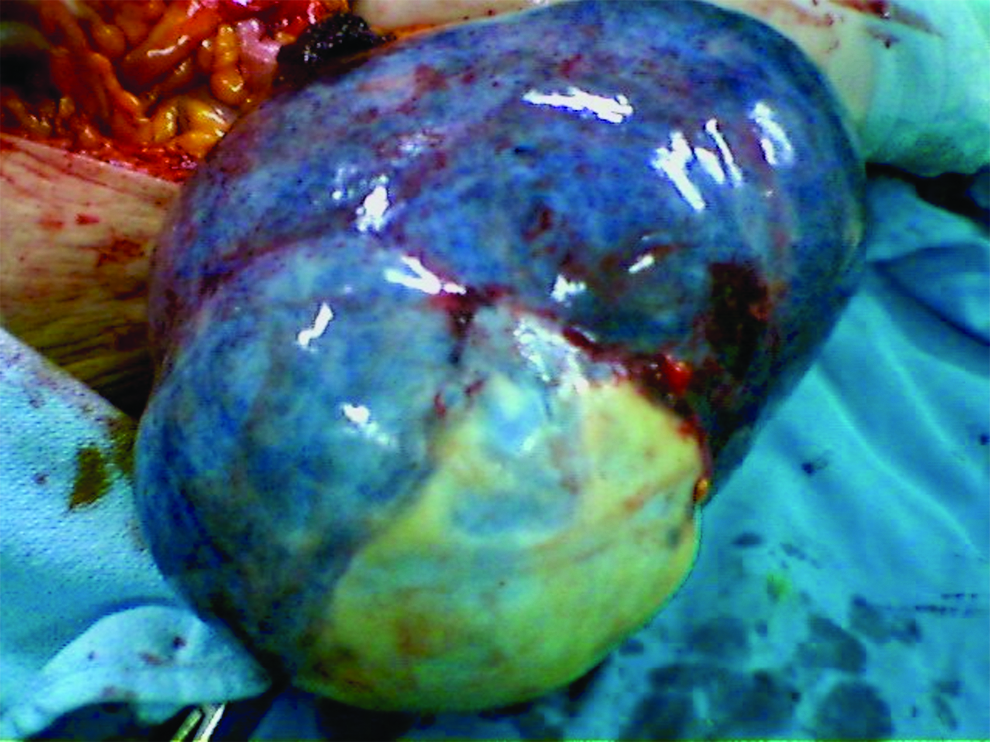
Forty year old; left adnexal torsion, laparotomy, cystectomy. March 29, 2007 22:01 pm pathology: endometrioma.
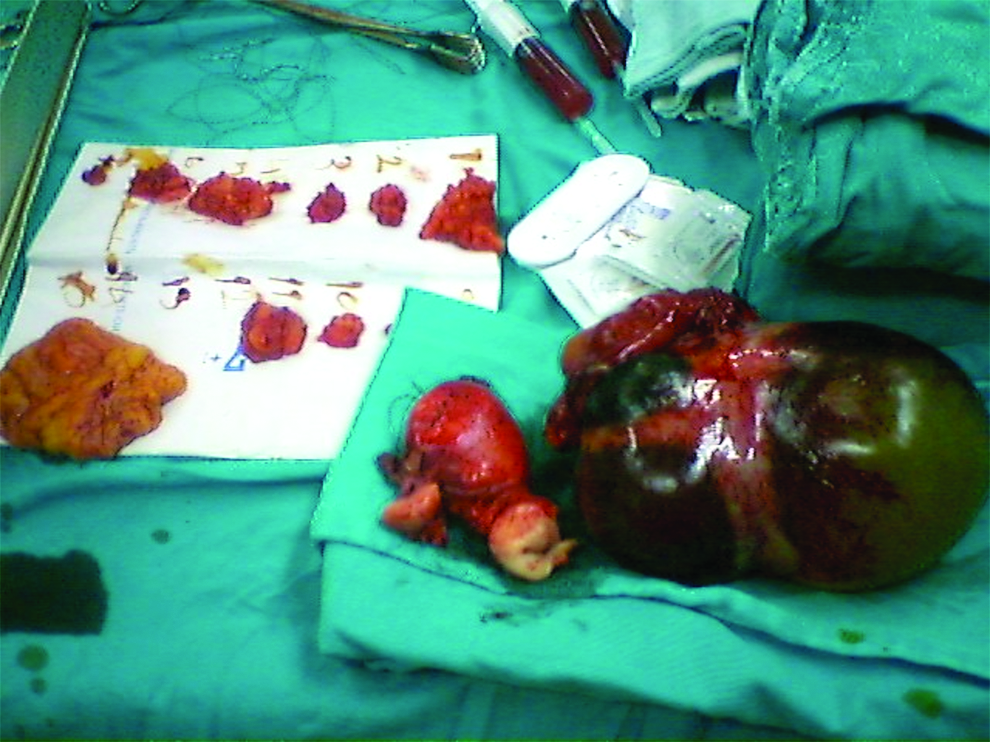
Seventy year old; right adnexal torsion, 20 × 15 cm adnexal mass, laparotomy, staging surgery. April 3, 2008 00:47 am pathology: cystadenocarcinoma.
TAH-BSO, total abdominal hysterectomy + bilateral salpingo-oopherectomy.
The laparoscopy group consisted of young patients with low parity, whereas the laparotomy group consisted of 160 patients of whom 92 (57.5%) were in menopause. Operation time and hospitalization time were shorter in the laparoscopy group and the statistical difference was significant. Torsions were mostly seen on the right side (58.8%).
For postmenopausal patients, TAH-BSO was performed. Unfortunately, in our center, there is no possibility of frozen pathological section study outside the working hours. Frozen section was taken from 16 of the postmenopausal patients because the operation was performed during working hours, 10 specimens were reported unidentified and 6 specimens were reported as benign. The rest of the patients were operated on after working hours because they presented with acute pain to the emergency department, so additional staging surgery was performed in 52 of these patients because of suspicion of malignancy from the macroscopic appearance of the mass. Staging included pelvic wash for cytology, hysterectomy and adnexectomy, omentectomy, and lymph node sampling (Fig. 3). The pathological results of these patients were malignant in 14 and borderline in 11 patients. So the pathological result was consistent with malignancy in 48.0% of patients for whom staging surgery was performed.

Thirty-nine year old; left adnexal torsion, laparoscopic detorsion cystectomy. July 17, 2016 03:33 am pathology: follicular cyst.
Pathological specimens were available for 322 of the 380 patients due to conservative surgery. Teratomas were the most common pathological finding followed by follicular cysts. A total of 14 ovarian malignancy and 11 borderline serous and mucinous tumors had been reported. Eleven ovarian malignancies had been reported in postmenopausal patients and three had been reported in premenopausal patients. There were six serous cystadenocarcinoma, four mucinous cystadenocarcinoma, and four granulosa cell tumor that had been reported as malignancy histopathological subtype. There were 16 unclassified tumors due to necrosis on pathological specimen (Table 5).
Six serous cystadenocarcinoma, four mucinous cystadenocarcinoma, and four granulosa cell tumor.
Discussion
Ovarian torsion is the rotation of the ovary or the adnex around its axis and the vascular pedicle.9,10 Some studies report that there is increased risk of adnexal torsion during pregnancy.11,12 A total of 36 of our cases were pregnant, 24 in the laparoscopy group and 12 in the laparotomy group.
The value of preoperative colored Doppler USG in the diagnosis is debatable. Lee et al. 9 in their study found that color Doppler USG can confirm the preoperative diagnosis in 87% of cases. In our study, velocity loss of blood flow was noticed in 82.6% patients. This was of clinical importance in the diagnosis.
Laparoscopic detorsion surgery is associated with less postoperative pain, more patient satisfaction and less hospitalization period than detorsion surgery with laparotomy. 13 Lo et al. studied 179 patients who were operated on for adnexal torsion. Laparoscopy was applied to 103 and laparotomy to 76 patients. Lesser postoperative complication and shorter hospital stay were documented in the laparoscopy group. 14 In another study by Oelsner et al. 15 on 102 patients with ovarian torsion, they found that patients who had laparoscopic surgery compared with those who had laparotomy surgery had lesser postoperative complications and shorter hospital stay. In our study we compared laparoscopy with laparotomy in the treatment of these patients and we found similar results to these studies.
We had performed 160 laparotomy surgeries (42.1%) to adnexal torsion patients of whom 92 (57.5%) were in menopause. Prevalence of laparotomy was high because data were collected since 2005 and we had had some technical insufficiencies especially for working hours. Between 2005 and 2008, we had performed 102 surgeries to adnexal torsion patients and 72 of them were laparotomy surgeries (70.6%). However, in the past 5 years, due to elimination of technical insufficiencies, our laparotomy rates had decreased dramatically to 15.8% (n = 24).
Although ovarian torsion may occur without any ovarian pathology, it is usually associated with benign ovarian cysts. The most frequent associating condition is mature cystic teratoma. In our study, the most frequent associating condition was mature cystic teratoma, the incidence of malignancy was 3.6% (14 patients), 11 patients were in menopause and 3 patients were in premenopause.
We observe malignancy rates of 11.9% among postmenopausal patients and 1.0% for premenopausal patients. In previous studies, Herman et al. 16 found the risk of malignancy in 3% of 33 postmenopausal patients, whereas Ozcan et al. 17 found the risk of malignancy in 16% of 25 postmenopausal patients. In a study by Lee and Welch, 18 the incidence of malignancy was 25% of 37 women with torsion and older than 60 years of age. Our study is the biggest in the literature with regard to the number of postmenopausal patients and number of patients who had malignancy.
In their studies, Eitan et al. 19 and Balci et al. 20 stated that because of delays in treatment of menopausal patients with adnexal torsion, the ovaries became necrotic, which limited the reliability of the frozen section results. In our study, 16 frozen sections were taken from postmenopausal patients since surgery was performed during working hours, 10 specimens were reported unidentified and 6 specimens were reported as benign.
A total of 52 patients had staging surgery due to suspicion of malignancy on macroscopic appearance and 14 malignant and 11 border line tumors (48%) had been reported. Staging surgeries had been performed by gynecologists who were specialized in oncological surgery in suspicion of malignancy before the operation due to USG findings (semisolid appearance, thick cysts wall, thick septations, and size of the mass).
In staging surgery, we had performed peritoneal washing cytology, TAH+BSO, omentectomy, lymph node dissection, and appendectomy. A total of 14 malignant cases had been optimally cytoreduced. In 11 cases the capsule was intact, there were no lymph node metastases, malignant cell negative peritoneal washing cytology (early stage). In 3 cases the tumor capsule was not intact, there were pelvic lymph node metastases, and malignant cell positive peritoneal washing cytology. There were no distant metastases or bowel implants or splenic metastases in all cases.
We had observed six serous cystadenocarcinoma, four mucinous cystadenocarcinoma, and four granulosa cell tumors among the malignancies. In the literature, there are no studies that report histopathological subtypes of malignancies, which were seen in ovarian torsions in postmenopausal patients.
The major limitation of our study is the retrospective nature of the clinical data. Although only 4 surgeons had performed these surgeries, another limitation is that different physicians performed the surgeries who have different case management styles with varying degrees of conservativeness and aggressiveness.
Conclusion
Laparoscopic surgery is preferred for young patients who want to preserve their fertility, but postmenopausal ovarian masses presenting with torsion should be analyzed with frozen section whenever possible; if not possible or not conclusive, staging surgery is more appropriate especially if there is suspicion of malignancy.
Footnotes
Disclosure Statement
No competing financial interests exist.