




Abstract
Abstract
Recently, a 5 mm laparoscopic stapler entered the market and is currently used for a wide variety of pediatric applications. The aim of this article is to be the first report of the use of this 5 mm laparoscopic stapler for open neonatal intestinal anastomosis in humans. We used JustRight (Justright Surgical) 5 mm laparoscopic stapler® in 5 patients, with a total of six anastomoses being constructed. Enteroenterostomies after bowel resection were performed in these neonates with diagnoses of closed gastroschisis with ileal atresia, multiple intestinal atresia, ileal atresia, and jejunal atresia. Side-to-side, functional end-to-end, stapled anastomoses were performed in the standard antimesenteric manner. Using 2.5 cm long staple loads, the anastomoses approximated 1.5 cm. Minimal staple line overlap was incurred. Enteral feedings were initiated, and nutritional goals met, on postoperative days 8 and 15.2, respectively (means). Postoperative recovery was uneventful, notably without anastomotic complications of leak or stenosis. No long-term follow-up was done. The 5 mm laparoscopic stapler offers an attractive alternative in open neonatal intestinal anastomosis, particularly in both ease and time of anastomosis. Its more generalized use in neonatal intestinal reconstruction awaits further scientific investigation.
Introduction
Stapling devices are commonly utilized in intestinal anastomosis repair and the frequency of their use continues to rise. 1 Neonatal anastomosis is commonly performed by hand due to limited applicability of stapler technology in this population. Recent literature recognizes laparoscopic assistance in neonatal anastomosis, but this still requires hand-sewn anastomosis as the laparoscopic assistance is for prevention of laparotomy. 2 The use of the 30/2.5 mm GIA Universal stapler® has been utilized in open anastomosis creation and has been discussed in the literature as possible options for neonatal anastomosis with good results (Covidien, Mansfield, MA). 3 With the development of the JustRight laparoscopic 5 mm stapler,® successful animal and human studies demonstrated a wide range of pediatric applications (JustRight Surgical, Louisville, CO).1,4 The goal of this study is to specifically report on the use of this 5 mm laparoscopic stapler during open neonatal intestinal anastomoses.
Materials and Methods
The 5 mm laparoscopic stapler was used in 5 patients for a total of six anastomoses constructed, with diagnoses indicated in Table 1. Using 2.5 cm stapler loads, side-to-side functional end-to-end stapled anastomoses were performed in the standard antimesenteric manner. The stapled anastomoses were 1.5 cm in length with minimal staple overlap (Fig. 1–4).

Intestinal atresia.
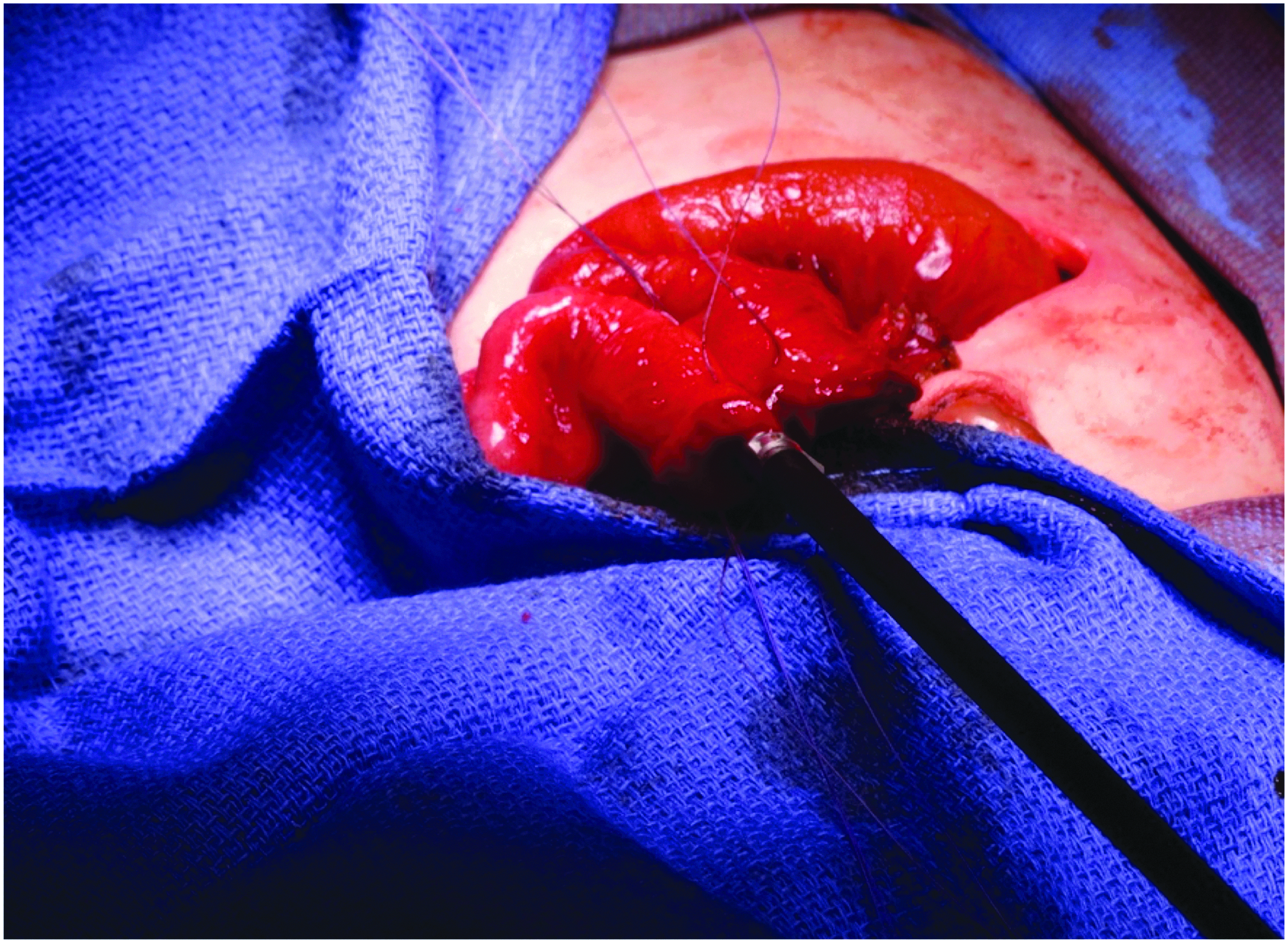
Side-to-side stapled anastomosis.

Stapled closure of enterotomy.

Final result of stapled anastomosis.
Demographics of All Patients with Corresponding Postoperative Diagnosis, Days to First Feeds, and Days to Goal Feeds
d.o., days old; m.o., months old.
Results
All patients were initiated on enteral feedings postoperatively, and the time to nutritional goal feeds is presented in Table 1. Postoperative recovery was uneventful among all patients, notably without anastomotic complications of leak or strictures.
Discussion
The 5 mm laparoscopic stapler offers an alternative approach in open neonatal intestinal anastomosis repair. Further research is required to compare return to enteral feedings after 5 mm laparoscopic stapler repair versus the classic hand-sewn approach. Also, a study should be carried out to evaluate the cost and operating time comparison of this stapler versus the hand sewn anastomosis repair, as well as long term complications.
Footnotes
Disclosure Statement
No competing financial interests exist.