




Abstract
Abstract
Purpose:
To study the modified type of double-covered self-expandable segmental metallic stents in terms of efficacy, complications, and long-term outcomes.
Patients and Methods:
A retrospective review of a consecutive series of 24 patients who underwent placement of the modified stent from July 2013 to July 2018 was conducted. Twenty-five modified segmental stents were implanted. Data regarding technical success and complications were collected and analyzed.
Results:
Stent placement was successful in all patients with no perioperative procedure-related deaths. The median follow-up time was 10.3 months (interquartile range 6.3–23.5 months). Adjustment was required in 9 patients (37.5%) due to stent migration. The mean dysphagia scores before stenting and during follow-up were 3.6 ± 0.7 and 0.9 ± 1.6, respectively (P < .0001). Fifteen modified stents were removed due to complications or cure.
Conclusion:
Modified double-covered self-expandable segmental metallic stents are safe and effective for palliation of esophageal fistula.
Introduction
Almost half of the patients diagnosed with esophageal cancer have lesions that cannot be resected due to metastatic or advanced disease with or without comorbidities. These patients have an ominous prognosis, with 5-year overall survival rates of 10%–15%.1,2 The goal of palliative treatment in these patients is to prevent respiratory complications. Covered self-expanding metal stents (SEMS) are effective in relieving dysphagia and restoring luminal patency, 3 and have been widely used for patients with esophageal cancer with esophageal fistula or esophageal stricture.4–6 Today, different kinds of covered metal stents are available.7,8 However, SEMS, including the Choostent, have a “hard” connection by nitinol wire. The disadvantage of this type of stent is that it cannot bend and is not suitable for circuitous esophageal lesions. To overcome this shortcoming, a modified segmental stent incorporating a “soft” connection with nylon wire was developed and was used in this study. We aimed to study this modified type of double-covered self-expandable segmental metallic stents in terms of long-term outcomes, efficacy, and complications.
Patients and Methods
This study was approved by the ethics committee of our university. All informed consents were obtained from the patients.
Study design
From July 2013 to July 2018, 24 consecutive patients with esophageal fistula who underwent modified covered segmental stent placement were retrospectively analyzed. Demographic data and indications for stent placement are shown in Table 1. The chest computed tomography scan with or without upper endoscopy were used for the assessment of the extent of disease. The chest computed tomography scan was performed during follow-up.
General Characteristics of Analyzed Subjects
IQR, interquartile range.
Modified segmental stents
Modified covered self-expandable segmental metallic stents with double-layered polytetrafluoroethylene membrane were used (coded ST71; Micro-Tech Co. Ltd, Nanjing, China). The stent was made of nitinol alloy and the stent segment was 2 cm in length and was connected with nylon wire. The inside and outside of the stent were covered and both ends of the covered part exceed the stent by about 3 mm. These stents are available in diameters of 16, 18, or 20 mm and a length of 80, 100, 120, or 140 mm, and each size has a diameter of 23 mm at both end segments. Recovery lines in both ends are used for stent adjustment or recovery (Fig. 1). Stents are bundled in a delivery system 650 mm in length and 8 mm in diameter.
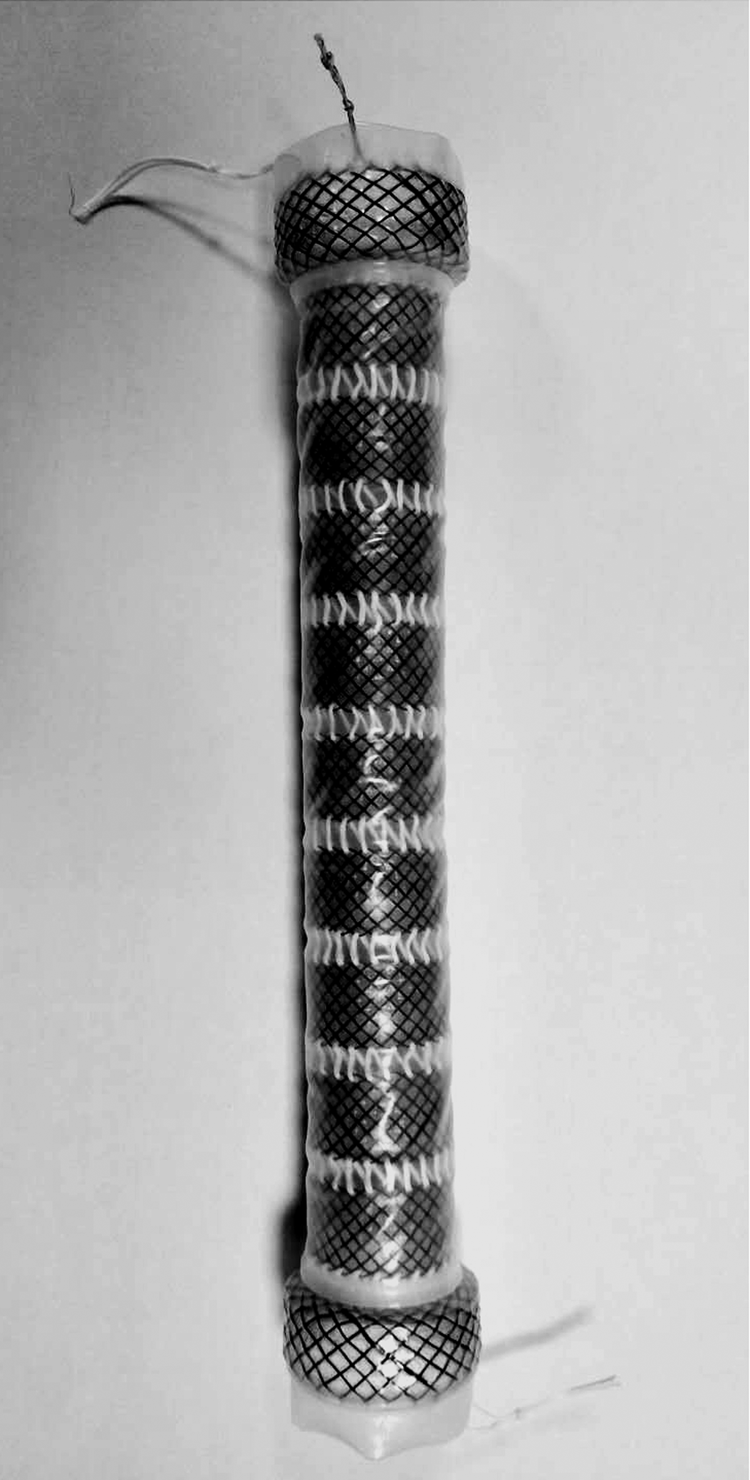
Modified double-layered polytetrafluoroethylene membrane-covered self-expandable segmental metallic stents. The stent segment was 2 cm in length and was connected with nylon wire. The recovery lines in both ends were used for stent adjustment or removal.
Technical details of stenting
All stent placements were performed under fluoroscopic guidance and local anesthesia. A 5F vertebral artery catheter (Cook Corporation, Bloomington, IN) was introduced, and then a stiff guide wire (Cook Corporation) was introduced. The modified segmental stent was implanted along the stiff wire (Fig. 2). A 10F–14F long sheath was inserted through a recovery line for stent adjustment or removal.

Modified segmental stent placement.
Definition
Minor complications included chest pain and discomfort, and incomplete stent deployment requiring balloon dilation. Major complications included stent migration, esophageal perforation, esophageal fistula, massive hemorrhage, and stent restenosis. 5 A 0–4 scale was used to evaluate the grade of dysphagia: grade 0 = normal swallowing, grade 1 = dysphagia to solid food, grade 2 = dysphagia with soft solid food, grade 3 = dysphagia to liquids, and grade 4 = inability to swallow saliva or esophageal fistula.
Statistical analysis
Variables were reported as mean ± standard deviation; median with interquartile range was used when data were not normally distributed. Categorical variable was presented as proportions. The student's t-test and analysis of variance were used to compare continuous variables by using Prism 5.0 software (GraphPad Software, Inc., San Diego, CA). Fisher exact test was used to compare incidence of complications. Significant difference was considered at P < .05.
Results
Twenty-four patients, 15 men and 9 women with a median age of 59.5 years, were enrolled in this study. Nineteen patients presented with carcinoma of the esophagus or stomach, and 18 patients underwent surgical resection before stenting (Table 1). A total of 25 segmental esophageal stents were used. The median diameter and length were 18 and 120 mm, respectively. Stent insertion was technically successful in each patient. Stent removal was performed within 0.5 month in 4 patients due to intolerance of the stent (n = 1) or repeated stent migration (n = 3), for a clinical success rate of 83.3%.
There were no perioperative deaths related to the stenting procedure. The overall hospital morbidity was 7%. One patient complained of mild chest pain or discomfort immediately after segmental stent placement. The pain disappeared within 3 days without any treatment. A total of 11 major complications (45.8%) were found after segmental stent placement. Stent migration, the most common complication (Fig. 3), was found in 9 patients, with a migration rate of 37.5%. With the exception of 4 stents removed within 2 weeks, 10 additional stents were removed due to migration (n = 3), stent restenosis (n = 1), or cure (n = 6) during follow-up (Fig. 4).
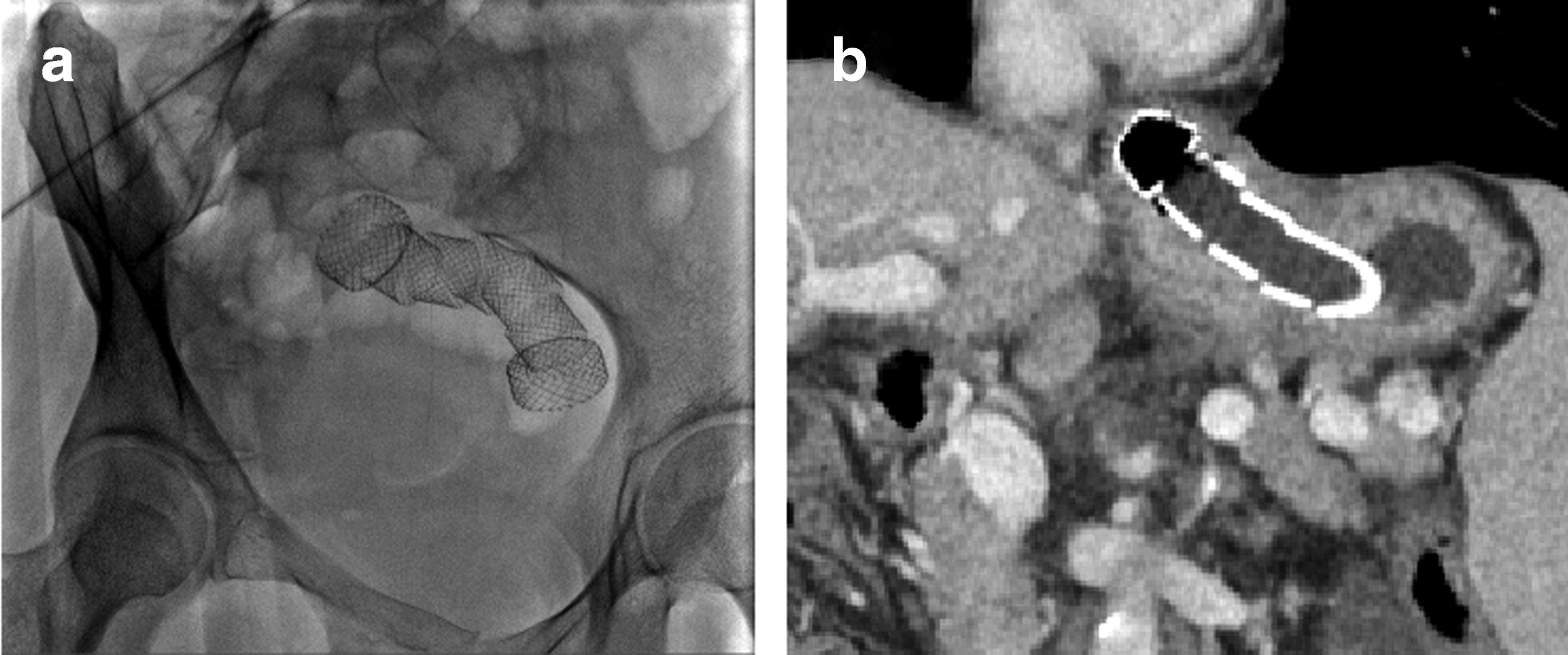
Stent migration.
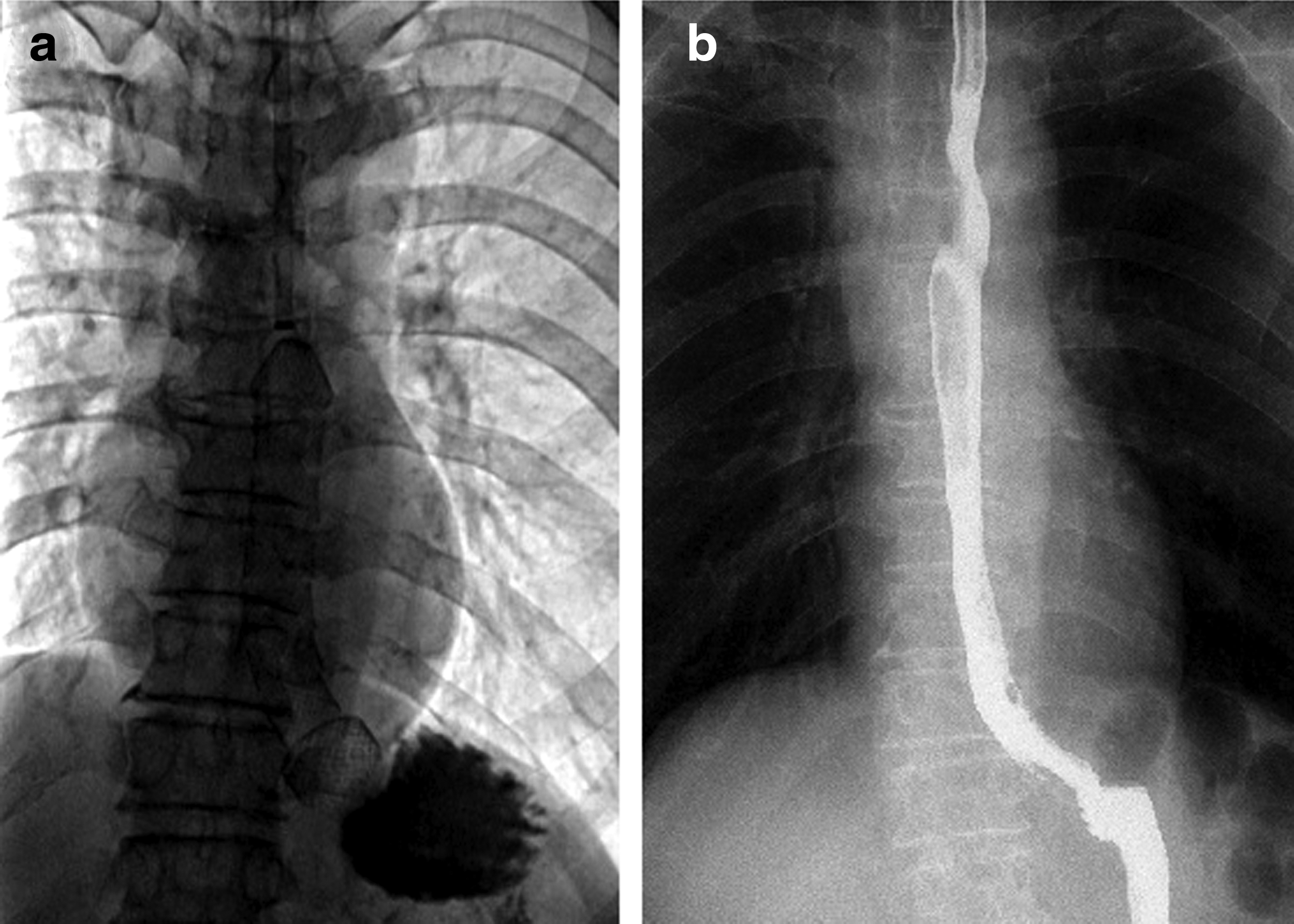
Modified segmental stent removal.
As shown in Table 2, the mean dysphagia score decreased significantly after stent placement (P < .0001). One patient was lost to follow-up after 31.2 months. The median follow-up period in the remaining 23 patients was 10.3 months. By the end of follow-up, 10 patients survived without obvious symptoms, 3 patients survived but the fistula did not heal, and 10 patients died. Survival rates were 85.2%, 68.1%, and 35.0% at 6, 12, and 36 months, respectively. The mean survival was 22.5 months (Table 2).
Long-Term Treatment Outcomes of Esophageal Segmental Stents for Esophageal Diseases
Versus dysphagia score before stenting, *P < .0001.
Discussion
Since the 1990s, SEMS have been widely used in patients with esophageal leaks or malignant dysphagia because their flexibility can adapt to angulated stenosis, they are easy to place, and are available in wide variety of sizes.5,9 Placement of SEMS is technically safe, requires minimal dilatation, and results in less morbidity.10,11 Different kinds of covered metal stents are available nowadays.7,8 However, SEMS still have some drawbacks, such as stent migration, stent restenosis owing to tissue ingrowths, or failure in stent removal. 12 Although SEMS seems to be better accepted by patients, their scientific efficacy has not been established conclusively.13,14
Commonly used SEMS have a “hard” connection by nitinol wire, using the nitinol wire to form a continuous whole. The Choostent SEMS is also connected by nitinol wire. The disadvantage of this stent is that it cannot bend and is not suitable for circuitous esophageal lesions. To overcome this shortcoming, a modified segmental stent with a “soft” connection with nylon wire was used in this study. Stent insertion was successful in each patient with no procedure-related deaths. Stent removal was performed within 0.5 month in 4 patients due to complications, for a clinical success rate of 83.3%.
In a comparative study by Conio et al., major complications were found in 48% of patients with the Polyflex stent and in 33% patients with the Ultraflex stent. 5 Rates of stent migration ranging from 0% to 19% for Ultraflex stents, 6% to 17% for the Polyflex stents, and 4% to 9% for the Flamingo stents have been reported.5,15,16 In this study, a total of 11 major complications (45.8%) were found after segmental stent placement. Stent migration was the most common complications, with a migration rate of 37.5% (9/24). Additional intervention due to complication is frequent.17,18 Despite the reported high incidence of migration, 19 we believe the modified segmental stent is still the best choice for our patients.
The choice of stent diameter is an important factor for the successful placement of an esophageal stent. Compared with other SEMS, those with a larger diameter might reduce the formation of granulation tissue, recurrence of dysphagia, and the risk of food obstruction. 20
One patient showed gastroesophageal reflux in our study, and was treated orally with omeprazole. Anti-reflux SEMS may prevent symptom of gastroesophageal reflux. 21 No significant differences in clinical outcomes or complication rates among the available SEMS, such as the Ultraflex and the Choostent have been reported, although Choostent placement has been associated with less postprocedural pain.5,18 It is necessary to compare the modified stent used in our study with other SEMS in future studies.
Footnotes
Acknowledgment
This work is supported by National Natural Science Foundation of China (Grant No. 81501569).
Disclosure Statement
No competing financial interests exist.