




Abstract
Introduction:
The use of single-port surgery is widely accepted in pediatric surgery, but the majority of reports are on its use for appendectomy or inguinal hernia repair using multiple instruments. The aim of this report is to demonstrate that both thoracic and abdominal single-instrument procedures are feasible and safe in children.
Materials and Methods:
The following cases were managed in our department for the past 12 months. Two types of telescopes (10- and 5-mm) with inbuilt working channels were used in all cases.
Results:
The 10-mm endoscope with a 6-mm inbuilt channel was used to partially reduce and then exteriorize an intussusception secondary to Meckel's diverticulum in a 9-year-old boy, to reduce a left ovarian torsion in a 8 year-old girl, and to perform a thoracoscopic exploration and lung decortication in a 16 year-old girl with empyema. A 5-mm endoscope with a 3-mm working channel was used to perform bilateral 2-level thoracic sympathotomy in a 13-year-old girl with palmar primary hyperhidrosis. There were no perioperative complications and follow-up was uneventful in all patients.
Conclusion:
Minimally invasive surgery is well established at present. Thoracic and abdominal single-port single-instrument procedures are safe and effective in children. This is a unique report on single-port single-instrument use in four completely different procedures and the first to describe its usage for thoracoscopic sympathotomy in children. Increasing technology development, allied to surgeons' skills, is crucial to worldwide adoption of this surgical modality.
Introduction
Minimally invasive surgery (MIS) is widely accepted both in pediatric and adult surgery, mainly due to its advantages on faster and less painful postoperative course and better cosmesis when compared with open approach. 1
Single-incision pediatric endosurgery (SIPE) is defined as MIS performed through a unique incision in the abdomen, chest, or any other virtual cavity in the human body, and it can be interpreted as an evolution of MIS into a nearly scarless procedure. A systematic review published in 20132 revealed that the majority of published articles on SIPE report appendectomy and inguinal hernia repair, and most surgeons use multilumen devices or multiple instruments through stab fascial incisions in a single large skin incision. A single-incision single-instrument (SISI) technique using scopes with inbuilt working channels (and, therefore, a smaller skin incision) has rarely been described and for a limited number of procedures.3–6
Recently, our department's experience on this technique for appendectomy was published. 7 Owing to its good results, this technique was further applied to other four pathologies during 2019.
With this article we aim to demonstrate the feasibility and safety of SISI surgery in a variety of pediatric surgical pathologies using scopes with incorporated working channels, to encourage the wide application of this technique. Moreover, to the best of our knowledge, this is the first report of a pediatric SISI thoracic sympathotomy for primary palmar hyperhidrosis.
Materials and Methods
A retrospective study of data of SISI surgery other than appendectomy performed in our pediatric surgery department was done including patients treated between January and December 2019.
All procedures were done in our department during the past 8 months (August 2019–April 2020). Telescopes with inbuilt working channels were used in all cases. Two types of scopes were used: a 10-mm 0° device with a 6 mm inbuilt working channel (HOPKINS® Straight Forward Telescope 0°, product number 26075 AA; Karl Storz) through a 12 mm trocar introduced through Hasson “open” technique; and a 5-mm 6° device with a 3 mm working channel introduced through a sheath that works as a trocar (Fig. 1; HOPKINS Wide-Angle Straight Forward Telescope 6°, product number 27092 AA; Karl Storz).
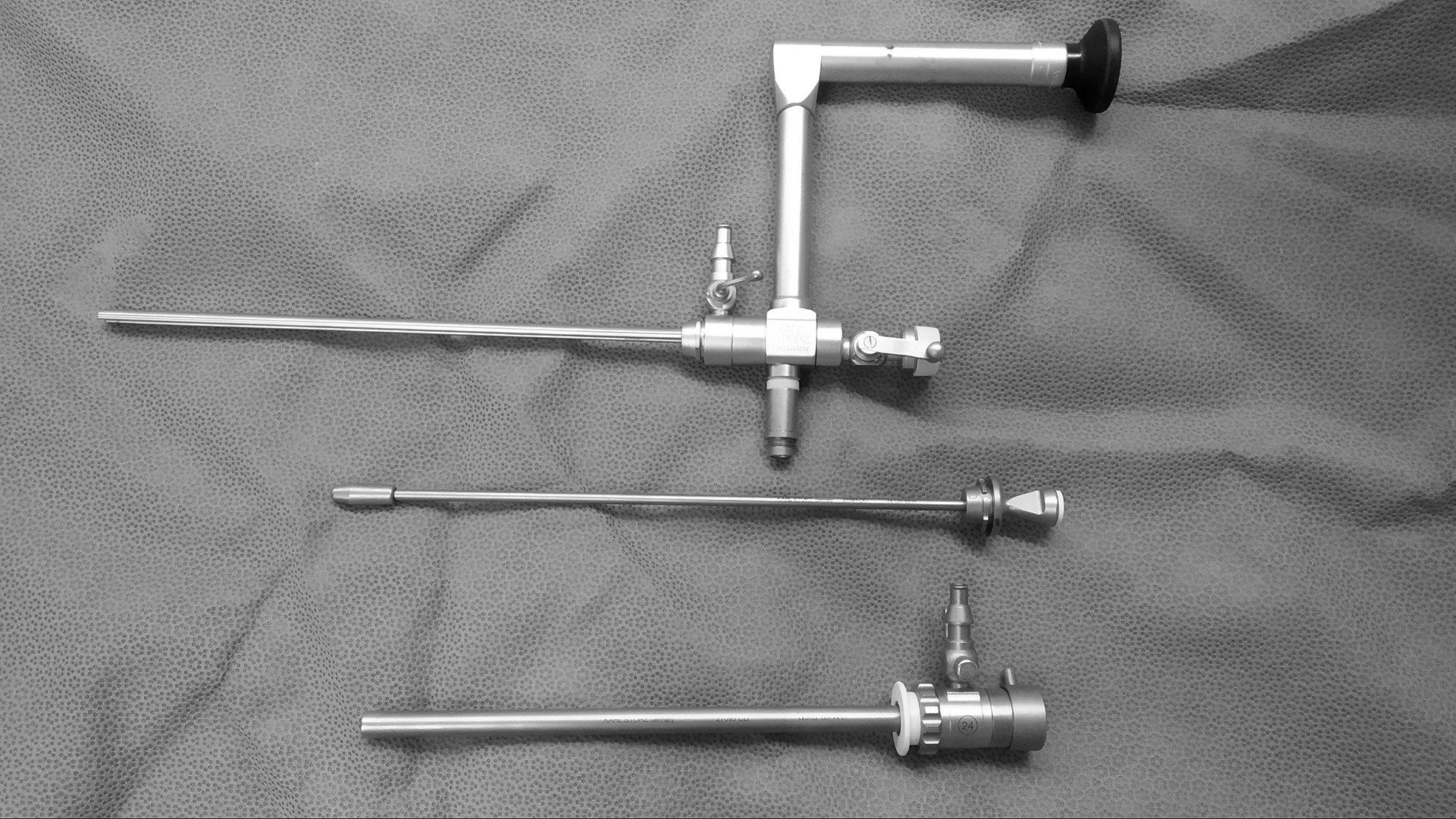
HOPKINS® Wide-Angle Straight Forward Telescope 6°, Karl Storz. From top to bottom: 5-mm 6° endoscope with 3 mm inbuilt working channel; dilator; sheath.
In all cases, just one incision of 1.0 or 0.5 cm for the 10- or 5-mm endoscope, respectively, was needed (only in the first case the umbilical incision was extended by 1.0 cm to safely exteriorize the bowel).
Institutional review board approval was obtained. Collected data from patients are anonymized, so there were no ethical implications.
Results
The first case was a 9-year-old 24 kg boy with bowel obstruction due to intussusception secondary to Meckel's diverticulum identified at ultrasonography. He was submitted to exploratory transumbilical laparoscopy using the 10-mm device: after lesion's identification and partial reduction using a grasper introduced through the working port of the endoscope, the bowel was exteriorized through the umbilical incision, and enterectomy (including the lesion) with end-to-end anastomosis was manually accomplished. Operative time was 100 minutes, postoperative course was uneventful and pathology results confirmed Meckel's diverticulum.
Second case: an 8-year-old 44 kg girl presented with a first episode of left ovarian torsion. During transumbilical laparoscopy with the 10-mm telescope, a grasper introduced through the 6 mm working port of the endoscope plus operative table tilting were used to successfully reduce the three complete twists of the vascular pedicle (despite the ovary's enlarged size), and the viable ovary placed in situ. Operative time was 90 minutes, postoperative course was unremarkable, and follicle development was reported on ultrasound 2 months after surgery.
Third case: a 16 year-old 65 kg girl with bilateral pneumonia complicated with right empyema without clinical improvement after 48 hours of adequate intravenous antibiotics was submitted to thoracoscopic exploration and lung decortication: with the 10-mm device introduced in the intercostal space below the scapula tip, a grasper or suction-irrigation tube was used to remove fibrin/pus and free the collapsed lung. Operative time was 180 minutes. The pleural disease was controlled, and chest drains were removed a week later.
Fourth case: the 5-mm telescope was used in a 13-year-old 38 kg girl with palmar primary hyperhidrosis. Double-lumen endotracheal intubation with one-lung ventilation was used, and the patient was positioned in a semisitting position with arms abducted at 90°. The scope was introduced through a 5-mm skin incision in the armpit (anterior axillary line at the level of the fourth intercostal space). Using a 3 mm dissector, the sympathetic thoracic chain over the third and fourth ribs was cut using electrocoagulation. The procedure was repeated on the other side. Operative time was 120 minutes, and after 6 months of follow-up both hands were dry, and the patient remained satisfied.
Discussion
Over time, MIS was developed to minimize patients' discomfort, decrease convalescence, improve cosmesis, 8 and reduce long-term complications such as bowel or lung adhesions, abdominal incisional hernias, and thoracic scoliosis after thoracotomy.
Single-incision laparoscopic surgery, a natural evolution of MIS that enhances these positive features, was first introduced in adult surgery in 1969. 9 Beyond improved cosmesis, there are numerous benefits in diminishing the number of incisions, such as less potential trauma during trocar insertion (bowel, viscera, or lung laceration), fewer port-site-related complications (wound dehiscence or incisional hernias) and reduced postoperative pain (particularly notorious in thoracic surgery). 5 Another advantage is the ability to convert to an alternate minimally invasive procedure by adding ports, maintaining the benefits of MIS over open approach. 10
In children, the first report on SIPE was done by Esposito in 1998 for a one-trocar appendectomy, 11 and since then there has been increasing adoption of SIPE, with appendectomy and inguinal hernia repair as the more common procedures. 2 Since the majority of procedures are done intracorporeally, multiple instruments are needed and used through a unique but enlarged skin incision.12–14 However, these techniques require specialized equipment (such as multiport trocars) and can be quite challenging, due to limited triangulation and retraction secondary to instrumentation on a single axis, 10 which can be aggravated by the 0° telescopes.
Through technological innovation, the development of devices that incorporated both optical and working channels made SISI surgery possible. In our department, transumbilical laparoscopic-assisted appendectomy using a telescope with inbuilt working channel became the most used approach for acute appendicitis, with good results. 7 Recently, we decided to expand the application of SISI technique to other procedures.
As described before, during 2019 we successfully extended the indications for SISI surgery in children in two abdominal (besides appendectomy) and two thoracic interventions using scopes with inbuilt working channels. On top of the already reported experience on SISI appendectomy, 7 the different pathologies reported in this article (bowel, adnexa, lung/pleura, and posterior mediastinum) demonstrate that a variety of procedures are easily feasible using already commercialized and widely available devices. Both the 10- and the 5-mm devices are easy to use, and the only specific requirement is that the 5-mm instruments (either grasper, dissector, or suction device) used in the 6-mm working channel of the 10-mm scope need to be longer than the conventional endoscopic instruments (45 cm versus 35 cm).
In abdominal procedures, these two cases demonstrate that both bowel and adnexal emergency procedures can successfully and safely be done using SISI. Adding to the well-known advantages of MIS (less bowel adhesions and faster recovery), this “all-in-one” technique used through the umbilicus becomes a “scarless surgery.”
Concerning thoracic surgery, although there are no natural scars surgeons can take advantage of to avoid new scarring, the armpit used for the SISI sympathotomy is an acceptable place to hide a new scar, especially for children. Several reports on single-incision thoracic sympathotomy are described,6,15–19 but none results on a single 5-mm skin incision such as the one we describe. Moreover, positive aspects of SISI thoracic surgery may also be the reduced number of incisions, minimizing the amount of pain caused by intercostal space distension and the potential lung trauma when introducing the instruments.
Some authors have shown concerns about the feasibility of single-port surgery.13,20,21 Having the optics and the instrument in the same axis, allied to a small angulation of the camera, can be quite challenging both inspecting the operative field and maneuvering the instruments. However, this can be overcome by manipulation of the camera positioning in relation to the instrument being used, rotating one over another; this is easily acquired during the rather fast learning curve. Also, tilting the operating table may be helpful in some circumstances as in our case 2, and previously described by Loux et al. 4 Moreover, a second or even third port could be easily inserted under direct view, if needed, maintaining the benefits of MIS.
All these procedures were safely conducted, with no complications at surgery or during the follow-up, and required just one small incision large enough for the endoscope to be inserted.
Although not evaluated by us, it is reasonable to accept that this technique reduces costs and, with experience, might reduce the total operation time by reducing the time consumed for trocar incision and closure. As demonstrated by Borges-Dias et al., the use of a scope with an incorporated working channel results in lower overall costs after a small number of cases, by reducing the amount of necessary trocars. 7 The operative time of the fourth case was longer than the average time described in literature,15,18 probably due to initial inexperience on maneuvering the 5-mm device; hence, it is expected that following cases have an even shorter operative time.
Limitations of our study include its retrospective and, therefore, descriptive nature. Cost analysis was not performed in these cases. Moreover, the small case series do not allow us to perform any data analysis.
Conclusion
We report four different procedures, abdominal and thoracic, including the first report of a single-port single-instrument thoracoscopic sympathotomy, successfully and safely performed in children with a 10- or a 5-mm endoscope with inbuilt working channel.
These results suggest that more interventions could be amenable to this safe, low-cost, and nearly scarless technique. Increasing technology development, allied to surgeons' skills, would be crucial to worldwide adoption of this surgical modality.
Footnotes
Disclosure Statement
No competing financial interests exist.
Funding Information
No funding was recieved for this article.