




Abstract
Objective:
Robotic platforms offer articulating needle drivers but are associated with high costs and lack tactile feedback. The recently developed mechanical Laparoscopic Articulating Needle Driver (LAND) (Flexdex®) for conventional laparoscopy offers enhanced dexterity without these limitations. The goal of this study was to assess safety and efficiency during the implementation of the LAND, and describe its learning curve, in an expert center for laparoscopic surgery.
Methods:
All LAND-assisted procedures after clinical implementation for a period of 16 months were included into this study. Primary outcome domains were safety (intra- and postoperative complications within 30 days) and efficiency (operative time, suturing, and knot tying time of staple defects of enteroenterostomy). CUmulative SUM (CUSUM) analysis was utilized to describe the enteroenterostomy suturing time learning curve across consecutive cases by plotting the deviation from the series mean.
Results:
Forty-five procedures (34 Roux-en-Y gastric bypass [of which 7 including diaphragmatic hernia repair], 2 diaphragmatic hernia repair with Nissen fundoplication, and 2 right-sided hemicolectomy) were included into this study. Median (range) operative time and enteroenterostomy suturing time were 68 (46–177) minutes and 161 (112–241) seconds, respectively, comparable with conventional needle driver standards. One procedure was converted to the conventional needle driver due to device malfunctioning and one patients' postoperative course was complicated by a Clavien–Dindo grade 3a complication (intraluminal bleeding requiring gastroscopy). CUSUM chart displays a progression toward the mean from case 22 onward, indicating a limited learning curve.
Conclusion:
The LAND can be implemented safely and efficiently at a center of excellence for laparoscopic surgery and is associated with a limited learning curve.
Introduction
Minimally invasive approaches have become standard practice for most surgical, urologic, and gynecologic abdominal surgical procedures. 1 Laparoscopic surgery inflicts less trauma and has been proven to allow a faster postoperative recovery. 2 However, the limited range of motion of the laparoscopic instrument within the abdominal cavity remains a challenge. 3 Especially during intracorporal suturing and knot tying to construct anastomoses or close defects or hernias, the conventional straight stick needle driver lacks range of motion and precision. 4 Robot-assisted laparoscopic platforms have introduced articulating needle drivers to increase dexterity and precision but are associated with high costs and lack tactile feedback. 5 With the introduction of a mechanical Laparoscopic Articulating Needle Driver (LAND) for conventional laparoscopy, intracorporal suturing and knot tying can be achieved with enhanced dexterity and precision without the loss of haptic feedback (Fig. 1). 6
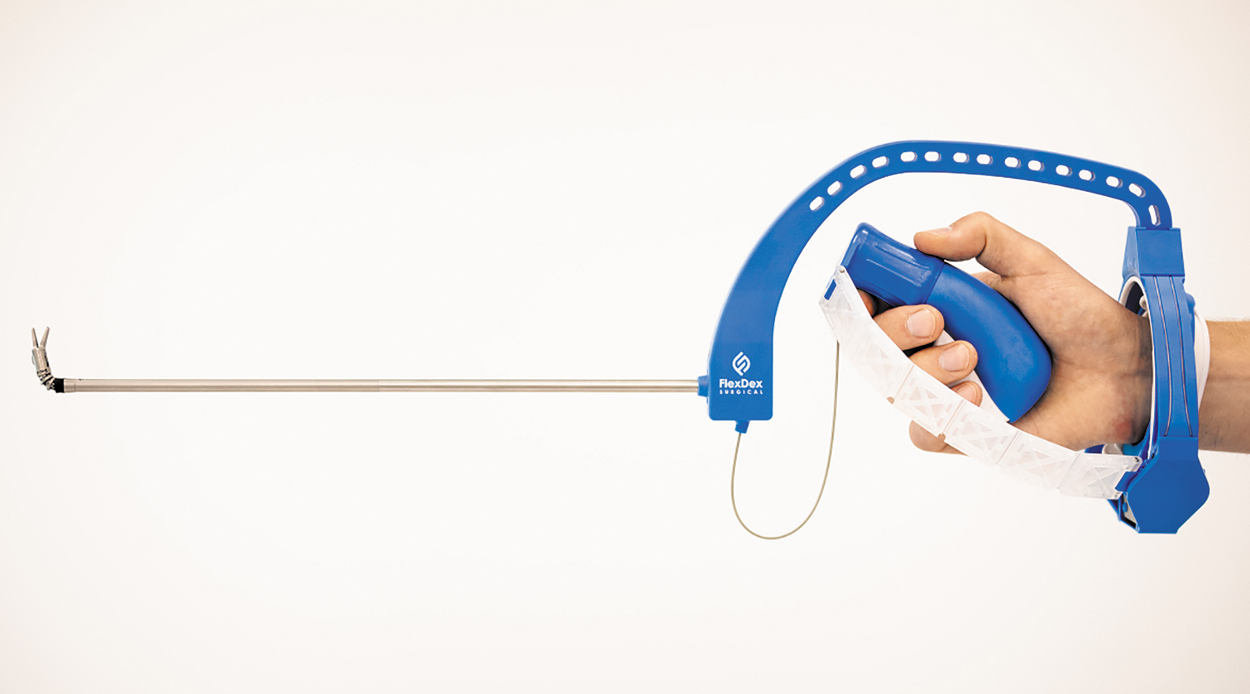
Laparoscopic articulating needle driver. Color images are available online.
The feasibility of the LAND has been established through a number of case series.6–9 However, the learning curve for the introduction of this novel technology into clinical practice has yet to be described. In 2018, the LAND was implemented at our institute after an industry-mediated training curriculum. The aim of this study was to prospectively monitor and analyze the learning curve for the implementation of the LAND in terms of safety and efficiency.
Materials and Methods
Study design and setting
We performed a prospective single-center cohort study assessing safety and efficiency during implementation of a LAND (FlexDex Needle Driver®; FlexDex, Inc., Brighton, MI) 6 during advanced laparoscopic abdominal surgery in accordance with the idea, development, exploration, assessment and long-term study framework (stage 2a: development). 10 This study was conducted at a single expert center in minimally invasive gastrointestinal and bariatric surgery. Máxima Medical Center is a center of excellence for laparoscopic gastrointestinal and bariatric surgery performing 250 advanced colorectal and 500 bariatric procedures laparoscopically per year.
Before clinical implementation of the LAND, a training curriculum was completed that included two industry-mediated training sessions and skills laboratory trainings encompassing ∼10 hours of dry laboratory training.
All LAND-assisted procedures starting from clinical implementation after completion of the training curriculum in May 2018 until September 2019 performed by a single expert laparoscopic surgeon were included into this study. Eligibility criteria required individuals to have received laparoscopic abdominal interventions using the LAND as a suturing and knot-tying instrument. Cases were selected based on the individual surgeon's assessment of proficiency, case difficulty, and device availability. This study was exempt from formal institutional review board approval and participant written consent due to its deidentified and observational design.
Outcomes and analysis
Data were collected from patient medical records and intraoperative video footage from the laparoscopic camera lens. Outcomes were analyzed according to the previously validated domain-based learning curve assessment methodology. 11 The primary outcome domains were safety and efficiency. The safety domain comprised intraoperative adverse events, 90-day postoperative morbidity (as graded by Clavien–Dindo classification 12 ), and mortality, readmissions, and reoperations. The efficiency domain comprised operative time (from incision to closure) and suturing and knot tying time of enteroenterostomy (E-E) staple defects for all Roux-en-Y gastric bypass (RYGB) procedures. All RYGB procedures were performed according to the laparoscopic fully stapled standardized surgical technique as described by Dillemans et. al., including the construction of a linear stapled E-E with subsequent closure of the staple defects with a running 3–0 Vicryl suture. 13 E-E suture time was defined as the time from loading the needle by the LAND procedure until completion of the final knot. Owing to the standardized size and location of the staple defects across cases, the E-E suturing and knot tying time was selected to display and analyze the LAND's implementation learning curve.
Statistics
Learning curves of suturing and knot tying times of E-E staple defects were plotted using moving average and CUmulative SUM (CUSUM) methodology. The moving average chart is a sequential control chart used to reliably demonstrate small deviations in outcome allowing the early identification of favorable or adverse trends. 14 CUSUM analysis is a validated technique used in the early evaluation of a novel clinical procedure to evaluate surveillance and quality control. 15 CUSUM depicts a graphical representation of the serial trend of procedural outcomes performed over time by plotting sequential differences between individual case E-E suturing and knot tying time and the series mean. 15 A rising CUSUM plot indicates that process variation is causing accumulating suturing times longer than the series mean, whereas a falling plot indicates suturing times shorter than the mean (i.e., process improvement). Statistical analysis was performed using IBM SPSS statistics version 25 (IBM, Armonk, NY).
Results
Overview
Forty-five procedures were included into this study. The following LAND-assisted procedures were performed: laparoscopic RYGB (n = 34, 76%), laparoscopic RYGB combined with Nissen fundoplication (n = 7, 16%), right-sided hemicolectomy (n = 2, 4%), and diaphragmatic hernia correction combined with Nissen fundoplication (n = 2, 4%). The LAND was deployed for all intracorporal suturing and knot tying depending on procedure type, including purse-string suture to fixate stapler anvil, running suture to close E-E staple defects, and interrupted sutured diaphragmatic cruss reconstruction. Closing of Petersens' space and the mesenteric defect of the enteroenterostomy was performed using a running v-lock suture obtaining a tight approximation of the two layers of the visceral peritoneum as recommended, thus omitting the need for knot tying for this step of the RYGB procedure. 16
Safety
One device malfunction occurred during the study period requiring conversion to a conventional needle driver to complete the index procedure without any compromise in patient outcome. Two postoperative complications occurred within 90 days including one urinary tract infection (Clavien–Dindo grade 1) after a right hemicolectomy and one intraluminal bleed at the level of the gastroenterostomy after RYGB, requiring endoscopic intervention (Clavien–Dindo grade 3a). There were no readmission or reoperations. There was no 90-day postoperative mortality.
Efficiency
Mean (standard deviation [SD]) operative time of the 45 procedures included into this study was 75 (33) minutes. Mean (SD) operative time of RYGB procedures was 62 (15) minutes, comparable with centers' conventional needle driver standards (data not shown). Of the 34 RYGB procedures performed, video material for 32 procedures was obtained. Mean (SD) suturing and knot tying time of E-E staple defects for all RYGB procedures was 156 (28) seconds. Moving average plot displays a steady downward trend of the average E-E suturing and knot tying time from 193 to 156 seconds (Fig. 2). CUSUM analysis of E-E suturing time demonstrates two distinct phases of the learning curve: accumulation of experience (cases 1–11) and optimization (case 11 onward) (Fig. 3). The first phase is displayed by a rising plot indicating suturing times longer than the series mean through case 11. Accumulative experience stabilized the learning curve through case 22 followed by optimization indicated by a steady downward trend toward the series mean.

Each dot indicates an individual case time. Moving average is represented by the blue line. Color images are available online.

Plot of the CUSUM of enteroenterostomy suturing time across the case series with two distinct phases of the learning curve: accumulation of experience (through case 11) and optimization (from case 11). CUSUM, CUmulative SUM. Color images are available online.
Discussion
This study reports the implementation of a LAND in advanced laparoscopic abdominal surgery at a single expert center in minimally invasive gastrointestinal and bariatric surgery. In a series of 45 cases, safety and efficiency during the early learning curve of this novel instrument are displayed. The mortality rate was 0% with a single intraoperative adverse event and one major complication (Clavien–Dindo grade 3a). The initial learning curve for this instrument comprised 11 cases, reaching the optimization phase. The steady state, and the true potential of this instrument, has not been reached in this early implantation series comprising 45 cases.
The LAND has been introduced into clinical practice in 2010. 17 Its potential as a low-cost alternative for enhanced dexterity and precision in laparoscopic surgery in comparison with robotic platforms has been suggested in a number of case reports and case series. The feasibility of this instrument has been implied for Nissen fundoplication, 6 pediatric pyeloplasty, 7 partial nephrectomy, 8 and sleeve lobectomy. 9 These first reports on clinical application of the LAND describe the advantages of the intuitive control of large degrees of articulation, especially in confined spaces entrapped by adhesions 6 or inside the thoracic cavity. 9 Little is known regarding the learning curve associated with the implementation of this novel instrument. In a small-scale study, laparoscopic-naive medical students were randomized to perform a series of standardized suturing tasks with either a conventional straight stick needle driver or a LAND. Use of the LAND seemed to be more challenging, suggested due to the fact that the mechanism of changing a suturing angle requires a hand and wrist movement in the direction opposite of the desired angle, which in unexperienced users may seem counterintuitive. 18 It remains unclear whether these conclusions can be extrapolated to laparoscopic experts. The results of this study imply that the learning curve associated with the implantation of the LAND into clinical practice appears to be limited. This instrument can be implemented safely and effectively after 10 hours of dry laboratory training before clinical implementation.
This single-center observational study has some limitations. First, being an early implementation study and inherent to its retrospective design, it lacks the methodologic strength of a control group or randomization and, although limited, suffers from missing data. Second, the presented learning curve describes the experience of a single surgeon and requires external validation to confirm our findings.
This is the first report describing the implementation of a LAND procedure into clinical practice in accordance with the IDEAL recommendations for surgical innovation. We sought to comprehensively describe the implementation and learning curve through previously validated methodology using a domain-based assessment including CUSUM chart analysis. Within the confines of these early results, these outcomes may indeed reflect the full potential of a LAND in advanced laparoscopic surgical procedures as a safe and effective tool to enhance dexterity and precision during laparoscopic suturing and knot tying.
Footnotes
Acknowledgment
We acknowledge the generous contributions of the anesthesia, nursing, and surgical house staff of the Maxima Medical Center.
Disclosure Statement
No competing financial interests exist.
Funding Information
No funding was received for this article.