




Abstract
Background:
The advent of laparoscopy has revolutionized surgery. The surgeon strives to minimize incisions and their adverse consequences. Although laparoscopy has gained widespread popularity, several advantages in open surgery are thereby lost. Tactile sensation of the tissue, hand-sewn anastomosis, and nonthermic vascular control are most prominent. To combine both approaches, single incision laparoscopic-assisted surgery (SILS) was advanced, trying to combine the best in both worlds. This approach is widely used in appendectomies. After having gained experience in this approach, we expanded the indications and hereby present our experience with bowel resections utilizing SILS.
Patients and Methods:
Data were collected retrospectively from operations performed during the past 3 years. We found 11 cases of SILS bowel resections: 3 sigmoidectomies, 3 small bowel atresia repairs, 1 subtotal colectomy, 1 Meckel's diverticulectomy, and 3 resections of bowel duplications. The age of the patients ranged from 2 days to 17 years. In all cases, a working 10 mm scope was inserted through the umbilicus, the bowel was extracted outside the abdomen through the umbilicus, dissection and resection with anastomosis were performed outside the abdomen in the classic open approach, and the bowel was returned to the abdomen.
Results and Conclusions:
All patients recovered promptly with no need for further intervention. There were no cases of wound infection, leak, or intra-abdominal abscess formation. Cosmesis was excellent with a small umbilical scar. We conclude that this approach is feasible and safe in a select population.
Introduction
The advent of laparoscopy has revolutionized surgery. All surgical disciplines are improving and perfecting minimal invasive procedures. 1 There is no doubt about the superiority of laparoscopic surgery in various procedures2,3 such as bariatric surgery 4 not to mention cholecystectomy.5,6 There is also no argument regarding the superior cosmesis of this approach. With time, more and more complex surgeries are performed through a minimally invasive approach,7,8 at times with no clear advantage over the classic open approach except in the cosmetic sense. 6 In fact, performing an “open surgery” has become outdated and many residents do not feel comfortable with the open approach.
Although cosmesis is important, there are certain advantages in open surgery that are bypassed or ignored during laparoscopy: tactile tissue sensation, nonthermic vascular control, or hand-sutured anastomosis, for example. Although the highly skilled surgeon is able to have tactile sensation and perform nonthermal control and hand-sutured anastomosis intra-abdominally, this requires advanced surgical experience and technique with the utilization of expensive surgical adjuncts. To have the best of both worlds, single incision laparoscopic-assisted surgery (SILS) was developed, although it did not gain wide acceptance yet.
When utilized, it is very safe and much less expensive than the fully laparoscopic approach, and provides an excellent cosmetic result. Our experience with SILS started mainly when performing appendectomies (>200 in the past 5 years), mostly in children and young adults. Having gained this experience, we sought to widen the scope of this approach to bowel resections. Although, as a pediatric surgical department, most of our patients are children, we believe that our experience can be extrapolated to a selected group of adults, and certainly adolescents.
Patients and Methods
We retrospectively accrued data from all bowel resections performed utilizing SILS. Patients' age ranged from 2 days to 17 years. All legal guardians of the patients signed a detailed informed consent for the SILS approach. IRB approval was waived as this study is retrospective and all parents consented to the procedure.
Surgical technique
All patients received general anesthesia with muscle relaxants. An 11 mm (Karl Storz Hopkins® Rigid 10 mm scope) port was inserted through the umbilicus after open (Hasson) periumbilical dissection. The abdominal cavity was insufflated with as little pressure as allowed an appropriate view, depending on the age of the patient. A 10 mm working laparoscope (Fig. 1) was introduced and the relevant pathology was identified. Intra-abdominal handling was minimal, only as needed to allow the bowel a tension-free extraction through the umbilicus.

Working laparoscope with grasper. Color images are available online.
Once the bowel was extracted, an open procedure was performed with suture ligation of the blood vessels and anastomosis as needed after resection. At the end of the procedure, the bowel was returned to the abdomen and an intra-abdominal laparoscopic inspection was performed to assure there was no bleeding, fluid collection, or anastomotic leak.
Patients
Eleven patients were identified. Three patients underwent sigmoid resections (aged 3–17 years) for redundant sigmoid causing intermittent volvulus (Fig. 2A). Three children were born with small bowel atresia [aged 1–4 days (Fig. 2B)]. One child was 6 months of age and underwent a subtotal colectomy for long segment Hirschsprung's disease, completed by transanal pull through at the same sitting (Fig. 2C). One child aged 5 years had a bleeding Meckel's diverticulum (Fig. 2D). Three patients (aged 1–3 years) had bowel duplications—one colonic, one small bowel, and one gastric (Fig. 2E).

Results
All patients underwent an uncomplicated anesthesia without need for prolonged ventilation. Neonates were transferred to the neonatal intensive care unit, whereas the others were returned to the ward after recovery. There was no need for repeated interventions and no adverse consequences such as bleeding, infection, anastomotic leak, or wound dehiscence were noted. Follow-up of 6–36 months was satisfactory with excellent cosmetic results (Fig. 3).
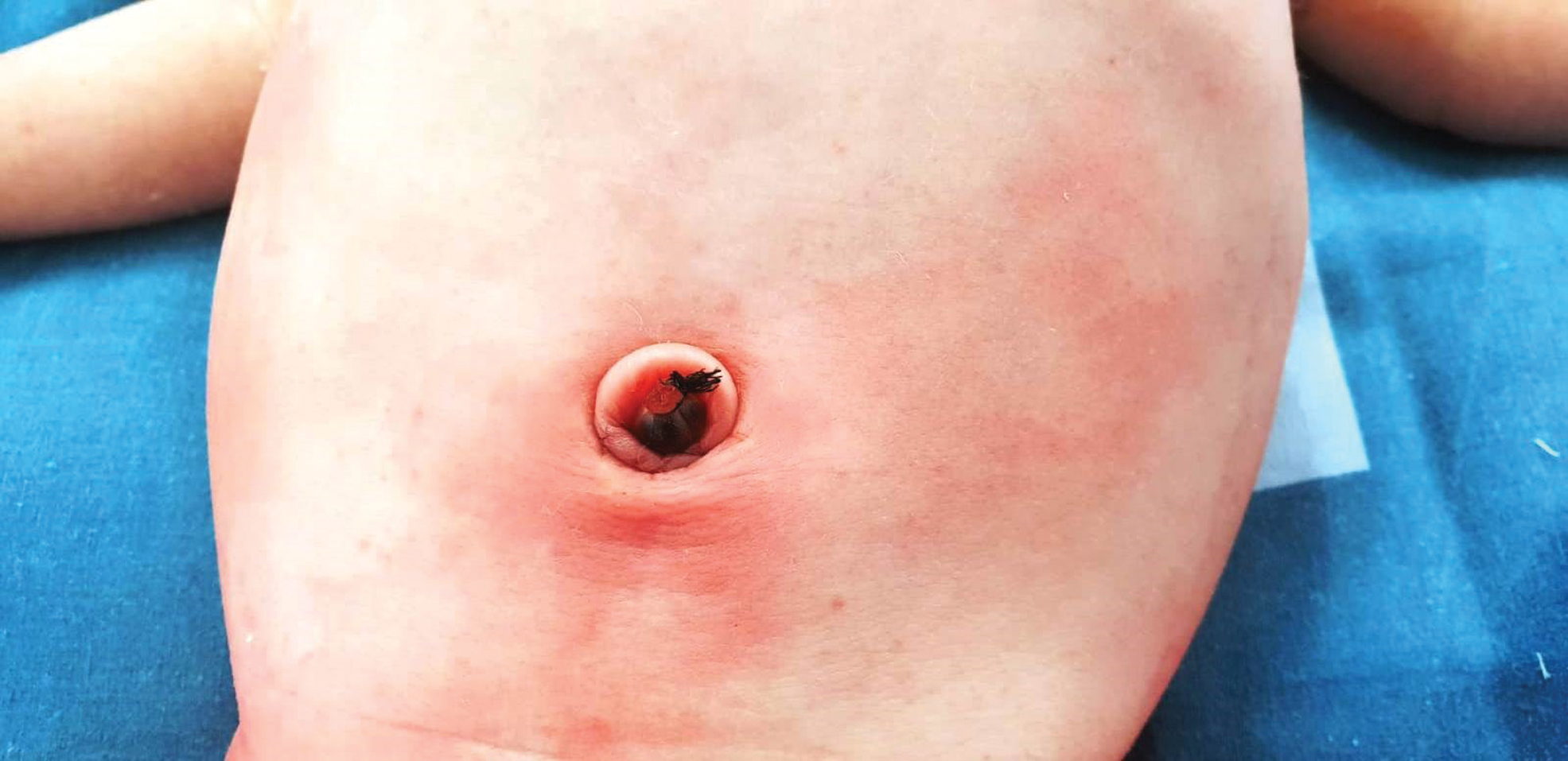
Postoperative cosmetic result. Color images are available online.
Discussion
Minimal invasive surgery has become the mainstay of surgical procedures. Constant technical and technological improvements allow major surgery through laparoscopy. There is no doubt regarding the safety and feasibility of most minimal invasive procedures,1,3 though not all are better in short- and long-term results when compared with the classical open approach. 6 In some cases, the goal of performing a minimal invasive procedure turns a simple operation to a complex technically demanding one.
One of the undeniable advantages of minimal invasive surgery is improved cosmesis, an important factor by itself. After gaining much experience with the SILS approach, we found that it combines the advantages of minimal invasive surgery, that is, good intra-abdominal scope and vision, precise identification of the area needing treatment, and excellent cosmetic result, with the advantages of open surgery. This approach, in our opinion, should be reserved for cases that do not involve an inflammatory or malignant mass. The bowel can be inspected extra-abdominally through the same incision. In cases of need, a 1 mm extension of the incision bilaterally should suffice to extract the lesion safely.
SILS allows a tactile judgment of the tissue, direct inspection of the anastomosis, and simple straightforward surgery. SILS also reduces the cost of surgery since there is usually no need for sophisticated (and expensive) technical devices. Therefore, we strove to expand our scope of surgical procedures performed through SILS to bowel resections in specific indications. Although we deal mostly in neonates and toddlers, we claim that this approach is feasible in adults with a good selection criteria and certainly in adolescents. We are presently expanding our scope to treat through SILS pelvic—mostly ovarian disorders and thoracic procedures.
Footnotes
Authors' Contributions
All the authors have read and approved the final article and agreed to submission.
Disclosure Statement
No competing financial interests exist.
Funding Information
No funding was received for this article.