




Abstract
Background:
Laparoscopic appendectomy has long been in the process of replacing open appendectomy owing to a better wound healing, better cosmetic appearance, less pain, and less postoperative adhesion. Although there are many methods for ligating the appendix stump, studies on energy-based coagulation methods have attracted great interest in recent years. In our study, we aimed to compare the use of LigaSure™ appendiceal sealing and ligation of appendiceal stump by endoloop with regard to duration of surgery, length of hospital stay, and complications in laparoscopic appendectomies.
Materials and Methods:
A total of 174 consecutive patients under the age of 18 who underwent laparoscopic appendectomy in our clinic between September 2016 and February 2021 were retrospectively analyzed. Patients with perforated appendicitis were excluded from the study. The patients were divided into two groups as the appendix stump was ligated with endoloop (Group 1) and sealed with LigaSure (Group 2). Demographic characteristics of the patients, duration of surgery, length of hospital stay, and complications were recorded.
Results:
Of the 132 patients who were included in the study, Group 1 consisted of patients using endoloop (n = 39) and Group 2 comprised patients that LigaSure was employed (n = 93). There was no significant difference between Groups 1 and 2 in terms of age and length of hospital stay (P = .126 and P = .784, respectively); however, the operation time was found to be significantly shorter in Group 2 (P < .001).
Conclusion:
The use of LigaSure is a safe and fast method to seal the mesoappendix and appendix stump in pediatric laparoscopic appendectomy. We think that infection complications due to stump leakage and intra-abdominal spillage will less be encountered.
Introduction
The most common emergency surgery in children is appendectomy. After the first laparoscopic appendectomy was performed in 1983, it became an alternative to open surgery. 1 Laparoscopic appendectomy has advantages such as rapid wound healing, better cosmetic appearance, less pain, and shorter hospital stay. 2
Along with technological improvements, laparoscopic instruments and techniques began to develop. Many methods such as stapler, endoloop, titanium clip, handmade loop, and LigaSure™ have been suggested to close the mesoappendix and appendix stump rapidly in a safe manner. 3 The use of electrothermal bipolar sealing system (LigaSure) methods to divide the mesoappendix has become increasingly common. To evaluate the thermal damage that may arise in the cecum, studies have been conducted and it has been reported as a safe method. 4 Experimental and ex vivo studies have also been performed on the closure of the appendiceal stump with bipolar coagulation methods, but there are limited clinical applications.5,6
In English literature review, we found that there was only 1 pediatric study comprising 312 patients in whom the appendiceal stump was sealed with Harmonic scalpel. 7 There is no study on the use of LigaSure in children that compare energy-based instruments and other methods in terms of operative time and possible complications.
In this study, we aimed to compare the duration of surgery, hospital stay, and complications of laparoscopic appendectomies in which the appendix stump was sealed with LigaSure and the appendix stump was ligated with the endoloop method.
Materials and Methods
The files of 174 consecutive patients who underwent laparoscopic appendectomy between September 2016 and February 2021 in our clinic were reviewed retrospectively, after the approval of the Harran University Clinical Research Ethics Committee (14/05/2018-E.19773, 18/05/31). Informed consent was obtained from the patients and their families before surgery. All the operations were carried out by single surgeon in both groups. The patients were divided into two groups as the patients whose appendix stump was ligated with an endoloop (Group 1) and those whose appendix stump was sealed with a LigaSure (Tyco Healthcare Valleylab, Boulder, CO) (Group 2). Although patients were operated with endoloop until January 2018, LigaSure was used to seal the appendiceal stump in all patients after this date.
Forty-two patients who were operated on for perforated appendicitis were excluded from the study. Demographic characteristics of the patients, length of hospital stay, and operation times were compared.
Surgical technique
After the insertion of a nasogastric and Foley catheter under standard general anesthesia, pneumoperitoneum was created over the umbilicus with a Veress needle with 10–12 mmHg CO2. A 5 mm trocar was inserted through the incision created on the umbilicus. Abdominal exploration was performed with a 5 mm 30° optic (Karl-Stroz®, Germany), appendectomy was accomplished by entering a 10 mm trocar from the left lower quadrant and a 5 mm trocar from the suprapubic region. A 10 mm trocar was used to remove the appendix.
After mobilization of the appendix, mesoappendix was skeletonized down to appendiceal base with LigaSure in both groups (Fig. 1). While the appendix stump was ligated with an endoloop in group 1, appendix was removed from the 10 mm port with an endobag. In Group 2, the appendiceal stump was sealed twice with LigaSure and removed from the 10 mm port without using an endobag (Fig. 2). Since the diameter of the appendix is usually >5 mm in patients with acute appendicitis, we preferred a 10 mm port to remove the appendix to avoid intra-abdominal seeding or port site infection.

Sealing of the mesoappendix with LigaSure.
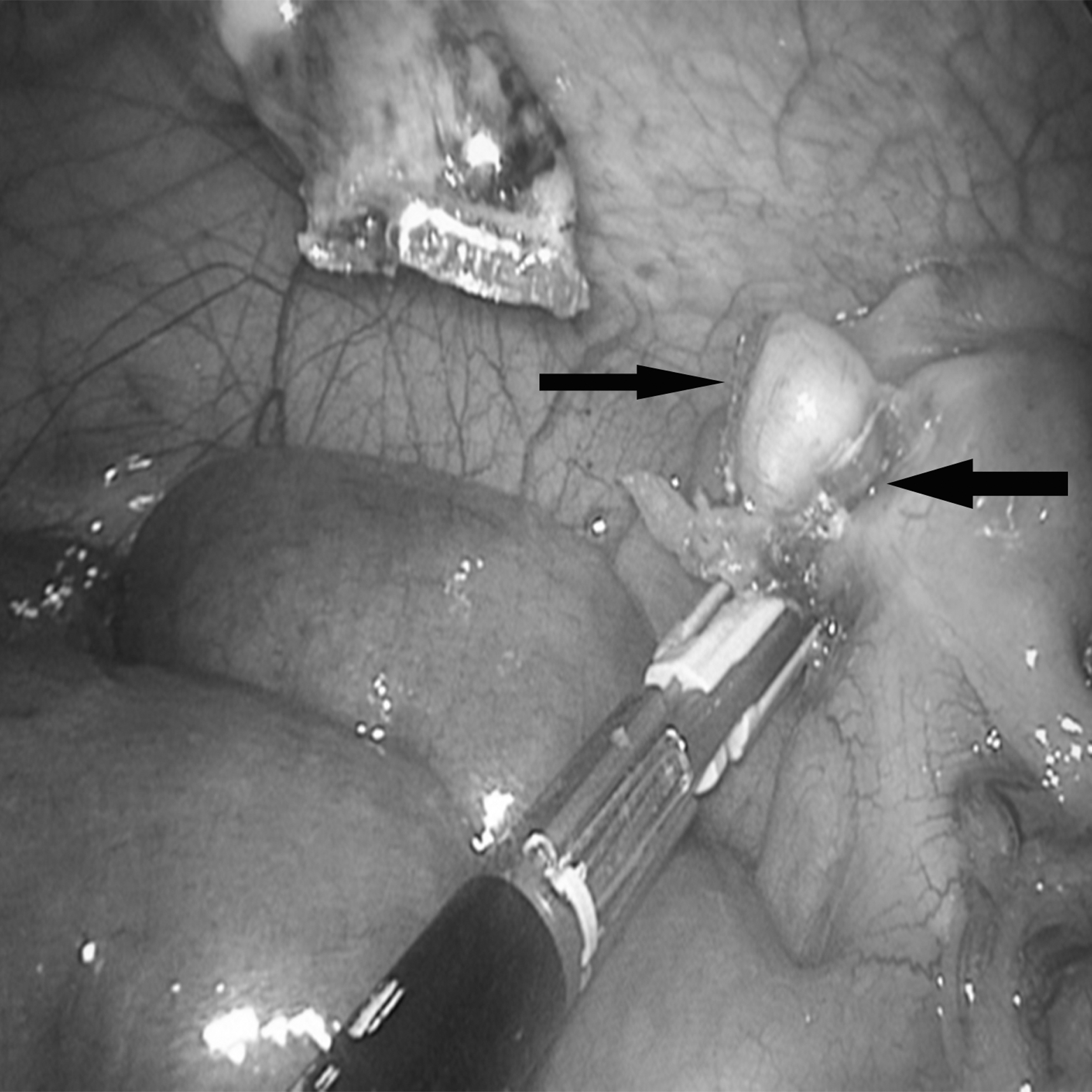
Sealing of the appendix stump with LigaSure and completion of the appendectomy. The thick black arrow shows the first step of the sealing process, the thin second black arrow demonstrates the second sealing step and transection of appendix that takes place 0.5 cm distal to the first sealing site.
Oral feeding was started 6 hours later, and they were discharged the next day. Patients are called to outpatient clinic for control in terms of routine wound infection or other complications 1 week later of hospital discharge. In case of any problem, patients are advised to admit to our hospital's emergency department or pediatric surgery clinic. The patients were followed for an average of 4 months.
Statistics
The data obtained from the study groups were evaluated with the “Statistical Package for Social Sciences for Windows 20” (SPSS, IBM Corp., Armonk, NY). The Kolmogorov–Smirnov test was used to test the normal distribution of the data. Mann–Whitney U test and Student's t-test were used for two-group comparisons. Continuous variables were expressed as mean ± standard deviation and median (first and third quartiles) according to distribution. Mann–Whitney U test and Student's t-test were used for two-group comparisons. P value <.05 was considered statistically significant.
Results
Of the 132 patients included in the study, 69 (52.3%) were boys and 63 (47.7%) were girls, and there was no difference between the groups in terms of gender. The mean age of the patients was 12.11. The mean operation time was 39.2 minutes in Group 1 and 29.6 minutes in Group 2. There was no significant difference between Groups 1 and 2 in terms of age and length of hospital stay (P = .126 and P = .784, respectively), but the operation time was found to be significantly shorter in Group 2 (P < .001), (Table 1).
Demographic Characteristics of the Patients
No postoperative stump leakage or intra-abdominal abscess was detected in either group. In Group 1, port entrance infection was detected in 2 patients and a postoperative ileus was identified in 1 patient, which resolved with conservative treatment. In Group 2, port entrance infection was found in only 1 patient and was found statistically significant (P = .043).
Discussion
The standard surgery in acute appendicitis was a conventional appendectomy up until 20 years ago. With the development of minimally invasive methods and the widespread use of laparoscopic instruments, laparoscopic appendectomy today is the method of choice preferred by most surgeons. There has been a rapid increase in laparoscopic interventions depending on the developments in technology. In addition to the advantages of laparoscopic operations, there are disadvantages such as the need for advanced technological tools and the lengthier operation times.
As the surgeon's experience increased and the instruments improved, laparoscopic surgeries began to be performed at the same time as the open surgical technique. In laparoscopic appendectomy, the most important step after the trocars are inserted is the division of the mesoappendix and ligation of the appendiceal stump. Whichever method is used, it is paramount to provide hemorrhage control with minimal equipment in a brief period, prevent stump leakage as well as avoid seeding of the infected matter to the surgical field and wound site.8,9 Instruments such as energy-based coagulation systems are becoming increasingly popular lately as they reduce operation time.
LigaSure is a bipolar sealing system with minimal thermal spread for vessels narrower than 7 mm. Tissue-based feedback mechanism programs the energy of these devices. 10 LigaSure denatures collagens with mechanical pressure and radiofrequency energy, thus ensuring reciprocal adhesion of tissues. 11 LigaSure has been shown to cause thermal injury in an area of <1.6 mm and can be used safely away from vital organs. 4 In another recent study, Shibao et al. found that LigaSure caused less thermal damage and shorter cooling time, especially in repetitive instrument use. 12 It has previously been shown that cauterizing the mesoappendix with LigaSure shortens the operation time.8,13 In our study, we divided the mesoappendix by LigaSure with ease in both groups, especially in cases where the mesoappendix was edematous and encountered no problems at all with the bleeding control. This led us to believe that it was effective in decreasing the operation time.
Inadequate ligation of the appendix stump causes complications such as postoperative fistula, sepsis, and peritonitis. 14 The ideal technique for tying the appendix stump should be safe, simple, and cost-effective. Although the use of an intracorporeal knot or endoloop is reasonably priced, it prolongs the operative time and may result in seeding of infective tissues from the distal appendix.9,15
In a study by Elemen et al., they compared appendectomies with LigaSure, endoclips, and conventional sutures and found better healing, less inflammation, shorter operative time, and similar burst pressures in the LigaSure group. 16 In the experimental study in rats, Aslan et al. found that the burst pressure in the cecum was similar in appendectomies performed with normal conventional suture and bipolar cautery. 5 In Gupta's study, the appendix stump was sealed twice, as performed in our own operations. 17
In recent publications, sutureless or clipless appendectomy is gaining attention.7,17,18 Application of foreign materials such as endoclips, endostapler, and endoloop may cause a foreign body reaction and postoperative adhesions. It has been reported that the endoclip and suture material used to tie the appendix stump can cause foreign tissue reaction, and that appendiceal stumps closed with endoclips and sutures recover with secondary wound healing mechanism. 16 Aydogan et al. compared LigaSure and endoclip in their study and found that the operative time was longer in the endoclips group and the rate of conversion to open surgery was higher. 19 In a recent study in children, it was shown that the use of endoclips in laparoscopic appendectomy caused more complications. 7 Although there were no clinical findings related to postoperative adhesion in both groups in our study, we hope that adhesions will be less encountered due to LigaSure utilization.
In the English literature to our knowledge, we could not stumble upon any clinical studies, neither in adults nor in children, demonstrating the sealing of the appendix stump with LigaSure. In this study, we found that the use of LigaSure resulted in shorter operative times and we detected no complications such as stump leakage, intra-abdominal abscess due to intra-abdominal seeding, or wound infection.
Conclusion
The use of LigaSure is a safe and fast method to seal the appendix stump in pediatric laparoscopic appendectomies. Although there is insufficient data to support the conclusions regarding adhesions and intra-abdominal infection reductions, we believe that infection complications due to stump leakage and intra-abdominal spilling will be reduced and postoperative adhesion would be decreased since there will be no foreign body in the postoperative period. Nevertheless, safety precautions should still be followed in terms of thermal injury when working close to vital organs. In addition, more comprehensive studies are needed to compare the effectiveness of LigaSure and harmonic scalpel with bigger patient numbers.
Footnotes
Authors' Contributions
Study conception and design by O.H.K.; data collection by O.H.K. and T.G.; analysis and interpretation of results by M.E.D. and M.E.B.; draft article preparation: O.H.K. and M.E.B. All authors reviewed the results and approved the final version of the article.
Disclosure Statement
No competing financial interests exist.
Funding Information
No funding was received from any source for this article.