




Abstract
Background:
With the development of surgical instruments and the growth of professional expertise over the past decades, laparoscopic pancreatoduodenectomy (LPD) is widely applied in different centers. However, there are still some controversies about the safety of this procedure. Meanwhile, perioperative outcomes are affected by hospital size, surgeon experience, and the learning curve. The purpose of this study is to compare the short-term outcomes of LPD with open pancreatoduodenectomy (OPD) at different stages of the learning curve.
Methods:
We retrospectively analyzed the clinical data of 911 patients who had received pancreatoduodenectomy (PD) at a single institution. Among them, 208 patients underwent OPD, and 703 cases received LPD successfully. We divided those patients into three phases based on the key point of the learning curve for LPD and compared the perioperative outcomes with OPD at each stage.
Result:
Morbidity and mortality rates associated with LPD were significantly higher in the initial stage than in the OPD group, whereas the number of harvested lymph nodes and R0 resection rate for pancreatic cancer were comparable to the OPD group. As surgical experience increased, postoperative complications, operating time, and intraoperative blood loss all are greatly decreased. At the mature stage of the learning curve, the rate of postoperative complications in LPD was lower than in the OPD group. Meanwhile, the length of hospital stay was significantly shortened compared to the OPD group.
Conclusion:
After a long period of training and learning, LPD can be performed safely. And LPD can produce comparable oncological results, with faster postoperative recovery and lower incidence of postoperative complications, after the surgeons successfully surmounted the learning curve.
Introduction
Pancreatoduodenectomy (
Some reports had showed that LPD has similar short-term and oncologic outcomes compared with open pancreatoduodenectomy (OPD), which has the advantages of minimal invasion, faster recovery, and shorter length of hospital stay.4,5
However, some potential doubts have been expressed about the performance of LPD, because the technique required for LPD is very sophisticated, even for experienced surgeons. Therefore, it would take surgeons a long time to practice those techniques over and over again; in addition, the perioperative and long-term results of patients are related to the surgeons' experience, learning curve, and hospital volume. 6 The learning curve for 1029 patients who received LPD was discussed and analyzed by Wang et al., who divided the learning curve into three stages: the initial stage (0–40), the stable stage (41–104), and the mature stage (>104). However, the research did not compare the perioperative outcomes with OPD at the same time. 7
On the basis of the research, we explored the learning curve of LPD and evaluated the demographics, postoperative complications, and oncologic results of 911 patients who underwent PD over 7 years, meanwhile, comparing the short-term outcomes with OPD at the same stage of the learning curve. To our knowledge, this is the largest single center study to date, so we hope that this report will help surgeons understand LPD in a comprehensive and profound way.
Patients and Methods
Patient population
Between April 2015 and June 2021, 911 patients received PD in our department. Of those patients, 703 patients underwent LPD, 208 patients received OPD. These patients were all operated upon by the same surgical team and provided informed consent before surgery. The indications of OPD are consistent with LPD. But, at the initial stage, the indications for LPD were those tumors without vascular invasion. If tumors are accompanied with vascular invasion, OPD is first choice in this stage. Along with the technical proficiency, those tumors with vascular invasion can be considered for indications of LPD in the stable and mature stage.
We underwent LPD with posterior colonic approach; however, OPD was with a traditional approach. The digestive tract reconstruction of LPD and OPD was performed by Child method, and pancreaticoje-junostomy was performed with Hong's needle method. We divided those patients into three phases according to the key point of learning curve with LPD (Fig. 1). Forty-three cases with LPD and 35 patients with OPD were performed in the initial stage. The stable stage was from December 2015 to September 2016, with 77 cases with LPD and 56 cases with OPD. The mature stage was from September 2016 to June 2021, and a total of 583 LPD and 117 OPD were successfully performed during this period.
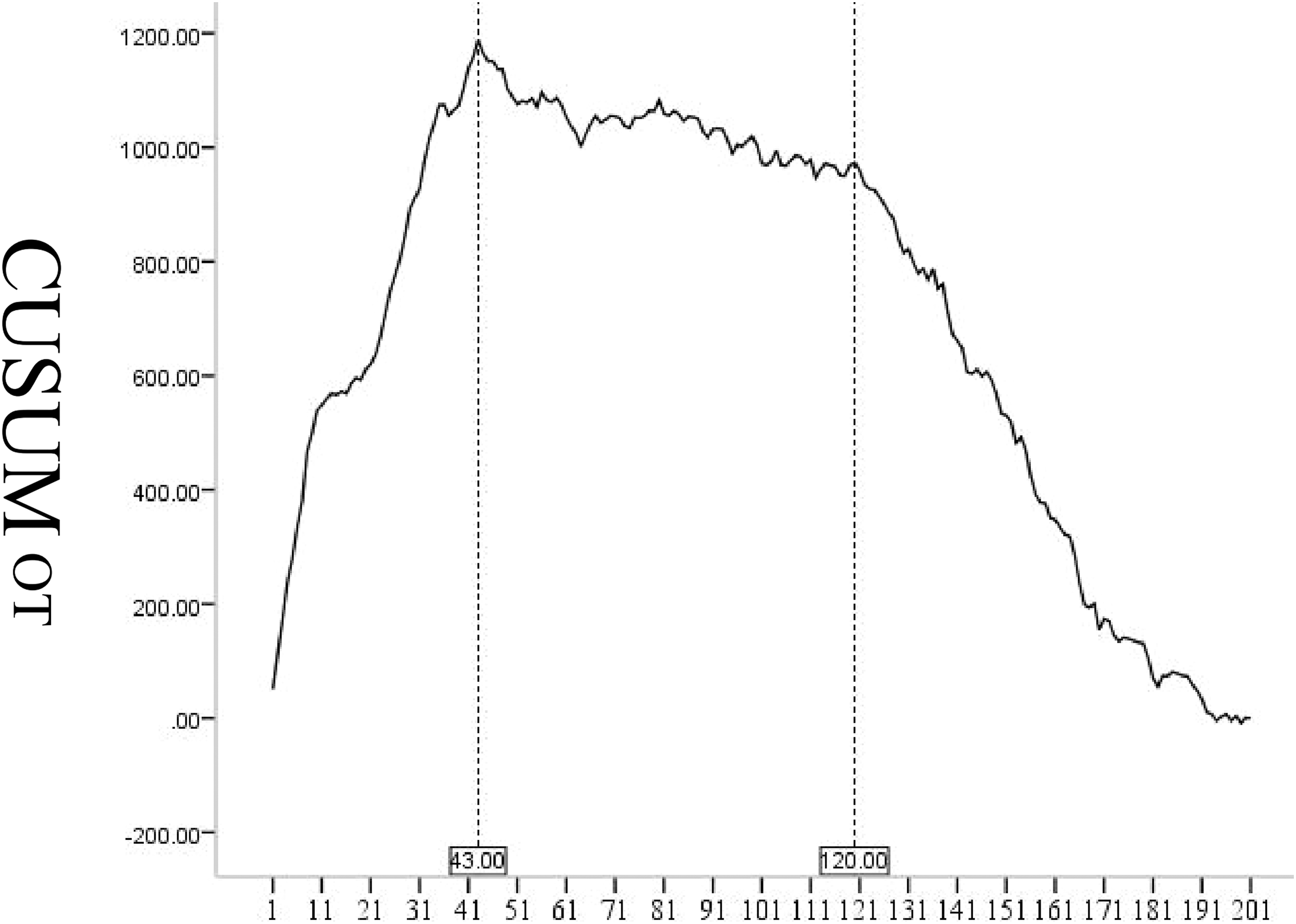
The learning curve of LPD in our department (R 2 = 0.965). LPD, laparoscopic pancreatoduodenectomy.
Date collection and definitions
These data were collected and entered into a database, including preoperative and intraoperative variables and postoperative outcomes. Preoperative variables included age, sex, body mass index (BMI), American Society of Anesthesiology Score (ASA), history of upper abdominal surgery, and comorbidities. Intraoperative variables included operative resection time, aberrant hepatic artery, estimated blood loss, vascular resection, blood transfusion, and concomitant resection. Postoperative outcomes included postoperative pancreatic fistula, bile leakage, delayed gastric emptying (DGE), postpancreatomy hemorrhage (PPH), and 90-day mortality, reoperation, Clavien-Dindo classification ≥grade III, pathological classification, the number of harvested lymph nodes, TNM stage, and R0 resection.
The definition and classification of POPF, 8 PPH, 9 DGE, 10 and bile leakage 11 are defined and graded according to corresponding international guidelines. Pathological examination followed the standardized protocol, and R1 resection means that the distance between the tumor's edge and the surrounding normal tissues is less than 1 mm at the microscopic scale. 12 Postoperative complications were categorized according to Clavien-Dindo classification. 13 Vascular resection was defined as any major vessels that required resection and reconstruction due to tumor invasion.
Statistical analysis
SPSS22.0 software was used to analyze these data. For quantitative variables, the results are expressed as the mean ± standard deviation. The results of skewed quantitative data were expressed as median with interquartile range. For categorical variables, the results were expressed as the number and percentage of cases. For continuous variables, we used the t-test or Mann–Whitney U test. The Kruskal–Wallis H test was used for pairwise multiple comparisons. P < .05 indicated that the difference between the two groups was statistically significant.
Results
Demographics and perioperative outcomes
Between April 2015 and June 2021, 911 patients received PD in our department, including LPD (n = 703) and OPD (n = 208). Table 1 shows the demographic data of LPD and OPD. There were no significant differences between two groups in terms of gender, age, complications, BMI, and preoperative biliary drainage; however, the OPD group seemed to have a greater proportion of patients with ASA grade III–IV than the LPD group. Perioperative outcomes and pathologic data are showed in Table 2. Compared with OPD group, LPD group had a shorter hospital stay (13.17 ± 3.55 versus 15.07 ± 4.23), less intraoperative blood loss (165.04 ± 56.81 versus 179.42 ± 67.18), and those were significant statistical significance between the two groups (P all <.05). Meanwhile, there were no significant differences in postoperative complications (Clavien-Dindo classification ≥grade III), POPF, PPH, bile leakage, and DGE. However, patients with LPD had longer operation time than those with OPD (254.99 ± 43.70 versus 232.31 ± 54.87, P < .001).
Demographics, Pathologic Data, and Perioperative Outcomes of 911 Pancreatoduodenectomy
BMI, body mass index; ENBD, endoscopic naso-biliary drainage; LPD, laparoscopic pancreatoduodenectomy; OPD, open pancreatoduodenectomy; PTCD, percutaneous transhepatic cholangial drainage; PTGB, percutaneous transhepatic gallbladder.
Pathologic Data and Perioperative Outcomes of 911 Pancreatoduodenectomy
DGE, delayed gastric emptying; LPD, laparoscopic pancreatoduodenectomy; OPD, open pancreatoduodenectomy.
At the same time, OPD group had a higher rate of multiple organ resection than LPD group (8 versus 4, P < .05), and compared with LPD group, OPD group had considerably higher with vascular resection and reconstruction (12 versus 10, P = .01). Within 90 days, the incidence of mortality was comparable between two groups (3.41% versus 4.80%, P = .352).
Pathological outcomes
After surgery, 574 patients in LPD group were diagnosed with malignant tumors (Table 3). Distal cholangiocarcinoma was the most common surgical indication (31.58%), followed by pancreatic cancer (24.89%). However, pancreatic cancer was the most common surgical indication in OPD group, accounting for about 52.40%, much higher than in LPD group (Table 4). In addition, it seemed that the tumor diameter was larger in OPD group (2.6 cm versus OPD 3.8 cm). At the same time, the number of harvested lymph nodes and the rate of R1 resection were similar between two groups.
Oncologic Results of 574 Patients who Underwent Laparoscopic Pancreatoduodenectomy with Malignant Tumors
Oncologic Results of 157 Patients who Underwent Pancreatoduodenectomy with Malignant Tumors
Comparison of perioperative data between the initial LPD learning curve and OPD of the same period
In initial stage, the operative time (355.39 ± 28.43 minutes versus 277.63 ± 38.11 minutes) and intraoperative blood loss (257.35 ± 80.12 mL versus 215.89 ± 81.10 mL) were longer than OPD. At the same time, the incidence of postoperative complications (≥CD III), POPF (Grade B/C), DGE, intra-abdominal sepsis, postoperative hemorrhage, and bile leakage [44.18% (19/43), 30.23% (13/43), 4.65% (2/43), 18.60% (8/43), 11.62% (5/43), 4.65% (2/43)] were higher than that in OPD group [31.43% (11/35), 14.28% (5/35), 2.85% (1/35), 20.0% (7/35), 8.57% (3/35), 2.85% (1/35)]. But there were no significant differences between two groups (all P > .05, Table 5). In addition, the incidence of pleural and abdominal effusions was slightly lower in LPD group than OPD group (18.60% versus 28.57%), but those differences were not statistically significant (P = .299).
Comparison of the Outcomes Between the Initial Stage of Laparoscopic Pancreatoduodenectomy and Open Pancreatoduodenectomy for the Same Period
BMI, body mass index; DGE, delayed gastric emptying; LPD, laparoscopic pancreatoduodenectomy; OPD, open pancreatoduodenectomy.
Comparison of perioperative data between stable LPD learning curve and OPD of the same period
In stable stage, the amount of intraoperative blood loss and operation time were still much greater than those in OPD group, and the differences were statistically significant. However, compared to those in initial stage, both intraoperative blood loss and operation time were considerably reduced. However, the incidence of pancreatic fistula (Grade B/C), intra-abdominal sepsis, postoperative hemorrhage, R1, was still higher than that in OPD group. But there were no significant differences between two groups (P > .05, Table 6). LPD group had a smaller number of harvested lymph nodes (13.49 ± 5.22 versus 14.09 ± 3.54) and a longer hospital stay (15.48 ± 4.34 days versus 14.91 ± 3.98 days) after surgery than those with OPD, but they didn't make sense (all P > .05). Meanwhile, 2 patients in LPD group underwent concomitant vascular resection, during this time, contrast to 4 patients in OPD group (2.59% versus 7.14%, P = .212).
Comparison of the Outcomes Between the Stable Stage of Laparoscopic Pancreatoduodenectomy and Open Pancreatoduodenectomy for the Same Period
BMI, body mass index; DGE, delayed gastric emptying; LPD, laparoscopic pancreatoduodenectomy; OPD, open pancreatoduodenectomy.
Comparison of perioperative data between mature LPD learning curve and OPD of the same period
In mature stage, we compared perioperative data between LPD and OPD (Table 7), discovering that the incidence of postoperative complication (≥CD III), intra-abdominal sepsis, pancreatic fistula (Grade B/C), reoperation, and DGE are all lower than that in OPD group; however, those differences were not statistically significant. But the length of hospital stay (12.66 ± 3.10 days versus 14.62 ± 3.09 days), operative time (242.00 ± 31.27 minutes versus 203.86 ± 39.74 minutes), and pleural and abdominal effusion (10.97% versus 17.09%) were statistically significant (P all <.05). However, in this stage, compared with OPD group, LPD group had more intraoperative blood loss (154.10 ± 49.53 mL versus 164.96 ± 61.82 mL, P = .039), but it was not statistically significant.
Comparison of the Outcomes Between the Mature Stage of Laparoscopic Pancreatoduodenectomy and Open Pancreatoduodenectomy for the Same Period
BMI, body mass index; DGE, delayed gastric emptying; LPD, laparoscopic pancreatoduodenectomy; OPD, open pancreatoduodenectomy.
Discussion
With the development of laparoscopic techniques and accumulation of surgical experience, LPD has gradually gained wide acceptance since 2010 in many high-volume pancreatic surgery centers.14,15 And the safety and feasibility of LPD have been confirmed by numerous researches. As early as in 2011, Gumbs et al. reported 285 patients who were performed LPD, which confirmed the safety and feasibility of LPD. 16 An increasing number of researches have shown that LPD offers some significant advantages over OPD, such as earlier oral intake, less blood loss, shorter hospital discharge time, less pain, faster recovery, and similar short-term morbidity and mortality rates.17,18 A multicenter randomized controlled trial showed that LPD has advantages for postoperative recovery and was equivalent in operation time and oncological results. 19
However, there are various controversies about the development of LPD. De Rooij et al. considered that if a low-volume center did fewer than 10 MIPDs (minimally invasive pancreatectomy) annually, the risk of death after MIPD would be doubled compared to OPD (8% versus 3%; P = .01). 20 Some researchers thought that LPD was linked to more complication-related deaths than OPD and that experience, learning curve, and annual volume might have influenced perioperative outcomes; therefore, they are worried about the safety of LPD. 21 Meanwhile, several researchers discovered that along with the accumulated surgical experience and passing through the learning curve, the incidence of postoperative complications for LPD will be significantly decreased.22–24 A multicenter retrospective study categorized the learning curve of LPD into three phases, but this study lacked a comparison of LPD and OPD simultaneously at each stage. 14
As a result, we compared the short-term outcomes of LPD with OPD at different phases of learning curve in this study. Compared to OPD, LPD has no evident advantages in initial stage. Due to lack of surgical experience, operation time and intraoperative blood loss during LPD were significantly greater than those during OPD. Meanwhile, perioperative complications such as pancreatic fistula, DGE, bile leakage, intra-abdominal sepsis, reoperation, and postoperative hemorrhage were much greater in LPD group than those in OPD group, but those differences were not statistically significant. Meanwhile, complication-related deaths were also significantly higher in LPD group than in OPD group (6.98% versus 5.71%). Nevertheless, there was no significant difference in the number of harvested lymph nodes and R0 resection rate between two groups at initial stage indicating that while the incidence of postoperative complications was higher in LPD group, the oncological outcomes could be comparable with OPD.
With the accumulation of surgical experience, LPD had some advantages over OPD. The operation time for LPD was shortened further, and the amount of intraoperative blood loss was also reduced compared with those at initial stage; in addition, the incidence of complications and its corresponding mortality are declining at an alarming rate. And the rates of postoperative complications were comparable to those associated with OPD at stable stage. After entering mature stage, LPD had several potential advantages over OPD. Postoperative complications associated with LPD were much less than those related to OPD, and the length of hospital stay was also significantly shortened, with statistical significance, compared to the OPD group (P < .001). And it leaded to better health outcomes and faster recovery.
In addition, the number of harvested lymph nodes and the rate of R0 resection were improved in LPD group compared to the previous stage, although the differences were not statistically significant compared to OPD group during the same stage. Based on the results of this study, we believed that radical tumor resection can be achieved with LPD, but the safety needed to be improved further and postoperative morbidity and mortality rates related with LPD were higher in the initial stage.25,26 However, as surgical experience accumulated over time, there was a substantial decrease in length of hospital stay, postoperative complications, and R1 rate indicating that continued improvement in surgical performance had a positive impact on patient outcomes. 27
However, the study has some limitations. First, in initial stage of LPD, we often preferentially select OPD for those patients with vascular invasion, so this may have caused a certain selection bias in LPD and OPD group, which may affect the results between two groups. Second, this is a retrospective study, which requires further prospective study to verify the results. Third, in this study, we only studied the short-term complications of LPD and OPD, so further studies are needed to verify the long-term results of two groups.
In conclusion, with the accumulation of experience, postoperative complications and mortality related to LPD decreased gradually. Meanwhile, the learning curve can influence the incidence of perioperative complications and mortality. After the surgeons have surmounted the learning curve, compared with OPD, LPD can achieve similar oncological results, as well as faster postoperative recovery, with a lower incidence of postoperative complications, which has obvious advantages.
Footnotes
Acknowledgment

Authors' Contributions
Conception and design: Y.L., S.W. Data analysis and interpretation: C.J., L.L., and Y.F. Article writing: All authors. Final approval of article: All authors.
Disclosure Statement
No competing financial interests exist.
Funding Information
No funding was received for this article.