




Abstract
Introduction:
Ensuring patient safety in minimally invasive surgery (MIS) within the field of pediatric surgery requires systematic and extensive practice. Many groups have proposed mastery learning programs encompassing a range of training methods. However, short courses often have a narrow focus on specific objectives, limiting opportunities for sustained training. Our aim was to analyze our results with an online long-term competency-based and supervised training.
Methods:
This is a retrospective cohort study with prospective data collection of scores and performance of trainees during online courses from October 2020 to April 2023.
Results:
All participants (n = 76) were able to set up their personal training gym and complete the intensive stage of the course. The total score evolved from 2.60 ± 0.56 at the first meeting to 3.67 ± 0.61 at the fourth meeting, exhibiting a significant difference (P < .013). A considerable drop out was observed in the follow-up stage, with only 53.8% of the participants completing the course. When compared with the first meeting, they also showed a significant improvement with a mean general score of 3.85 ± 0.25 (P < .013)
Conclusion:
We have presented a novel online training program, based on continuous training that demonstrated that the unlimited access to a personal training gym allows surgeons to improve and maintain MIS skills.
Introduction
Ensuring patient safety in minimally invasive surgery (MIS) within the field of pediatric surgery requires systematic and extensive practice. However, due to the rarity of certain conditions, acquiring the necessary psychomotor skills can be challenging, particularly for surgeons with limited experience. 1 Consequently, it has become imperative to seek skill acquisition outside the operating room since it has shown a better patient outcome. 2 Simulation-based education (SBE) has emerged as a crucial approach to facilitate the acquisition of competence in a safe environment, while also offering cost-effective alternatives.1,3–5 Even experienced surgeons can benefit from SBE by maintaining and enhancing their skills. 6
In recent years, various groups have proposed mastery learning programs encompassing a range of training methods, from on-site instruction to virtual assistance.7–11 However, short courses often have a narrow focus on specific objectives, limiting opportunities for sustained training beyond the duration of the course. It has been observed that participants in such courses express a desire to continue practicing exercises to preserve their acquired skills.
Therefore, our objective was to analyze our results with an online long-term competency-based and supervised training.
Materials and Methods
This is a retrospective cohort study with prospective data collection of scores and performance of trainees during online courses from October 2020 to April 2023. Participants were categorized into three different levels of expertise according to the number of surgeries performed. (1—beginner, <20 MIS; 2—intermediate, between 21 and 60; 3—advanced, >60).
A specialized training model was developed according to our previous published guide for long-term MIS courses. 6
Setting up the personal gym
Upon registration, each trainee received a package containing the necessary materials to set up their personal gym at their provided address. The package included the MTBOX 7 box trainer, an endocamera, a kit for performing essential exercises, and 5 mm laparoscopic surgery instruments (scissors, Maryland dissector, grasper, and a needle holder). Trainees were responsible for assembling their personal gym (Fig. 1) by connecting the provided materials to a notebook and a secondary device, following the provided tutorials. Before the start of the course, a virtual technical meeting was conducted to assist participants in the setup process.
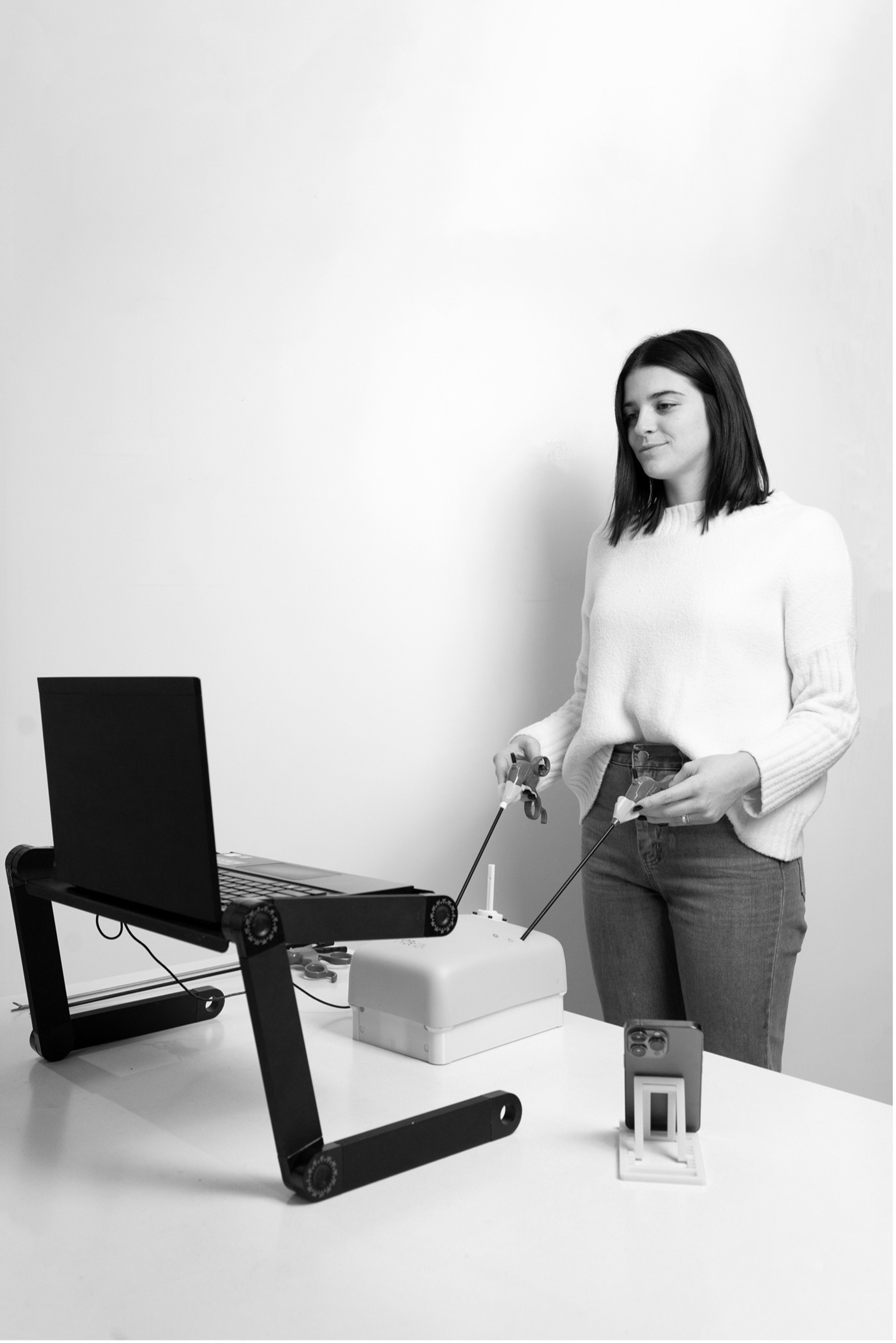
Diagram illustrating the setup of the personal gym.
Organization of the course
The online SBE program consisted of both synchronous and asynchronous activities. All the necessary support materials such as bibliographies, exercises, videos, and tutorials, as well as assignments, were made available to the students through a virtual classroom created using the web-based instructional platform Google Classroom®. The materials were organized into six didactic modules corresponding to each stage of training, along with general considerations.
Synchronous virtual meetings were conducted using the Zoom® platform. Debriefing sessions were held at the beginning and end of each educational session, and breakout rooms were utilized to facilitate small group interactions. Each faculty member interacted with no more than 2 participants at a time. Trainees were assessed by faculties through two different cameras, capturing their movements inside and outside the trainer (Fig. 2).
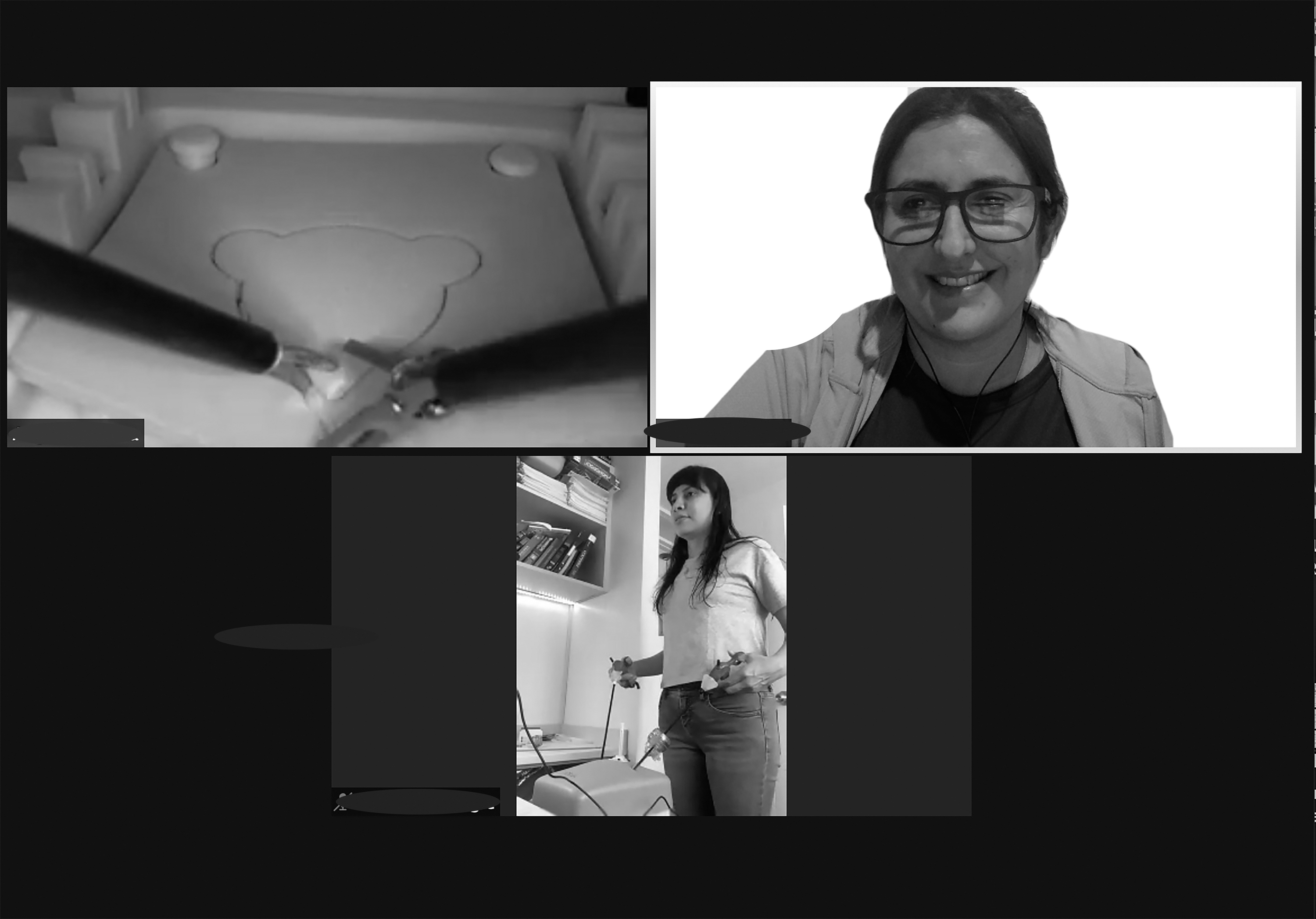
Synchronous online meeting. One instructor with 1 participant.
Asynchronous activities were also incorporated into the course. Participants were required to upload videos of their training to the virtual classroom and complete forms to evaluate their weekly progress and register any requests. Communication between meetings was maintained through email and WhatsApp®, where instructors responded to participant questions in an informal manner.
Both types of activities were maintained along the two stages of the course.
Course stages
(a) Intensive stage (first month): The main objective of this stage was to exercise and develop technical skills. Synchronous activities consisted of four weekly 3-hour meetings, during which participants trained with the faculties. Trainees were expected to review the supporting materials before each meeting. After each session, they received a personalized report containing their outcomes and suggestions for further training. To assess progress in this stage, exercises from the first three meetings were repeated in the final meeting. The same instructor who had evaluated the trainee's progress in the earlier meetings conducted the final assessment and developed a follow-up program.
(b) Follow-up stage (2nd to 6th month): The goal of this stage was to maintain and improve the skills acquired during the previous period. Participants were provided with different tasks and tutorials to continue their training. Two virtual meetings were held in the fourth and sixth months to review participants' skills and progress. In addition, goals and ergonomics were reassessed during these meetings. The training course concluded at the end of the sixth month.
Exercises and GOALs
The training meetings included a series of exercises, which were progressively introduced during the intensive stage. Table 1 provides a summary of the exercises performed during the training. These exercises were selected and developed from the Fundamentals of Laparoscopic Surgery Program. 12 In addition, five GOALs 13 were established to assess manual skills (Table 2). Faculty members assigned scores ranging from 1 to 5 for each GOAL based on their observations. As said previously, the assessment of exercises and GOALs occurred in both the intensive and follow-up stages. The general score was obtained by adding each score and dividing it by the total of scores.
Exercises Included in the Training Period
GOALs Assessed by the Instructor
Data collection
Upon enrollment, participants completed multiple forms. In the initial survey, they were informed about the scientific use of the data collected during the training courses. The forms included:
Initial assessment form: Participants provided information about their previous experience and biometric data. Middle term survey: This survey ensured participants' engagement with the course and checked whether they were performing the recommended training. Intensive stage survey: Participants evaluated the outcome of the intensive stage. Final survey: Filled at the end of the follow-up stage, this survey evaluated the overall course and allowed participants to share their experiences with the personal gym and the online course.
Tutors were required to fill a form during and after every meeting assessing the GOALs' score of each participant for each exercise.
All the information was later gathered to be analyzed.
Statistical analysis
In this study, a comprehensive statistical analysis was performed to assess the data collected. Numerical variables were summarized using the mean and standard deviation. Ordinal variables, in contrast, were summarized using the median and percentages. To investigate the significance of differences between two groups, the F-test two-sample for variances was employed. A critical significance level of P < .05 was chosen.
Results
Between October 2020 and August 2023, we had 76 participants but only got full data on 63 participants (39.6% male), from 5 different Hispanic countries.
All participants were able to set up their personal training gym with no difficulties and 100% completed the intensive stage of the course. During this initial stage, 70% answered the surveys, all of whom managed to train with an average of 4.4 hours per week.
When comparing the scores in meeting I and IV in the intensive stage, the total score evolved from 2.60 ± 0.56 at the first meeting to 3.67 ± 0.61 at the fourth meeting, exhibiting a significant difference (P < .013). As it can be observed in Figure 3A, not only the minimum score was increased but also the group showed a more uniform behavior.
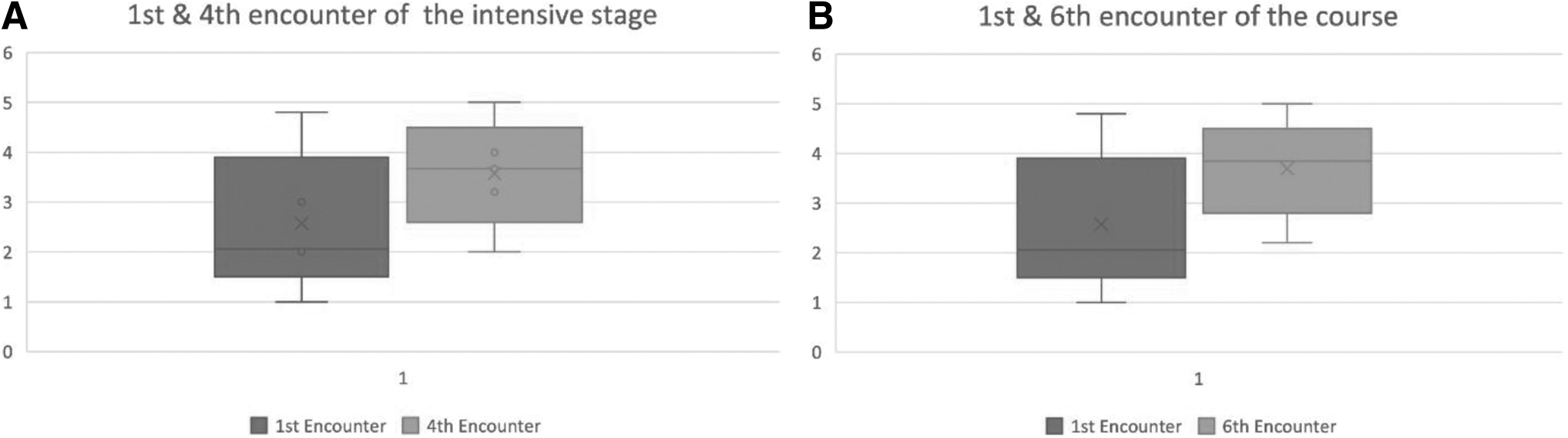
Statistical analysis of scores between the encounters.
According to the “middle term” and “intensive stage” surveys, the use of the trainer, together with the online course, was useful for skills acquisition.
A considerable drop out was observed in the follow-up stage, with only 53.8% of the participants completing the course. Of them, 31.4% attended both meetings, 17.1% only the fourth-month meeting, and 51.5% the sixth-month meeting. Of those who participated, only 24% incorporated training routinely, for >2 hours per week.
At the end of this stage, 97.15% of the assessed participants maintained or improved their skills when compared with the first meeting with a mean general score of 3.85 ± 0.25 (P < .013) (Fig. 3B), the mean scores from the fourth encounter to the 6-month test, of those who attended, improved from 3.77 ± 0.24 to 3.85 ± 0.25 though it was not significant.
Discussion
The results of this study provide valuable insights into the effectiveness of a new educational online proposal for MIS, based on a structured and personalized training course, with a focus on skills acquisition and maintenance. As the data demonstrated, the course had a significant positive impact on participants' skills, as well as their ability to set up and maintain personal training gyms.
One of the notable strengths of the course was the high level of participant engagement and completion of the intensive stage with 100% of them completing this initial phase.
The analysis of skills development between the first and fourth meetings during the intensive stage revealed participants improved their skills, with a statistically significant increase in the total scores from 2.60 ± 0.56 at the first meeting to 3.67 ± 0.61 at the fourth meeting. The same pattern was observed at the last encounter of the follow-up stage with mean scores of 3.85 ± 0.25.
The findings of this study are consistent with current research, which highlights the efficacy of training for enhancing laparoscopic skills.1,14,15 Moreover, they corroborate earlier studies suggesting that online training can yield results comparable to traditional in-person training.7,8,10 In addition, it changes the current flow of short-term courses to a more sustained program that favored skill retention.
However, it is essential to acknowledge a significant dropout rate during the follow-up stage, with only 53.8% of participants completing the course. Furthermore, a relatively low proportion (24%) managed to incorporate training into their routines for >2 hours per week. This could have happened due to extensive working hours that surgeons are used to have, or lack of acknowledging the benefits of continuous training. Nevertheless, among those who completed the program, an impressive 97.15% maintained or improved their skills.
Although these results suggest the course's effectiveness in fostering skill retention among actively engaged participants, it is essential to recognize that our study's limitations lied in the dropouts and a lack of information on nonpracticing individuals. Further attempts to maintain the surgeon's interest in training are being done including the incorporation of more challenging scenarios.
Conclusions
We have presented a novel online training program, based on continuous training and mastery learning that demonstrated that the unlimited access to a personal training gym allows surgeons to improve and maintain MIS skills. In addition, the personalized mentoring, with on-demand specific material guaranteed high adhesion to the program.
Footnotes
Authors' Contributions
Study conception and design were contributed by C.G., I.D., S.V., A.M.P., and C.M. Data acquisition was carried out by R.K., M.B., and A.C.F. Analysis and data interpretation were done by C.G., I.D., and C.M. Drafting of the article was by C.G. and A.M.P. Critical revision was done by G.B.M. and C.M.
Disclosure Statement
G.B.M. is the owner of We Train. C.M. is the CEO of We Train. C.G., I.D., S.V., R.K., and M.B. work as instructors for We Train.
Funding Information
No funding was received for this article.