




Abstract
Purpose:
This study aims to evaluate the educational quality and appropriateness of laparoscopic radical nephrectomy videos on YouTube using the LAParoscopicsurgery Video EducationalGuidelineS (LAP-VEGaS) criteria. It focuses on understanding the role of online resources in medical education and objectively assessing their quality.
Methods:
A search was conducted on YouTube™ for “laparoscopic radical nephrectomy” on August 15, 2023, leading to the selection of the first 125 videos. Videos were chosen based on length (over 1 minute), content (laparoscopic radical nephrectomy), language (English), and nonindustry sponsorship. The LAP-VEGaS criteria, encompassing 16 items under five main categories: video introduction, case presentation, procedures, outcomes, and educational content, were used for evaluation, assigning 0 or 1 point per criterion.
Results:
Out of 100 videos meeting the criteria, they were divided into two groups: personal uploads by expert surgeons (Group-1) and institutional uploads by hospitals and organizations (Group-2). Group-2 videos had longer durations and higher LAP-VEGaS scores. The transperitoneal approach was preferred in 88% of the videos, and 84% were right laparoscopic nephrectomies. Group-2 had significantly higher LAP-VEGaS scores (6.3 ± 2.2) compared with Group-1 (4 ± 2.1) (P < 0,001). The number of videos published over the years increased, while LAP-VEGaS scores fluctuated.
Conclusion:
Assessing laparoscopic radical nephrectomy videos on YouTube™ using the LAP-VEGaS criteria helped understand the role of online sources in medical education. Institutional uploads were found to be more successful in educational aspects, emphasizing the need for continuous quality review of online medical education materials. This study also guides how to evaluate and improve medical education materials on online platforms.
Introduction
The internet is now considered to be the largest and most up-to-date source of medical information and evaluation. In recent years, health professionals have increasingly used it to obtain medical information.1,2 YouTube™, currently the second most visited website worldwide after Google, serves as a video sharing platform.3,4 In the field of medical education, YouTube™ has gained prominence among operating theatre nurses, medical students, junior doctors, and consultants. However, despite its widespread use by surgical teams, there is no control mechanism regarding the appropriateness, accuracy, and educational value of medical videos uploaded to YouTube™.5,6
Radical nephrectomy (RN) is the gold standard treatment for nonmetastatic renal cell carcinoma (RCC). RN was first described by Robson in 1963. 7 Towards the end of the 20th century, laparoscopic transperitoneal and retroperitoneal radical nephrectomies were performed and the first transperitoneal laparoscopic RN was performed by Copcoat et al. in 1991. 8 Nowadays, the laparoscopic method is preferred to the open method for RN. Among the laparoscopic methods, the transperitoneal approach is more popular because the retroperitoneal approach has a limited working area compared with the transperitoneal approach.
The LAP-VEGaS (LAParoscopicsurgery Video EducationalGuidelineS) guideline was created in 2018 by a committee of 33 surgical specialists, including a urological surgeon. The LAP-VEGaS guideline includes 16 criteria (see Table 1). In defining these criteria, the committee members reached a common consensus of 82%. The aim of LAP-VEGaS is to produce videos suitable for high quality education and training. 9
Summary of LAP-VEGaS Criteria
LAP-VEGaS, LAParoscopicsurgery Video EducationalGuidelineS.
Statistical Analysis
Table-2 Comparison of personal uploads and instutitional uploads of Youtube contents.
Mann–Whitney U test.
Pearson’s chi-square test.
The aim of this study is to evaluate the video quality and educational value of laparoscopic RN videos on YouTube™ according to the LAP-VEGaS guidelines.
Materials and Methods
On 15 August 2023, a search was performed on YouTube™ by typing “laparoscopic radical nephrectomy” into the search box. As a result of the search, the URL addresses of the first 125 videos were recorded. The inclusion criterion was set as laparoscopic radical nephrectomy videos. Exclusion criteria were defined as; videos shorter than 1 minute; videos sponsored by an industrial company; use of a language other than English in the video description or content; videos about complications of laparoscopic radical nephrectomy.
The LAP-VEGaS criteria consist of 16 criteria under five main headings: video introduction, case presentation, procedures, outcomes, educational content. Video introduction; title, including pathology and procedure, author information, and disclosures. Case presentation; patient anonymity, imaging, baseline patient characteristics, preoperative workup, and treatments. Procedures; theatre set-up and equipment required, patient, surgeon and trocar positions, anatomical demonstration, step-by-step approach. Outcomes; theatre and hospital time, morbidity, images of wounds and specimens, functional outcomes. Educational content; pictures, snapshots, diagrams and tables, audio/written commentary. For each of the 16 criteria, a score of 1 is given if the video content is present and 0 if it is not. Videos evaluated using the LAP-VEGaS criteria receive a score between 0 and 16.
Video duration, number of views, number of likes, and the type of account that uploaded the video to YouTube™ were assessed and recorded according to the LAP-VEGaS criteria by 2 surgeons who were adequately trained to perform laparoscopic RN and routinely perform laparoscopic RN. The type of upload account was analyzed in two separate groups: individual uploads and institutional uploads. Institutional accounts were defined as official institute or hospital accounts, congresses, and accounts belonging to urological associations.
Statistical analysis
SPSS 25.0 (IBM Corp., New York, USA) was used for statistical analysis. Normality tests were assessed using the Kolmogorov–Smirnov test. Descriptive statistical methods (mean, standard deviation, frequency, ratio, percentage) were used to evaluate the study data. Mann–Whitney U test and chi-square test were used for paired groups. Statistically significant P value was defined as <.05.
Results
In our study, 100 videos were deemed suitable for the study after the exclusion criteria were applied. Personal uploads by the expert surgeons included in the study were designated as Group-1 (n = 64). The uploads made by institutes, hospitals, and institutional organizations (association, congress secretariat, etc.) were designated as Group-2 and compared statistically (see Table 2). The median video duration was significantly higher in Group-2 (20 versus 10). However, the video duration showed a very wide range between videos (from 1 minute to 101 minutes). The median number of views was higher in Group-2, but this finding was not statistically significant (1402 versus 802). The number of likes was significantly higher in favor of Group-2 (15.5 versus 6, P = .021).
In 88 videos (88%), the transperitoneal approach was preferred. However, there was no significant difference in the distribution of surgical procedures between Group-1 and Group-2. Right laparoscopic nephrectomy was performed in 84 (84%) of the uploaded videos.
The LAP-VEGaS score was found to be 6.3 ± 2.2 in Group-2, whereas this value was only 4 ± 2.1 in Group-1 and was found to be statistically significant (p < .001). The main results of the analyses were that the videos from institutional uploads were more successful in terms of educational content, the average video duration was longer, and they were watched and liked more.
The scan data between 2009 and 2023 were grouped into 5 equal time periods, and the number of videos uploaded over the years and the change in LAP-VEGaS scores obtained over the years were plotted graphically (see Fig. 1). While the number of uploaded videos increased over time, the LAP-VEGaS score showed a fluctuating trend. The highest LAP-VEGaS score was obtained in the time interval 2018–2020, and this value was found to be 5.7 ± 2.4. The lowest mean LAP-VEGaS score was found in the period 2021–2023 (3.6 ± 2.1). The number of videos published tended to increase steadily over the defined time periods. It was observed that a total of 38 videos were published between 2021–2023. It was also found that approximately 2/3 of the videos published as a result of a total of 15 years of screening were published in the past 6 years.
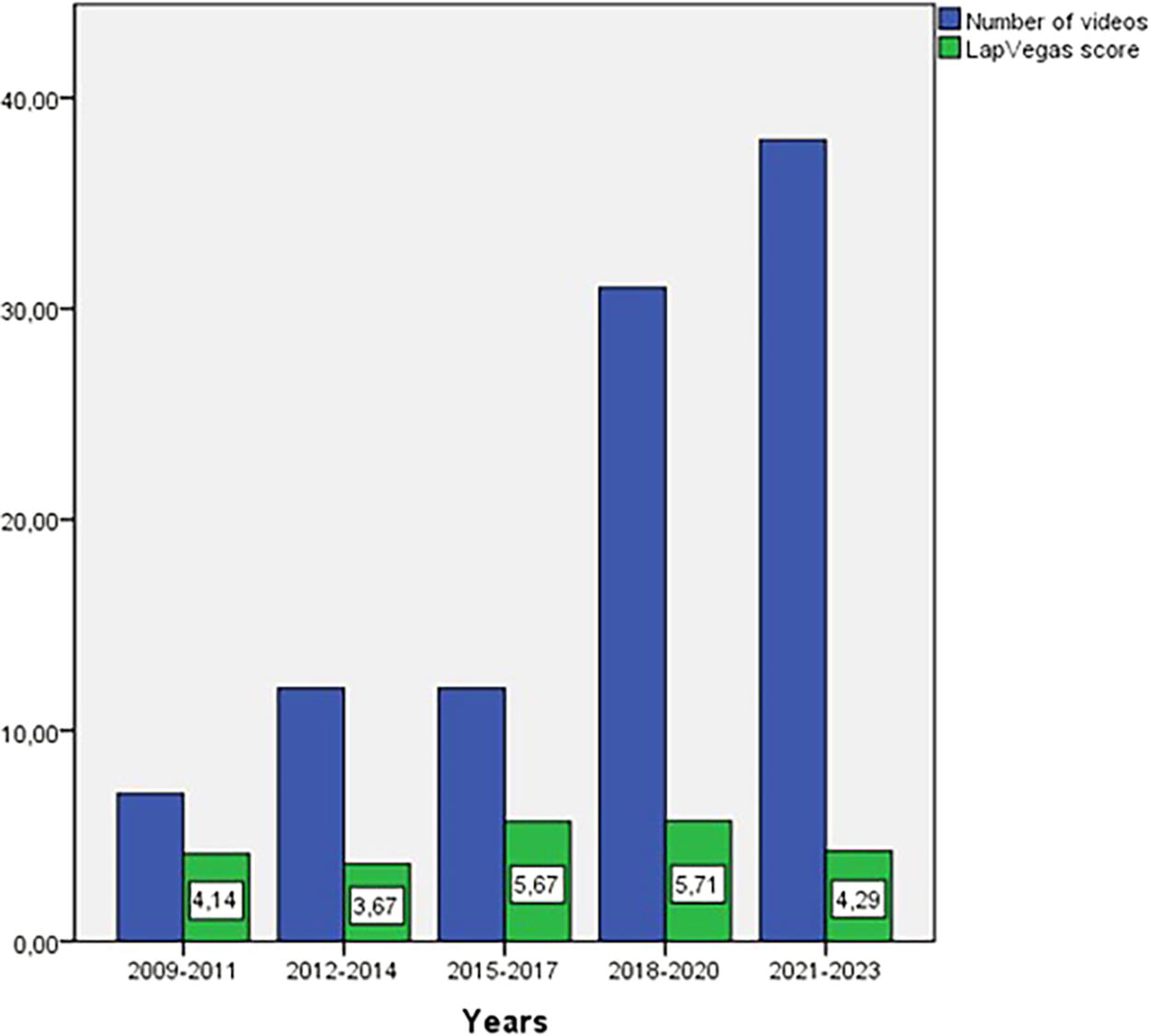
Change in LAP-VEGaS scores over the years.: The scan data between 2009 and 2023 were grouped into 5 equal time periods and the number of videos uploaded over the years and the change in LAP-VEGaS scores obtained over the years were plotted graphically (see Fig. 1). While the number of uploaded videos increased over time, the LAP-VEGaS score showed a fluctuating trend. The highest LAP-VEGaS score was obtained in the time interval 2018–2020, and this value was found to be 5.7 ± 2.4. The lowest mean LAP-VEGaS score was found in the period 2021–2023 (3.6 ± 2.1). The number of videos published tended to increase steadily over the defined time periods. It was observed that a total of 38 videos were published between 2021–2023. LAP-VEGaS, LAParoscopicsurgery Video EducationalGuidelineS.
Discussion
With the growing popularity of the internet, online resources for health information and education are becoming increasingly important. In particular, video-sharing platforms such as YouTube™ are widely used as medical educational material. However, there are serious concerns about the quality and educational value of these videos. In our study, we evaluated laparoscopic radical nephrectomy videos available on YouTube using the LAP-VEGaS criteria.
Davies et al. examined the information-seeking behavior of physicians and showed that the internet is playing an increasing role in the acquisition of medical information. 1 Similarly, Rössler et al. evaluated the quality of medical information presented on platforms such as YouTube™ and found that it varied across different topics. 2 These findings highlight the importance of quality control mechanisms to increase the confidence of health professionals and students in online resources.
Madathil et al. emphasized that health information on YouTube™ should be systematically reviewed and its quality assessed. 4 Similarly, Gupta et al. found an inverse correlation between the popularity of YouTube™ videos that may contribute to the education of general surgery residents and the quality of the video. 10 In their study of the educational quality of laparoscopic right hemicolectomy videos on YouTube™, Moctezuma-Velázquez et al. found no correlation between the LAP-VEGaS score and the number of views and likes. The LAP-VEGaS score was significantly higher for videos uploaded by medical associations, journals, compared with videos uploaded by doctors/physicians or academic associations. 11 On the other hand, the reason why the LAP-VEGaS score of the videos uploaded to YouTube™ by institutes, hospitals and institutional organizations (association, congress secretariat, etc.) in our study was higher than the other group is thought to be possibly passing through a control mechanism prior to upload. These findings highlight the need to evaluate medical education materials on online platforms.
Piskin et al. evaluated the quality and educational value of laparoscopic surgery training videos on YouTube™. Their findings highlight the importance of online resources in laparoscopic surgery education. 12 Dincer et al. compared the quality of laparoscopic surgery videos on the WebSurg® and YouTube™ platforms and showed that online platforms can meet different educational needs. 13 In the light of our study, it seems more appropriate to follow YouTube™ content produced by institutes, hospitals, and institutional organizations (associations, congress secretariats, etc.) than other sharing platforms, as the place of the internet in obtaining education and information has increased significantly.
Aktöz et al., found the educational value and quality of videos on Websurg® to be of better quality than YouTube™ when evaluating the educational reliability and quality of laparoscopic hysterectomy videos both platforms. 14 Websurg® was created by minimally invasive surgeons to improve the knowledge and training of surgical teams 15 In our study, similar to Websurg®, videos produced by institutes, hospitals, and institutional organizations (association, congress secretariat, etc.) were found to be more suitable for training.
On the other hand, analyzing the distribution of published videos over time shows that LAP-VEGaS scores fluctuate over time, with the highest scores being achieved in certain periods. This highlights the need for continuous monitoring and updating of the quality of online medical content.
In our study, the evaluation of laparoscopic radical nephrectomy videos using the LAP-VEGaS guidelines is an important step in determining the educational value and quality of online resources. The LAP-VEGaS guidelines are a comprehensive tool to objectively assess the quality of educational materials. Our results show that videos of institutional underwriting are more successful in terms of education and that LAP-VEGaS scores are higher for these videos. However, there is a need for continuous review and updating of training materials offered on online platforms.
Online platforms such as YouTube™ can be an important resource for medical education, but care should be taken to ensure the quality and accuracy of the content. The use of guidelines such as LAP-VEGaS can be a useful tool in assessing the quality of content and developing educational materials. In addition, more emphasis should be placed on content produced by professional medical organizations and various methods should be developed to encourage users to access reliable sources.
Conclusion
The assessment of laparoscopic RN videos on YouTube™ using the LAP-VEGaS guidelines has helped us to understand the role of online platforms in medical education. It was concluded that videos uploaded by institutions were more successful in terms of education and that online resources should be continuously reviewed. This study highlights the usefulness of the LAP-VEGaS guidelines for evaluating medical education materials on online platforms. Future research should further investigate how online platforms can be improved to increase their educational value.
Footnotes
Acknowledgments
This paper was previously submitted to Research Square as a preprint and can be found at https://doi.org/10.21203/rs.3.rs-3976779/v1.
Authors’ Contributions
R.K.: Conceptualization, methodology, data collection and analysis, article writing. K.K.: Conceptualization, article editing. E.T.: Methodology, supervision, article writing, and editing. E.O.: Data collection and analysis. M.Ç.: Conceptualization and data collection. S.D.: Data analysis and article writing. R.T.: Supervision.
Disclosure Statement
The authors declare that they have nothing to disclose.
Funding Information
This research received no specific grant from any funding agency in the public, commercial, or not-for-profit sectors