




Abstract
Introduction:
Prostate cancer is the most prevalent urogenital cancer among males. Radical prostatectomy remains the gold standard for localized prostate cancer treatment, with minimally invasive procedures (laparoscopic, robot-assisted laparoscopic) increasingly replacing open surgeries. YouTube™, a popular digital platform, hosts a substantial volume of prostate cancer-related videos, presenting a mix of accurate and misleading content. Given these challenges, researchers have proposed evaluation frameworks to assess the quality of YouTube™ videos. This study evaluates the educational adequacy and contextual relevance of laparoscopic radical prostatectomy (LRP) videos on YouTube™ using established video evaluation criteria.
Methods:
A search using the keyword “Laparoscopic Radical Prostatectomy” yielded 200 YouTube™ videos. After applying inclusion and exclusion criteria, 131 videos were analyzed by three laparoscopic prostatectomy specialists. An evaluation was performed using scoring systems, including LAP-VEGaS, DISCERN, JAMA, GQS, and video power index (VPI).
Results:
Of the 131 videos, 88 (67%) were from individual participants (Group 1), and 43 (33%) were from corporate channels (Group 2). Group 2 demonstrated significantly higher JAMA, GQS, and mDISCERN scores (P = .028, .005, and .001, respectively). The LAP-VEGaS score was also higher in Group 2 (7.09 ± 0.43) compared to Group 1 (5.08 ± 0.26; P < .001). VPI values were significantly greater in Group 2 (P = .008).
Conclusion:
This study highlights a critical gap in the educational quality of LRP videos on YouTube™. Using comprehensive scoring systems, corporate channels consistently provided higher-quality educational content compared to individual contributors.
Introduction
Prostate cancer is the second most prevalent type of cancer in men, after lung cancer. 1 Radical prostatectomy (RP) is regarded as the gold standard in the treatment of localized prostate cancer. RP surgery can be performed through an open approach, laparoscopically, or robot-assisted. Postoperative pain, hospitalization time, and blood transfusion rate are reduced in laparoscopic surgeries compared to open surgery. 2
YoutubeTM is a public video-sharing website that allows users to watch unlimited video content and upload videos. 3 Users can upload videos, write comments on uploaded videos, and express their likes about the video. 4 With the widespread use of the internet, YouTubeTM has become one of the most important sources for accessing health information for both patients and doctors. 5 However, since the posts are not subject to any inspection, they may also contain misleading, inaccurate, and insufficient information. 6 Consequently, numerous studies have been conducted to examine the accuracy and reliability of YouTubeTM videos concerning health-related issues. The findings of these studies demonstrate variability depending on the subject under investigation; however, the role of these videos in terms of information and education is noteworthy in many cases.7,8
In the domain of healthcare, a multitude of scoring systems have been developed by experts, each comprising distinct criteria. These systems have been devised to evaluate the content of videos on the YouTubeTM platform, ensuring its adequacy and accuracy for patients or doctors. Among these systems, LAP-VEGaS, modified DISCERN, JAMA, and GQS have garnered the most prevalent usage.9–12 Additionally, the video power index (VPI), a metric calculated by evaluating the duration of videos published, the number of views, and the quantity of positive and negative reactions expressed through the use of a formula, has been employed to assess the popularity of the examined content within the virtual environment. 13
A review of previous publications revealed an analysis of YouTubeTM content on a wide range of subjects. However, no study has hitherto examined the educational adequacy of laparoscopic radical prostatectomy (LRP) videos on YouTubeTM in terms of content. The objective of this study was to ascertain the educational quality of LRP videos published on YouTubeTM by employing the most commonly used scoring systems.
Materials and Methods
On November 1, 2024, a search was conducted on YouTube™ using the keywords “laparoscopic radical prostatectomy.” The initial 200 videos that appeared in the results were then selected for further analysis. The inclusion criterion for this study was the presence of videos that explicitly demonstrated LRP procedures. Exclusion criteria included videos shorter than one minute, incomplete or partial operation videos, videos from industrial companies, videos with a language other than English in the video description or content, and videos about complications of LRP. After exclusions, the number of days since upload, total likes, dislikes, views, video time, surgical approach, and presentation of lymph node dissection were recorded. The evaluation process involved three experienced laparoscopic surgeons, who were adequately trained in performing laparoscopic RP. LAP-VEGaS, JAMA, mDISCERN, and GQS. In the event of discrepancies in the scores, the videos were reexamined, and the scores were recalculated. VPI is calculated using the formula: Like Ratio × View Ratio/100. View ratio was calculated as (number of views)/(number of days since upload), and like ratio was calculated as (number of likes) × 100/(like + dislike).
The type of upload account was analyzed into two distinct categories: individual uploads and institutional uploads. The institutional accounts were defined as official institute or hospital accounts, accounts belonging to congresses, and accounts belonging to urological associations. The groups were then compared according to video quality, educational level, and informativeness level.
The LAP-VEGaS criteria are comprised of 16 criteria, which are divided into five main headings: video introduction, case presentation, procedures, outcomes, and educational content. Videos evaluated using the LAP-VEGaS criteria receive a score between 0 and 16 (Fig. 1).
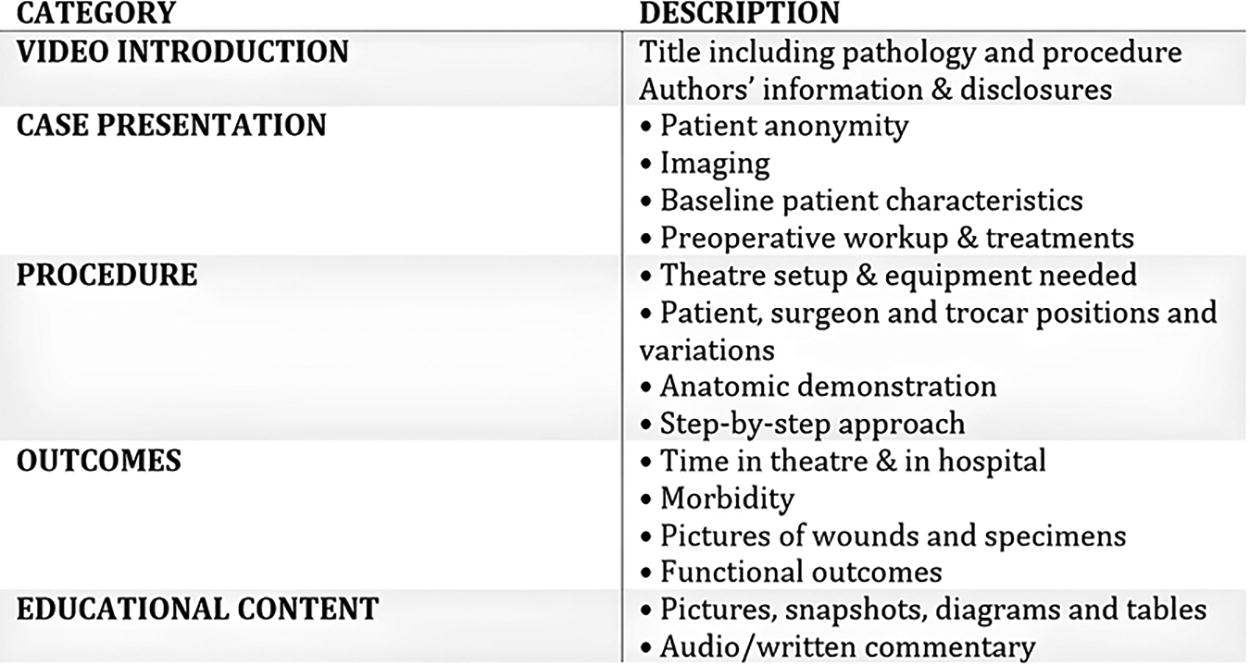
LAP-VEGaS criteria.
JAMA, GQS, and modified DISCERN scores are scales that measure the adequacy of video content in informing patients, video reliability, and quality (Fig. 2). The JAMA system allocates 1 point to each of four criteria (Authorship, Attribution, Disclosure, and Currency), resulting in a total score of 4 points. According to the JAMA scoring system, the least valuable information is valued at 1 point, while the most valuable information is valued at 4 points. The modified DISCERN system comprises five questions, each of which can be answered with a “yes” or “no” response, and is scored on a scale of 0 to 5, with 5 representing the highest level of achievement. The GQS, which consists of five questions, was utilized to assess the overall quality, flow of information, and educational value of the videos. A 5-point GQS indicates excellent quality, while a 1-point GQS indicates low quality.

JAMA, GQS, and modified DISCERN evaluation criteria.
The popularity of the videos was evaluated with an index called the VPI. This study is classified as an IRB exempt study, and as such, no ethical approval has been provided.
Statistical analysis
The statistical analysis was conducted using SPSS 25.0 (IBM Corp., New York, USA). The normality of the data was assessed through the implementation of the Shapiro–Wilk test. Descriptive statistical methods (mean, standard deviation, frequency, ratio, percentage) were employed to evaluate the study data. For paired groups, the Mann–Whitney U test and chi-squared test were employed. The correlation between parameters was determined using the Spearman’s correlation test. A P value less than .05 was considered statistically significant.
Results
In accordance with the study criteria, 131 LRP videos were reviewed, 88 (67%) of which were published on an individual (Group 1) and 43 (33%) on a corporate YouTubeTM channel (Group 2). The analysis revealed no significant differences between the two groups with respect to video duration, retroperitoneal/transperitoneal approach, and lymph node dissection (Table 1). A statistically significant difference was observed in the number of views (P = .032) and the number of likes (P = .031) in favor of Group 2.
Comparison of Personal Uploads and İnstitutional Uploads of YouTube Contents
Bold data represent statistically significant data as p < 0.005.
Man–Whitney U test.
Pearson chi-squared test.
The findings of this study demonstrate that JAMA, GQS, and mDISCERN scores were found to be significantly higher in favor of Group 2. The P-values are .028, .005, and .001, respectively.
The LAP-VEGaS score was measured and found to be statistically significantly higher in Group 2 (mean ± SD: 7.09 ± 0.43) than in Group 1 (mean ± SD: 5.08 ± 0.26) (P < .001). Similarly, the VPI value was found to be higher in Group 2 than in Group 1, and this difference was statistically significant (P = .008).
When the correlation between the LAP-VEGaS score and YouTubeTM viewing parameters was examined (Table 2), a statistically significant correlation was identified between VPI, number of views, and number of likes (P < .001). The correlation was found to be most robust in the context of views, with a significant positive correlation of r = 0.471 (Fig. 3).
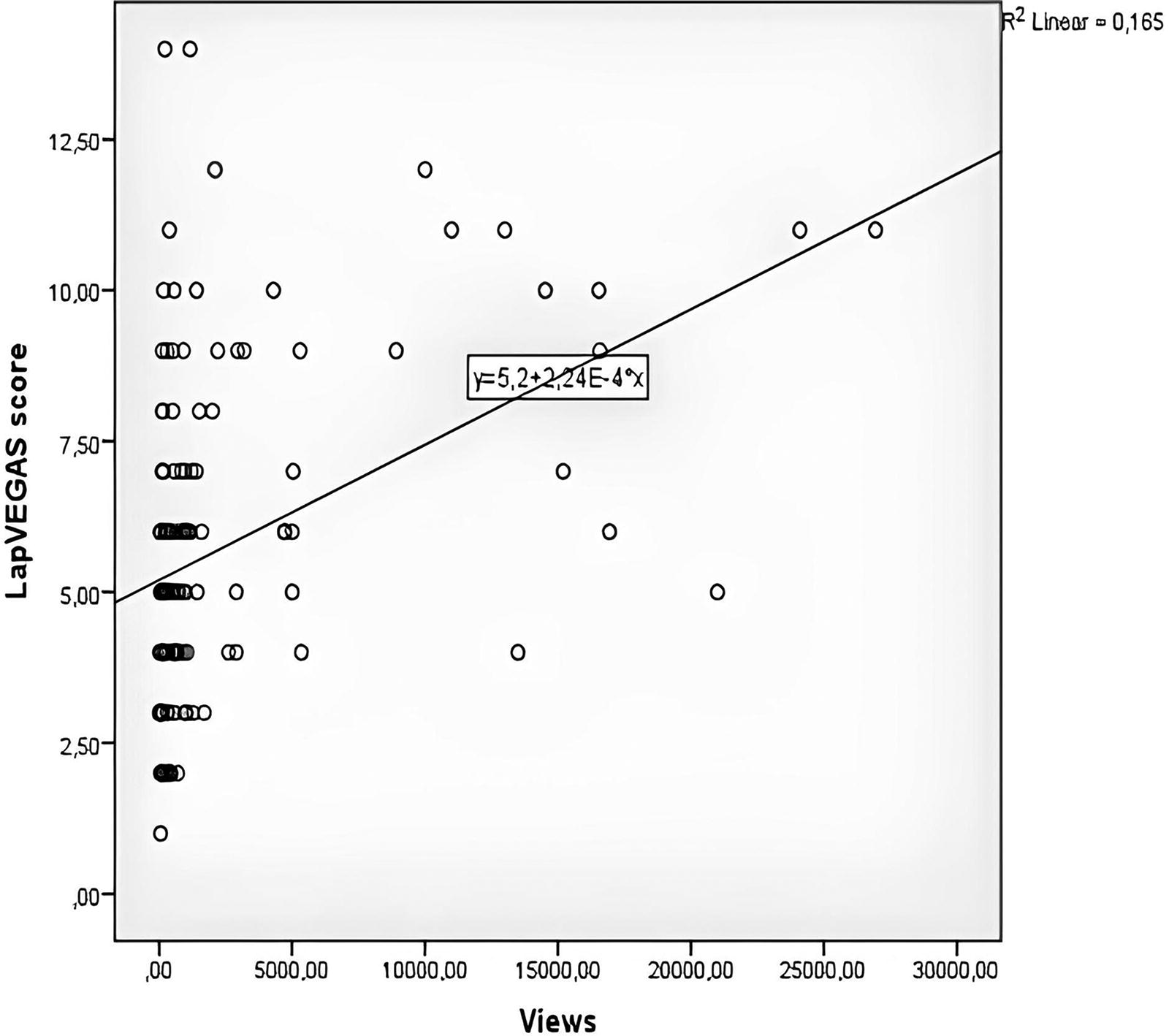
Correlation between views and LAP-VEGaS score.
Correlation Data Between LAP-VEGaS Score and YouTube Viewing Parameters
Bold data represent statistically significant data as p < 0.005.
Spearman’s correlation.
Discussion
Prior to the advent of the internet, learning was predominantly characterized by face-to-face education. However, with the proliferation of the internet across the globe, online education has witnessed a marked surge in recent years. The number of medical content videos published on the YouTubeTM platform is continually increasing. 14 These digital resources have begun to play a significant role in medical education. A study by Friedl et al. reported that students who used multimedia tools in their learning exhibited higher success rates in surgical procedures compared to students who relied solely on written texts. 15 In contrast, Lee et al. emphasized the efficacy of educational videos prepared by experts in facilitating surgical learning, while Shim et al. underscored the educational value of well-prepared educational videos, comparable to the learning gained from undergoing surgery under expert supervision.16,17
A study conducted in Portugal reported that the majority of surgical assistants and specialists viewed videos related to the surgical procedures they would perform prior to surgery. 18 A survey of urology assistants in the USA revealed that nearly all respondents reported viewing surgical videos on YouTubeTM, with minimally invasive surgery videos being the most popular. 19 A subsequent survey of urology assistants revealed an escalating trend in the utilization of the internet, applications, and social media for educational purposes. 20
A substantial body of research has indicated that videos, particularly those disseminated by associations or official organizations, exhibit superior quality in terms of educational content and contain more accurate information. However, the prevalence of such videos remains limited, with a paucity of educational resources available in numerous domains.21–23 For instance, a study assessing videos pertaining to incontinence treatment following prostatectomy concluded that the majority of these videos were of low or medium quality. 24 As has been previously documented, a significant number of videos pertaining to urethral catheterization on YouTubeTM have been found to contain inadequate or erroneous information. Consequently, it has been proposed that a meticulous selection process be implemented for videos, with the objective of ensuring that educational videos are made available to students prior to undergoing catheterization. 25 In the present study, the majority of LRP videos observed on YouTubeTM were of individual origin, exhibiting suboptimal video quality, a limited number of views, low rates of user engagement, and a lack of educational rigor. Corporate videos were comparatively scarce, and those that were available exhibited higher scores than the individual videos. However, these corporate videos also demonstrated deficiencies. Videos with high scores were characterized by superior image quality, proper organization of surgical phases, and the inclusion of informative and instructional content related to the procedure. However, it is noteworthy that no video received a perfect score from all evaluators.
A recent study evaluated and compared the educational quality of LRP and robotic RP video contents, finding that both types of surgery yielded several quality videos. However, it has been reported that there is an absence of an objective parameter to evaluate the educational quality of videos. 26 Conversely, numerous publications employed the LAP-VEGaS score to assess the educational value of videos and found it to be effective in this regard.9,27,28 The observation that the LAP-VEGaS score was particularly elevated in the videos favored by the surgeons who evaluated the videos in our study led us to conclude that this scoring could be utilized as an evaluation of video quality. Furthermore, the observed correlation between LAP-VEGaS and VPI, which measures the popularity of a video in the virtual environment, reinforces the notion that LAP-VEGaS can serve as a reliable scoring system.
Conclusion
A review of the available content on the YouTubeTM platform indicates that educational videos concerning LRP do not yet fully meet current needs, in terms of both quantity and quality. There is a clear need for the publication of more qualified, content-rich educational videos by urology associations and academics.
Footnotes
Authors’ Contributions
E.A.: Conceptualization, methodology, data collection and analysis, and article writing. M.Ç.: Conceptualization and data collection, data analysis, and article writing. M.S.B.: Conceptualization and article editing. M.L.A.: Conceptualization and data collection. B.S.Ç.: Conceptualization and data collection.
Author Disclosure Statement
The authors declare that they have nothing to disclose.
Funding Information
This research received no specific grant from any funding agency.