




Abstract
Abstract
Purpose:
Lymphedema of the arm is one of the most common and underestimated side effects of breast cancer treatment. It is known to negatively affect the quality of life (QoL) in breast cancer survivors. However, there are multiple questionnaires used to measure QoL in lymphedema patients. The current study aimed to determine the most complete and accurate questionnaire.
Methods:
A systematic literature search in Cochrane Library database CENTRAL, MEDLINE, and EMBASE was conducted in August 2016 by two independent researchers. The strategy used for the search was: ((“Lymphedema”[Mesh]) AND (“Quality of life”[Mesh])). All QoL questionnaires for patients with breast cancer-related lymphedema (BCRL) were included. An overview of the assessed QoL domains and arm symptom-specific questions was made, to assess the most complete and accurate questionnaire.
Results:
A total of 142 studies were identified, of which 49 met the inclusion criteria and 15 different questionnaires were extracted. The Lymphedema Quality of Life Inventory (LyQLI), assesses all QoL domains, except for the possibility of wearing the clothes of choice, and assess all specific arm symptoms. The Lymphedema Functioning, Disability, and Health (Lymph-ICF) Questionnaire assesses all QoL domains, except for sexual functioning, and does assess all specific arm symptoms.
Conclusion:
According to the results obtained, the LyQLI and Lymph-ICF questionnaires were the two most complete and accurate questionnaires to assess QoL in patients with BCRL, because these questionnaires assess the largest number of QoL domains and specific arm symptoms.
Introduction
B
Lymphedema of the arm is considered one of the most distressing and underestimated side effects of breast cancer treatment.9–13 Breast cancer-related lymphedema (BCRL) is caused by an acquired interruption of the axillary lymphatic system after locoregional treatment such as radiotherapy and/or lymph node dissection.14–17 Previous studies showed that the incidence of lymphedema of the arm ranged between 8.4% and 21.4% after breast cancer treatment, with an estimate incidence of 16.6%. 18
Lymphedema is known to have a significant impact on the physical, psychological, and social health of patients.18–21 To measure the actual impact of BCRL on QoL, a good questionnaire is mandatory. However, there is no consensus about the best questionnaire to measure QoL in these patients with BCRL. Several different questionnaires have been used for patients with BCRL in previous studies.22–35 A recent review assessed the quality of four QoL questionnaires in patients with BCRL. 36 However, more different questionnaires than four have been used in all other previous studies.22–35 Furthermore, the previous review compares the validity of the questionnaires, but the amount of different aspects of QoL was not taken in account. In the present study a literature review was performed to provide an overview of the different questionnaires, to assess the most complete and accurate one, not only based on validity but also on the amount of different aspects of QoL. The different subdomains included in the questionnaires were analyzed to target the impact of BCRL with more accuracy.
Methods
This systematic review was conducted according to the PRISMA guidelines. 37
Data sources
A systematic literature search in MEDLINE, EMBASE, and the Cochrane Library database CENTRAL was conducted in March 2017 to identify all questionnaires reporting on QoL in BCRL patients. The search was performed using predefined search terms: ((“Breast cancer-related lymphedema”[Mesh]) AND (“Quality of life”[Mesh])). The reference lists of included articles were hand searched to supplement the literature search to ensure that no relevant studies were missed by the search strategy.
Selection process
Eligibility assessment of the articles was performed in a standardized manner by two independent reviewers. The title and abstract of all retrieved hits were screened and reviewed individually to identify all relevant articles reporting on QoL in patients with lymphedema of the arm. No restrictions for language, publication date, or publication type were applied. All variations of questionnaires measuring QoL were identified based on the full-text versions of the articles. Disagreements between both reviewers were resolved by consensus.
Data extraction
A data extraction sheet was developed containing information about the questionnaires. For each of these questionnaires, the following variables were gathered: full name and abbreviation of the questionnaire, validity (Cronbach's alpha coefficient), type of answer, and the assessed QoL domains (physical function, mental function, daily activities, hobbies and job, mobility, social activities, and sexual function). Using this data extraction sheet, a selection of questionnaires was made, based on the number of QoL domains assessed. Questionnaires which assessed all or all except one QoL domains were selected. For the selected questionnaires another data extraction sheet was developed, containing information about the arm symptom-specific questions, which were assessed in the questionnaires. Specific arm symptoms were: pain, heaviness, swelling/tightness, loss of strength, tingles/burning/pins, skin problems, possibility to elevate the arm, movement difficulties of the arm, and problems in wearing the clothes of choice.
Results
Study selection
The literature search identified a total number of 142 studies. After selection, using the criteria described in Figure 1, 49 studies were included. In these 49 studies, 15 different questionnaires were used.
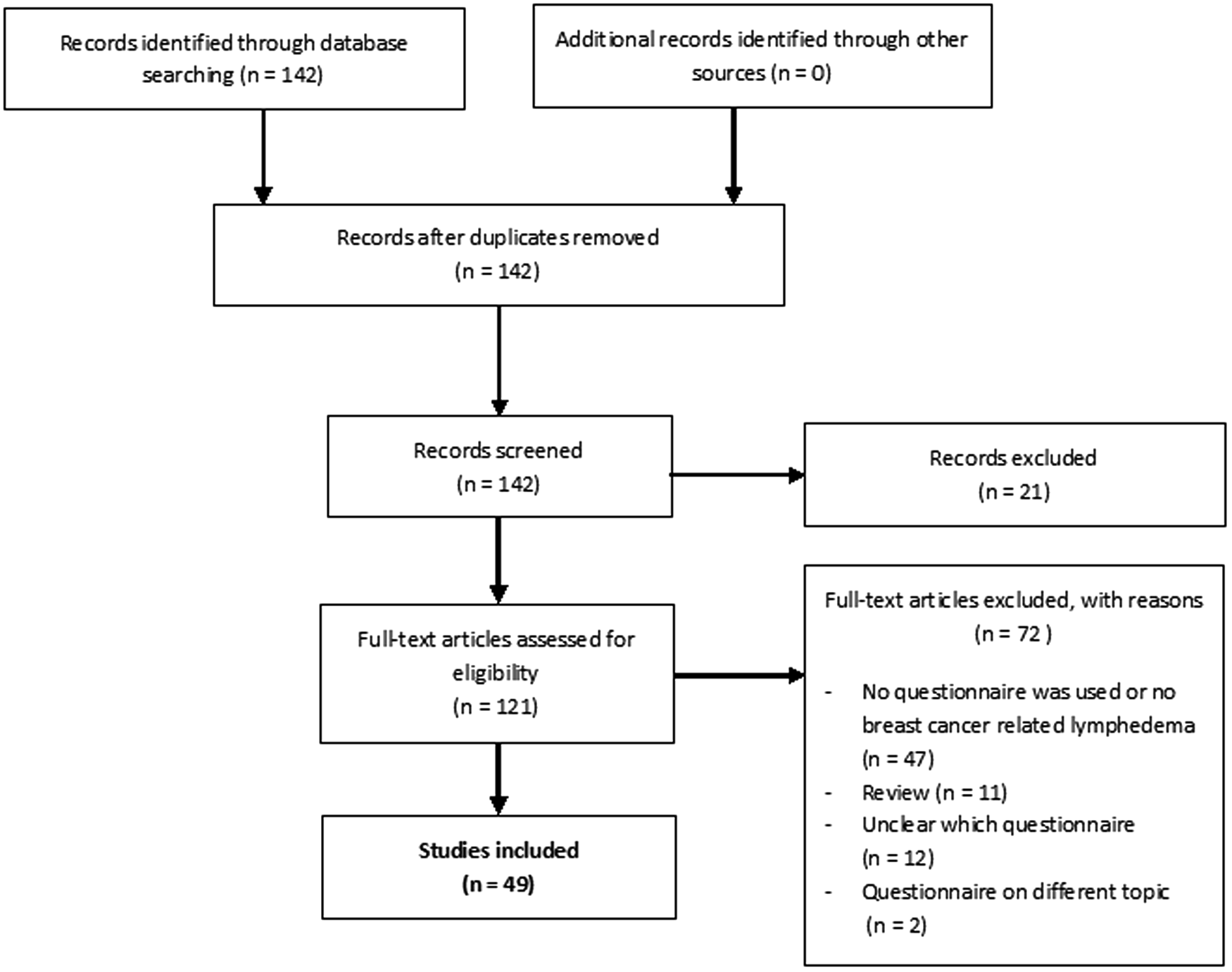
Flow diagram of the literature search according to PRISMA statement.
Questionnaire characteristics
The 15 identified questionnaires were subdivided in three categories:
Group I: General health questionnaires; this group consisted of six questionnaires. Group II: Cancer-specific questionnaires; this group consisted of three questionnaires. Group III: Lymphedema-specific questionnaires; this group consisted of six questionnaires.
All of the assessed questionnaires were validated previously (Table 1).
In group I, one out of six questionnaires used a combination of visual analogue scale (VAS) score and categories. The rest of the questionnaires used categories. All the questionnaires reported on mental function. Only one questionnaire reported on hobbies and jobs. Four questionnaires reported on physical function and daily activities. In addition, only one questionnaire included questions on mobility, two on social activity, and one on sexual function. The DASH questionnaire was the only questionnaire in this group which assessed all QoL domains.
In group II, the EORTC QLQ-C30 is a cancer-specific questionnaire, which is commonly used in combination with the EORTC QLQ-BR23 questionnaire. Altogether, these questionnaires provide a complete breast cancer-specific questionnaire, assessing all QoL domains. All questionnaires in this group used a categorical score.
In group III, only the Lymphedema Functioning, Disability and Health (Lymph-ICF) questionnaire used a VAS score. The rest of the questionnaires used categories. Two out of six questionnaires assessed all QoL domains, the other four assessed all QoL domains, except for sexual function (Table 2).
VAS, visual analogue scale.
Eight of the included questionnaires assessed all or all except one QoL domains; these questionnaires were selected for further analyses on assessment of arm symptom-specific questionnaires. Four of them assessed all QoL domains, the other four assessed all QoL, except for sexual function. One of the selected questionnaires was in Group I, one in Group II, and six were in Group III. Table 3 shows an overview of the assessed arm symptom-specific questions for each selected questionnaire.
The questionnaires from group I and II assessed only four out of nine arm symptoms. The questionnaires from group III assessed between six and nine arm symptoms. The Lymph-ICF was the only questionnaire, which assessed all nine arm symptoms. The Lymphedema Quality of Life Inventory (LyQLI) assessed all arm symptoms, except for the possibility to wear the clothes of choice.
Discussion
A large number of questionnaires are currently used to assess QoL in BCRL patients.22–35 The objective of the present study was to provide an overview of the different questionnaires, to assess the most complete and accurate one to measure QoL.
Previous studies showed that lymphedema of the arm in breast cancer survivors did not influence global QoL. However, there was a major impact on many specific symptoms such as fatigue and arm symptoms.6–8 This suggests that more specific PROMs are needed to measure QoL. In this context, to measure the impact of lymphedema on QoL it is not only important to assess global QoL and the different QoL domains, but also to assess all specific arm symptoms.
The Lymph-ICF and the LyQLI assessed most QoL items, the different QoL domains, and the specific arm symptoms. In the Lymph-ICF all QoL domains, except for sexual function are assessed and all arm symptom-specific questions are assessed. In the LyQLI, all QoL domains are assessed and all arm-specific questions, except for the possibility of wearing all clothes of choice are assessed.
An important difference between the Lymph-ICF and the LyQLI is the answer type. The Lymph-ICF uses VAS, whereas the LyQLI uses categorical answers. A VAS is commonly used to rate various subjective experiences, and therefore it is often used in QoL measurements. Potential advantages of these scales are the wide score range and high sensitivity. An important disadvantage is that they have a lower completion rate than other rating scales. 38
In the present study the EORTC QLQ-C30 and QLQ-BR23 questionnaires were assessed together, because this combination is commonly used for breast cancer survivors. This questionnaire combination contains all QoL domains. However, only four out of nine arm symptom-specific questions were assessed in this combined questionnaire. Therefore, this questionnaire combination might not be accurate enough to measure QoL in patients with BCRL.
Another questionnaire which seemed to fulfill the demands after the first analysis was the DASH. The DASH also contains all QoL domains. However, similar to the QLQ-C30/QLQ-B23, only four out of nine arm symptom-specific questions were assessed.
Both the DASH and the QLQ-C30/QLQ-BR23 did not contain questions about swelling of the arm. However, it should be mentioned that often before an increase in volume is measurable, patients experience symptoms such as tenderness and numbness of the arm. 39
Conclusion
In conclusion, the Lymph-ICF and LyQLI questionnaires seem to be the two most complete and accurate questionnaires to assess QoL in patients. Based on our results, one of these two questionnaires should be used in research and clinical practice concerning QoL in BCRL patients.
Footnotes
Acknowledgment
The authors would like to thank professor C.H.C. Dejong for his help in the writing of the article and correcting the English. Ethics: There was no review of an institutional review board, because it is a review of the literature. No human subjects were involved.
Author Disclosure Statement
No competing financial interests exist.